Top Five Alternatives to Traditional Book Clubs

photo via etsy.com

photo via etsy.com

I know those “what you think X is, what X actually is” memes are played out and dumb so forgive me:

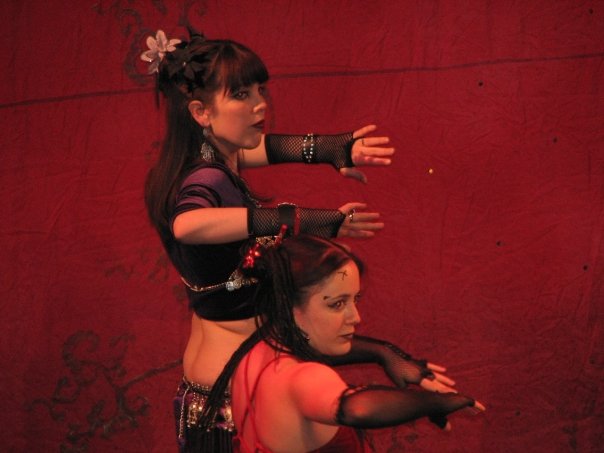
What book clubs want you to think goes on at book club: Ladies, libations, and literary discussion. Basically this guy’s wet dream.

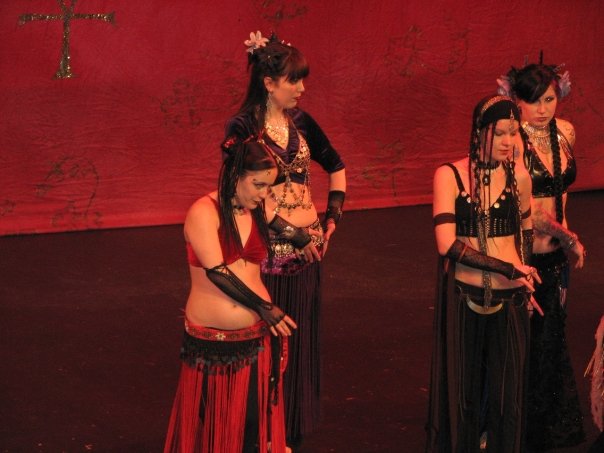
What you think actually goes on at book club: a bunch of 30-something ladies drink wine, eat snacks, and pretend to have read the book for a few minutes before moving on to more important subjects, like, I dunno, shoes or something.

What actually goes on at book club: I have no idea. I’ve never been to one.

I know traditional book clubs are still a thing. Several people I know (some in real life!) love them. But for those of you who are too lazy to clean your house and/or have trouble interacting with people IRL, there are SO MANY other options. In no particular order:

1. #YegBookClub
The idea for this post came courtesy of blogger Kristen Finlay, who came up with #YegBookClub. It’s very simple, which is why is works so well: each month, an Edmonton-authored book is chosen and a date and time for the chat is set. Read the book, use the hashtag during the chat, and connect with other readers. You can still drink wine and no one has to know that you’re wearing your stayin’-in leggings.

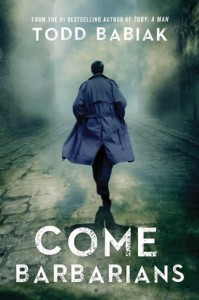
The inaugural #yegbookclub pick was Todd Babiak’s Come Barbarians. I found out about it too late and hadn’t read the book but had fun participating anyway. This will be a regular event for me from now on. I was inspired to start the book that same night (it’s fantastic so far.)

Oh, and the author participated, AND gave a hint about the next book in the series:

Continue reading

Mini Reviews, Manic Pixie Dream Girl Edition: Another Name for Autumn and Me Before You

Who do you think of when you hear the phrase “manic pixie dream girl?” If you’re my age, it’s probably Natalie Portman. If you’re a little younger, maybe it’s Zooey Deschanel. I don’t have any women’s or film studies cred to back me up, but to me the MPDG is a non-conventional and non-threatening woman-child who exists to teach a hero an Important Lesson. This device is pretty unappealing for obvious reasons.

I’ve thought about the MPDG phenomenon a couple times lately, while reading the American novella Another Name for Autumn and again while reading British blockbuster Me Before You. Both feature quirky, twee heroines, but neither are running around dancing in the rain; they’re both dealing with some fairly heavy stuff.  All the quirkiness with none of the shenanigans! Sounds fun, eh? I don’t hate these books, but I have Issues with the heroines that coloured my reactions.

(Note: for thoughts from someone who DOES know what they’re talking about when it comes to MPDGs, see this article by author Jennifer Quist.)

AnotherNameAnother Name for Autumn by Corrie Greathouse
My rating: 2/5 stars
Goodreads
I won’t paste the Goodreads synopsis here because it wasn’t reflective of the reading experience for me. I see this as a stream-of-consciousness account of a woman dealing with isolation and loss. So far, so good. But the unnamed narrator is a weird combination of Ally McBeal and uber-MPDG Natalie Portman in Garden State and not in a good way (could that possibly ever be in a good way?) She’s forever thinking her quirky, romantic thoughts, and that’s all we get, is her thoughts, relentlessly. Like this:

I wasn’t in love with anyone then but I had this love that was light and spirited and heavy and true and it belonged to someone.

What? And what is it with MPDGs and the rain?

I stopped going outside unless it was raining. When it rains, no one can see that your eyes are filled with years and your heart is full with holes. When it rained, I would sometimes sit outside, hoping my heart would fall silently from the sky again and come back to me.

The writing is all… very much liked the examples above. Oddly childlike and repetitive. It’s all love and hearts and music and fate.

Despite my issues with the character and the writing style, I finished the book in one sitting. It’s not that impressive a feat at 100 pages, but I did stay up past my bedtime. There is something strangely compelling about the writing and it’s rhythm. I was pretty confused at the end. I can barely decide if I liked it or not. If I liked it, it’s because all the stuff I didn’t like was done so well and so consistently, that I couldn’t help myself.

This book being published by a new, small press, there aren’t many other reviews out there, but I would love to see what some of my fellow bloggers think of it. Hit me up if you want my copy, it’s tiny, so I can probably mail it pretty cheap!

Thank you to Black Hill Press for the review copy!

mebeforeyouMe Before You by Jojo Moyse
My rating: 2/5 stars
Goodreads
Synopsis: I’m assuming you know what it’s about, since everyone and their mother is reading it right now.

If any book is screaming for a gif-laden review, it’s this one. I’m at a disadvantage, because a) I’m too lazy to find a bunch of gifs and b) my Kobo died, taking all my annotations with it. It’s telling that almost all my annotations were “Run girl run” or “red flag!” or some variation. This is yet another story of a rich, devastatingly handsome, overbearing/possessive/jealous asshole and a young, poor, aimless woman who is just begging to be told what to do. Fifty shades of are you fucking kidding me with this shit.

Before I rant on, I will say that Moyse is a good writer. No inner goddesses here. The writing flows nicely and the dialogue is really well done. There’s not much to challenge the reader, though. The symbolism is beyond obvious (Lou is literally lost in a maze at one point, like, yes, we get it, she needs to find herself and stuff.) And I do appreciate the subversion of some of the tired romance tropes – Lou’s not a virgin, and Will’s disability means he’s not the typical virile hero.

But Lou. Oh Lou. She’s the one who inspired the title for this post. She’s got MPDG vibes with her cutesy outfits and child-like naivety, but she’s so stuck in a rut that I don’t really understand why either of her romantic interests are into her. It’s also hard to root for her when she ends up in the thrall of Will. I just wanted her to get away from him and into a healthy relationship, like, maybe with a therapist. Don’t even get me started on how all the trauma of being gang raped as a teen is magically gone once she talks to Will about it once for like five minutes. Don’t even.

And Will. So many of my contemporaries are singing his praises on blogs across the land  and I was ready to like him. I didn’t mind that he was an asshole to Lou at first – I kind of didn’t blame him – but did none of the swooning readers notice how he slowly and creepily insinuates himself into Lou’s life and makes her more or less dependent on him? When Will conveniently gives a job to her desperate, unemployed dad, I forget my exact annotation was but it was for sure in all caps. It’s not romantic for a guy to make your entire family financially dependent on him, it’s pathological!

So I found the two characters and their “romance” abhorrent. But the real deal breaker for me came early on, when the premise of the book was revealed, because it’s 100% ridiculous. I guess I won’t go into it just in case, but a lot of the plot is pretty “convenient” (Lou doesn’t own a computer, Will’s parents can outfit an entire annex for a quadriplegic but can’t Google voice recognition software, Will happens to be fabulously rich, etc.)

I know a lot of you loved this book and part of my reaction is due to my heightened expectations. I didn’t hate it quite as much as this review may make you believe, but despite decent writing and an imaginative premise, I didn’t find it much better than any other romance novel I’ve read. 

What do you think of Manic Pixie Dream Girl characters? Do they annoy you as much as they annoy me?

A Very Bronte Blog Post: Villette and A Bronte Burlesque

Do you have a favourite Bronte novel? If not, go read some of their stuff. It’s okay, I’ll wait.

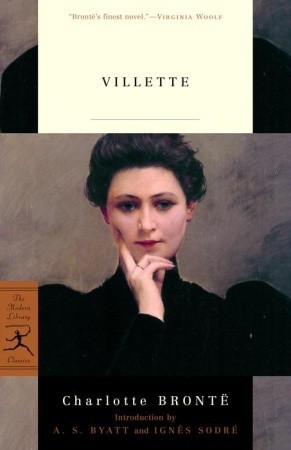
Villette Charlotte BronteThe perceptive Rory at Fourth Street Review suggests that many readers identify strongly with either Jane Eyre (Charlotte) or Wuthering Heights (Emily), but not both. I’ve been a Wuthering Heights girl since I read it 17 years ago, but I’ve broadened my Bronte horizons of late: I read my first Anne book, Agnes Grey last fall, I read Charlotte’s Villette last month, and just recently saw a play based on the Bronte’s lives.  I’m still Team Emily, but it’s time for me to give Charlotte her due: Villette is her masterpiece (sorry Jane fans) and she’s the most interesting of the siblings.

I didn’t even get around to reviewing Agnes Grey last year. It definitely had it’s moments, but the biggest impression it left was my wonder at how things were so different in Anne’s time; mostly in terms of the qualifications needed to educate children (be female, be unmarried, have a pulse?) Villette made me wonder about this stuff too, but I also felt the universality of Lucy’s situation. She could be anyone, at any time, not just a 19th century teacher, whereas Agnes was trapped in time. Indeed, if you have ever loved someone more than they love you, you’ll identify with Lucy Snowe.

Villette reminded me of a smaller-scope Middlemarch. Both novels are named for a city and are about the divisions between classes and sexes and have wonderful feminist perspectives. Middlemarch has much more going for it, from politics to academia to satire – so much, in fact, that I’m paralyzed to write a proper review. Villette is more of  a character study – a convincing portrait of Lucy and her world. It’s a tragedy, and at times gothic and romantic. It’s odd in its construction – a straightforward narrative most of the time, but then, BAM, there’s a stream of consciousness account of Lucy’s severe depression. Or a delerious description of Lucy tripping out after being drugged. An anti-Catholic rant. A ghost nun. And so on.

Jane Eyre is great, but it just wasn’t this ambitious or this awesome. I made the mistake of finishing Villette over lunch time at work, and spent that afternoon in a state of bewilderment. I may have said “oh no she DIDN’T” aloud. It’s pretty much the opposite of the satisfying “Reader, I married him,” but to me, the ending was more satisfying for being so ambiguous.

Charlotte, Emily, Branwell, and Anne via https://www.facebook.com/sendinthegirls

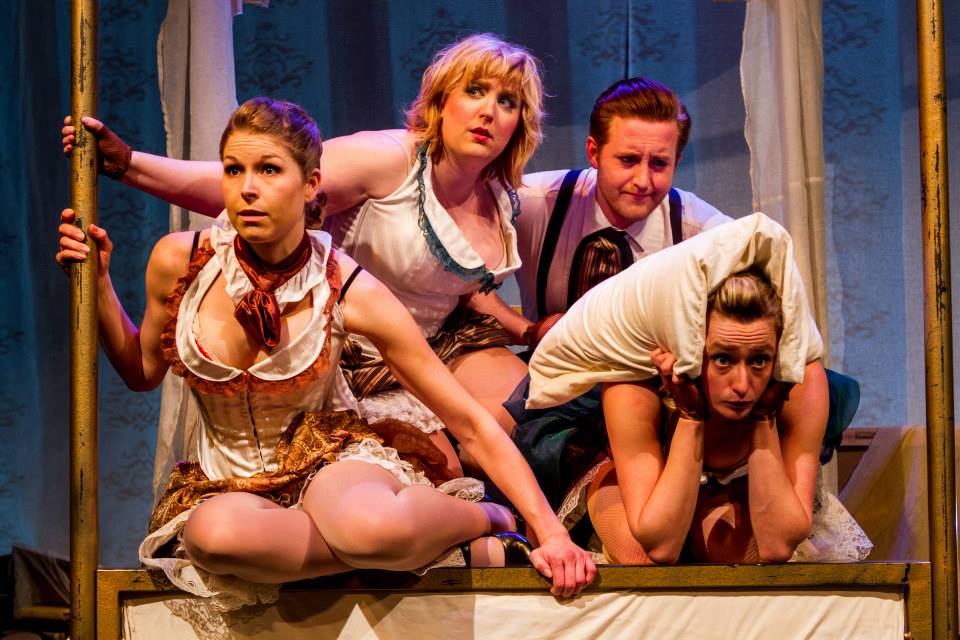
Send in the Girls in A Bronte Burlesque: Charlotte, Emily, Branwell, and Anne via https://www.facebook.com/sendinthegirls

Villette was the perfect preparation for seeing A Bronte Burlesque, a production of local theatre company Send in the Girls. Charlotte is the star, and we first meet her on her deathbed, her siblings having all died years earlier. Villette is never mentioned, and not often referenced (it’s all about Jane Eyre) but dying Charlotte, bitter and alone, put me in mind of Lucy Snow immediately.

In real life, Charlotte was newlywed and pregnant at her death, though this is never mentioned in the play. So, the story is manipulated, but what story isn’t? A Bronte Burlesque is confined to the insular world of the four Bronte siblings: Charlotte, Emily, Anne, and Branwell, the underachiever brother who I didn’t even know about till I saw the play.

It’s about exposing (get it?) the real Charlotte, how her ambition drove her to betray her siblings. She’s successful, but haunted by the past. Emily and Anne are laid bare as well – Anne and her jealousy, Emily and her depravity.

I had always wondered about Emily: how did she write so convincingly about obsession and loss, living such a short and isolated life? This play suggests that there was some Flowers in the Attic action going on up at Haworth, which made me question my teenage obsession with Wuthering Heights for a second before realizing this is a work of fiction about another work of fiction and every interpretation is as valid as the next – icky or not.

The burlesque element was fun, and worked well on a metaphorical level – you know, exposure, identity, femininity -but sometimes I would remember that they were supposed to be related and it got a a little weird. Or a lot weird. Seeing Emily throw herself at her own brother to the strains of Radiohead’s “Creep” was one of the more bizarre experiences of my life. This play was not exactly date night material.

The set, music and costumes were gorgeous. I was entertained and I gained a serious appreciation for Charlotte Bronte. And I simply love the fact that there’s a local theatre company doing something like this with literature and history! I never read biographies, but now I’m on the lookout for a good one – maybe Elizabeth Gaskell’s  on Charlotte, or Daphne Du Maurier’s on Branwell.

Tell me, are you Team Emily or Team Charlotte? Is there a Team Anne? Branwell?? 

Book Trailers: They Aren’t All Awful

The first time I saw a book trailer, I thought it was a joke. Surely, this wasn’t actually part of the marketing strategy for this big name author, working with a big name publisher? It was, though. And most book trailers are just as bad. Cheesy word art, stock film, and low production values abound.

Yeah, I’m biased – I like my literature and everything associated with it to be quiet. I have a fairly high sensitivity to noise and my two and four year olds use it all up, often before 8:00 am. I’ve never even listened to an audio book. But you know, I’m hip, I’m cool, and I can accept that book trailers are a thing; but if they’re to be a thing, can’t they be a thing done well?

For a deeper analysis of what’s gone wrong with book trailers, check out this from Book Riot or this from The New Yorker. Read on for a few of my book trailer picks: the good, the bad and… the Franzen. Continue reading

The Good Mother Myth edited by Avital Norman Nathman: Review + Giveaway!

thegoodmothermyth

The Good Mother Myth edited by Avital Norman Nathman | Published in 2014 by Seal Press| Source: Review copy from the publisher

My rating: 3/5 stars
Goodreads

Synopsis:

In an era of mommy blogs, Pinterest, and Facebook, The Good Mother Myth dismantles the social media-fed notion of what it means to be a good mother. This collection of essays takes a realistic look at motherhood and provides a platform for real voices and raw stories, each adding to the narrative of motherhood we don’t tend to see in the headlines or on the news.

From tales of mind-bending, panic-inducing overwhelm to a reflection on using weed instead of wine to deal with the terrible twos, the honesty of the essays creates a community of mothers who refuse to feel like they’re in competition with others, or with the notion of the ideal mom — they’re just trying to find a way to make it work.

It’s been years since I read a collection of feminist essays – probably since Dropped Threads in the early 00s. I love reading and I love feminism, but these days I tend to get my fill of non-fiction essays on blogs. Many of the contributors to The Good Mother Myth are bloggers and the book didn’t quite exceed the sum of its blog posts, but it was a good attempt. Rather than my usual list of favourite stories/pieces, here are the things I look for in a nonfiction anthology, and how this book stacked up:

Credibility
Anyone can write a blog (hi, case in point!) but a book has some credibility attached to it. Then there are the little extras to add an ever greater sense of it – blurbs and forewords and introductions. Continue reading

2014 Preview: Diversity, CanLit, Classics, and Second Chances

I’m still catching up on 2013 reviews, but 2014 reading is well underway. Here’s what you can expect this year on Reading in Bed.

Diversity!
I am pretty dismayed that off all the books I read last year, only 12% were by authors of colour. Here are some of my current and planned reads that will help tip me over 25% this year:

orendabridgeofbeyondinside outsixmetres

  • The Orenda by Joseph Boyden. It’s my current read and HOLY CRAP IS IT GOOD.
  • The Bridge of the Beyond by Simone Schwarz-Bart. nybooks.com says: “This is an intoxicating tale of love and wonder, mothers and daughters, spiritual values and the grim legacy of slavery on the French Antillean island of Guadeloupe.” Yeah. Plus, that cover.
  • Inside Out: Reflections on a Life So Far by Evelyn Lau. An excuse to write about how Lau’s first memoir, Runaway, changed my life.
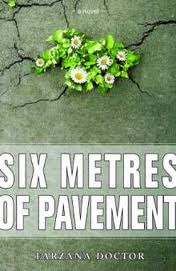
  • Six Metres of Pavement by Farzana Doctor. My favourite calendar girl in Bare it for Books.

Follow book blogger Leonicka for lots of resources on diversity in Canadian literature. She’s going all out and reading 85% authors of colour this year!

Local Authors!
My next local read will likely be Come Barbarians by Todd Babiak. As for new #yegwrites stuff, so far I’m looking forward to Marina Endicott‘s fourth novel, Falling for Hugh and Laurence Miall‘s debut novel Blind Spot.

Here’s a great roundup of Edmonton books in 2014.

CanLit!
Apart from the Edmonton stuff, here’s my most anticipated CanLit:
frog musicthegirlwhocrimeagainstmy

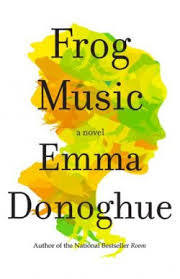
  • Frog Music by Emma Donoghue. She’s got a way with titles. I loved Room and Slammerkin, so my expectations are high.
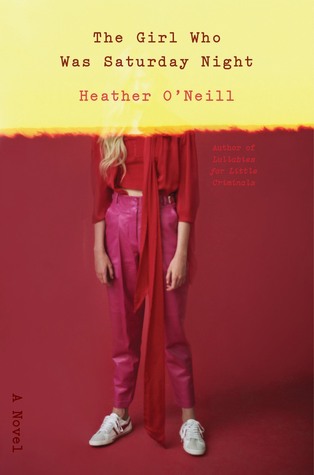
  • The Girl Who Was Saturday Night by Heather O’Neill. I’ve been waiting eight years for O’Neill to write another book. Bring it on!
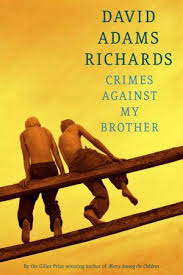
  • Crime Against My Brother by David Adams Richards. Apparently brings the main character of Mercy Among the Children back – one of my favourite books of all time.

I will also solider on with the Storytellers Book Club challenge. It helps that I won a set of all five books in their contest last year!

Classics!
I haven’t forgotten about The Classics Club! In fact, I’m right on pace. I chose 50 books to read over five years, and approaching the one year mark, I’ve read eleven.

I’m also contemplating Behold the Star’s Russian Literature Challenge. Krisitlyn of Reading in Winter gave me War and Peace for Christmas, plus I hear reading Chekhov can improve your life.

Back from the DNF

tristramcovertinkerThe English Patient by Michael Odaantjehouseofsandfifthbusiness

I might set this one up as a challenge hosted here on the blog. I’ve abandoned a few books over the years, and this is the year I give them another shot. I’m including books that I straight up DNF’d (did not finish) and books that I finished, but didn’t really appreciate, often because I read them too young. Here is a sampling, with my excuses for not finishing in the first place. Watch for an introductory post soon (and if anyone wants to help me design a button, that would be cool…)

  • Tristram Shandy by Laurence Sterne: Pregnancy brain
  • Tinker Tailor Solider Spy by John LeCarre: Baby brain
  • The English Patient by Michael Ondaatje: Too young. Attempted at 22 or so and got really lost.
  • The House of Sand and Fog by Andre Dubuois III: Too young. Read at age 20.
  • Fifth Business by Robertson Davies: Too young. Forced to read in high school, I hated it. Read a description of it recently and it sounds AMAZING.

This sounds like a lot of books, but I’m leaving room for random books, recommendations, read-alongs, and review books; you know, the four Rs. 

Obligatory end-of-post question: what are YOU planning to read this year?


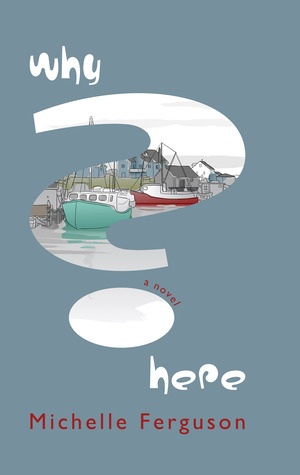
Why Here? by Michelle Ferguson

whyhere

Why Here? by Michelle Ferguson | Published in 2013 by Borealis Press| Source: Review copy from the author

My rating: 3/5 stars
Goodreads
Synopsis:

Potato Island, Nova Scotia, is a quiet place sheltered from the problems of the outside world. When Ian McKendrie, a young man from Toronto, arrives and begins selling the products of his small meth lab, the Islanders are anxious to rid the Island of this scourge.

The judge in Halifax sees things differently. He sentences McKendrie to house arrest on the Island with conditions that seem no punishment at all. So, when an opportunity presents itself, the Islanders decide to take the law into their  own hands and impose a few “conditions” of their own.

I have an appreciation for drug stories that goes back to Evelyn Lau’s Runaway, read as a preteen and before I’d smoked a cigarette, let alone anything else. By the time I saw Trainspotting at seventeen, I’d done plenty. My parents objected to renting the movie because it glorified drug use, but it actually scared me off trying hard drugs. The “baby on the ceiling” hallucination scene may look kind of ridiculous by today’s special effects standards, but it was a pretty effective deterrent in my case.

Other drug and addiction books that I love: The Basketball Diaries, Heather O’Neill’s Lullabies for Little CriminalsFear and Loathing in Las VegasA Clockwork OrangeGo Ask Alice, every other Irvine Welsh books I’ve ever read. Oh, and Spun, which is a movie but relevant because it’s specifically about meth and absolutely horrifying. So that’s my frame of reference.

Why Here? is a a drug story. Addicts, dealers, and law enforcement dance around each other in a tiny isolated community, till the community’s had enough and regular folks turn vigilante.  The premise is very similar to Ferguson’s first novel, From Away (my review), but this story succeeds in ways that From Away didn’t – the writing is fresher, and the stakes are higher. I really like how the older adults were the heroes; not the twenty-something drug dealers or the teenage drug addicts, but the people in their 50s and 60s who’d had enough. And the ending was great. I almost thought it was headed towards the “special moment” 90s sitcom ending, but then it was suddenly open ended and hopeless or hopeful, depending on your perspective.

Ferguson took some risks; however, the story just isn’t gritty enough. All those drug books I’ve read have given me certain expectations. I want devastating relapses, and sweaty, hallucinating withdrawals. I want the manic filth of “Spun.” I want Trainspotting‘s baby on the ceiling. I needed something harrowing or horrible to believe that this community would take the law into their own hands. That, or I need a strong lead character to hang that belief on, and I didn’t quite find that in the ensemble cast.

After two books with similar settings and themes, I’m left wondering about the author’s intentions. Are these morality tales? Celebration or condemnation of small town, maritime culture? I await Ferguson’s next move.

Thank you to the author for the review copy!

I ended up watching a bunch of scenes from Spun while writing this review. As stylized and dated as this movie is, it’s worth a watch. 

Eat It edited by Nicole Baute and Brianna Goldberg

eatitbig

Eat It: Sex, Food and Women’s Writing edited by Nicole Baute and Brianna Goldberg | Published in 2013 by Feathertale | Source: Review copy from editor

My rating: 4/5 stars
Goodreads

Synopsis:

What’s the best way to poison one’s husband? What happens when the body itself becomes a source of food? Can a potato be political? EAT IT ’s contributors explore these questions and more with equal parts humour and gravitas, revealing that for many women food is about love but also power, biology, social obligation, experimentation, nourishment, pain and pleasure.

My husband says that my sister and I are obsessed with food. It’s true that any time we’re together, the conversation tends toward it, but, isn’t it normal, almost necessary, to talk about something you do three, (okay, seven,) times a day? I suppose it’s true that a vegan (her, not me) always has more to consider and plan. But are we really that weird for talking about recipes and restaurants and our mutual crush on Chef at Home?

Eat It made me feel a little more normal. Here’s a whole bunch of people just talking about food, and writing poems about food, and imagining menus and remembering childhood meals. Of course, it’s not only about food. As the subtitle suggests, there’s more at play, and for women there are usually extra helpings (sorry) of guilt and shame on the one hand, and love and acceptance on the other.

Let’s address the all-women thing: this book isn’t *for* women. Anyone who enjoys a good short story or poem or creative non-fiction will get something out  of this. But I love that this book is written, edited, and published by women. I’m paraphrasing @snpsnpsnp (again!) when I say that feminism isn’t making stuff for women, it’s women making stuff, and so this right here is feminism in action!

The stories are grouped into sections that correspond to life stages. This made me wonder: what is it about relationship status and food? The ice cream for the single and broken hearted, the home cooked meal for the domesticated, pickles for the pregnant? Why are these images so enduring in our culture? I don’t have an answer after reading this book, but I do have a whole bunch of perspectives on food and life from some awesome writers.

Now, the stories: I have a few favourites to tell you about, but the whole collection is quite strong. There aren’t many big names; former Giller short lister Sarah Selecky is probably the biggest. The variety of forms and tones and voices is quite impressive for such a slim book. It really would have made a perfect stocking stuffer for my food-obsessed sister; I just wasn’t done reading yet.

  • “Pot Luck of Nutritional Tips” by Sara Hennesy. You may have seen Sara on Video on Trial, which I shame-watched regularly back before I had to worry about my kids repeating everything they hear. Her monologue had me laughing and nodding (“Slather my lady junk in yogurt for all the right reasons? Done and done.”) and it’s a pretty good commentary on the ridiculousness of media messages about women and food.
  • “A Lady’s Gotta Eat” is the story of one woman’s quest for the perfect hamburger and also maybe an orgasm? I don’t know, I was reading all sorts of stuff into this one.
  • “Left Over” by editor Nicole Baute is a very short piece about loss and remembrance and it made me cry.
  • “Our Lady of Perpetual Sorrows” by Katie Daubs, for the title, and the first line, “Girls started dressing like sluts for Halloween in 1997,” because that was the first year I did it, too.
  • Stories about breastfeeding! There are two, one poignant and one hilarious. This is very relevant for me as my two year old nursling shows no signs of stopping, and even I, pro-breastfeeding, quasi-attachment parent, am questioning whether it’s time to shut it down. The whole “if he can ask for it, he’s too old” thing is clearly baloney, but where’s the pithy saying for a 35 pound toddler who motorboats you and screams “I need it,” because this was not covered in What To Expect. Uh, your mileage may vary on this one.

A note on how to find this book: it’s a little tricky, as it’s likely to be stocked with literary journals, but I’m told the easiest way to is to order online here. I would lend you mine, but it’s going to my sister next.

(Psst, Cait: I made Isa Chandra’s vegan chocolate cookies last night and they were amazing. It’s the molasses, I think. We ate them all, sorry.)

Thank you to the editors for providing a review copy of this book!

Reading in Bed Year in Review #4: Best Books and Blog Stats

I love statistics. You’re probably sick of them by now, what with the many end-of-year blog posts, but I love how they’re both meaningless and mean everything; how “numbers don’t lie” but they can tell whatever story we want them to tell. Here are the numbers that made up my year of reading.

…but first, a public service announcement: Goodreads has a sweet stats thiny that shows you how many books you’ve read, how many pages you’ve read, how you rated your books, and more! Go to “My Books,” then “stats” which is on the left side in tiny font, then click “details.” It’s magic! Here’s mine. You can also export your books to Excel to do EVEN MORE analysis – click “import/export” in that same tiny, left hand menu.

Books ReadFavs

  • Books read in 2013: 52 (Book a week!!)
  • Books read in first six months: 12
  • Books read in last six months: 40

I knew my reading picked up after I finished Moby-Dick this summer but I didn’t realize the extent till now. I never thought I’d read 50 books in a year, but it looks like I could reasonably go for 75 next year!

About the Author

  • 35 Female (67%) 16 male (31%) 1 various (2%)
  • 22 Canadian (42%) 16 American (31%) 9 British (17%) 2 French (4%) and 1 each: Columbian, Russian, Irish. 
  • 48 white (88%) 6 visible minority (12%)

I didn’t restrict myself to female authors this year, but I did stack the deck a bit by choosing female authors on the Classics Club list, and, by accepting review copies from independent presses – I have a feeling that female authors are over represented in smaller publishers. I won’t set any specific goals for next year, but I’d love to read more books by minorities.  I’m sure I’ll still read lots of CanLit, butI gotta read some more World Lit too, beyond the States and the UK. Anyone got any good world lit reading challenges happening? I’ll probably do the Russian Lit one but would love to broaden my horizons even further…

Genres and Lists

  • 18 classics (35%), 25 contemporary lit fic (48%), 3 non fiction (6%), 3 YA (6%), 2 romance (4%), 1 anthology (2%)
  • 11 1001 Books for a total of 115 read
  • 11 Classics Club picks for a total of 11

Ratings

  • 10 five star reviews (19%), 19 four star reviews (37%), 14 three stars (27%), 3 two stars (6%), and 2 one star reviews (4%).

Compared to the average Goodreads rating…

  • I rated 22 books higher. The most underrated book was The Testament of Mary, which I rated a 5, compared to average 3.56 rating.
  • I rated 28 books lower. The most overrated book was Dragon Bound, which I rated a 1, compared to average 4.19 rating.

Blog Stats

discostu

  • 17,000 page views in 2013. Compare that to 900 in 2011 and 3,500 in 2012. As Disco Stu would say, “if this trend continues, HEY!”
  • Most viewed post of 2013: What’s The Deal With Infinite Jest? It’s a year later and I still don’t know what the deal is! It’s funny because I wrote it in a very unplanned, stream of consciousness style, which I don’t often do. I’m just happy to share the WTFness and the DFW love.
  • Most viewed post that was actually written in 2013: The Fault in Our Stars: Use Your (Literary) Allusion. I get searches for “Fault in our stars allusions” on a daily basis, particularly in the summer, which tells me that a lot of students write papers on TFioS, and makes me realize how different writing papers must be these days.

And now, on to the good stuff: my best and worst reads of the year!

Continue reading

Storytellers Book Club #1: The Progress of Love by Alice Munro

Progress-Love-Munro

For all the details on The Storytellers Book Club, see my introductory post or Douglas Gibson’s website

This update’s been a long time coming. I signed up for this CanLit challenge back in August. Alice Munro’s Nobel win inspired me to get cracking with The Progress of Love. I’m down to the wire here – I have till Dec. 31st to review a book club selection for a chance to win all five books, including selections from CanLit heavyweights Davies, MacLennan, MacLeod and Gallant. I’d tell you to get on it too, but with two days to go, you’re either in or you’re out by now!

The Progress of Love: Review
I was third in line for this book at the library for a couple of weeks, which is unusual for something published 25ish years ago. Must be that Nobel buzz! But you wouldn’t know this book is 25 years old. Munro’s stories are timeless, and you feel they could have been written 100 years as easily as 10 years ago.

The Progress of Love isn’t Munro’s most famous collection. It won the Governor General’s Award but her two Giller winners, The Love of a Good Woman and Runaway, seem to be the most well known. My only experience with Munro is Too Much Happiness, and with only that for a basis of comparison, The Progress of Love didn’t quite measure up. The first five stories were so good that the rest were slightly disappointing. My favourite was “Miles City, Montana” which shows us that the Mommy Wars are nothing new:

I had a dread of turning into a certain kind of mother – the kind whose body sagged, who moved in a woolly-smelling, milky-smelling fog, solemn with trivial burdens. I believed that all the attention these mothers paid, their need to be burdened, was the cause of colic, bed-wetting, asthma. Continue reading