I discovered two beloved and durable classics in 2025, but only one counts towards my 1,001 Books challenge: Don Quixote by Cervantes, translated by Edith Grossman.
As for me, I read Don Quixote (DQ hereafter unless I mean the character) while binge-watching It’s Always Sunny in Philadelphia (IASIP hereafter), and now, it is inextricably linked with The Gang’s adventures.
This is perhaps not as meaningful as others’ experiences, but as I watched and read, I started to suspect that Cervantes invented the sitcom, rather than the novel, which he is often credited with. This feels significant, as sitcoms are dying out, after overtaking novels as a dominant narrative form in the twentieth century*. So while I’m interested in what Cervantes has to say about freedom, imagination, and the dying days of the Spanish empire, my brain was primed to see him inventing the form that eventually led to Danny DeVito writhing on the floor, naked and covered in hand sanitizer.
So rather than write a review of DQ, as you hardly need me to tell you if you should read it, I’m going to look at all the ways in which DQ is echoed in IASIP, a show that premiered exactly four hundred years after the First Part of the Ingenious Gentleman Don Quixote of La Mancha was published in 1605.
Welcome to Novellas in November 2025, in which I try to catch up on reviews by tackling the novellas I’ve read so far this year.
This novella stuck with me, not only because it is so good, but because my interpretation of it seems to be a rare one, and maybe a wrong one. So, to the extent that a philosophical novel based on true events which I may have interpreted incorrectly can be spoiled, beware of spoilers ahead.
By any metric, summer is over. School’s in (and I have a high school student!), leaves are falling, and I have a disappointing tally of reviews from my 10 Books of Summer. But I have big plans for fall.
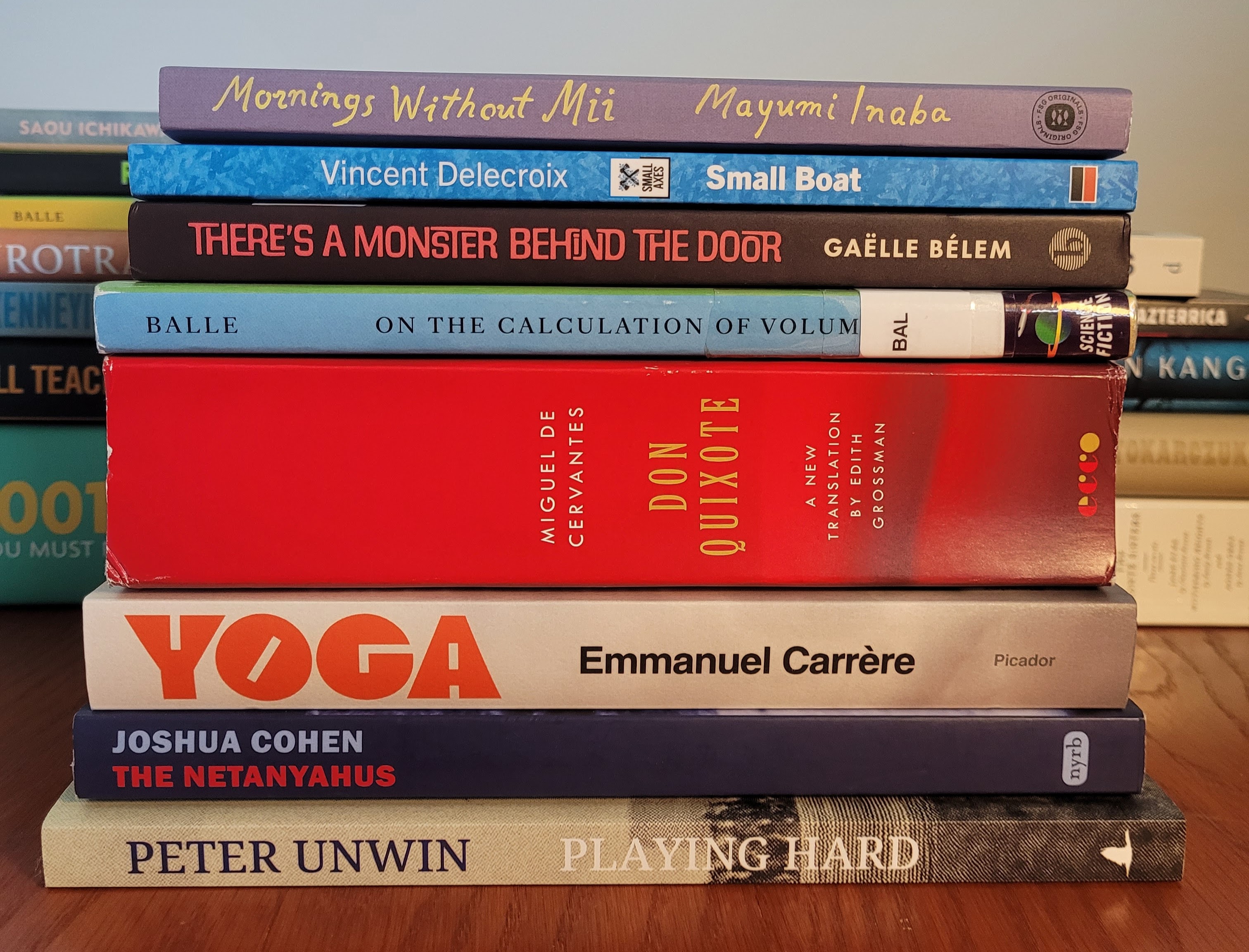
The Netanyahus by Joshua Cohen: finished, past deadline, and unlikely to review, given the effort that would take, for a book that most people read back in 2021. It’s worth a read though, if you’re holding out.
Athena by John Banville: my least favourite of the Book of Evidence trilogy, but still a stand out. Might tackle The Sea next.
Small Boat by Vincent Delacroix tr. Helen Stevenson: This book took me by surprise. Should have won the IBP, probably (I didn’t read the winner so I can’t really say).
There’s a Monster Behind the Door by Gaëlle Bélem tr. Karen Fleetwood and Laëtitia Saint-Loubert: A strong start, but it kind of petered out in the end.
Playing Hard by Peter Unwin (a review copy, a collection of essays about games and sports): Did not get to this. It’s a tough one; an author I enjoy writing about a subject I’m not terribly interested in.
Don Quixote by Cervantes tr. Edith Grossman: See below
Mornings Without Mii by Mayumi Inaba tr. Ginny Tapley Takemori: Finished in an airport, sobbed.
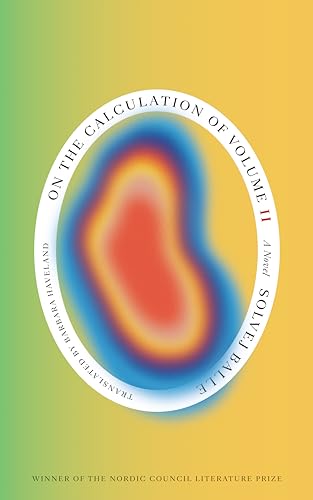
On the Calculation of Volume IIby Solvej Balle tr. Barbara Haveland: Reviewed and enjoyed. November 18th, pub date of the third book in English, cannot come fast enough (apologies to Tara, who would certainly prefer to get to the 19th.)
1 Book of Fall preview
If I am going to read one book this fall, it will be Don Quixote. I tried and failed a few times over the summer, getting no farther than the introduction* and first few chapters, but I’m on chapter 8 now and believe I am “locked in,” as my kids would say. So far, I am struck by how this novel, often touted as the *first* novel, is about someone who went crazy from reading too many novels (well, romances). In light of recent moral panics like this one, I am curious about when and how the act of reading fiction went from being indulgent and ruinous (see also: Northanger Abbey) to virtuous and edifying.
If you’ve read Don Quixote and have any tips or resources for me, please share!
NovNov to the rescue
What about all those books of summer that I didn’t properly review? Luckily, most of them are novellas and would qualify for my favourite alliterative book blog event, Novellas in November. I would really like to write about Small Boat, as I have a theory about it that is either so obvious that no one talks about it, or so out there that I will look like an idiot. Can’t wait to find out which. I also want to talk about Dua Lipa’s book club, and this was a recent pick, so a perfect way in.
A disappointing review tally, but I did read 8/10 and started one more. Onward!
*The introduction is by Harold Bloom, who features rather prominently in The Netanyahus, in a strange coincidence, or bookish serendipity!
On the Calculation of Volume II didn’t feel as magic as Book I (read my review if you aren’t familiar with the premise of this series). It took me weeks to read, when it should have only taken days. After a year of gloomy continental November 18s, Tara decides to impose some seasonality. She travels north to experience winter, then south for spring and summer, finally settling in Düsseldorf. Once she was done chasing the seasons, I started to feel the magic again, but while she travelled around, getting into various scrapes (a sprained ankle, a mugging), I found myself pondering things, like, how many November 18s she’s really lived through. We know she’s done 367 in a row when this book opens, and about 1,000 of them by the end, but how many before all this? Or to put it explicitly, how old is she?
I thought I had found a definitive answer, but when I came back to grab a link for this review, the links are dead, only the result previews linger.
The search results preview still says she is 29, but clicking through to the Goodreads page today, I find no mention of her age at all. The same preview-to-page disparity exists on Net Galley and the Booker International Prize reading guide, which I swear to god said “29” when I clicked through a few weeks ago, but now says Tara is in her “late 20s.”
It’s an eerie feeling. Not as eerie as Tara noticing a hotel guest dropping a piece of bread in the same exact way, at the exact same time, day after day, of course. It’s eerie in the opposite way – I can’t re-create what I saw. I can still see it, but it’s just out of reach.
All this pondering led to even more pondering: which November 18 is Tara reliving? We know (?) that she’s 29, and these books were published in Danish in 2020, so Tara could be a Millennial born in 1990, reliving November 18, 2019. We also know that Balle conceived of the idea in 1987, so Tara could be a Boomer born in 1958, reliving November 18, 1987, making her roughly Balle’s age. But smart phones exist in Tara’s world, though they aren’t ubiquitous, and Tara carries information on a USB stick, not in the cloud, which puts her squarely at the end of the aughts or the early 2010s. Tara is in fact an Xennial. My age.
This threw me for a loop at first, but it makes sense. A tech-averse antiquarian book dealer circa 2010 is probably just the type of young person who could live off the grid like this. Tara doesn’t turn to the internet for answers or resources during her travels, and she’s able to “forget” to charge her phone, eventually tossing it. I can’t relate, but in 2010 it was still possible.
I could relate to Tara’s obsession with Rome – I love a good Wikipedia rabbit hole. A Roman coin she obtains in an early November 18 acts like a talisman, and around day #900, it becomes a fixation. She gets back online to see if the key to her time warp is somewhere in the ancient world. Learning about Rome replaces her fixation on seasons and weather that drove most of this volume, which replaced her fixation on the calendar year and the rotation of the planets which drove the first.
Eventually, Tara takes her obsession offline and audits a Roman history class at a local university, where she seems to meet some fellow travellers in a last-page cliffhanger.
At this point, 29-year-old Tara is also 32-year-old Tara, having lived through nearly three years’ worth of November 18s. By the time Book III comes out (on November 18, of course!) and we find out what happens next, 44-year-old me will be 45, with only one additional November 18 under my belt. I only wish it could be November 18, 2010, as I was on my first maternity leave, and my emails suggest I was mostly concerned with Kindermusic classes and exchanging recipes with my sister (in one exchange I asked her “wtf is sriracha” – these were primitive times!)
If this book had been as magical as the first, I still would have thought whether Tara is a fellow Xennial (generations are my hyper-fixation), but it wouldn’t have derailed my reading. I got exhausted thinking about it all – the timeline, her ambivalence towards technology, the logistics of her travels – and put the book down for days at a time. There are also passages that felt oddly repetitive, which is a funny thing to complain about in a book about living the same day over and over. I have to believe that the repetitiveness and the vague timeline are purposeful, and that I, like Tara, just can’t see the big picture yet.
I got close to glimpsing something bigger near the end. Not the obvious themes around climate change and whatnot, but an extended riff on containers, of all things. There is no way for me to properly quote this, as it sprawls over several pages, but I have done my best:
#1021
I have discovered something alarming. Or at least, it’s not a big discovery, but I do now find it alarming: everything in the Roman world is a container.
It’s not only all that freshly blown glass, all those Roman cups and flacons and vases… A house has become a container, with light falling into the centre and water flowing down into a pool when it rains…Like a bowl the harbor endeavors to contain the sea…The temples too have become containers…the entire empire is now a container, the Roman container, and the walls define the empire… That is what scares me. That everything has become a container. The boundless empire has been walled in, it is a bowl, a vessel, and the Romans get no further… I want to know why. I search for answers but I have fallen into the Roman’s container.
As someone who loves to think in hierarchies and taxonomies, and to assign significance to things that might just be random, this hit real hard. Books I and II are a container for my feelings about womanhood, ageing, and technology. With five more books to go, who knows what else they can contain?
This book has been called a lot of things – devastating, a tour de force, exceptional; but also generic treacle. Molly Young, who wrote one of two reviews of this book for the New York Times (published days apart; would love to know how this happened there) acknowledges the extreme opinions, and says that “If you don’t like Carrère now, you never will.” In the spirit of what Young calls Carrère’s “extreme candor,” I will tell you straight away that I don’t like him now, and (presumably) never will.
Saying this feels wrong. I don’t like “him”? I don’t know the man, though after reading this book, a 2017 New York Times profile, and several articles about the dissolution of his marriage, I feel pretty confident saying that I don’t like his whole deal: his approach to writing, his perspective on fiction, his smugness, and especially his mixture of mindfulness and obliviousness.
Yoga is classified as nonfiction in North America, but as a novel in France. Maybe we can split the difference with autofiction, which is generally understood to be writing based on real life, with few attempts to conceal names, places, and dates, but written in the style of fiction, with some liberties taken to make a more coherent story, or emphasize a theme or two. In my opinion, Yoga goes beyond a few liberties into something more sinister and more annoying. Yoga is also written from an assumption that the reader is extremely interested in Carrère’s writing process, down to how fast he can type. Given his stature in French literature, that might be true for some readers. Not for me.
In April 2018, I was following the International Booker Prize (then Man Booker) for the first time, reading political books translated from Arabic and Chinese, post-post modern books translated from Korean and Polish, and some stuff I can’t even explain translated from Hungarian. Less, a novel about an American man’s midlife crisis, wasn’t really on my radar, despite winning the Pulitzer Prize that very month.
I vaguely remember seeing the cover and thinking, that looks like chick lit. These days, I would probably assume it was a “spicy” romance, but these were more innocent times. More specifically, the cover reminded me of a Sophie Kinsella novel, perhaps a gender-swapped Shopaholic. Turns out I wasn’t far off!
A refreshed 20 Books of Summer challenge is upon us! Unlike last year, I do have 20 books to choose from, but it’s more realistic for me to commit to ten. My most successful 20 Books of Summer was my first, in 2019, when I read and reviewed 14 books, but I’ve never come close to that again. I join this challenge as an intention: to read these books (eventually) and to spend time writing reviews during the summer.
In keeping with the spirit of this book, I will be brief.
Shaka is a wealthy middle aged woman with disabilities who lives in an assisted care facility. She says the following about holding a heavy book:
Holding in both hands an open book three or four centimetres in thickness took a greater toll on my back than any other activity. Being able to see; being able to hold a book; being able to turn its pages; being able to maintain a reading posture; being able to go to a bookshop to buy a book—I loathed the exclusionary machismo of book culture that demanded that its participants meet these five criteria of able-bodiedness. I loathed, too, the ignorant arrogance of all those self-professed book-lovers so oblivious to their privilege.
I found it ironic that many reviewers criticize the book for being too short, with underdeveloped characters and plot. To be fair, Hunchback is extra short, stretched over 90 pages in my edition due to wide margins and small pages. But I thought it was clever to have the form follow the spirit of Shaka’s complaint.
Ichikawa packs a ton into those pages – a frame narrative, excerpts from Shaka’s erotic fiction and tweets, literary allusions, some Covid commentary, and yes, a plot – a pretty shocking one!
The frame narrative stars Mikio, a persona Shaka uses to write erotic fiction, which we get to sample in the first few pages. At the end of the book, Mikio reappears and upends everything, in a way that I of course cannot describe here.
Shaka’s story, within this frame, is encapsulated in this anonymous tweet:
My ultimate dream is to get pregnant and have an abortion, just like a normal woman.
Shaka’s not serious at first – it’s more of a provocative commentary on rights for people with disabilities. But when she starts to act on this impulse, Hunchback becomes a story about class as well as disability. She finds a poor “beta male” who works in the assisted living facility to make her dream into reality.
And here’s where I had a little trouble. The scenario is a little far-fetched. The author has said that about 30 percent of Hunchback is based on her life. She asks the reader to believe a lot of convenient things, presumably the fictional 70 percent, to drive the plot and give it symbolic weight.
What ensues is a very twisted Normal People scenario in which a rich girl alternately wants to submit to, and assert her power over, a poor boy who is sort of her employee (this boy is no Connell though, alas). If Ichikawa appeased the critics and developed the story further into the future, or delved into Shaka’s past, it could have become even more artificial. As it stands, the somewhat-convenient plot is balanced by the strength of the writing and the astonishing ending.
The International Booker Prize jury found something compelling in short narratives this year. With the exception of Solenoid, each longisted book is under 300 pages, and most are under 200. Hunchback is not underdeveloped at all. The length works, thematically and structurally.
If I have a criticism, it’s that the narrator’s erotica and shitposts are pretty tame, and I’m not sure if that was intentional or not. But that might say more about my reading and scrolling habits than anything!
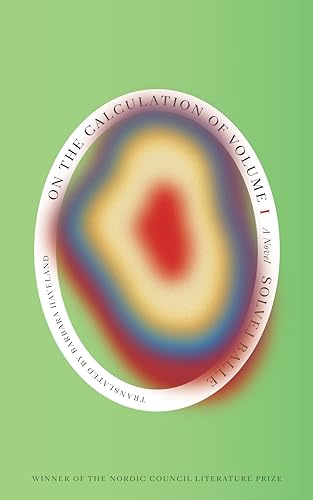
On the Calculation of Volume I is a compelling read, which is impressive, given that very little happens, and the end of the book is not the end of the story. It’s the beginning of a planned septology, and the last two or three books haven’t even been written yet.
Like The Unworthy, this is a novel written as a diary of a woman who is going through something strange, but unlike The Unworthy, that point of view is perfectly executed. You get the sense that the author has a bigger purpose, a structure that isn’t obvious yet, that needs to be played out in seven parts. I hope it’ll come together just like the calculation of volume came to Archimedes. Just know that there is no “Eureka!” moment in this first book.
Before we talk about what this narrator is going through, I recommend you read this review, in The Cut of all places, which provides some important background on how this book came to be. If you are, like me, annoyed by ambiguous timelines and convenient ways of circumventing technology, it’s helpful to know that Solvej “conceived of On the Calculation’s concept in 1987, then started writing in 1999.” I learned this after finishing the novel, and was instantly less annoyed by the fact that the narrator doesn’t try to use technology to figure out what’s happening to her. If there ever was a time to google “[problem] + reddit”, this is it…
The problem is that, as the story opens, Tara Selter has been living the same day, November 18th, over and over again, 121 times and counting, while the rest of the world is seemingly reset overnight and experiencing a normal, one-and-done day. Her diary takes us back to the first November 18th, the one that was preceded by November 17th, then through some of the intervening 120 November 18ths, and then forward through an entire year of them, without making the diary device feel forced or artificial.
Most of the book is given over to the practical problems of existing out of time, of which there are many. How many times can Tara explain her problem to her husband in the morning, get his help and advice through the day, just to wake up and have to explain it all over again? How long can she hide out in her own house, or other houses, to avoid him when it becomes clear that he’s holding her back? How much food can she eat before the empty cupboards in the house, and then the store shelves in town, are noted? How closely can she observe the world for deviations in how the day unfolds, whether in the movement of stars, or the way a person in a Paris hotel drops a piece of bread at the same time every day, and will those deviations lead her to a way out of November 18th, and back to the regular passing of time?
The most magical thing this book does is make one wonder who has it worse: Tara, stuck in one day, with no way to have a relationship with anyone or anything that lasts more than 24 hours; or everyone else, moving through their November 18th like automatons, unable to exercise free will or see beyond the ruts they run in. Only Tara can step back and try new routes and new angles, and see the possibilities that exist in one day.
One missing element did annoy me though. I kept wondering whether or not Tara gets periods or if she could get pregnant. Hubby’s always willing, no matter what iteration of November 18th we’re in or how far they get in their time travel investigations, and no birth control is mentioned. Other bodily functions seem to move forward, even though the days don’t. Nothing snaps a woman in line with time and seasons and cycles more than all that. But in addition to not knowing what year it is, we also don’t know how old Tara is, so I don’t really know how much of a factor this could be.
I guess we have six more books in which to figure that out, along with more pressing questions like why did this happen to Tara and how can she break free? I look forward to shouting “Eureka!” in a few years, once those last books are written and translated into English – assuming I don’t fall into a time warp before then.
Like last year, the 2025 International Booker Prize longlist is out of left field. Former winners, who I thought were a lock, were shut out (Han Kang, Olga Tokarczuk, László Krasznahorkai) and some of these translations were published in North America before the UK, which is unusual. But the most surprising thing about this longlist is that every author is an IBP first-timer. Past longlisters like Yoko Ogawa were shut out too.
I have to think this was on purpose, and I’m not sure how I feel about it. Does Han Kang need this, months after winning the Nobel? Surely not. Is each of these 13 books better than her latest, We Do Not Part, which I read because I was so certain it would be longlisted? Highly unlikely.
2025’s longlist is diverse, representing ten original languages and eleven nationalities. There are a couple of short story collections, several novellas (the shortest of which is practically a short story itself at 112 pages,) and one near-700 page chunkster. The list is skewed towards women (9 of 13) and boomers (6 of 13), and trends a bit older in general. There is no Gen Z representation at all, and the millennials are of the elder variety.
Find these stats and everything you need to know about obtaining these books in Canada in the updated “How to read the IBP in Canada” spreadsheet, or if you’re in a hurry, you can refer to the plain-text longlist below.
The longlist is fairly accessible in Canada. By the end of March, all the books will be available from Blackwell’s for the bargain price of $337.23 CAD. If you prefer to spend your money locally (elbows up and all that) most of them will be available through Canadian retailers too, with the exception of Small Boat and There’s A Monster Behind the Door. I’m just disappointed that my library system has none of these in ebook format. If Kobo thinks I’m going to spend $25.99 on a 192-page ebook (Eurotrash), they’ve got another thing coming.
I don’t quite know what to make of the longlist, but I’ve already read one (On the Calculation of Volume I, the first in a septology, but not the first partial septology to be longlisted!) and have another seven on the way, either from Blackwells, Magpie Books, or the library. In the meantime, the IBP Shadow Panel has created a Substack to round up their reviews. They are without their usual leader, Tony from Tony’s Reading List – he’s still blogging though, so if you want to see what’s going on in translated lit outside of this list, he’s your guy.
If you want to know my thoughts, well, let’s see if I can crank out a few reviews. First challenge: say something about On the Calculation of Volume, a story about a woman who wakes up to the same day over and over again, without mentioning Groundhog Day.
The Book of Disappearance by Ibtisam Azem, translated from the Arabic by Sinan Antoon
On the Calculation of Volume I by Solvej Balle, translated from the Danish by Barbara J. Haveland
There’s a Monster Behind the Door by Gaëlle Bélem, translated from the French by Karen Fleetwood and Laëtitia Saint-Loubert
Solenoid by Mircea Cărtărescu, translated from the Romanian by Sean Cotter
Reservoir Bitches by Dahlia de la Cerda, translated from the Spanish by Heather Cleary and Julia Sanches
Small Boat by Vincent Delecroix, translated from the French by Helen Stevenson
Hunchback by Saou Ichikawa, translated from the Japanese by Polly Barton
Under the Eye of the Big Bird by Under the Eye of the Big Bird, translated from the Japanese by Asa Yoneda
Eurotrash by Christian Kracht, translated from the German by Daniel Bowles
Perfection by Vincenzo Latronico, translated from the Italian by Sophie Hughes
Heart Lamp by Banu Mushtaq, translated from the Kannada by Deepa Bhasthi
On a Woman’s Madness by Astrid Roemer, translated from the Dutch by Lucy Scott
A Leopard-Skin Hat by Anne Serre, translated from the French by Mark Hutchinson





 Reading in Bed