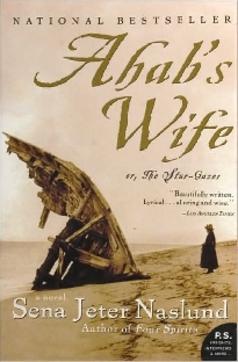
Moby Dick Read-A-Long Chapters 31-45: Schooled in Cetology

Moby Dick Read-A-Long

I’m having a hard time writing this post because there’s so much I want to say. This is the section where I went from “this is pretty good/funny” to “Oh. This is sublime.”

The thing that struck me is that Moby Dick is so honest. Ishmael tells us everything we need to know about whales, and more. Ahab admits that he’s chasing the White Whale to exact revenge – he revels in it. You’d think a person would be sort of embarrassed about that. Starbuck has doubts and tells Ahab immediately.  When I had questions – how on earth can anyone find a whale in the ocean? Why is it a big deal that Moby Dick is white? – Melville answers them, thoroughly. No suspension of disbelief required. Yet at the same time, symbols, allusions, and imagery abound – you know, all that good high school English stuff.

So not only is Moby-Dick postmodern before there was a postmodern, but it’s creative nonfiction before THAT was a thing, either. Amazing.

Share your thoughts in the comments, or better yet, link to your own post.

Lost at sea? For all the details on this read-a-long, including schedule and sign up, click here.

Chapters 31-45

  • Cetology: Chapter 32 is called Cetology and it’s the first of the “whale” chapters. So far, it’s the one I marked up more than any other. This is the thing that readers complain about, I mean, we were just getting somewhere with the story, and we’re taking a 15 page detour to talk about the science of whales? But it’s amazing. Here are some passages I liked:

As yet, however, the sperm whale, scientific or poetic, lives not complete in any literature. Far above all other hunted whales, his is an unwritten life.

What could be worse than the unwritten life? This chapter is full of literary analogies. Ishmael classifies whales using book sizes – it makes no sense, but somehow it’s perfect. Melville was a total book nerd and probably figured his readers might be, too. Way to know your audience!

The Killer is never hunted. I never heard what sort of oil he has. Exception might be taken to the name bestowed upon this whale, on the ground of its indistinctness. For we are all killers, on land and on sea; Bonapartes and Sharks included.

Growing up in Vancouver, whales=killer whales. So far, this is the only time they’re mentioned but Melville has a good point about their name.

This killer whale has hurt me many times over the years. via canucks.nhl.com

This killer whale has hurt me many times over the years. via canucks.nhl.com

uncertain, fugitive, half-fabulous whales…the Pudding-Headed Whale… can hardly help suspecting them for mere sounds, full of Leviathanism, but signifying nothing.

Whoa, nice Shakespeare reference. Pretty bold. Also, “Pudding-Headed Whale.”

For small erections may be finished by their first architects; grand ones, true ones, ever leave the copestone to posterity. God keep me from ever completing anything. This whole book is but a draught — nay, but the draught of a draught. Oh, Time, Strength, Cash, and Patience!

Makes me wonder what Ishmael means – that there’s more to the story? That the story isn’t the point, the reader has to build on it?

It was the idea also, that this same spermaceti was that quickening humor of the Greenland Whale which the first syllable of the word literally expresses…When, as I opine, in the course of time, the true nature of spermaceti became known, its original name was still retained by the dealers; no doubt to enhance its value by a notion so strangely significant of its scarcity.

I’m just laughing because obviously labeling something “Whale Jizz” is going to enhance it’s value. Obviously.

Moving on. There were other high points in this section:

via Babylit.com

via Babylit.com

  • Sing Out For New Stars: I’ve referenced the children’s “Baby Lit” version of Moby Dick I bought for my son (… and myself) a few times. My terribly MS Paint-ed logo uses one of the illustrations. Another one of the pages in that book contains the words “Sing out for new stars.” Something about that grabbed me, and I finally read the whole passage in this section. And I love it.

…the first pyramids were founded for astronomical purposes: a theory singularly supported by the peculiar stair-like formation of all four sides of those edifices; whereby, with prodigious long upliftings of the legs, those old astronomers were wont to mount to the apex, and sing out for new stars; even as the look-outs of a modern ship sing out for a sail, or a whale just bearing in sight.

SlowMan

  • Melville’s influence: One of the best things about reading classics is recognizing their influence on modern literature. As I read about Ahab’s ivory prosthetic leg, I was reminded of J.M. Cotzee’s 2005 novel Slow Man. The main character is a curmudgeonly and solitary old man who loses his leg in a bicycle accident. But in some ways, “slow man” is the anti-Ahab, as he can’t even remember the name of the man responsible, let alone obsess about revenge. Slow Man is a postmodern work, and I’m beginning to think that most postmodernist were influenced by Melville to some degree. In this case, I’m convinced, since I found a quote from Slow Man in which a prosthetic leg is compared to a harpoon. That ain’t no coincidence.
  • White on White: So I mentioned there’s a whole chapter on the colour white. What the hell do you say about white for a whole chapter? Try this on for size:

…the sailor, beholding the scenery of the Antarctic seas; where at times, by some infernal trick of legerdemain in the powers of frost and air, he, shivering and half shipwrecked, instead of rainbows speaking hope and solace to his misery, views what seems a boundless churchyard grinning upon him with its lean ice monuments and splintered crosses.

Beautiful and devastating. I love “shivering and half shipwrecked.” Might be my new literary earworm.

Tune in Next Week: Time to chase some whales.

WWW Banner

Tweetbanner

Major fail on my part. Now I’m just not including the hyphen to be consistent. Ughhh.

I’m not the only one who loved Chapter 32:

What did you think of this section? Link to your blog post below and drop me a line in the comments.


Moby Dick Read-A-Long Chapters 16-30: Starbucks, Ahoy!

Moby Dick Read-A-Long

Ishmael and Queequeg take a back seat as we meet The Pequod and her crew. Share your thoughts in the comments, or better yet, link to your own post.

Lost at sea? For all the details on this read-a-long, including schedule and sign up, click here.

Chapters 16-30

  • America, Fuck Yeah: This is embarrassing, but I thought Moby Dick was a British novel until very recently. Like, basically until I started reading it. I *know,* great American novel, right? I had to keep reminding my self in the first few chapters that we’re in New York, not London. I don’t know where I got this idea, but it was hard to shake… now that we’re a ways in, I’m finally seeing this as an American novel. The owners of the Pequod are Quakers, and that’s pretty American. So is Ishmael’s description of these whaling Quakers:

They are fighting Quakers; they are Quakers with a vengeance.

  • Starbucks, Ahoy: The other thing that’s reminding me this is an American novel is that Starbucks is named for the Pequod’s first mate, Starbuck.  Figures that the month I decide to give up lattes is the month I will be reading Starbuck over and over and over again.
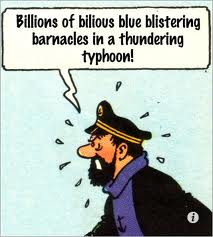
  • Billions of blistering blue barnacles!

    Loving the nautical talk!

    Ahab in the House: Melville sure likes to build anticipation. In the first 15 chapters, I was wondering if we’d ever get on the boat. Over the next 10 or so, I wonder where the heck Ahab is. Is he really ill, but almost better, as Ishmael is told? Or is it something more sinister? What’s he hiding? We finally meet Ahab near the end of this section, and much is made of his strange birthmark and other physical characteristics. The first time we hear him speak, he calls one of his mates “ten times a donkey, and a mule, and an ass,” and in the next chapter, abruptly throws his pipe overboard as smoking no longer gives him any pleasure. Hmm. Something on your mind, there, Big A?

  • Ishmael’s AWOL: I felt Ishmael’s absence in this section, as he steps back into a more traditional narrator role. I got to thinking about his motivation for taking part in the voyage in the first place. Ishmael presents it as basically his wanting to see the world, and having nothing better to do. YOLO, if you will. Or should I say YOJO? (Nailed it!) I hope we get back into Ishmael’s head soon.
  • Pre-Post-Modern: This section has a couple of passages that could fit in a postmodern novel, despite being written before postmodern, or even modern, was a thing. First, there are some structural oddities, like two chapters called “Knights and Squires,” which I thought was a Kobo fail at first. My favourite chapter so far, and the most “postmodern” in this section, is The Advocate, in which Ishmael turns away from the action to rant about the “injustice hereby done to us hunters of whales.”  He gives examples of arguments against whaling and skewers them. He really gets worked up. 

No dignity in whaling? The dignity of our calling the very heavens attest. Cetus is a constellation in the south! No more! Drive down your hat in the presence of the Czar, and take it off to Queequeg!

Tune in Next Week: Everything you wanted to know about whales but were too afraid to ask.

WWW Banner

Tweetbanner

Actually I thought the short chapters would be helpful:

Check out this great comment from Heather on last week’s post, about Ishmael and Queequeg:

As far as the relationship between Ishmael and Queequeg, I like how Melville used language about marriage and love to describe their friendship. We discussed this in an American Lit college course I took, and we came to the conclusion that we have to be careful about simplifying this too much. Theirs is a very deep, connected friendship, but not really in anyway sexual. To get hung up on the what we see as a potential sexual side to their relationship (not that I’m saying you’re doing this at all) is to miss out on how special/tight their friendship is.

What did you think of this section? Link to your blog post below and drop me a line in the comments.

Reading Roundup: May 2013 Blogging Breakthrough

TBR Pile

A literal To Be Read Pile.

Last month I committed to writing a little bit everyday. I didn’t quite make it, but I blogged TWELVE times this month, which is like WHOA compared to my usual two posts. My secret is to let go of perfectionism. Not every post has the most perfect picture, or every book title and twitter account linked. It’s that kind of thing that makes me spend too much time obsessing rather than just writing and interacting, which is kind of the point of blogging, for me.

Any of you bloggers out there have tips to keep a good blogging streak going?

Books Read

  • Frances and Bernard by Carlene Bauer. 5 Stars. The night I finished this book, I bawled for an hour. I was doing that thing where you flip ahead to make sure something awful wasn’t about to happen, because if it was, you need to mentally prepare. But I couldn’t prepare for the ending, obviously. Just go read this, please. Review coming once I can emotionally handle it.

Books ObtainedThe Outlander

  • The Road by Cormac McCarthy. People recommended this book to me a few times after my post about dark and depressing reads. My mom found it at a used book sale for $2. Score!
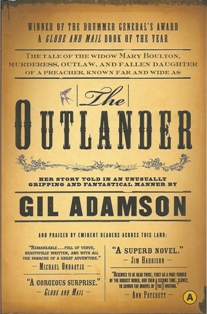
  • The Outlander by Gil Adamson. Another score at the book sale, and I just realized it’s the Canada Reads selection from a few years back – my copy has a different cover. Excited for this one. You had me at “19 year old widow by her own hand.”
  • Dance, Gladys, Dance by Cassie Stocks. I was very fortunate to get a signed copy of this Leacock Medal winner courtesy of Matt at NeWest Press. Pickle Me This calls it feminist and smart. Sounds good to me.

Books I Want to Read

Swimming to Elba

  • Fugitive Pieces by Anne Michaels. Cannot for the life of me remember where I read a review, but I know I added it to the list immediately. I also know it won the Orange Prize in 1997 and that’s good enough for me.
  • Molotov Hearts by Chris Eng. Read about this punk rock YA book over at Alexis Keinlen’s blog. What can I say, a boy with a mohawk broke my heart once.
  • Swimming to Elba by Silvia Avallone. Sounds like a good coming of age book. Will pick it up despite annoying cliche “girl facing away” cover.
  • She Rises by Kate Worsley. Read this review at She Reads Novels and added it to the list when I read “reminds me of Sarah Waters.”

On the Blog

I officially posted enough this month to justify a recap.

Reviews

#MobyDick2013 – Moby Dick Read-A-Long

Events, Memes, and Randomness

What’s Next on Reading in Bed

#MobyDick2013 continues, I’ll probably start planning my beach reads for July (I like to plan ahead) and a #yegbooks fall preview. Stay tuned!

Movie Review: The Great Gatsby (2013)

The-Great-Gatsby-2012-Movie-Title-Banner

Book snob rule #1: The book is always better than the movie.

Reality: I enjoyed the movie version of The Great Gatsby more than the book. *gasp*

(Note: I do abide by Book snob rule #2: Always read the book first. Let’s not go crazy here.)

I read The Great Gatsby back in 2011. I liked it. I liked it a lot. I did not love it. I don’t have a well thought out explanation as to why, but it didn’t grab me or shake me up enough to get into my favourites.

The movie, though? It grabbed me. All the stuff people are bitching about, the music, the over-the-top visuals, the casting, the framing device, it all just worked. Yes, I definitely have residual 16-year-old feelings for the Leo and Baz combo. I watched Romeo + Juliet so many times  that I can still quote it pretty accurately, and I wore out the soundtrack on CD. But it’s more than that.

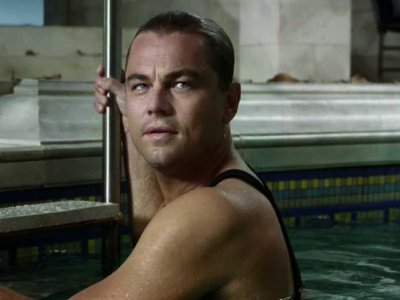
Let's not focus on the fact that Leo looks approximately 8 years old in this movie.

Let’s not focus on the fact that Leo looks approximately 8 years old in this movie.

For me, the anachronisms were seamless and worked as a commentary in the vein of the more things change, the more they stay the same. The exception is the scene where a car-full of twenties flapper-types are listening to H.O.V.A, which was so jarring that people in the theatre laughed. I’m going to tell myself it was an homage to the music video for the same song, where Jay-Z rides around town on a parade float (incidentally, Jay-Z looks SO YOUNG in that video.)

I also loved that the movie was very faithful to the book. Passages are highlighted on screen as Nick writes the manuscript for The Great Gatsby as part of his recovery from a nervous breakdown. My most loved and hated lines* were highlighted this way, which made the movie experience very reminiscent of my reading experience.

I notice that the most savage reviews are American, while the Canadian press has been a little kinder. I think Gatbsy is so enshrined in the American consciousness that no adaptation will be good enough. For this Canadian, Leo + Baz + great literature + 2.5 hours in the fancy grown up theatre (they serve you drinks!) and I’m happy.

Leo Gatsby

Age appropriate Leo

*My favourite line. Super obvious, but somehow, I’d never read this, and didn’t know the ending, when I read the book. Reading this for the first time knocked me on my ass.

So we beat on, boats against the current, borne back ceaselessly into the past.

My least favourite line. First of all, what the hell else are you going to blossom like? Second of all, I just can’t with the flower/vagina metaphor. It’s a little too Summer’s Eve for me.

At his lips’ touch she blossomed for him like a flower and the incarnation was complete.

Moby Dick Read-A-Long Chapters 1-15: Fine Young Cannibals

Welcome back, read-a-longers! We finally get to talk about the actual book. Share your thoughts in the comments, or better yet, link to your own post.

Lost at sea? For all the details on this read-a-long, including schedule and sign up, click here.

Etymology and Excerpts

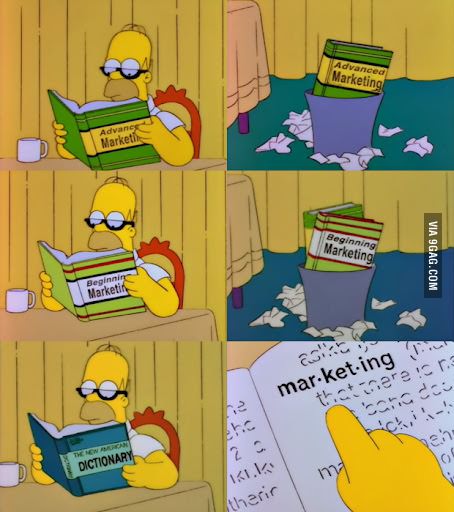
The book starts with the origin of the word “whale” and a collection of whale-related excerpts from literature, philosophy, and scripture. This section reminded me of when Homer Simpson tries to teach himself about marketing by reading an advanced marketing book, and trades down to simpler and simpler books until he’s reading the dictionary.

Homer Simpson Marketing

Via 9gag.com

The excerpts are great. They show the huge variety of ways in which people deify and demonize whales. Of course, the excerpts only go up to the mid 1800s, and I couldn’t help but think about the modern ones I would add:

  • Blubber by Judy Blume: Talking about bullying before it was cool. She didn’t even have to wear a pink shirt.
  • She’s Come Undone by Wally Lamb: Just your basic girl meets dying whale, girl goes batshit crazy story.
  • Free Willy: Charming children’s movie and popular euphemism for taking one’s dick out.

Okay, onto the actual story!

Chapters 1-15

  • Lots of lead up: Chapters 1-15 take us up to page 83 in my paper copy, and we haven’t even got on the boat yet. This section is all about setting the scene, introducing our narrator (call him Ishmael) and his BFF, the heavily-tattooed “Feegeean” Queequeg. We follow Ishmael from New York City to New Bedford to Nantucket as he prepares to go on his first whaling voyage.
  • Lots of funny: The tone of this first section is surprisingly light and funny. Hilarious, actually. Ishmael’s roundabout logic as he explains why he decides to take part in Queequeg’s “pagan rituals” made me LOL:

I was a good Christian; born and bred in the bosom of the infallible Presbyterian Church. How then could I unite with this wild idolater in worshiping his piece of wood? But what is worship? thought I. Do you suppose now, Ishmael, that the magnanimous God of heaven and earth – pagans and all included – can possibly be jealous of an insignificant bit of black wood? Impossible! But what is worship? – to do the will of God? that is worship. And what is the will of God? – to do to my fellow-man what I would have my fellow-man to do to me – that is the will of God. Now, Queequeg is my fellow-man. ANd what do I wish that this Queequeg woudl do to me? Why, unite with me in my particular Presbyterian form of worship. Consequently, I must then unite with him in his; ergo, I must turn idolater.

  • Heart of Darkness: I can’t help but compare the way Queequeg is introduced to the way Conrad talks about the “savages” in Heart of Darkness. Conrad’s European characters are half thrilled, half disgusted by the thought that they have anything in common with the “savages” they encounter in The Congo.  Queequeg is certainly seen as “other,” and Ishmael is terrified of him at first, but Ishmael accepts him so quickly, and so readily, and not just as a shipmate but as a friend (or perhaps more, see below,) despite the fact that he sells shrunken heads and is casually described as a cannibal.

For all this tattooings he was on the whole a clean, comely looking cannibal.

  • HoYay!: For those not familiar with this television-fandom term, HoYay! is short for “Homoeroticism, Yay!” and refers to situations, dialogue, etc. that could be interpreted to have homoerotic undertones, and suggests that fans of the show are generally in favour of this interpretation, usually in a somewhat ironic way. Exhibit A:
    Ryan and Seth

    California, Here We Come

    Ishmael and Queequeg meet in the bedroom and things just get cozier from there. I was most definitely NOT expecting this element of the story, and I think I finally get the “HoYay!” concept, because it is indeed delightful.

Thus, then, in our hearts’ honeymoon, lay I and Queequeg – a cosy, loving pair.

Tune in Next Week: 

Chapter 16 is called “The Ship” so things are about to get nautical.

WWW Banner

Tweetbanner


Heather of Between the Covers has the distinction of the first person to giggle about the Dick in Moby Dick. I am shocked it took this long.

@ebookclassicsand I are reading neck and neck!

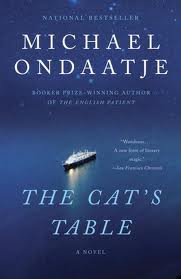
The Cat’s Table by Michael Ondaatje

The Cat's Table

My rating: 5/5 stars

Release date: August 30, 2011

Publisher: McLelland

Synopsis:

In the early 1950s, an eleven-year-old boy boards a huge liner bound for England. At mealtimes, he is placed at the lowly “Cat’s Table” with an eccentric and unforgettable group of grownups and two other boys. As the ship makes its way across the Indian Ocean, through the Suez Canal, into the Mediterranean, the boys find themselves immersed in the worlds and stories of the adults around them. At night they spy on a shackled prisoner — his crime and fate a galvanizing mystery that will haunt them forever.

With the ocean liner a brilliant microcosm for the floating dream of childhood, The Cat’s Table is a vivid, poignant and thrilling book, full of Ondaatje’s trademark set-pieces and breathtaking images: a story told with a child’s sense of wonder by a novelist at the very height of his powers.

Is there such thing as an earworm, for text instead of music? A wordworm? If so, I have had a wordworm, off and on, since finishing The Cat’s Table. I find myself mentally rereading the end this passage compulsively:

We stepped back, further into the darkness, and waited. I saw the man move the strap of her dress and bring his face down to her shoulder. Her head was back, looking up at the stars, if there were stars. Continue reading

Moby Dick Read-A-Long Post #1: Thar She Blows

What better time to start reading a Victorian novel than Victoria Day? I don’t have much to share about the book yet, as I’ve just dipped my toe in, but here are a few bits and pieces as we get started.

What’s All This Then?

We’re reading Moby Dick from May 20 – July 22. For all the details and to sign up, click here.  Here’s the schedule:

  • Start date and Introductory Post: Monday, May 20th, 2013. 
  • Etymology + Chapters 1-15: May 27th
  • Chapters 16-30: June 3
  • Chapters 31-45: June 10
  • Chapters 46-60: June 17
  • Chapters 61-75: June 24
  • Chapters 76-90: July 1
  • Chapters 91-105: July 8
  • Chapters 106-120: July 15
  • Chapters 121-136 + Epilogue : July 22

My Editions of Moby Dick

I bought a second hand, no-nonsense, 2004 edition of the physical book. No intro, no biography, just the text.

Henry's ready.

Henry’s ready.

I attempted to replicate 101 Book’s hilarious My 2-Year-Old Judges Books By Their Covers by asking my three year old what he thought this book was about. I’m a little alarmed by what he came up with: “The whale swings his tail. Swish swish. Then the men come and BANG HIM!”

I’ll do most of my reading on my Kobo. I’ve had bad luck with free ebooks, but local MD fan @Wittermeir tells me this is a good one. He’s also kindly lending me Why Read Moby Dick by Nathaniel Philbrick, so I’ll be able to share tidbits with you. Moby Dick fans are the best!

mobydickebook

Click for the free ebook

My Hopes for Moby Dick:

  • That I’ll be surprised by something. I’ve peeked at the first few chapters, and so far, I’m surprised by how funny it is. I’m often surprised when big scary classics are funny or romantic. If there’s a romantic element in MD, that’ll be something.
  • That reading and understanding Moby Dick will give me a deeper appreciation of other literature. After reading Dostoyevsky and Mann last year, I found allusions to and reflections of their writing in all sorts of surprising places. I suspect Melville’s influence is just as large as theirs, if not larger.

My Fears:

  • The descriptions of the whale and whaling will put me to sleep. After years of sleep deprivation, it doesn’t take much.
  • That I won’t get it. That the meaning of this book will fly over my head. You guys will help me out though, right?

Here are a couple features that I hope to include every Monday.

WWW Banner

Moby Dick Card Game

Slightly cooler than D&D.

I’ve always found it strange that a culture that creates a clear demand for television programs about things like crab fishing, tuna fishing, logging, trucking, duck hunting, and working in pawn shops is a culture that poo-poos the sort of documentary view Melville often gives us of whaling.

Tweetbanner

Comment below to share which edition you’re reading, and your thoughts going into this crazy read-a-long. Once you’ve written this week’s post, add a link to it (and check out the others) by clicking the Mr. Linky icon:

NeWest Press Spring Spectacular: Local Literary Love

Rebecca Campell

Rebecca Campbell. Photo credit Brie Binicki

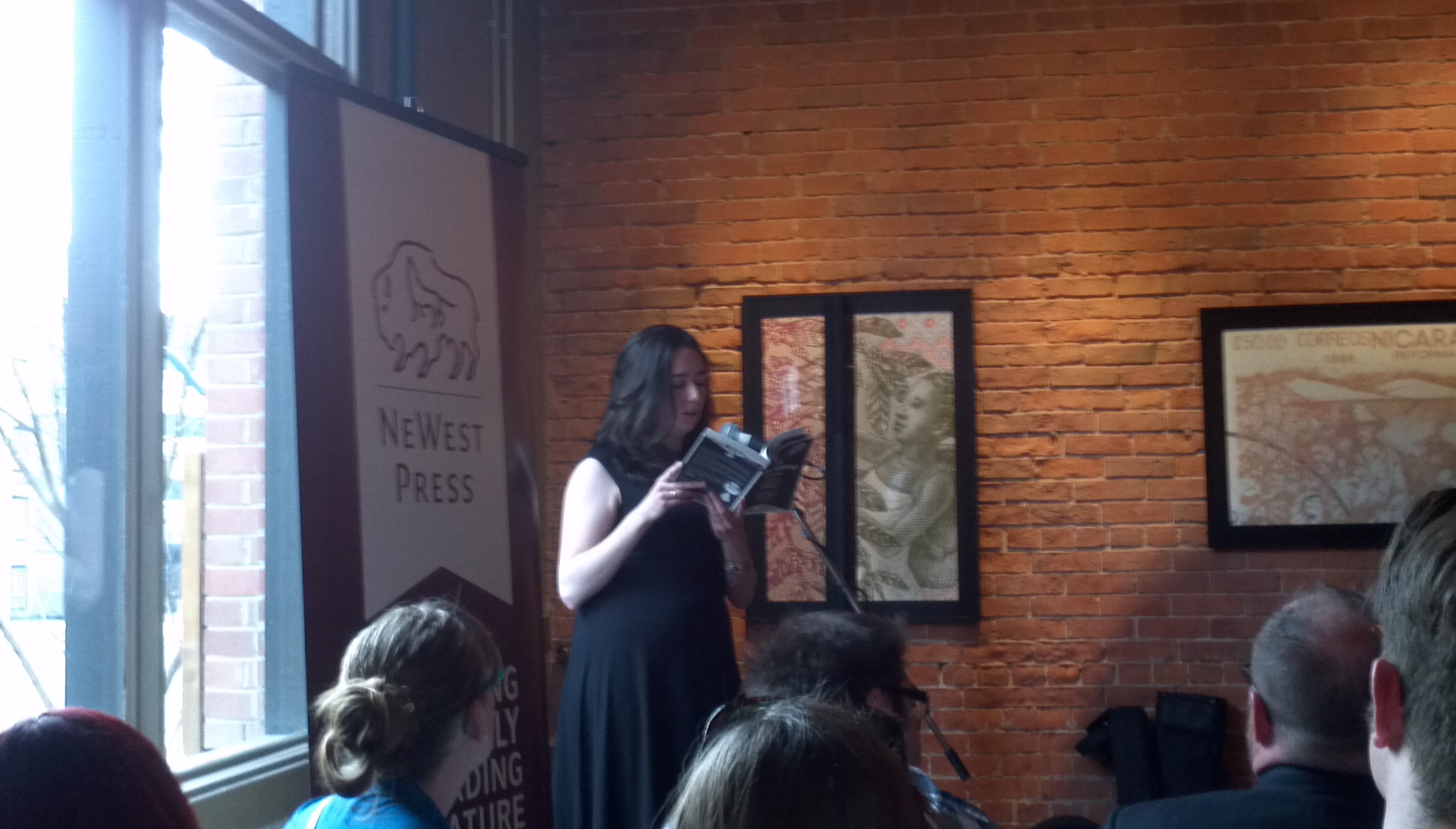
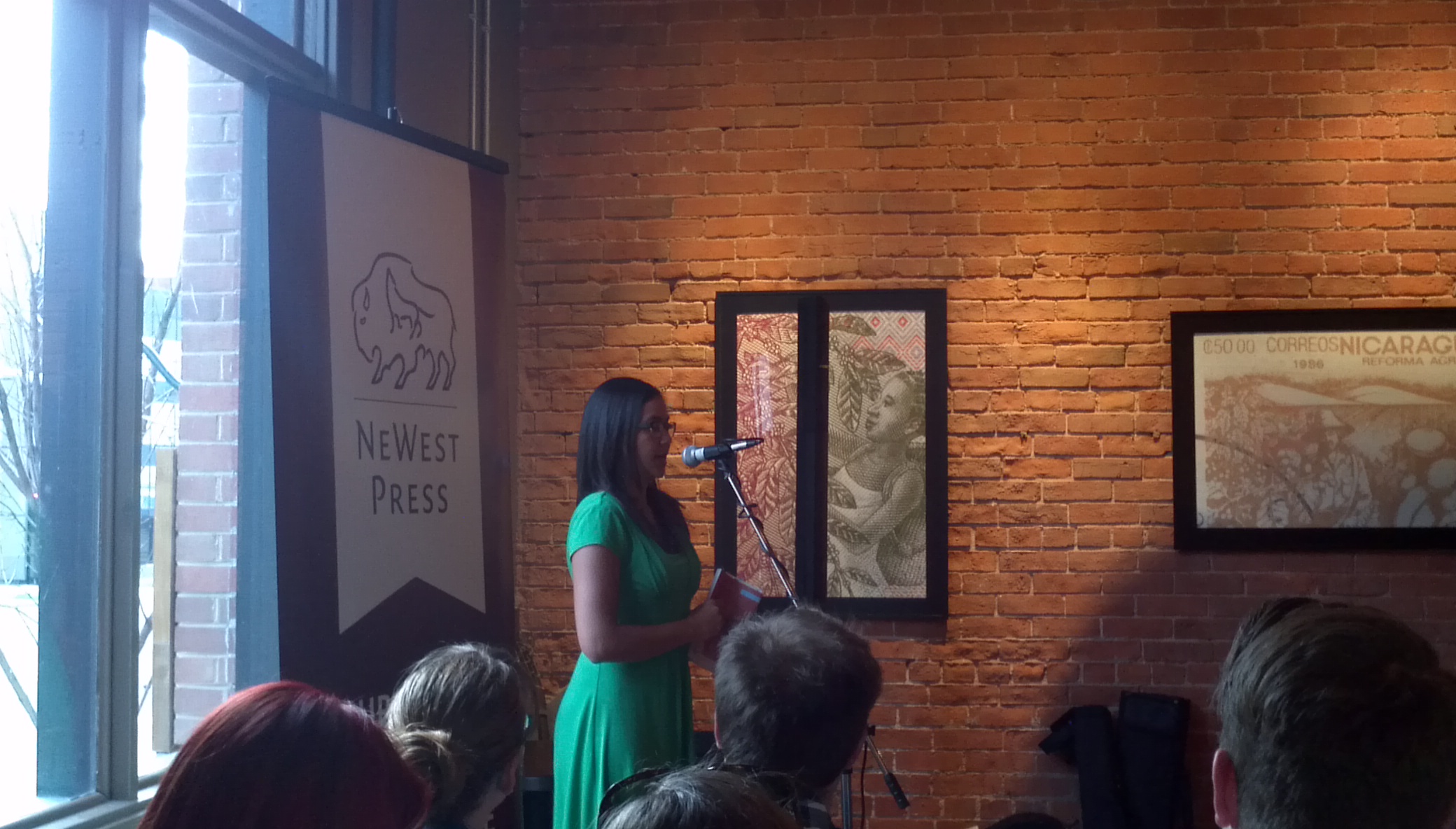
The Edmonton Book Bloggers were out in force last night, rubbing shoulders with the #yegbooks elite at the NeWest Press Spring Spectacular. This was only my second author reading, and had a very homegrown vibe compared to the Michael Ondaatje extravaganza back in March.

When I say homegrown, I don’t mean unprofessional. The event was very well run. Roast Coffee House was an almost perfect venue (just too hot), and Chris Craddock’s MCing was both brief and funny, which is exactly what you want from an MC. I thought it was strange to have a musical act, but Tyler Butler was fantastic, and gave the proceedings a nice, mellow vibe. Major shout out to NeWest’s Matt Bowes for pulling this event together.

Corinna Chong Reading

Corrina Chong. Photo credit: Brie Binicki

We haven’t even talked about the readings!

  • Jenna Butler read from her poetry collection Seldom Seen Road. She was so poised and confident, and her work is beautiful. I was nodding along with her descriptions of small town prairie life.
  • Rebecca Campbell was up next, and she blew my mind when she read my favourite passage from The Paradise Engine. Rebecca seemed a little nervous, and stumbled on a few words, but she dropped the f-bomb like she owned it. She really showed off the power of her prose (read my review).
  • Marguerite Pigeon read from the thriller Open Pit. I admit that I had no interest in this book before, but she left us hanging and gave such a wonderful preview of her characters that I think I’ll pick it up on my Kobo soon.
  • Finally, Corinna Chong read from Belinda’s Rings, and chose a funny excerpt followed by a dark one that hinted at the contrasts in her stunning debut novel (read my review).

I encourage you to check out the other Edmonton bloggers for their take. Rick from The Book-A-Week Project has a post up already (keener!) and Brie from Eat Books is working on hers. We also welcomed Elizabeth from Gossamer Obsessions to our little club, and I ran into author Jennifer Quist who posted this recap, including a hilarious account of our awkward “don’t I know you from somewhere” introduction.

I leave you with my night went in tweets and pictures. This is how I felt while getting ready to leave the house:

This is me with authors Corinna Chong and Rebecca Campbell, who both recognized me (omg) and were so lovely to talk to:

Corinna Chong, Moi, and Rebecca Campbell

Corinna Chong, Moi, and Rebecca Campbell. Photo credit: Brie Binicki

And here’s my haul. Why yes, that is a signed copy of Cassie Stock’s Leacock Medal winning novel, Dance, Gladys, Dance. Jealous?

Three Paradise Engines, Two Belinda’s Rings, one Dance, Gladys, Dance, and a partridge in a pear tree.

Anna From Away: Too Sexy for the States

I was notified by Goodreads that D.R. MacDonald has a new book coming out this month called The Ice Bridge. I really enjoyed his last novel, Anna From Away (see a brief review here,) so I clicked over and started reading the synopsis. Soon I realized that The Ice Bridge is Anna From Away under a different title. And different cover image. And a just slightly different description.

A little digging revealed that Anna From Away was published in Canada by Harper Collins Canada on September 11, 2012, and The Ice Bridge was published in the USA by Counterpoint on May 14, 2013.

Let’s compare and contrast:

Anna From Away by D.R. MacDonald     The Ice Bridge by D.R. MacDonald

Compare this line from the synopsis of Anna From Away:

Part erotic love story, part quest for home and heart, Anna From Away is a superbly crafted tale of love after love, a novel rich in atmosphere and infused with lyrical descriptions of land and sea. 

To the synopsis of The Ice Bridge:

Part love story, part moral fable, and part quest for home and heart, The Ice Bridge is a superbly crafted tale of love after love, a novel rich in atmosphere and infused with lyrical descriptions of land and sea.

Why was this book positioned as an erotic love story in Canada, and as a love story/moral fable in the States? In my opinion, “erotic love story” is pushing it a bit, but, sexual attraction and betrayal do play a big role in the story, and there is one sex scene in particular that is pretty darn steamy. In this post-Fifty Shades world, what is the American publisher afraid of but putting that out there?

Sexiness aside, the American title and cover are so BORING. I was really drawn to the cover of Anna From Away, but there’s nothing about The Ice Bridge that makes me want to read it.

I’m going to see if I can find anyone at Harper or Counterpoint who can tell me more. What do you think? The States just can’t handle all that maritime sexiness?

The Magic of Saida by M.G. Vassanji

Magic of Saida

My rating: 4.5/5 stars

Release Date: September 25, 2012

Publisher: Doubleday Canada

Thank you Brie of Eat Books for giving me a copy of this book.

Synopsis:

The Magic of Saida tells the haunting story of Kamal, a successful Canadian doctor who, in middle age and after decades in North America, decides to return to his homeland of East Africa to find his childhood sweetheart, Saida. Kamal’s journey is motivated by a combination of guilt, hope, and the desire to unravel the mysteries of his childhood–mysteries compounded by the fact that Kamal is the son of an absent Indian father from a well-to-do family and a Swahili African mother of slave ancestry. Through a series of flashbacks, we watch Kamal’s early years in the ancient coastal town of Kilwa, where he grows up in a world of poverty but also of poetry, sustained by his friendship with the magical Saida.

This world abruptly ends when Kamal is sent away by his mother to live with his father’s family in the city. There, the academically gifted boy grows up as a “dark Indian,” eventually going to university and departing for Canada. Left behind to her traditional fate is Saida, now a beautiful young woman. Decades later, Kamal’s guilt pulls him back to Kilwa . . . where we discovers what happened to Saida during a harrowing night of sinister rites. This complex, revelatory, sweeping and shocking book, is a towering testament to the magical literary powers of M.G. Vassanji.

This book humbled me, repeatedly.

When I read the blurb and saw “East Africa,” I thought, great! I just did a bunch of research on East African culture (for work,) so I am gonna get ALL the cultural references. I was hardly past the first page when I realized that, um, no. First of all, my research was on Somalia and Ethiopia, and East Africa encompasses way more than just those countries.  Continue reading