Tagged: 20 books of summer
10 Books of Summer makes way for 1 Book of Fall
By any metric, summer is over. School’s in (and I have a high school student!), leaves are falling, and I have a disappointing tally of reviews from my 10 Books of Summer. But I have big plans for fall.
10 Books of Summer wrap up

- Less by Andrew Sean Greer: actually reviewed, and enjoyed!
- The Netanyahus by Joshua Cohen: finished, past deadline, and unlikely to review, given the effort that would take, for a book that most people read back in 2021. It’s worth a read though, if you’re holding out.
- Athena by John Banville: my least favourite of the Book of Evidence trilogy, but still a stand out. Might tackle The Sea next.
- Small Boat by Vincent Delacroix tr. Helen Stevenson: This book took me by surprise. Should have won the IBP, probably (I didn’t read the winner so I can’t really say).
- There’s a Monster Behind the Door by Gaëlle Bélem tr. Karen Fleetwood and Laëtitia Saint-Loubert: A strong start, but it kind of petered out in the end.
- Playing Hard by Peter Unwin (a review copy, a collection of essays about games and sports): Did not get to this. It’s a tough one; an author I enjoy writing about a subject I’m not terribly interested in.
- Don Quixote by Cervantes tr. Edith Grossman: See below
- Mornings Without Mii by Mayumi Inaba tr. Ginny Tapley Takemori: Finished in an airport, sobbed.
- Yoga by Emmanuel Carrère tr. John Lambert: actually reviewed, and enjoyed ripping it to shreds.
- On the Calculation of Volume II by Solvej Balle tr. Barbara Haveland: Reviewed and enjoyed. November 18th, pub date of the third book in English, cannot come fast enough (apologies to Tara, who would certainly prefer to get to the 19th.)
1 Book of Fall preview

If I am going to read one book this fall, it will be Don Quixote. I tried and failed a few times over the summer, getting no farther than the introduction* and first few chapters, but I’m on chapter 8 now and believe I am “locked in,” as my kids would say. So far, I am struck by how this novel, often touted as the *first* novel, is about someone who went crazy from reading too many novels (well, romances). In light of recent moral panics like this one, I am curious about when and how the act of reading fiction went from being indulgent and ruinous (see also: Northanger Abbey) to virtuous and edifying.
If you’ve read Don Quixote and have any tips or resources for me, please share!
NovNov to the rescue

What about all those books of summer that I didn’t properly review? Luckily, most of them are novellas and would qualify for my favourite alliterative book blog event, Novellas in November. I would really like to write about Small Boat, as I have a theory about it that is either so obvious that no one talks about it, or so out there that I will look like an idiot. Can’t wait to find out which. I also want to talk about Dua Lipa’s book club, and this was a recent pick, so a perfect way in.
A disappointing review tally, but I did read 8/10 and started one more. Onward!
*The introduction is by Harold Bloom, who features rather prominently in The Netanyahus, in a strange coincidence, or bookish serendipity!
Yoga by Emmanuel Carrère, translated by John Lambert

This book has been called a lot of things – devastating, a tour de force, exceptional; but also generic treacle. Molly Young, who wrote one of two reviews of this book for the New York Times (published days apart; would love to know how this happened there) acknowledges the extreme opinions, and says that “If you don’t like Carrère now, you never will.” In the spirit of what Young calls Carrère’s “extreme candor,” I will tell you straight away that I don’t like him now, and (presumably) never will.
Saying this feels wrong. I don’t like “him”? I don’t know the man, though after reading this book, a 2017 New York Times profile, and several articles about the dissolution of his marriage, I feel pretty confident saying that I don’t like his whole deal: his approach to writing, his perspective on fiction, his smugness, and especially his mixture of mindfulness and obliviousness.
Yoga is classified as nonfiction in North America, but as a novel in France. Maybe we can split the difference with autofiction, which is generally understood to be writing based on real life, with few attempts to conceal names, places, and dates, but written in the style of fiction, with some liberties taken to make a more coherent story, or emphasize a theme or two. In my opinion, Yoga goes beyond a few liberties into something more sinister and more annoying. Yoga is also written from an assumption that the reader is extremely interested in Carrère’s writing process, down to how fast he can type. Given his stature in French literature, that might be true for some readers. Not for me.
Continue readingLess by Andrew Sean Greer

In April 2018, I was following the International Booker Prize (then Man Booker) for the first time, reading political books translated from Arabic and Chinese, post-post modern books translated from Korean and Polish, and some stuff I can’t even explain translated from Hungarian. Less, a novel about an American man’s midlife crisis, wasn’t really on my radar, despite winning the Pulitzer Prize that very month.
I vaguely remember seeing the cover and thinking, that looks like chick lit. These days, I would probably assume it was a “spicy” romance, but these were more innocent times. More specifically, the cover reminded me of a Sophie Kinsella novel, perhaps a gender-swapped Shopaholic. Turns out I wasn’t far off!
Continue reading20 Books of Summer 2025
A refreshed 20 Books of Summer challenge is upon us! Unlike last year, I do have 20 books to choose from, but it’s more realistic for me to commit to ten. My most successful 20 Books of Summer was my first, in 2019, when I read and reviewed 14 books, but I’ve never come close to that again. I join this challenge as an intention: to read these books (eventually) and to spend time writing reviews during the summer.
This year, new hosts have taken over for Cathy. I for one welcome our new overlords, AnnaBookBel and Words and Peace.
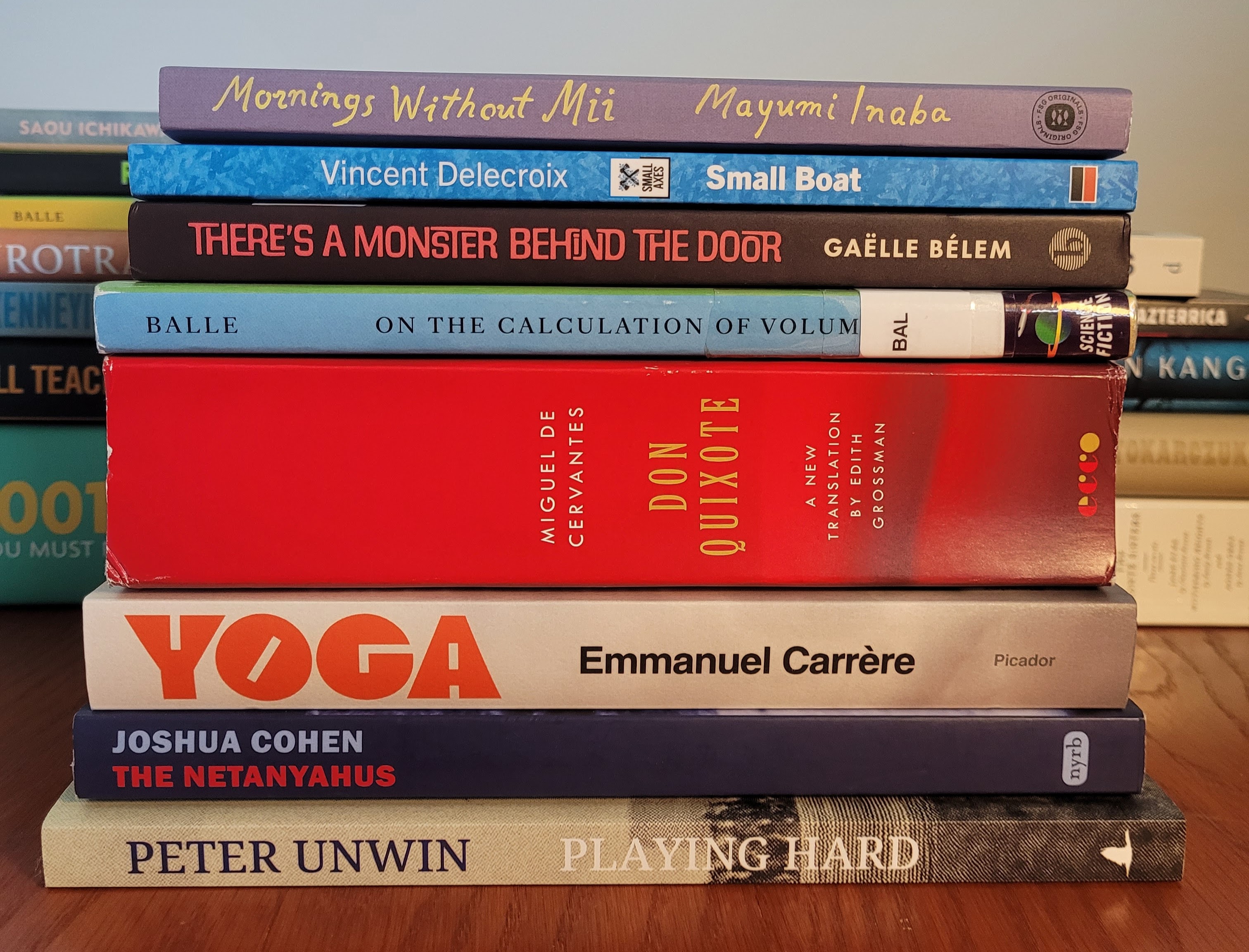
My list is another random assortment of books in my house or that could be in my house soon:
- Less by Andrew Sean Greer (cheating because I’m halfway through it now)
- The Netanyahus by Joshua Cohen (carry over from last year)
- Athena by John Banville (the last in the Book of Evidence series)
- Small Boat by Vincent Delacroix tr. Helen Stevenson (an IBP shortlister)
- There’s a Monster Behind the Door by Gaëlle Bélem tr. Karen Fleetwood and Laëtitia Saint-Loubert (an IBP longlister)
- Playing Hard by Peter Unwin (a review copy, a collection of essays about games and sports)
- Don Quixote by Cervantes tr. Edith Grossman (I thought about doing a read along but I’m too lazy)
- Mornings Without Mii by Mayumi Inaba tr. Ginny Tapley Takemori (cover buy!)
- Yoga by Emmanuel Carrère tr. John Lambert (been on my TBR since I read this review)
- On the Calculation of Volume II by Solvej Balle tr. Barbara Haveland (next in the septology)
Join in and let’s review some books! I promise to comment on yours if you promise to comment on mine.
My Year of Last Things
This is a book blog, not a personal blog, but I do write about life events here, and sometimes things don’t feel real until I do.
The births of my children are here. Moving into our house, briefly. My sister moving to the States. Then the fire happened, and I wrote about what it’s like to lose all your books, but I didn’t write about what it’s like to lose a pet.
If you follow me on social media, you might know that in the immediate aftermath of the fire, my husband found our cat Perogy in a bad state and got her to an emergency vet, where she remained for three weeks. You might have missed the “Missing Cat” posts about Shirley, though, as they were only up for a day, until my husband found her too. She didn’t make it.
Shirley was three years old, a pandemic pet born in 2020 and adopted by us in 2021. The SPCA named her and we didn’t see any reason to change it. She was loud, lazy, a bit of a glutton, cuddly, soft, playful, a constant companion to anyone sitting on a couch or lying in a bed, and scared of everything. She would have been very scared that day – the noise, the smoke, the heat, people stomping around. The firefighters told me she most likely escaped the house and we’d find her later, that it happens all the time, but I didn’t believe them.
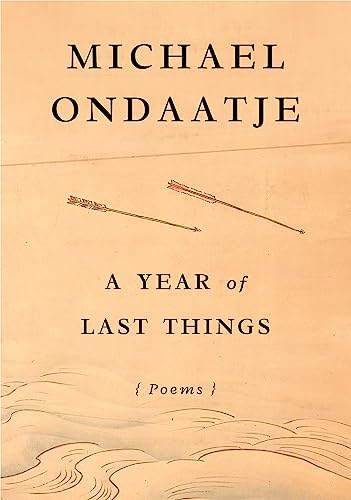
I’ve never lost a pet this way, only older pets who were ready to go and gave us time to prepare. I’ve also never lost a pet in the midst of a crisis – usually losing the pet is the crisis. I have mourned her, but alongside a bunch of other stuff, and seven months later, it can still feel awfully fresh; never more so than when I read the poem “November” in Michael Ondaajte’s new collection A Year of Last Things.
I’ve tried Ondaatje’s poetry before, and found it fairly impenetrable, with literary and cultural references that are beyond me. A lot of the poems in this collection are like that, though I got a hint of something different in this first line of the first poem, “Lock”:
Reading the lines he loves
he slips them into a pocket,
wishes to die with his clothes
full of torn-free stanzas
and the telephone numbers
of his children in far cities
I love that line about carrying the telephone numbers of your children in your pocket. Old fashioned but relatable. Later, we are treated to prose poems – mini-essays, really- about the horrors of boarding school and confronting an abuser.
And then there’s “November“:
Where is my dear sixteen-year-old cat
I wish to carry upstairs in my arms
looking up at me and thinking
be careful, dear human
Ondaatje addresses his cat, Jack, and remembers how he was adopted (“I found you as if an urchin in a snowstorm”), how he became a member of the family, (“learned the territories of the house”) and grew old (“Was it too soon or too late/that last summer of your life”). He despairs that he “cannot stand it,” this loss, and imagines meeting Jack again in a place “where language no longer exists”.
This poem has nothing much to say about my particular circumstances. “November” is about an old cat, and an old owner who can imagine meeting him again soon. Shirley was a young cat, and I am a (relatively) young owner who, if I believed in an afterlife, would anticipate waiting a long time for such a reunion. This poem doesn’t have anything particularly new to say about grief, either: it ends in a paraphrase of a 17th century haiku about the timelessness of nature, maybe, or the endless nature of grief?
It’s not a good poem because of what it says, but because of how it says it. It’s good because in ten stanzas (read them all here), it reminded me that my grief is real, and made me write about it here, making it even more real. It’s good because it made me think about my brother, who imagines his cat referring to people as “humans,” usually derogatory, and that made me smile. It’s good because the line near the end, “You no longer wait for us” took my breath away. Cats aren’t loyal and protective like dogs, but they do wait for you. I think about Shirley waiting for me that day. I knew she didn’t leave the house. She waited where she always did when she was scared, under the couch. That couch was just too close to the fire.
This is barely a review but it does remind me, and hopefully you, why it’s a good idea to read poetry: for those lines that takes you back to a place or a feeling, even one you cannot stand going back to.

Shirley, lying on top of someone’s legs as they lounged on the couch, as she was wont to do
Hope Will Never Die (but you will)

I write this from a place of uncertainty, anxiety, and hope: the brief but interminable span of time between games six and seven of the 2024 Stanley Cup Final.
The fact that there will be a game seven at all is a minor miracle. If the Oilers win game seven, it will be a historic, statistically improbable, and miraculous comeback by a team that was at the bottom of the league earlier this season and was down 0-3 in this series. Edmonton hasn’t won the cup in 34 years. A Canadian team hasn’t won a cup in 30 years. It’s been nine years since the Oilers drafted Connor McDavid and began the long climb out of the decade of darkness and into the light.
“Hope Will Never Die” was a slogan coined by OilersNation and festooned across t-shirts and other merch to mark the occasion of McDavid’s first game. “Believe” is another popular slogan that’s used by many teams and sponsors. How does a sports fan endure ten years of lacklustre, playoff-missing hockey without hope? How does anyone wait for anything without believing they will get there eventually?

I’ve been reading about hope recently, and what I’ve read isn’t great. This isn’t surprising when you think about what happens when sports fans’ hopes are let down: riots, domestic violence, and depression.
Pema Chödrön writes in When Things Fall Apart, a collection of talks given by the Buddhist nun over several years:
Hope and fear come from feeling that we lack something, they come from a sense of poverty. We can’t simply relax with ourselves. We hold on to hope, and hope robs us of the present moment.
This chapter, “Hopelessness and Death”, is one of the most challenging in the collection, as it runs counter to a lot of the ways we frame things in the west. Chödrön sees hope as a manifestation of fear, and reminds us that all fear is rooted in a fear of death. Hope is a way of trying to make life feel secure and free from doubt, to deny the fact that you are mortal, to desperately try to avoid death, and so hope is destined to fail us. This idea resonated with me – some of my greatest moments of frustration in life have come from wishing (hoping) that things could be different, that I could be different.
Chödrön points out that all theistic religion is about hope: that if I do and say the right things, someone, some deity, will take care of me. Many religions also include an afterlife – an escape from death. It’s fitting that Oilers fans refer to McDavid, our great hope, as “McJesus.” Chödrön advocates for living with hopelessness:
When we talk about hopelessness and death, we’re talking about facing the facts. No escapism…Giving up hope is encouragement to stick with yourself, to make friends with yourself, to not run away from yourself, to return to bare bones, no matter what’s going on.
Hockey fans talk about hope, but the Oilers don’t, or not much. They talk about playing one game at a time, getting back to basics, and enjoying the moment. Kinda sounds like Chödrön, right? That’s no coincidence, as the Oilers have hired celebrity mindfulness coach George Mumford this season. The linked Instagram reel is short, but Mumford mentions fear, trying by not trying, and being present. His method is a little hard to discern (disclosure: have not read his books) so I’m not sure if he’s got the Oilers meditating daily or what, but whatever it is, it seems to be making a difference.

Unlike Chödrön, Mumford doesn’t fit into a particular mindfulness tradition. His website cites “positive psychology, mindfulness, philosophy, neuroscience, the recovery movement, group and organizational dynamics, and spiritual traditions from around the world.” I don’t know what Chödrön thinks of this popular version of mindfulness, but I know that critic and author Becca Rothfeld would have a field day with it. In her recent essay collection All Things Are Too Small, she casts a withering glance on western-style mindfulness, which is divorced from its eastern origins and grew out of the “mind cures” and “positive thinking” movements of the twentieth century. It’s an interesting angle, but sadly, the weakest piece in the collection. Rothfeld sets up ridiculous straw man arguments – that meditation means you can never think or judge, that mindfulness is an all-or-nothing proposition – which is a shame, because she’s onto something in criticizing the commodified version of mindfulness that’s peddled on apps these days. I have no doubt she’d scoff at Mumford’s vague pronouncements and slick website.
And yet! Mumford must be on to something too, because I’ve been watching the Oilers for 25 years and this team, this year, feels different.
At this moment, despite what I’ve learned, and my years of on-and-off, half-assed mindfulness, I remain half agony, half hope.
Oilers in seven.

Laser Quit Smoking Massage by Cole Nowicki

Are “short essay collections” a thing? Flash essays? Micro essays? I don’t know that I’ve ever read a collection like this before: 25 essays in 144 pages for an average of under 6 pages each. A couple of them come off as a little underdone, but most of them feel full: of odd characters, familiar places, and moments of catharsis and recognition. And humour! I laughed out loud at a joke about Balzac, Alberta, which does indeed sound like “ballsack” – as my kids will note every time we pass it on the way to Calgary.
Speaking of Alberta, I thought Big Mall would be the most locally and personally relevant book I’d read this year, but another millennial Albertan who eventually moved to Vancouver has entered the chat. Cole Nowicki grew up in Lac La Biche, Alberta, a town familiar to me because it’s close to a friend’s lake lot, where I would go camping (under duress) when the kids were small. Going to the Timmies, or the oddly-punctuated “The Bargain! Store” was a highlight of those trips.
It doesn’t really matter if you’ve been to Lac La Biche, though, or if you understand why it is a big deal that they have a Boston Pizza there. These are the best kind of personal essays, where the very specific experiences and interests of one person reveal something universal. You probably didn’t have a conversation with your mom about Blink-182 lyrics as a child, but you will recognize (I hope) the comfort to be found in the commiseration of a parent. You probably didn’t watch a parent go through a mental health crisis (I hope) but you will recognize the pain of growing up and realizing that your parents can’t or won’t commiserate with you the same way anymore.
I also enjoyed the essays that were a little less personal and more about the absurdities of the places we live, IRL and online. “The Big Dog in the Sky is Dirty”, about a sculpture of a poodle in Vancouver, doesn’t take an obvious position for or against public art, but exposes the class implications and bureaucracy around who gets to experience it. There are no pictures in these essays, but Nowicki also maintains a blog where you can read an earlier version of this essay and see the poodle in question.
There were other essays that could have been enhanced with pictures (“The Dark Lord of Vancouver Karaoke”, just to verify that “Arcanabyss” is a real guy, which he is) and one where I was very glad there weren’t (“A Brief History of People Finding Weird Shit in Their Ears”, which was horrifying in exactly the way you think). Early adopters of the internet will appreciate the lore around gail.com and “pooptime”, a website that I thought must have existed in the early aughts era, between “bathroom books” and social media, but was somehow still publishing content in 2018.
The only essay that fell a bit flat to me was the skateboarding one. The “well-worn cliche” of how skateboarding mirrors the growth and upheaval of adolescence is acknowledged early on, and for me, the essay didn’t overcome that. This tracks for me, as I regularly read Nowicki’s blog, Simple Magic, but skim over the hardcore skateboarding stuff. I keep coming back because I find so many gems (which are usually at least skateboarding-adjacent.)
This is the first of my 20 Books of Summer challenge. I enjoyed it so much that I immediately started another essay collection, No Judgement by Lauren Oyler, which is much bigger – in length, in scope, and in public reaction. Laser Quit Smoking Massage is easily the better collection, in terms of choice of subject, use of humour, and respect for the reader’s time and attention (I’ll expand on the latter if I review No Judgement.) I don’t foresee any hit pieces in Bookforum for this one, I hope readers give it a chance anyway.
20 Books of Summer 2024
20 Books of Summer has always been more about the motivation to *actually review* books for me, not reducing my TBR, and never more so than this year. I don’t own 20 books, let alone 20 books I haven’t read before. Hence the shorter list.
This year is special though, as it’s the tenth anniversary of an event that started as a TBR challenge with 8 participants that now attracts upwards of 100 bloggers each year. No mean feat given the state of blogging today and the fact that this is a rather high-commitment event (with very relaxed rules to make it manageable.) Congratulations to Cathy for keeping the pages turning and the reviews rolling in since 2014.
My list of 15 has no theme other than “these are books in my house or that I might get into my house at some point this summer”:
- Breasts and Eggs by Mieko Kawakami tr. Sam Bett and David Boyd (for Women in Translation month, perhaps)
- The Wars by Timothy Findley (a CanLit classic)
- A Tree Grows in Brooklyn by Betty Smith (an American classic)
- The Netanyahus by Joshua Cohen (has been recommended to me many a time)
- Agnes Grey by Anne Brontë (the book I was rereading at the time of our house fire, apologies to Edmonton Public Library for the lost copy!)
- Jane Eyre by Charlotte Brontë (it’s in the edition I got in order to read Agnes)
- Wuthering Heights by Emily Brontë (see above and it’s time for a reread anyway)
- Ghosts by John Banville (the next in the Book of Evidence series)
- Brooklyn by Colm Tóibín (a rare instance of “seen the movie, not read the book” and preparation for…)
- Long Island by Colm Tóibín (the much-anticipated sequel)
- Kairos by Jenny Erpenbeck tr. Michael Hofmann (my tradition of reading the International Booker Prize winners continues)
- Laser Quit Smoking Massage by Cole Nowicki (a slim essay collection)
- A Year of Last Things by Michael Ondaatje (a slim poetry collection)
- When Things Fall Apart by Pema Chödrön (they sure have been)
- The Tenderness of Wolves by Stef Penney (a Little Free Library pick)

Join in and let’s get this TBR back down to zero, or at least review some books this summer!
Abigail by Magda Szabó, translated by Len Rix
We’ve reached the end of 20 Books of Summer 2023, and with this, I have read and reviewed eight books, which I count as a huge win! Three of those were 1001 Books, two were by women in translation, and at least one had been on my shelf for more than ten years. Huge thanks to Cathy and all the participants for the motivation.

I just about died recently, when I heard someone on Booktube refer to The Idiot (Batumen, not Dostoyevsky) as “dark academia”. In what world? I’m not saying an adult, literary novel can’t be classified this way but like… The Idiot just isn’t it. It’s missing the gothic setting and magic and whatnot. It’s a campus novel at best, and I’d argue it’s not even that because a fair amount of the book takes place off-campus.
It got me thinking about adult novels that do have the requisite lush settings, closed societies, mystery, and danger, like The Secret History and Vita Nostra, and whether a book like Abigail fits.
Most of the action in Abigail takes place in a fortress-like boarding school, and it’s got some sorta-supernatural elements, namely, a statue named “Abigail” the school girls confide in via written notes, and who sometimes writes back. It’s a closed society but it’s very much in the real world of Hungary in 1943, and it’s a very refreshing take on the coming of age novel, in that romance and friendship are present, but are not the drivers of Gina’s journey.
Gina enters Bishop Matula school as a child, with no idea why her beloved father, “the General,” banished her from her comfortable, cosmopolitan life in Budapest, to a religious school in the middle of nowhere full of naive country girls. By the midway point, she is forced to grow up when her father tells her the truth about why he’s hidden her away, and about what’s really happening to Hungary, and to him.
The mystery and magic of “Abigail”, as in, how a statue is able to respond to the various crises and complaints of the girls, drives the early narrative, but for me, this was a story about bullying, and adults trying to exert control over the uncontrollable force that is teenage girls. The real dark side of academia!
I grew up in a time where bullying was seen as pretty normal and nothing to get worked up about, while my kids are growing up with pink shirt days and no-bullying pledges. Despite having been bullied myself, in a somewhat similar way as Gina (this book is most realistic depiction of bullying I’ve ever read), I’m skeptical of anti-bullying campaigns. Isn’t the whole point of bullying that kids get to subvert the social order adults want to impose, the “play nice” messages they’ve been fed since preschool? A way for those with little control over most aspects of life to exert control over the most relevant things in their view: their peers? Why would a social marketing campaign cooked up by adults change all that? Maybe I’m too cynical, but I just don’t see bullying going away.
There’s more to this story than bullying, though. What makes it so genius is that it parallels the social control inside Bishop Mantula (both official – the strict rules and routines – and unofficial – the unspoken social rules the girls concoct, and severe consequences for those who don’t conform to both) with the social control exerted by a nation during wartime. Communication is strictly controlled and mostly propaganda in both cases, so the sudden appearance of anti-war messages on landmarks, in train stations, and even in the church feel just as magical as the messages from Abigail. The girls nominating one student to sing hymns loudly in the dayroom, so the rest can gossip undetected, is just as ingenious as the dissident who breaks into the church, and switches all the readings and hymns to ones with anti-war messages. Teenage girls are dissidents in training – by the end, quite literally.
I still don’t know if this all counts as “dark academia” or if that even matters, but fans of The Secret History or Vita Nostra will probably like this, as it takes its young student characters seriously while still portraying them as suitably naive, and all the more dangerous for it.
Howards End by E.M. Forster
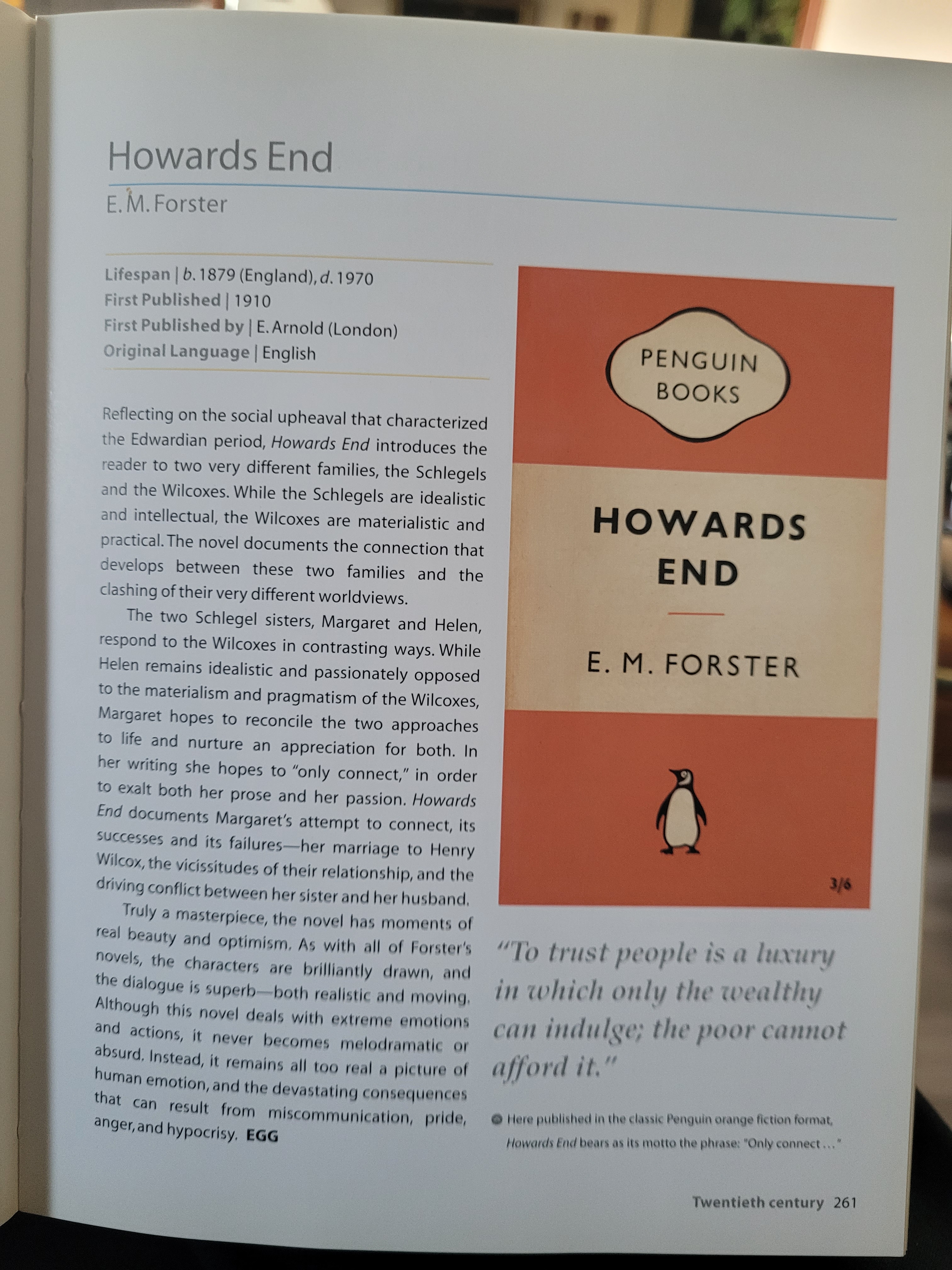
Howards End is #754 on the 1001 Books You Must Read Before You Die list. See the whole list and my progress here. This summer, I’m reading from the list for my 20 Books of Summer challenge, and instead of straight reviews, I’m going to compare the 1001 Books write ups with my own impressions.

If you’re my age (an ageing Millennial or a youthful GenXer, depending who you ask) you might have seen that genre of TikTok that points out that the way we thought about the 1960s as teenagers is the way teenagers today think about the 1990s (i.e. as ancient history.) This made me think about the classic lit equivalent: the way we thought about Victorian literature as teens is the way we should think about Edwardian literature today.
The metaphor doesn’t really work, because my microgeneration felt like whatever was going on in the 90s was fresh and new, whereas Victorian and Edwardian literature have only even felt “old”. But the fact remains: when I was a teenager getting into classic lit, books from 100-125 years ago were Victorian, and now books that old are Edwardian. Maybe it’s time to stop obsessing about the Brontës and Dickens and see what those Edwardians were up to*.
Howards End is the perfect place to start, written 113 years ago, navigating feminism, politics, and those newfangled “motors” that were taking over the roads. I enjoyed it thoroughly, though Forster (this is my first) does tend to get a little… off track at times. A lot of random philosophizing when I just wanted to know how the family was going to deal with Helen’s latest scandal.
The 1001 Books write up is on the bland side, so I started flipping through the adjacent pages, to see what else was happening circa 1910. Plenty of fellow modernists like Woolf, Lawrence, and Mann, but also the more traditional John Galsworthy. The write up for The Forsyte Saga (1906) could have applied to Howards End in that it mentions Beauty (with a capital B) and the urge to possess it, and how the family unit can stand in for society. It also calls it a “monument to the Edwardians.”
These books are both great depictions of the last gasps of Victorian-era morals and the emergence of Edwardian concerns. Forster contrasts the artistic Schlegels with the practical Wilcoxes, while Galsworthy gives us Soames Forsyte, representing the pursuit of property and power, while cousin Jolyon and wife Irene represent the pursuit of love and feeling. Galsworthy wanted to “only connect the prose and the passion” as much as Forster did, he just didn’t come up with such an eloquent way of putting it (and sorry, but legally, you have to quote this line in a review of Howards End.)
But they offer a pretty limited view of the lower classes. In both books, artistic, passionate men of a lower class are brought in to cause a commotion among the wealthy characters, and then they (spoiler alert) immediately die. Women of the lower classes are even more incidental – servants or prostitutes, mostly. There’s nothing to connect there. Why don’t we get a prosaic poor person to contrast with the passionate Leonard Bast in Howards End, or with Irene’s lover Philip Bosinney?
After perusing the 1910 era of the 1001 Books, I flipped all the way to the end. #4, On Beauty by Zadie Smith, is a loose retelling of Howards End, and while I read it too long ago to cite the details, I’m pretty sure it addressed the class shortcomings. The write up says it’s a novel about “art, love, race, class, family” which sounds about right. I looked up an ebook preview to see how Smith adapted Forster’s opening chapter that begins “One may as well begin with Helen’s letters to her sister.” (yep, with email transcripts). A reread might be in order.
As for which adaptation is better, please stand by: a DVD of the 1992 Howards End is on hold for me at the library. Don’t hold your breath though, The Forsyte Saga (2002) is one of my favourite historical mini-series ever!
*I do not actually plan to stop obsessing about the Brontës
 Reading in Bed