Tagged: 1001 Books
2014 Year in Review #1: The Stats
Are we sick of year in review posts yet? No? I really enjoyed doing multiple, detailed posts last year, but Bookstravaganza took up most of my December so I’m gonna keep things simple this time round. Stats today, best and worst books tomorrow. And maybe top literary crushes (okay, definitely top literary crushes!)
Books Read

- Books read in 2014: 64 (up from 52 last year)
I thought I might hit 75 this year, but it was not to be. Without the Novellas in November and Bookstravaganza boosts, I would have ended up around 52, just like last year. I can live with that!
About the Author
- 58% female (down from 67% last year)
- 19% person of colour (up from 12% last year)
- 55% Canadian (up from 42% last year) 22% American 16% British and 1 each: Argentinian, French, Irish, Russian, Guadeloupean.
- Only two Edmonton-area authors this year.
I put a bit of effort into reading more authors of colour this year, and I guess nearly 20% is alright – it’s tough to know, honestly. With gender I’m going for parity, but what’s parity with race? 20% is pretty representative of our population here in Edmonton, but if you expand to Canada, or North America, or world wide, your target would be very different. So my goal with regards to authors of colour next year is to review more of them. That’s where my power as a blogger lies. Some of the best books I read this year were by authors of colour, and I didn’t review them. More on THAT tomorrow.
Genres and Lists

- 19% classics (down from 35%), 53% contemporary lit fic (up from 48%), 9% non fiction (up from 6%), and a handful of YA, poetry, erotica, romance, and historical fiction.
- 8 1001 Books for a total of 123 read
- I’m kind of defunct on The Classics Club. I erased my list because it wasn’t speaking to me anymore. The idea, though, was to read 50 classics in five years, and I read 12 classics this year, so I’m on track.
Ratings
- 13% were rated five stars (down from 19%), 45% were four stars, 30% were three stars, 13% were two stars, and thankfully, I did not read a single one-star book this year because I decided not to continue with the Fifty Shades trilogy. I will totally see the movie though. For research! And stuff.
Compared to the average Goodreads rating…
- I rated 27 books higher. The most underrated book was Villette, which I rated a 5, compared to average 3.72 rating. How dare you, people who rated this book less than a 5! It’s perfection!
- I rated 37 books lower. The most overrated book was Me Before You, which I rated a 2, compared to average 4.31 rating. Apologies to Kristilyn and Brie, who are probably not my friends anymore.
Blog Stats
- 23,000 page views in 2014, up from 17,000 in 2013 and next to nothing in 2011 and 2012. Thank you 🙂

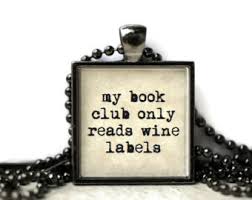
photo via etsy.com
- Most viewed post of 2014: The Fault in Our Stars: Use Your (Literary) Allusion. Man, you people love John Green!
- Most viewed post that was actually written this year: The Top 5 Alternatives to Traditional Book Clubs. Hope you all found something that works for you!
- Least successful posts in 2014: My reading soundtrack posts. Well, too bad, they are my favourite to write so I’m gonna keep doing them.
Stay tuned for more 2014 year in review, hopefully before it becomes ridiculously late in the current year!
Reading in Bed Year in Review #4: Best Books and Blog Stats
I love statistics. You’re probably sick of them by now, what with the many end-of-year blog posts, but I love how they’re both meaningless and mean everything; how “numbers don’t lie” but they can tell whatever story we want them to tell. Here are the numbers that made up my year of reading.
…but first, a public service announcement: Goodreads has a sweet stats thiny that shows you how many books you’ve read, how many pages you’ve read, how you rated your books, and more! Go to “My Books,” then “stats” which is on the left side in tiny font, then click “details.” It’s magic! Here’s mine. You can also export your books to Excel to do EVEN MORE analysis – click “import/export” in that same tiny, left hand menu.
Books Read
- Books read in 2013: 52 (Book a week!!)
- Books read in first six months: 12
- Books read in last six months: 40
I knew my reading picked up after I finished Moby-Dick this summer but I didn’t realize the extent till now. I never thought I’d read 50 books in a year, but it looks like I could reasonably go for 75 next year!
About the Author
- 35 Female (67%) 16 male (31%) 1 various (2%)
- 22 Canadian (42%) 16 American (31%) 9 British (17%) 2 French (4%) and 1 each: Columbian, Russian, Irish.
- 48 white (88%) 6 visible minority (12%)
I didn’t restrict myself to female authors this year, but I did stack the deck a bit by choosing female authors on the Classics Club list, and, by accepting review copies from independent presses – I have a feeling that female authors are over represented in smaller publishers. I won’t set any specific goals for next year, but I’d love to read more books by minorities. I’m sure I’ll still read lots of CanLit, butI gotta read some more World Lit too, beyond the States and the UK. Anyone got any good world lit reading challenges happening? I’ll probably do the Russian Lit one but would love to broaden my horizons even further…
Genres and Lists
- 18 classics (35%), 25 contemporary lit fic (48%), 3 non fiction (6%), 3 YA (6%), 2 romance (4%), 1 anthology (2%)
- 11 1001 Books for a total of 115 read
- 11 Classics Club picks for a total of 11
Ratings
- 10 five star reviews (19%), 19 four star reviews (37%), 14 three stars (27%), 3 two stars (6%), and 2 one star reviews (4%).
Compared to the average Goodreads rating…
- I rated 22 books higher. The most underrated book was The Testament of Mary, which I rated a 5, compared to average 3.56 rating.
- I rated 28 books lower. The most overrated book was Dragon Bound, which I rated a 1, compared to average 4.19 rating.
Blog Stats

- 17,000 page views in 2013. Compare that to 900 in 2011 and 3,500 in 2012. As Disco Stu would say, “if this trend continues, HEY!”
- Most viewed post of 2013: What’s The Deal With Infinite Jest? It’s a year later and I still don’t know what the deal is! It’s funny because I wrote it in a very unplanned, stream of consciousness style, which I don’t often do. I’m just happy to share the WTFness and the DFW love.
- Most viewed post that was actually written in 2013: The Fault in Our Stars: Use Your (Literary) Allusion. I get searches for “Fault in our stars allusions” on a daily basis, particularly in the summer, which tells me that a lot of students write papers on TFioS, and makes me realize how different writing papers must be these days.
And now, on to the good stuff: my best and worst reads of the year!
Continue reading
Cool Story, Bro. (Why DFW Appeals to the Male Reader)
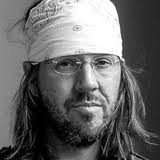
There’s something about DFW that makes me think he called people, or was called, “Bro.” Must be the bandanna.
After finishing Infinite Jest and realizing I had no idea what just happened, I found a few reviews on blogs I already follow. I was heartened to find that I was not the only one who finished the book and was completely and utterly confused.
I also noticed that all the Infinite Jest posts were written by males. This might not seem like a big deal, but, the vast majority of book bloggers I follow are female. Indeed, the vast majority of all book bloggers are female. Searching past my own blogosphere, I found numerous articles, reading groups, Twitter accounts, and wikis devoted to DFW and his work, and they were nearly all written by men. What gives? Why are all of DFW’s super fans male? Continue reading
What’s The Deal With Infinite Jest?
I just finished Infinite Jest, and I have questions.
I finished the book early one morning, before the kids were awake. The first thing I did was Google “what happened in Infinite Jest.” The second thing I did was Google “Infinite Jest WTF” and my own blog was the fourth result. Gulp.
I started to read some blog posts and critical reviews, and quickly realized that if I just read what other people think, I’m not going to draw my own conclusions. So, I quickly wrote down my questions and impressions so they’re as fresh as possible. I don’t want to sound smarter than I am because I’ve read a bunch of other people’s thoughts.
(As an aside, 101 Books identifies this, reading reviews before forming an opinion, as a sign that you might be a book snob. Well… I’ve come to terms with my book snobbery, so I’m okay with that!)
This post is for other people who finished Infinite Jest, and, like me, were like “WHAT HAPPENED,” so you’ll feel better; for people who finished it and totally understood everything, so you’ll feel smart; and for people who haven’t read this book, so that maybe you’ll be intrigued enough to pick it up. Despite not understanding everything, I think this is an important book for all of us borderline millennials and, well, everyone. To paraphase DFW himself, this book is about what it is to be a fucking human being.
In no particular order, here are my questions, impressions, thoughts, and feelings upon finishing Infinite Jest. Spoilers, etc:
- What is the significance of TEETH in this book? Off the top of my head, the ADA forgives Gately for causing his wife’s obsession with cleaning her teeth, one of Himself’s films was about teeth, one of ETA staff is obsessed with teeth, Mario is “homo dental” which I don’t even know if that’s a thing, and every time I read “Ortho Stice” I thought of braces. This may seem like a weird thing to fixate one, but it is really bothering me!
- These is a serious lack of female characters in this book. The settings are primarily male: A tennis academy and a drug recovery house, both of which of course have female residents, but are male dominated. The primary females are damaged or physically different – Joelle’s face (both as PGOAT and UHID), Avril’s height, Pat’s limp. Continue reading
Infinite Jest broke my Kobo. And my brain.
Once I got over my initial fear, I’ve been pretty cocky about reading Infinite Jest. It’s been WAY easier than I thought it would be. I’m able to pick it up here and there without backtracking to remember what happened. DFW’s quirks and tics aren’t bothering me much (though starting sentences with “and but so then” just doesn’t make sense to me.) It’s just SO much easier to read something written in and about a culture you’re familiar with, than say 19th century Russia. My shiny new Kobo Glo is really helpful, too. I can look up words right on screen (my new favourite word is postprandial) AND I can jump back and forth between main text and end notes (good thing because there are a ton of them).
So I’m thinking I’m quite SMRT. Then this happens:

CALCULUS!
Calculus was by far the most difficult subject I’ve ever learned. In an academic career marked by minimum effort and honour roll results, calculus was just beyond my brain’s capabilities. I worked harder than any of my other classes and barely passed. Having to think about calculus again was like a big smack down, reminding me that I’m not that smart after all.
And THEN the end notes started to get out of control. The Kobo works great until you have footnotes within an end note. Then it just sort of shrugs and says “yeah, I don’t know, you find your own way back.” And end note 123 splinters into its own chapter for some reason. I guess it takes a book like Infinite Jest to expose the limitations of the technology (DFW probably would have LOVED that. You know his BFF Jonathan Franzen would.)
So, what’s the point of all the fussy words, strange constructions, copious end notes, and mathematics? Is DFW just messing with us? Trying to make the reader feel dumb? Weeding out the riff raff? Showing off? I think it’s a bit of all of these, but there’s probably some meta stuff going on… like, life isn’t a straightforward narrative, or something. I don’t know. I’m feeling pretty dumb right now.
But, I will soldier on! I’m one third of the way through after 23 days of reading, so I’m on track to finish in less than three months total. For the record, though, this is the ONLY way I want to deal with calculus from now on:
Let’s Get Infinite

Dave Eggars writes in the foreword to Infinite Jest, “This is not a book to be read with a child on your knee.” I’m paraphrasing, as I actually have a child on my knee right now and can’t get up to find the book. Continue reading
Reading Roundup: September 2012
Who knew I could do enough book and bloggy things in one month to warrant an update?
September was a challenging month. Henry went through pink eye, thrush, teething, and colds. He still doesn’t sleep at night. Or ever. But, I feel like I’m getting back into a groove. My commitment to read every day helps a lot. There were a few days where it didn’t happen, but usually, if I tell myself “just one sentence,” I’ll end up reading a few pages. I may never be as prolific a reader and blogger as most, but this feels good.
I got books! And things!
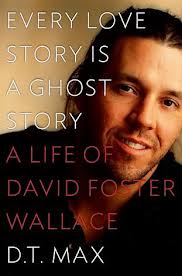 Won: Every Love Story is a Ghost Story by DT Max, a biography of the late David Foster Wallace. The Edmonton Journal’s book columnist Michael Hingston (@mhingston) had an extra copy to give away and I entered on a whim; I’ve never read any of DFW’s work. I was going to jump right in with Infinite Jest, but Michael suggested I start with something a little less ambitious, like Consider the Lobster. “Considering” that Infinite Jest is more than a thousand pages long, I think I’ll take that suggestion. Check out Michael’s blog for lots of local literary goodness.
- Bought: Infinite Jest by David Foster Wallace. This might just be the longest book I’ve ever attempted. Eek.
- Bought: Love in the Time of Cholera. See my rant about the cover here.
- Gifted: A brand new, pink Kobo Glo. It’s great! Mostly. Review to come.
I read books! Yes, plural, BOOKS.
- Vineland by Thomas Pynchon – I wrote up my initial thoughts on this excellent book. Four stars, nearly five.
- From Away by Michelle Ferguson – Review soon. Interesting themes but the characters didn’t come alive for me. Three stars.
I did things on other blogs!
- I guest blogged on Reading in Winter. Check out my post on Paranormal in Classic Literature. What a great experience. Kristilyn even helped me with the final touches as I was in the middle of sleep hell with my seven month old.
- I created my Classics Club list! Now I just have to actually join. I figure it’ll be book snob central – so excited.
- I committed to do a guest post for Angry Vegan in October. It’s not a book blog, so I’ll have to come up with something a little different. Here’s a guest post I did last year about my week-long vegan challenge failure.
Here’s to an even more productive October. And hopefully some sleep.
Damn it, Oprah.
I was so bothered by not having the exact quote I wanted for this post that I bought a myself a new hardcover copy of Love in the Time of Cholera. I could only find the first sentence of this passage online, and it was driving me nuts. Here it is in its entirety. I just love this!
It was also the time when he happened to find in one of his mother’s trunks a liter of cologne that the sailors from the Hamburg-American Line sold as contraband, and he could not resist the temptation to sample it in order to discover other tastes of his beloved. He continued to drink from the bottle until dawn, and he became drunk on Fermina Daza in abrasive swallows, first in the taverns around the port and then as he stared out to sea from the jetties where lovers without a roof over their heads made consoling love, until at last he succumbed to unconsciousness. Transito Ariza, who had waited for him until six o’clock in the morning with her heart in her mouth, searched for him in the most improbable hiding places, and a short while after noon she found him wallowing in a pool of fragrant vomit in a cove of the bay where drowning victims washed ashore.
I love that I have a brand new copy of this book. Now I’m on a mission to pick up nice hardcover editions of my favourite books. For Love in the Time of Cholera, I chose the first edition cover art. I was so not impressed when it arrived with the Oprah’s Book Club stamped on it. Ugh. Going to watch for that next time.
Do you buy special editions of your favouite books? Are you picky about book club logos? Am I being overly snobby or what?

This is what it’s supposed to look like, unsullied by Oprah’s stamp of approval.
Babies of Wackiness
Vineland by Thomas Pynchon is #176 in the 1,001 Books You Must Read Before You Die.
This isn’t a review of Vineland. I’m not ready for that yet. But I really want to talk about it, so I’ll begin with a shout out to Matt Bowes of This Nerding Life for bringing Vineland to #yegbookswap. I was one of the last to choose an adult book, and there wasn’t much left except for Pride and Prejudice (read it) and The Count of Monte Cristo (too long), and Vineland. I’d never heard of Vineland, and only had Matt’s reason for choosing it to go on. He wrote, “For some reason, I love ’60s burnouts. Hopefully you will too.”
Burnouts are just the beginning. There are also zombies, ninjas, and yuppie lumberjacks, to name a few. The narrative is layered with multiple flashbacks, flash-forwards, dream sequences, and narrators interrupting each other; and full of pop culture references both real and invented. It’s the kind of book you just want to devour. One night I informed my husband that he was in charge, walked to the park, and read for a solid hour, but apart from that, it was read in chunks of ten minutes here, and twenty minutes there. It was hard to keep the plot straight reading this way, so I looked for a reader’s guide, and found Babies of Wackiness.
Babies of Wackiness is not your typical SparksNotes-type reader’s guide. It was created in 1990 by Pynchon super-fans John Diebold and Michael Goodwin. They put the guide online in 1998 – and it shows. Old timers like me remember when most web pages looked like this.

Old school.
Babies of Wackiness was exactly what I needed: succinct chapter summaries and a list of important passages, with a brief and accessible discussion on the major themes. I was so happy to see that my favourite passage was mentioned. I’ll leave you with that passage while I think about what else I want to say about this incredible book. Stay tuned.
The first time I read this, it took my breath away. I had to put the book down.
So the big bad Ninjamobile swept along on the great Ventura, among Olympic visitors from everywhere who teemed all over the freeway system in midday densities till far into the night, shined-up, screaming black motorcades that could have carried any of the several office seekers, cruisers heading for treed and more gently roaring boulevards, huge double and triple trailer rigs that loved to find Volkswagons laboring up grades and go sashaying around them gracefully and at gnat’s-ass tolerances, plus flirters, deserters, wimps and pimps, speeding like bullets, grinning like chimps, above the heads of TV watchers, lovers under the overpasses, movies at malls letting out, bright gas-station oases in pure fluorescent spill, canopied beneath palm trees, soon wrapped, down the corridors of the surface streets, in nocturnal smog, the adobe air, the smell of distant fireworks, the spilled, the broken world.
And, just because, here are my own babies of wackiness:

Getting ready for a few home renos

- Something wacky was going on here

Sixteen Saltines
Occasionally, I am allowed to listen to the radio in the car between renditions of “Supercalifragilisticexpialidocious.” (Ben loves the “hum diddle iddle iddle hum diddle ay” part.) It’s important that I don’t play it too loud, or appear to be enjoying myself, lest Ben realize that we’re not listening to his music and demand that I “PUSH THE BUTTON.”
One day, when conditions were good, I was listening to the local modern rock station (Nirvana every hour, on the hour) when I heard the lyric, “She doesn’t know but when she’s gone I sit and drink her perfume.” I cranked the volume just long enough to figure out what we were listening to before switching over to Disney Soundtrack Hell, as it was clearly a reference to Love in the Time of Cholera, one of my all time favourite books.
“Sixteen Saltines” by Jack White is supposedly a big “eff you” to his former partner Meg White, but this lyric makes me think there’s more to it. In the book, unrequited lover Florentino Ariza drinks Fermina Daza’s perfume to literally make himself lovesick. It’s a powerful image, and I don’t think it was used accidentally. I would LOVE to provide a quote from the book, but I can’t find my copy. I’m a bad book owner.
I love literary allusions in music, and I especially love it when I find them myself, because then I get an “aren’t I clever” bonus. What are your favourite musical literary references?
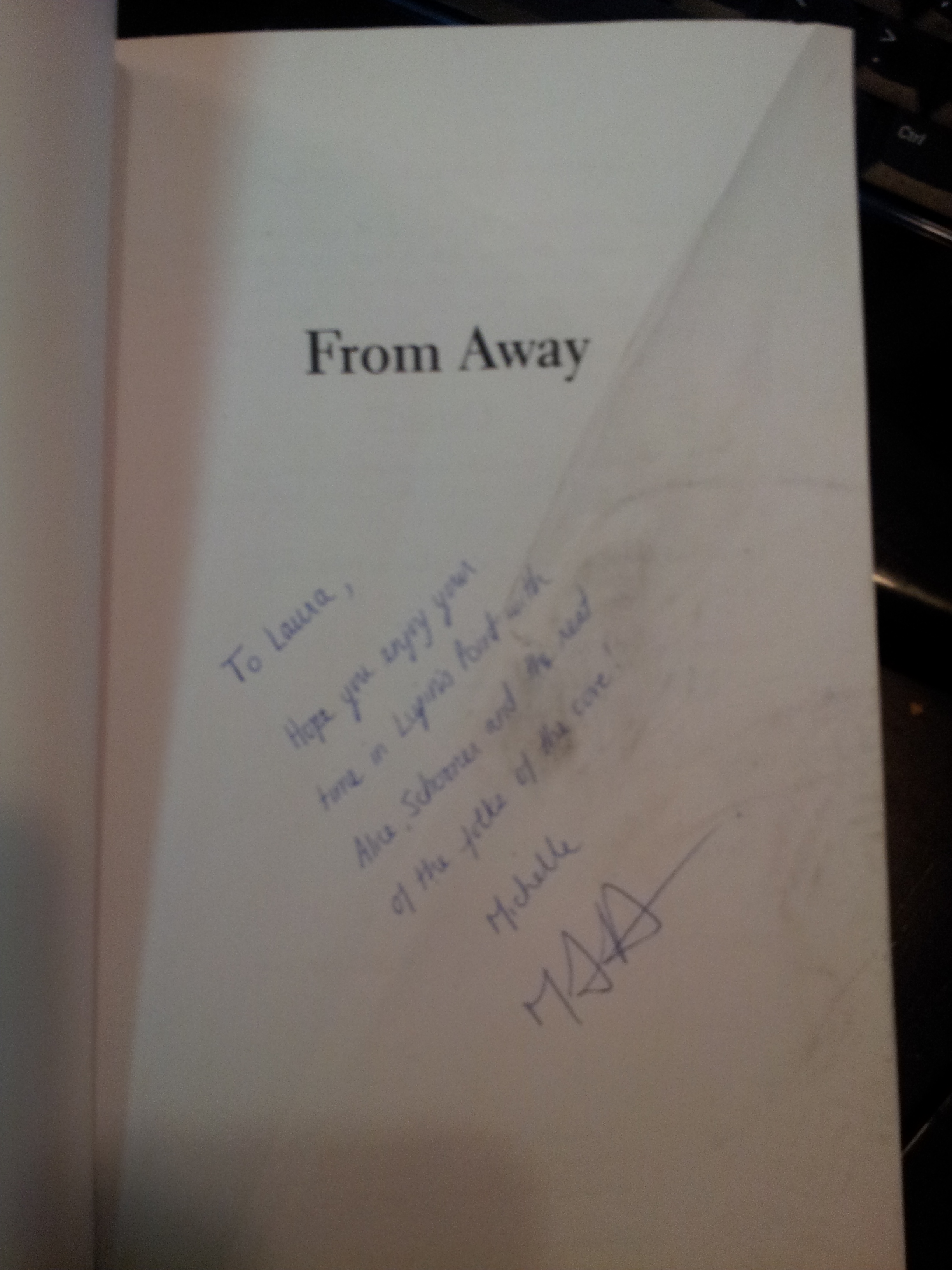
How? How did this happen? Sorry, Michelle!
A few asides:
- In other Bad Book Owner news, my mom finally returned my signed copy of From Away. Yes, that is a FOOTPRINT over the author’s note and signature. This is why I can’t have nice things.
- I love that I got to work “Sixteen” into this post, because today is my 16×2 birthday. Sixteen was quite the year for me. First job, first love, first heartbreak, first… well. MANY FIRSTS. I hope that 32 is just as auspicious and a lot less traumatic.
 Reading in Bed