A new feature in which I tell you about my book-related media consumption in a conspicuous manner.
I can’t imagine a scarier scenario than being forced to sit down and watch, listen to, or read every single thing I subscribe to: every video on my YouTube feed, every new podcast on PocketCasts, every blog post on WordPress.
Okay, scary is a but much. Excruciating? Exhausting? Can’t-even-ing?
My feeds are way out of control. While there’s plenty of incentive to “curate” media that forces you to consume everything – think scrolling through Instagram, Twitter, and Facebook- it’s all too easy to stay subscribed to stuff you don’t care about when you can just stop clicking. Eventually, though, it gets to be too much and steps must be taken.
Let’s stay positive. While I curate my feeds (i.e. unsubscribe like whoa) here’s what’s made the cut, starting with Booktube.
The must watches
Steve Donoghue: Daily videos, reads everything, fastest Booktube-drama outrage-to-redemption cycle I’ve ever witnessed (#fakereadergirls, what?) and most of all, he has so much fun with this. He’s always on the verge of a laugh. Happy one thousand subscribers!
The Poptimist: High production values, hilarious, great taste, and (extremely important to me) a soothing manner and voice. His videos are the only ones I watch twice in a row, because they are that entertaining; and so packed with goodness, I miss things the first time around.
WhatKamilReads: Great taste (in books and style) and seems so warm and humble. His book recommendations are genuine and heartfelt. His video always make me smile.
exlibris: Makes classics seem just as vital and relevant as the new releases everyone else is reading.
Virginia Woof: As the kids say, I am “here for” everything she does: book hauls, book unhauls, condom hauls… yep. CanLit and LGBTQ focused and her makeup is always “on point.” (you watch too much Booktube and you just start talking like this, sorry.)
Jason Purcell: Guess who’s back? Take everything I said above and combine it in one Booktuber and you’ve got Jason.
Honourable mentions
Amanda Centre: Delightfully off kilter. Become one of her fellow cyborgs, you won’t regret it.
Emma Tobias: The only #fakereadergirls response I deigned to watch and it was a gooder.
Brixton: A brand new channel, endorsed by Jason Purcell.
Books Beauty Ameriie: It’s just one thing that’s got me subbing… if you get that reference, you should get why I died when I realized who this Booktuber is.
If you’re reading this, you’re probably a blogger, so tell me, is Booktube a big part of your book-related media consumption? Who are your must watches?
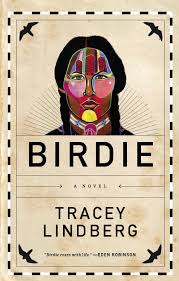
May is new release month at Writereads, your favourite-with-a-u Canadian book club podcast. I am guest hosting onceagain, which means I get to choose the book, and I’m taking liberties. Birdieby Tracey Lindberg will be nearly one year old by the time the podcast comes out, so it doesn’t really qualify as new. But we need to talk about it. Not just because it’s by a local author, or about a contemporary Indigenous woman, or because it’s brilliant, but because I don’t think it got a fair shake on Canada Reads.
Birdie was the third book to get booted off Canada Reads this year (Americans: this is our public broadcaster’s annual books game show, like a televised Tournament of Books, and we are super smug about it,) and it was frustrating to see so much left unsaid. To be fair, there’s not enough time to really get into any of the books, even with four hours of air time (though they could cut down on the trailers and title sequences and dramatic pauses.) Here are a few thing I want to talk about:
Contestants were frustrated that Birdie’s timeline is not linear. At one point, Birdie’s defender, Bruce Poon Tip, said that to want Birdie to conform to the type of narrative we’re used to, we’re “colonizing” the book. What does that mean? We didn’t get to find out.
There was little mention of humour. Birdie’s teenage obsession with The Beachcombers and The Frugal Gourmet are so absurd and so specifically Canadian. Skinny Freda’s penchant for white guys, all of whom she refers to as “Phil,” reminded me of Cher Horowitz’s “Barneys.”
A lot of time was spent on how “other” this book is. Non-linear. Stream of consciousness. Compound words and Cree poetry mixed in. Yeah, it’s different (and made the other books sounds BOR-ing) but it also reminded me of so many other books! It has the unrelenting focus on interior life of Villette, the absurdity of Malarky, the horror and hope of Push. Birdie is unique but it’s also part of a tradition of women writing about women.
So, read Birdie, subscribe to Writereads, and listen in as Kirt, Tania, and I try to cram all this in to a one-hour podcast. It should be up in mid-May.
I’ve written one self-indulgent feeeeelings post about aspects of book blogging culture this year, so forgive me for going on about one more: readathons. I didn’t write about them before because I didn’t know what to say. I don’t get them.
I know what they are. This one in particular, Dewey’s 24 Hour Readathon, involves everyone around the world reading for the same 24 hour block, documenting progress online, and cheering each other one through mini-challenges, blog-hopping, and literal (but virtual) cheerleaders.
I kind of get why readathons exist. Community building. Blog discovery. Blog motivation/mojo-getting-back incentive.
It’s the “24 hour” thing I can’t reconcile: the rules are lax, but the name kind of implies that it’s about reading as much as possible for 24 hours. Some people take this very seriously and block off parts or all of their days. Some actually stay awake for 24 hours. I just feel like, I already read as much as I can. I already fit reading in to small pockets of time and read at times when I really shouldn’t (the bathroom comes to mind) and ignore my children when I’m on a roll and stay up till my eyes cross. I’m supposed to do more? Why?
A lot of the “fun” of readathons seems to be figuring out how to avoid those pesky things that get in the way of reading time. Readathoners discuss cook-ahead meals, so as to avoid cooking on the day. Snacks are purchased and kept in arms reach. Cozy clothing is laid out. TBR stacks are arranged.
Brock of Let’s Read helped me understand the disconnect a little better with this video from a previous readathon. He’s got a couple of young kids and demonstrates how he fits reading in between feeding and playing and bedtime – things you can’t reschedule.
I can’t reschedule the things that interrupt my reading time. I can cook ahead as much as I like, but only my four year old knows what specific item of food he will demand at a to-be-determined time loosely associated with “lunch.” I could throw my kids in front of screens all day while I read, but I would rue the day (or part of the day?) come bedtime. If you’ve had to put two pent up, bug-eyed, overstimulated-with-Minecraft kids to bed, you know it’s not worth it. I could stay up till the MST end time, 6:00am Sunday, which would give me an hour or so till breakfast. And if you’ve ever spent, oh, give or take, three years of your life not sleeping through the night, you know there is nothing worth missing a night’s sleep.
Giving in my my cynical side: If I actually wanted to get rid of something that impedes my reading, it would be my phone; but then how would I document my reading/snacking progress across multiple social media channels? Also, aren’t -athons usually for charity or something?
Anyhoo, I clearly don’t understand the appeal but I’m going to try and find it. I’m officially doing Dewey’s 24 Hour Readathon! Here are the deets:
TBR
No.
The Liar by Nora Roberts: My personal challenge is to start and finish my first Nora Roberts book during the readathon. For details on why, see ebookclassics on popular books. My mom is reading along with me and she’s 125 pages in already!
The Diviners by Margaret Laurence: My current read, and I’ll switch to it if The Liar becomes tiresome.
The Wizard of Oz: Benjamin’s current read.
Stupid Ninjago book: Henry’s current obsession. You know, it’s bad enough when kid’s books are thinly-veiled marketing material, but this is literally a catalog.
Snacks and meals
Mini Eggs. Not nearly enough were consumed at Easter.
We’re going out for lunch and having frozen pizza for supper. Yep, phoning it in on the meal front.
Book-related activities
I’m taking the boys to their first comic book store in the morning. We’re going to Happy Harbor Comics downtown. I hope they have Lumberjanes in stock…
Later, I’m attending the Edmonton launch of Even This Page is White, the new poetry collection by Vivek Shraya. I got a babysitter, as I don’t think the kids are ready for their first poetry reading.
Impediments/family members
Benjamin, 6
Henry, 4
Did I mention Jason’s in the States, and I’m solo-parenting?
Jason gets home around 10pm. I may have to look up from my book, as I have’t seen him in a week.
Good luck, readathoners. I shall document my progress in all the usual spots, look for (or temporarily block) @lauratfrey.
*Imagine the title of this post sung of the tune of that part of “Writing to Reach You” by Travis in which they acknowledge their debt to an even bigger Britpop band. If you don’t know what I’m talking about, uh, brush up on your late 90s Britpop?
The opening of a new publishing house in Edmonton would be a momentous affair no matter what. Add in a literary and historical fiction focus, an intriguing debut run of five novels by Alberta authors, and the most opulent book party I’ve been to apart from the one I attended with Gwyneth Paltrow, and Stonehouse Publishing‘s launch looks like the literary event of the year thus far.
The Books
Stonehouse Publishing wants to publish “the best in Canadian fiction, but not necessarily ‘Canadiana’.” So, not this stuff (though someone really should write a novel about a troupe of French Canadian clowns.) They also plan to reissue forgotten classics, kicking off with Evelina by Fanny Burney next year. As of May 1st, you can get your hands on five books: Three historical novels, set in WWI-era Canada, Regency England, and revolutionary France; a thriller set in contemporary Ukraine (Course Correction,) and a murder mystery set in rural Alberta (Edge of Wild.) I took the three historicals home:
Mary Green by Melanie Kerr: I reviewed Kerr’s first book, Follies Past, a few years back and was pleasantly surprised by the Pride and Prejudice prequel, which stands on it’s own easily while still capturing the style of Jane Austen. I’m very excited to meet Mary Green, who is not an Austen character, but does exist in Regency England and is a neglected orphan who (presumably) must rely on her wits to cope in London society.
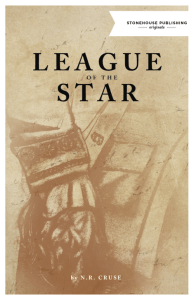
League of the Star by N.R. Cruse: Hearing the first few pages, in which a sheltered teenage girl sees a man for the first time on a ship, while escaping the French revolution, got me hooked.
Kalyna by Pam Clark: I’ve read plenty of WWI-era CanLit but never from the perspective of Ukrainian immigrants. Time to fill in a few gaps.
The Party
The majority of book parties in Edmonton take place in the basement of Audreys Books and feature coffee and cookies. To be clear, I’m not knocking that! This was just on a different level. Hosted in the beautiful Boyle Street Community League, there was a DJ, a photo booth with historical costumes, a snack bar loaded with tea and scones, and a cash bar. Authors met readers in elaborately decorated booths, and readings took place in a comfy armchair in the middle of it all.
I saw and was seen, particularly by Matthew Stepanic of Glass Buffalo and Claire Kelly of NeWest Press. I also met author Melanie Kerr in person for the first time, after corresponding by email on and off for years. She is a delight, and her blog, though not updated so often these days, has some gold in the archives, including this post, if you’re a “begs the question” stickler like me.
It all went off beautifully. The only oddity was that author N.R. Cruse, who was apparently in the crowd, never sat at her booth, signed any books, or read a passage from her novel (her editor read for her.) Cruse is known to be reclusive and claims to be a direct descendant of Daniel Dafoe. I think of her as Alberta’s answer to Elena Ferrente.
Q&A with publisher Netta Johnson
Editor Julie Yerex and Publisher Netta Johnson were much too busy to chat the night of, so I asked some questions by email.
Reading in Bed: I recently read an article about how historical fiction is seen as less prestigious than contemporary literary fiction. This has always confused me. When I see a book classified as “historical fiction” and it’s clearly got tons of literary merit (e.g. Wolf Hall) I wonder why the setting makes it a whole different genre. Do you think historical fiction is seen as less prestigious than contemporary, and did this influence how you chose your focus for Stonehouse, your first run of books, how you market them, and so on?
Netta Johnson: I thought this question was very interesting, and it serves to highlight how much things change, and yet stay the same. Lately, I have been reading the whole set of novels by Dumas. I had tried to read the Three Musketeers many years ago, but somehow couldn’t get properly interested. Without knowing it, I started to read the 3rd in the series, The Vicomte to Bragelonne and was pretty captivated by the portrayal of the Musketeers at age 50; the characters were so much more interesting in their middle-age. Reading the introductions to these books, I was struck to discover that these challenging and intricate novels (my words) were considered rather fluffy and insubstantial at the time of their publication, and often dismissed as ‘romances’. Perhaps popularity is the heart of the problem, and then and now, it is hard for reviewers to take books seriously when they are popular? Or maybe it is hard to separate the literary historical fiction from the genre historical fiction sold in grocery stories?
RIB: I’m super excited about your plans to publish forgotten classics. Can you tell me how you came to choose Evelina by Fanny Burney for your first book? (By the way, I’m going to host a Fanny Burney readalong this year. I’m thinking Cecilia. I’ve never read her but I’m noticing she’s trending a bit. I first heard about her on RonLit’s YouTube channel.)
NJ: I found Fanny Burney about 18 years ago, via Jane Austen. I began reading Evelina with the expectation that it would be dry and educational, and soon found myself laughing through much of the book. Cecilia is twice the size, and much more serious. It has a very personal appeal to me, so I am never sure if that will translate to others. Julie and I sometimes joke that she is Kanye and I am Jay-Z (thank you, Buzzfeed quizzes!), and in terms of 18th century heroines/books, she is Evelina and I am Cecilia.Evelina is so much more approachable, lighthearted, and when it was first released (anonymously), it spread like wildfire. Cecilia is a longer, darker novel, and it had some pretty famous intellectual admirers (Dr. Johnson, Edmund Burke, Hester Thrale, Napoleon). In Cecilia, FB takes a pretty sharp look at a number of social issues/problems of that time. Cecilia introduces you to misers, superficial friends, gamblers, social climbers, struggling tradesmen (and the poor in general), while showing the social problems with dueling (unavoidable, but the main two consequences were either death or jail, whether you won or lost), and the aimlessness of the aristocratic class. As an underage woman and an heiress, Cecilia is at the mercy of various different people, and as she waits the last few months till she comes of age and inherits her money, she is prey to every kind of snare. There is even a public suicide! Another amazing thing about this book is that we don’t even meet the hero for 120 odd pages. For any time, it is rather unconventional.
RIB: As publishers, are you in tune with all the bookish new media out there: blogs, Booktube, Bookstagram, and so on? Any favourites? How about Snapchat?
NJ: We have to look some of these up! Right now, we think we have a handle on Facebook, Twitter and just staring with Instagram. I didn’t even know the other ones existed!
Note: they’re humble, but their hashtag game was on point: if you missed the big launch, check out #Stoholaunch on Twitter and Instagram.
The first six of the year were a bit of a bust. The Vegetarian blew me away at first, but hasn’t stuck with me. Since then, I’ve read two phenomenal books, which you will hear more about soon: Birdie by Tracey Lindberg and Cat’s Eye by Margaret Atwood.
Welcome to the second year of A Day in the Life, hosted by Trish of Love, Laughter and a Touch of Insanity. At first glance, this is not my type of blog event. What do I care what people do with their days? Yet, somehow, I do care. I guess it’s true that how we spend our days is how we spend our lives, which is not a quote from Days of Our Lives, it’s from a serious book (The Writing Life by Annie Dillard.) I participated on a whim last year, and read every single post linked up – more than fifty. This year, seventy two bloggers have already linked up, so I’ve got some reading to do.
My day in the life was not a standard one at all; I was on vacation, the kids were in school, and my sister arrived from Minneapolis.To mix things up, I documented my day with Snapchat*. I kind of messed up, though. Instead of saving all the individual snaps I did that day, I saved my story as a video. So take a little look see, or read on for the text version.
Wednesday, March 23 2016
6:07 am: Wake up for the day. This is a sleep-in, I’m usually up for the day by 5:30. Leisurely breakfast (green smoothie), get ready, catch up on social media.
6:57 am: Wake Benjamin up, give him breakfast (dry Cinnamon Toast Crunch)
7:00 am: “Wake” Henry up, as in, dress him and brush his teeth while he sleeps
7:24 am: Make school lunch with disgusting soy-based “peanut” butter
7:43 am: Henry still sleeping, Benjamin is ready to go
7:48 am: Benjamin dropped off at school. Benefit of living across the street is that I can go from “one child still asleep” to “at school” in five minutes.
7:53 am: Henry eats breakfast (Cheerios, he must pour his own milk, and the milk must fill the bowl)
8:20 am: Henry dropped off at daycare. FREEDOM… to do errands. Also, snow.
8:45 am: Errand number one: get car washed at fancy car wash. This is a once-per-year treat. This year I let them upsell me on the vinyl package. It’s so shiny! I read a devastating chapter of Cat’s Eye while I wait.
9:27 am: Errand number two: I am the Easter Bunny. I love London Drugs. I contemplated buying a copy of Birdie by Tracey Lindberg (I got it from the library,) not knowing it had been kicked off Canada Reads just a half hour earlier. Rude!
10:03 am: Errand number three: groceries. First time in Oliver Square Safeway since they renovated; it’s pretty uppity now. I’m also pretty sick of Jamie Oliver’s smug grin everywhere I look.
10:38 am: Pit stop: I pay almost ten bucks for a cup of tea and toast with peanut butter and jam in a fancy cafe (Cafe Blackbird) because I’m on vacation, damn it.
10:58 am: Errand number four: stock up on bras at My Filosophy. When you find the one, you just know. And you go back to buy it in multiple colours. I also tried on some clothes (vacation!)
11:29 am: Pick up Benjamin at school. I could pick up Henry at this time too, but, decide to have some one-on-one time.
12:03 pm: Lunch at Delux. Benjamin enjoys watching soccer highlights on the big screen (“why do they take their shirts off when they’re happy? Do girl soccer players take their shirts off?”) and free cotton candy.
1:21 pm: Emails and stuff while Benjamin watches some bizarre BBC Kids program.
2:45 pm: Screen time continues; blog for me, TV for him.
3:00 pm: Hide and seek. Neither of us are very good.
3:15 pm: Pick up Henry at daycare.
3:44 pm: Head to the park. Drama ensues when they don’t want to play the same game, and Benjamin finds a friend to play with and Henry doesn’t, and I end up carrying Henry home crying. Henry weights almost 50 lbs, so this counts as cardio.
4:30 pm: Read the boys a Star Wars book they bought at yesterday’s book fair.
5:00 pm: Jason arrives home with 24 beers in preparation for my family visiting this weekend. Not clear if the beer is for them, or him. I start making supper – trying a new recipe from Simply Nigella (out from the library and I’ll likely purchase; I’ve now made five recipes and they’re all great! Tonight I made Cauliflower & Cashew Curry.)
5:41 pm: All three boys refuse to eat the DELICIOUS curry. Jason barbecues hot dogs.
6:30 pm: Boys are back on screens after supper. I spend some… alone time with Jason. Five minutes later, Henry needs his butt wiped. So much for romance. No snaps of either of these events.
7:16 pm: Board game with Benjamin. Sequence Letters is great for letter recognition.
7:43 pm: Snack time. The boys made me buy a dragon fruit yesterday, so today I make them try it. I end up eating most of it. Very mild. Then we hang out and read/ have screen time for a bit.
8:15 pm: Jason puts Benjamin to bed. Benjamin goes down easy (always does.) I begin the nightly rigmarole with Henry, which includes stories, additional snacks, bathroom trips, stuffies, back rubs, and sometimes, all-out tantrums.
9:05 pm: Henry demands warm milk.
10:19 pm: Almost done. We’re in the “lying in bed beside him in a dark room, breathing steadily, trying to fake sleep/not really fall asleep” phase.
10:38 pm: He’s down. FREEDOM! (i.e. wasting time online)
11:30 pm: My mom drops my sister off at my house. She’s just picked her up from the airport; she is visiting for a couple days over Easter. Oh yeah, I bought a signed copy of Freedom and had it shipped to her house in Minnesota to avoid international shipping, and she’s brought it with her. Eeek! We stay up yakking for an hour.
12:30 am: To bed, more wasting time on my phone.
1:00 am: To sleep.
*It’s totally cool and normal for a 35 year old to be on Snapchat. Here are some tips for elder Snapchatters I found. Follow me, I’m lauratfrey!
I’ve hinted about my super-duper, super-long review of The Wake for months. And it did take months to write. It also took some particular experiences, pieces of advice, and pep talks. I want to give a few shout outs, and a little preview, as it’s definitely in TL;DR territory. I’m proud, but also nervous. I wrote about The Wake, a novel about the Norman Invasion in 11th century England,in the context of Reconciliation in Canada.
It is controversial to suggest we need yet another account of colonization from the English point of view, but The Wake is an important novel in much the same way as Joseph Boyden’s The Orenda. The Orenda is one of Canadian literature’s first balanced accounts of first contact between Indigenous peoples and Europeans, including French and Indigenous points of view, and importantly, multiple Indigenous points of view (it is quite common that Indigenous peoples and their perspectives are presented as a monolith, despite the plural “peoples.”) The Orenda won the 2014 Canada Reads competition, and has been recommended as required reading for all Canadians.
The Wake should also be required reading for Canadians, not for its balanced perspective, and only partially for the old “those who don’t know, doomed to repeat” reasons, but mostly because learning that the Norman invasion was itself a colonization and that English people are no more a monolith than Indigenous peoples are and that the way we label people “Anglo-Saxon” is almost as misguided as the way we used to label Indigenous peoples “Indians” is very much in the spirit of reconciliation. The Truth and Reconciliation Commission’s mandate states that “The truth of our common experiences will help set our spirits free and pave the way to reconciliation.” The Wake addresses the themes of common experience, colonization, violence, and even cultural genocide.
Thanks to the people who helped me write this:
Jennifer Quist for encouragement and suggesting I get in touch with The Rusty Toque
Jane and Miranda for organizing a “Read the TRC” group, which I wrote about here
Wab Kinew and Ray Saddleback Jr., who spoke at a City of Edmonton employee event last year, where I first heard the phrase “renegade tribe” which made me think of England’s “greenmen” and inspired the direction this review took
Carolyn of Rosemary and Reading Glasses for her review, which informed mine
My sister Cait for proofreading and advice
If you make it through this monster review, please let me know what you think.
I love that our library will use any school break as an excuse to put on a bunch of free programs for kids – or, more than they usually do, because they always have free programs for kids. Spring break is next week, and those in the Edmonton area should go to the website or check out the program guide, and read on for my picks.
I have a contentious relationship with kiddie events and programs. Working parents of younger-than-school-age children probably know where I’m going with this: the vast majority of programs for preschool age kids, with the notable exception of swimming lessons, are offered on weekday mornings or afternoons. That means you don’t get to do mommy-and-me yoga, and your child doesn’t get as many opportunities to learn with you outside the house.
Kim Bates, a Digital Literacy Librarian at Edmonton Public Library, has heard the same complaint from parents. “We have had customers request more evening and weekend programming and as a result we have been scheduling more of our programs at those times with the working parents in mind.”
May I just say thank you? Here are a few spring break highlights that’ll work for you if you work nine to five (or 8:15-4:45, in my case.)
One Book, One Break, Many Adventures! Lumberjanes Vol. 1
I loved last year’s One Book One Edmonton project so much that I wrote about it twice. One Book One Break is a child-friendly take on the concept: make a book available to everyone in Edmonton, and give them chances to talk about it and win prizes.
There’s been so much buzz about comic book Lumberjanes on book blogs and Booktube that I wasn’t sure if it was for kids. Kim says Lumberjanes appeals to a “wide demographic” but cautions that “some preschoolers have found the creatures in the book a bit scary.” My four year old cannot abide Goosebumps reruns, so I’m going to take Kim’s advice and check it out myself before I share it with him. It sounds like it’ll be perfect for my six year old.
Everyone in Edmonton can download a copy of Lumberjanes on Hoopla, and the library is ordering extra physical copies. Each day during Spring Break, libraries will have a new activity sheet that doubles as an entry to prizes which include an iPad Mini 4 and an autographed edition of Lumberjanes to the Max Edition Volume 1. Details at epl.ca/onebookonebreak.
Working parent friendly dates: this one’s on your own time, and many branches are open till 9pm weeknights, so there’s plenty of time to get your entries in.
Minecraft Madness
Minecraft at the library is nothing new, but given the popularity (bordering on obsession in my house), three branches will set aside a Minecraft-dedicated computer for the whole week of Spring Break. I asked Kim if kids get as crazy as mine do when they’re playing Minecraft at the library, and she said that while there generally aren’t fights over the computers, “kids do often like to talk to each other as they play so I do expect plenty of strategizing and cheering!” My kids could use this good example. Oh, the horror of being a one-iPad household!
Working parent friendly dates: Drop in during opening hours at Stanley A. Milner, Woodcroft or Sprucewood branches.
Lego at the Library
Awesome. (via hollywoodreporter.com)
Lego without risk of stepping on a rogue brick at 6:00 am? Sign me up. For kids 6-12.
Working parent friendly dates:
Saturday March 26, 2:00 pm at Capilano
Saturday April 2, 3:00 pm at Meadows
Saturday April 2, 3:00 pm at Woodcroft
Minion Movie Marathon
The downtown library is showing all three Minion movies (does anyone even call them Despicable Me?) over Spring Break. Yeah, you might own them at home, but sometimes a change of venue works wonders. All ages.
Working parent friendly dates: Saturday April 2, 2:00 pm (The Minion Movie) at Stanley A. Milner
Puppet Adventures
Great for younger kids, as long as they can sit still for more than a minute at a time. Look, we’ve all been that parent dragging their kids out of a library program, there’s no shame. All ages.
Working parent friendly dates:
Saturday April 2, 2:00 pm at Calder
Saturday April 2, 2:00 pm and Sunday April 3, 2:00 pm at Castle Downs
Sunday April 3, 2:00 pm at Clareview
Saturday March 26, 1:30 pm and 3:00 pm at Lois Hole
Saturday March 26, 2:00 pm at Stanley A. Milner
Saturday April 2, 2:00 pm and 3:00 pm at Whitemud Crossing
Bonus (and shameless self-promotion; I work for the city and helped develop this): If you’re looking for more kids’ programming in Edmonton, check out myrecguide.ca and create a custom guide to City of Edmonton registered programs – swimming lessons, daycamps, arts, yoga, kickboxing, and much more. You only see the ages, interests, and locations that work for you. And, there are more and more options for us working parents on evening and weekends. We’re working on it!
This post was inspired by, but not paid for by, Edmonton Public Library. I mean… they’re a library. What did you expect? They do lend me free books though.
I haven’t watched this many movies since before I had kids, when Netflix & Chill was still Blockbuster & Chill* and it’s all thanks to ebookclassics’ Book to Movie Challenge 2016. It’s comforting and nostalgic to go shopping at HMV, to buy movie snacks, to wait till everyone’s gone to bed and curl up with blankets on the couch by myself and watch a movie. Here are my first three adaptations of the year. I also saw The Revenant in theater, but I haven’t read the book, so I’ll spare you the Leo gifs.
Emma (1996)
The book: I read Emma for the 200th anniversary in late 2015, and for the second time that year, I started a “reread” to find I’d never read the original at all. It was a delightful, cozy read, though nowhere near my favourite Austen; the stakes are simply too low. Emma doesn’t care about getting married until the very end (uh, spoiler) so her marriage plot is kind of boring. I would love to revisit Emma and Knightly a few years into their marriage and co-habitation with finicky Mr. Woodhouse. I got the feeling Knightly didn’t think about what he was agreeing to. My reading experience was heightened by two blog events: Dolce Bellezza’s Read Along and Sarah Emsley’s Emma in the Snow, which is still going strong, and features guest posts by experts about food, urban planning, and why Mr. Knightley is not a super creep, to name just a few.
The movie: It’s a very literal interpretation of the book. It was boring, but pleasantly so, just like the book. I’m pretty sure they added the archery scene with Emma and Mr. Knightly just to get the shot of Emma aiming her bow and arrow for the poster. Apart from that, there are no real surprises or innovations.
The casting: I don’t mind when an actor doesn’t look the way I imagined, but I am a stickler for ages. Emma is twenty years old, and Gwyneth Paltrow (who I love, but can only think of as Goopy Paltrow thanks to dlisted) was 24 when the movie came out. Harriet is seventeen and Toni Collette was 24 as well. I don’t know if we are told Frank Churchill’s age, but certainly he should be older than Emma. Ewan McGregor is older than Goopy, but just barely. Everyone looked too old to my eyes. I read Emma as a teenage story, though that might just be me comparing the text to Clueless.
Anna Karenina (2012)
The book: I read AK many years ago. I have an Oprah’s Book Club edition, because before blogging, I didn’t know that was gross. I don’t remember a lot about it, so it didn’t make a huge impression.
The movie: I loved it. The costumes, the music, the stage/backstage framing, Keira, and Matthew Mcfayden especially. It didn’t matter how faithful it was to the book (not that I’d remember) because it clearly wasn’t meant to be. My only gripe is that they didn’t make this movie years ago, when Jude Law could’ve played hot Vronksy instead of the crotchety husband. I mean:
The casting: see gripe above re. Vronsky casting. As for Anna, she is 28 in the book, and Keira was 27 when it came out. Vronsky’s age felt right; Aaron Taylor-Johnson is five years younger than Keira. Mr. Karenin is supposed to be about twenty years older than Anna, and Jude Law is only about thirteen years older than Keira, but their age difference felt okay. My favourite actor was Matthew Mcfayden as the patriarch of the first unhappy family we meet. I liked him here just as much as in P&P.
In Her Shoes (2005)
The book: Read last month for Franzen in February, In Her Shoes is my third Weiner novel and middling among books that are themselves pretty middling. It wasn’t as good as Good in Bed, but it was better than super-boring Fly Away Home (though FAH will always have a place in my heart for allowing me to write this.) IHS starts with a tired premise (one sister is a frumpy harpy, the other is a good-time girl, will they ever learn to accept one another) but Weiner takes a few risks and explores some interesting territory with respect to class and consent in the beginning. It never really goes anywhere though. After a bizarre middle section in which the messed-up sister grifts her way through a Princeton dorm, and the serious sister quits practicing law in favour of dog walking, which has no impact on her yuppie lifestyle, everyone ends up exactly where you knew they would.
The movie: Apart from some questionable casting (see below), the movie is much tighter than the book, doing away with the middle section, but still giving us Maggie’s redemption through literature. I don’t know what it says about me that I preferred Maggie to learn to love literature from an old man than to learn it herself. Apparently Weiner was inspired by Push by Sapphire (also a movie, Precious) which is just… look, that’s going to be a WHOLE other blog post. Let’s just say that I will never forget reading Push and I have already forgotten a lot of In Her Shoes.
The casting: Age is not an issue this time, but Rose (Toni Collette) is supposed to be overweight, and this is played up in a couple of important scenes. In one of these, Maggie (Cameron Diaz) calls Rose a “fat pig” to which Rose scoffs “that’s the best you can do? You’re my sister,” just before their estrangement. In the movie, it’s a bizarre moment, because Rose is not fat. Both actresses still manage to rock this scene. The male leads were quite a bit more attractive then they seemed to be in the book, and, strangely, the sassy black friend becomes a cynical white friend.
Spot the “fat sister”
*My most memorable Blockbuster & Chill was Reservoir Dogs, on my second date with a guy I met online. Reader, I married him.
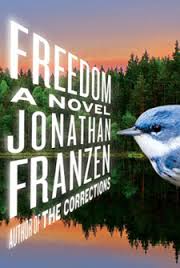
The second in a series in which I convince hapless readers to take on the Fran Man, today’s First Franzen is courtesy of my sister Caitlin Higgins. Caitlin is a sometime-vegan Canadian ex-pat living in St. Paul, Minnesota and previously shared a tour of Freedom’s notable settings. Check her out on Twitter or on her blog, The Angry Vegan, now defunct, but worth reading the archives.
So many feelings happened as I read this book, but surprisingly, when I finished I didn’t know how to share my opinion. I didn’t love Freedom; I didn’t hate it. There were points where I felt both of these feelings as I read, but I walked away thinking, “Really??? That’s it??”.
I started out selfishly thinking it was going to be a great book, because it was set in St. Paul, MN and I moved to St. Paul just a few months before. I love reading books set in places I have been. I really like recognizing streets and landmarks (I found out later that Barrier Street does not really exist… was it supposed to be symbolic?). There is something about walking in the same place a book is set that gives you an instant connection.
There is so much flipping around in this book from one character’s story to the next, making it a tricky read. Most of my reading is done in 20 minute spurts at the gym with long breaks in between, and I was constantly forgetting where I was in the story. I can’t blame Franzen for that one though. Now that I have a hard copy, I can see, this is no gym read!
The story is told in a mix of Patty narrating her own life and marriage, and a variety of characters in Patty’s world narrating: husband- Walter, son- Joey, BFF/Lover- Richard, and a little bit from daughter Jessica. Franzen is great at giving these characters depth. I truly felt I understood the character under the spotlight and then as the story went on, I would change my opinion as I learned more and more. However, as I continued to read, it was clear he is only good at that for his male characters. I went through so many emotions about Walter. First, I liked him, and even compared him to my husband. Then, I hated him. He seems so spineless. (No longer comparing to the husband!). I was either shaking a fist at him or rooting for him to do the right thing.
Patty, on the other hand, seemed to be a victim, never having control, never truly making decisions, and never having her own true plot, even when she should have. Looking back, this happened with Jessica’s character as well, and Joey’s girlfriend. Really, there was not one female character in Freedom that had the depth of the male characters. It made me really dislike this book. Everything centralizes around Patty, so how could she not be more than some helpless lump!?! Shame on you, Franzen! Is that how he sees women? Maybe, maybe not, but I walk away thinking he is a sexist jerk.
Putting my thoughts on Franzen and female characters aside, I really got into the book. I was forever rooting for someone to do something (anything!!). In the end, after everything that everyone had been through, Patty goes back to Walter and Walter takes her (Of course, after some passive aggressive punishment). Why would she go back!? WHY does he take her back?! I hated the ending so much I almost threw my Kindle across the gym. The end left me wondering why I had wasted the last few weeks reading this well-written, anger-inducing, yet somehow dull story. I wanted the book to get outside boring and normal life in some way. I wanted Patty to be OK, and all I was left with is Patty right back where she started. To me, Franzen took the easy way out.
So what do I think about Freedom? I guess it is OK (I am rolling my eyes as I type). It clearly evoked emotion, which in my case can be tough to do. I would rather spend a month reading a novel that allows me to escape from the dreary reality I live in (OK, not always dreary, but not all that exciting either). This did not do that. Despite the lack of female character depth, I did think that the book was so well written, that I’d give Franzen one more chance… even though I have a feeling I will be angry again if I do. Maybe I am a glutton for punishment.
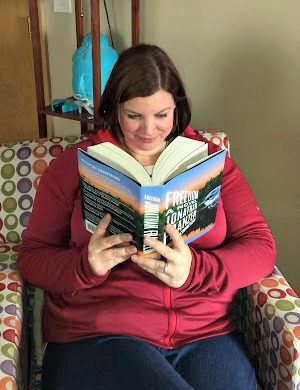
Caitlin, seething with anger, reads Freedom
Alright, well, I’m zero for two. I need to convince someone to read The Corrections. Everyone loves The Corrections!





 Welcome to the second year of
 …and my very first professional book review! After five years of writing about books here at Reading in Bed, I’m so proud to
 Minecraft at the library is nothing new, but given the popularity (bordering on obsession in my house), three branches will set aside a Minecraft-dedicated computer for the whole week of Spring Break. I asked Kim if kids get as crazy as mine do when they’re playing Minecraft at the library, and she said that while there generally aren’t fights over the computers, “kids do often like to talk to each other as they play so I do expect plenty of strategizing and cheering!” My kids could use this good example. Oh, the horror of being a one-iPad household!



 Reading in Bed