How to read the 2025 International Booker longlist in Canada
Like last year, the 2025 International Booker Prize longlist is out of left field. Former winners, who I thought were a lock, were shut out (Han Kang, Olga Tokarczuk, László Krasznahorkai) and some of these translations were published in North America before the UK, which is unusual. But the most surprising thing about this longlist is that every author is an IBP first-timer. Past longlisters like Yoko Ogawa were shut out too. 

I have to think this was on purpose, and I’m not sure how I feel about it. Does Han Kang need this, months after winning the Nobel? Surely not. Is each of these 13 books better than her latest, We Do Not Part, which I read because I was so certain it would be longlisted? Highly unlikely.  

2025’s longlist is diverse, representing ten original languages and eleven nationalities. There are a couple of short story collections, several novellas (the shortest of which is practically a short story itself at 112 pages,) and one near-700 page chunkster. The list is skewed towards women (9 of 13) and boomers (6 of 13), and trends a bit older in general. There is no Gen Z representation at all, and the millennials are of the elder variety.

Find these stats and everything you need to know about obtaining these books in Canada in the updated “How to read the IBP in Canada” spreadsheet, or if you’re in a hurry, you can refer to the plain-text longlist below.

The longlist is fairly accessible in Canada. By the end of March, all the books will be available from Blackwell’s for the bargain price of $337.23 CAD. If you prefer to spend your money locally (elbows up and all that) most of them will be available through Canadian retailers too, with the exception of Small Boat and There’s A Monster Behind the Door. I’m just disappointed that my library system has none of these in ebook format. If Kobo thinks I’m going to spend $25.99 on a 192-page ebook (Eurotrash), they’ve got another thing coming. 

I don’t quite know what to make of the longlist, but I’ve already read one (On the Calculation of Volume I, the first in a septology, but not the first partial septology to be longlisted!) and have another seven on the way, either from Blackwells, Magpie Books, or the library. In the meantime, the IBP Shadow Panel has created a Substack to round up their reviews. They are without their usual leader, Tony from Tony’s Reading List – he’s still blogging though, so if you want to see what’s going on in translated lit outside of this list, he’s your guy.

If you want to know my thoughts, well, let’s see if I can crank out a few reviews. First challenge: say something about On the Calculation of Volume, a story about a woman who wakes up to the same day over and over again, without mentioning Groundhog Day. 

  • The Book of Disappearance by Ibtisam Azem, translated from the Arabic by Sinan Antoon
  • On the Calculation of Volume I by Solvej Balle, translated from the Danish by Barbara J. Haveland
  • There’s a Monster Behind the Door by Gaëlle Bélem, translated from the French by Karen Fleetwood and Laëtitia Saint-Loubert
  • Solenoid by Mircea Cărtărescu, translated from the Romanian by Sean Cotter
  • Reservoir Bitches by Dahlia de la Cerda, translated from the Spanish by Heather Cleary and Julia Sanches
  • Small Boat by Vincent Delecroix, translated from the French by Helen Stevenson
  • Hunchback by Saou Ichikawa, translated from the Japanese by Polly Barton
  • Under the Eye of the Big Bird by Under the Eye of the Big Bird, translated from the Japanese by Asa Yoneda
  • Eurotrash by Christian Kracht, translated from the German by Daniel Bowles
  • Perfection by Vincenzo Latronico, translated from the Italian by Sophie Hughes
  • Heart Lamp by Banu Mushtaq, translated from the Kannada by Deepa Bhasthi
  • On a Woman’s Madness by Astrid Roemer, translated from the Dutch by Lucy Scott
  • A Leopard-Skin Hat by Anne Serre, translated from the French by Mark Hutchinson

The Unworthy by Agustina Bazterrica, translated by Sarah Moses

There’s a TikTok trend (which will probably be over by the time you read this) which is meant to look like a first-person horror video game with captions like “POV: YOU WAKE UP DURING THE BLACK PLAGUE (1351)” and “POV you wake up as a worker in Titanic in 1912”. There are milder and sillier examples, but most have a scary, historical vibe. This is one of the few instances of “POV” being used correctly on the app, rather than used as a lazy setup for a punchline.

First-person perspective is much more common in literature, and while you can’t really do it “wrong,” you can do it badly. Brandon Taylor wrote a scathing essay about this. His beef is more broad and nuanced than mine. My bar is pretty low: if I’m reading a story told in first-person narration, I just need to understand WHY I am reading it. Like, is this character talking to me? How? Are they writing the story down? Why? When? Are they telling the story to another character? Reminiscing to themselves? It usually boils down to “WHO ARE YOU TALKING TO”?

So I’ll give The Unworthy this: we know who the unnamed first person narrator is talking to, and how, and why. She is writing in a diary. And not just any diary: a forbidden diary made of foraged materials that must be hidden every night. A diary she writes to and for herself, to “remember who [she] was,” but later imagines someone (us, I guess) might find and read.

However. The first-person point of view in The Unworthy is very limiting. Taylor notes that many such narrators are “lacking both explanatory power and the impulse toward explication itself.” This is a problem in any kind of fiction, but in speculative fiction, it’s particularly frustrating. Bazterrica has to build two worlds simultaneously: the outside world, afflicted by plague and climate disaster and war; and the cloistered world of the House of the Sacred Sisterhood, in which our narrator has found refuge. The reader needs a sense of why anyone would stick around, eating crickets and being tortured, and why the rank and file of this House, the titular Unworthy, want so badly to be elevated to the ranks of the Chosen.

The narrator’s diary has to keep the reader apprised of the present-day plot inside the House, and the backstory of how society collapsed. But our narrator is not really a main player in either. She is an observer. She relays the goings-on in the House, where young women are segregated into castes and tortured by a sexually sadistic Superior Sister and a mysterious man known only has “Him,” while through her memories, we find out what it was like to survive the collapse of society, but never get an idea of what exactly happened, or how fast, or when. And I never got a sense of how any of it felt, for the narrator or anyone else.

There are some interesting elements here. The writing is repetitive, but in a good way: it’s incantatory and reminiscent of chanting, which sets the right culty mood. I love the way He constantly warns the women against worshipping “the erroneous God, the false son, the negative mother,” (though as a lapsed Catholic, it sounds a little strange to talk about a mother rather than a holy spirit) and I love the House’s unofficial motto, “without faith, there is no refuge”. 

I question the narrator’s need to transcribe that motto quite so many times though. The Unworthy leans a little too hard into the diary thing, the narrator constantly stopping mid-sentence when she’s scared of being caught, and crossing out dangerous thoughts. But it also commits the cardinal sin of epistolary novels: including shit a real person would never bother to write down. We’re almost in “Castle AUGHHHH” territory. You’d think if you were writing in ink made from scrounged materials, and sometimes your own BLOOD, you would simply not write the same words over and over again. Or, say, keep those super-subversive thoughts in your head rather than writing them down just to cross them out. At the very least, not include quite so many parenthetical asides.

Speaking of blood, given this author’s reputation for gross-out writing (her previous novel featured cannibalism), I was expecting a lot more from the violent scenes. The various castes within the monastery are disfigured to denote their status (eyes sewn shut, eardrums perforated, tongue cut out, etc.) and the Superior Sister loves a good torture sesh for anyone who gets out of line. But because nothing bad happens to our narrator -no one sews her eyes shut or sticks a needle in her nipple or whips her or hangs her (I’m leaving out the one actually kind of cool/disgusting punishment, but even it is glossed over) – we are kept at a remove. We can only access the shocking stuff through her perspective, mediated by a diary. 

Leaving aside the diary conceit and perspective, The Unworthy also suffers because none of this is new, and many have done it better. I recently read Arboreality by Rebecca Campbell, a scary-realistic account of climate change-driven societal collapse and recovery that offers real insight into a possible future. If you’re looking for violence, degradation, lesbian panic, and religious trauma, you can go all the way back to the 18th century and read The Nun by Denis Diderot or The Monk by Matthew Lewis. I promise you, there are scenes in both that will disturb you more than anything this sacred sisterhood gets up to. If you’re looking for a book about cloistered young women trying to stay safe in an uncertain world, who experience mystical shit and bully each other, try Abigail by Magda Szabó. Each of these books make the best of their genres (speculative fiction, gothic x2, and YA, respectively) and are original and insightful. The Unworthy falls right into the pitfalls of its genres (YA, dystopian) and its first-person, epistolary perspective.

Brandon Taylor likens the glut of first person novels to reality TV, calling them “casting tape fiction.” The Unworthy is even worse: it’s TikTok fiction. “POV: You Wake up in a Weird BDSM Cult after Surviving Climate Disaster.” If I wanted that, I’d go to my for you page.

Best Books of 2024

Unlike my worst books of the year, I don’t see coherent themes in this list, nor is there a clear standout. None of these are perfect; they all annoyed me, just a little, in some way. In whittling the list down to ten, I tried to keep only the books where the annoyance is more about me than the book. In the order I read them:

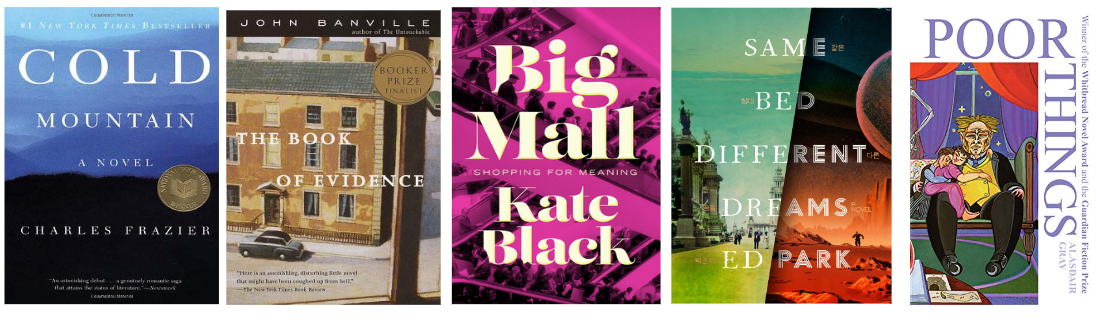
  • Cold Mountain by Charles Frazier. They don’t write them like this anymore. Sprawling historical love story based on The Odyssey. Bonus: gave us a great movie adaptation starring Jude Law at peak hotness.
  • The Book of Evidence by John Banville. This actually could be a standout. Pitch perfect, creepy as hell, and based on a true story, but this book does so much more than recount or sensationalize. 
  • Big Mall by Kate Black. If you want to read about the intersection between resource extraction, colonialism, animal cruelty, violence, tourism, architecture, and your local shopping mall, this is probably your best (and only) bet. My review and interview here.
  • Same Bed Different Dreams by Ed Park. This reminded me of Infinite Jest (complimentary) not only in content – sports, alternate history, Canadian subplot that I didn’t see coming- but in how it blew my fucking mind.
  • Poor Things by Alasdair Gray. Yes, it was a book first. Yes, the book is “better,” in that, there’s more there, and more of Bella Baxter in particular. 
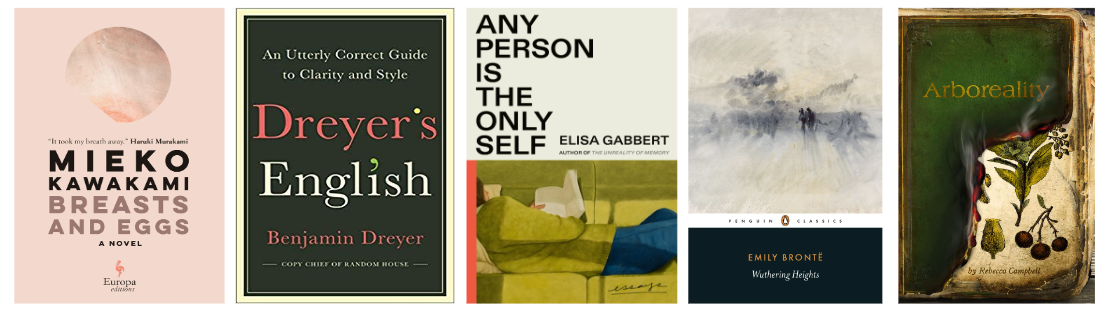
  • Breasts and Eggs by Mieko Kawakami, tr. Sam Bett and David Boyd. I stayed away from this one for too long because I had the impression that it was one of those very on-the-nose feminist “message” novels, but it’s not. It’s brilliant.
  • Dreyer’s English by Benjamin Dreyer. A rare case of an author’s social media presence selling me on a book. He vindicated my pickiness about Oxford commas and insistence on the proper use of “begs the question.” It’s the perfect book to read while falling asleep (complimentary.)
  • Any Person is the Only Self by Elisa Gabbert. This is what I was looking for in the handful of millennial woman writer/critic essay collections I read this year. Humour, literary criticism, and, notably lacking in the others I read this year, humility.
  • Wuthering Heights by Emily Bronte. If I reread WH in a given year, it will appear on my best books list. 
  • Arboreality by Rebecca Campbell. A near-future climate disaster novel in which things start going downhill rapidly in 2025 might be a bit much right now, so I’m glad I read it in 2024.

I don’t need to ask for your best books, we’re all posting them. Keep them coming!

Bad Land by Corinna Chong

I don’t love the mountains, which is a controversial thing to say here in Alberta. Everyone goes to the mountains, and feels at peace, at home, in awe, or whatever. Many “leave their heart” there. Maybe it’s because I grew up in Vancouver, where it was normal to see mountains (and an ocean) but I need a little more than a large rock formation to get me speaking in clichés.

I’m also not easily impressed by so-called disaster woman stories. There’s got to be a little more going on than “this woman is weird and messy.” 

Bad Land, thankfully, has got more going for it. In addition to a weird woman, there is also a weird little girl. And it’s not set in the mountains; it’s set in the one place in Alberta that actually does make me feel a sense of awe: the badlands. 

“Then the puckered hills begin to swell out of the earth, growing higher, wider, baring their stripes of ancient rock and clay and ash, layer upon layer. As the Buick sinks into the valley, the hills knit together behind them, closing them in.”

That’s exactly how I feel driving into Drumheller. The landscape is not just majestic and imposing, it’s downright alien. It also contains a ton of fossils and other buried treasures, enough to capture any child’s imagination. 

Henry in Drumheller circa 2018, with a stuffed dinosaur

Growing up there makes it a little less magical. Regina’s Drumheller childhood with her younger brother Ricky and German paleontologist mother, called “Mutti,” feels as stifling as you might expect. The book opens with adult Regina still there, living alone in her childhood home, estranged from her family, and working at the most stereotypically Drumheller place possible. She’s a character, known for taking her beloved bunny, Waldo, for walks around the neighbourhood, and for her imposing size. Regina is surprised to find Ricky on her doorstep after seven years of no contact, with a six-year-old daughter, Jez, in tow. The rest of the novel unravels the reasons for the estrangement, and tracks Regina’s bond with troubled Jez and her efforts to find and reconcile with Mutti.

A flashback illustrates Regina’s strained relationship with her mother. Young Regina tries to impress her mother by finding treasures in the badlands, thinking that Mutti would “gasp, praise my keen eye, and offer to take me out for ice cream” if she could just find a fossil, or a piece of amber. Regina eventually finds what she imagines is a dinosaur egg. When she breaks it open with a hammer and finds something even more magical – sparkling crystals – she imagines Mutti will “jump out of her stockings” and that they will be famous for their discovery. Of course, it’s just a geode, and Mutti is quick to tell her it’s nothing special, at least not anymore.

“It might have been worth something, you know. I think about four hundred dollars, maybe more. But there you’ve gone, smashing it to bits. Must you go around smashing everything, Regina?”

Chong has dug into strained mother-daughter relationships before, in her debut novel Belinda’s Rings. Both novels feature distant mothers with the kind of STEM jobs that little girls dream about (a marine biologist in Belinda’s Rings), absent fathers, fraught sibling relationships, and generational trauma and abuse. Sudden outbursts of violence feature in both books. The past is always just below the surface, threatening to break through. Bad Land is a more mature work, and takes more risks. It can be read as a thriller, full of twists and family secrets, culminating in a madcap road trip. Or, it can be read as an examination of one woman’s inner life, rich in metaphor and atmosphere, and mysterious in its conclusions about family and memory. 

Maddeningly for such a propulsive read, Chong makes some choices that throw the reader out of the story. The most jarring was Regina’s analog lifestyle – no phone, no computer, and as far as we’re told, no media consumption at all. I was compelled to hunt for clues about her age and the year, hoping to justify this choice as something other than a plot contrivance – as with most fiction, it’s very helpful when characters can’t Google things- but Bad Land is mostly devoid of political and pop culture references. I eventually found enough to place the present-day narrative in 2016, and peg Regina at 36, which makes Regina’s inability to conduct a simple Google search strain credulity. 

I flew through Bad Land, but upon finishing, I wasn’t sure how I felt, or how successful the novel was. So, I sought out reviews. Surely, a Giller Prize-nominated novel that was published mere weeks ago would have a couple of reviews to peruse. Other than an unfairly negative review in Publisher’s Weekly (which refers to Randy’s wife as Clara rather than Carla) and a positive review in a BC literary journal (which refers to Waldo as a childhood pet; he’s definitely not) there’s very little to go on. There are ten reviews on Goodreads, one of which is mine. This probably says more about the state of review culture than the book, but I was sorely disappointed! 

Despite my uncertainty, I hope more people read Bad Land, mostly so I can read more perspectives on it. I want to know whether you think Regina’s character is supposed to reflect how childhood trauma becomes an adult fear of abandonment, and that her bond with Jez shows how trauma can be healed by the love of a child. Or, as I tend to think, that Regina is the “bunny lady” and Jez is lost in a dream world for reasons that aren’t so simple, or maybe for no reason at all. 

Like a fossil is only an impression of the real thing, all we can know of Regina is what Chong shows us. Bad Land is haunting no matter which way you read it – and like a geode, whether you break it open the right way or not, it’s still beautiful.

The boys were convinced this rock was a dinosaur skull (circa 2017)

Hope Will Never Die (but you will)

I write this from a place of uncertainty, anxiety, and hope: the brief but interminable span of time between games six and seven of the 2024 Stanley Cup Final. 

The fact that there will be a game seven at all is a minor miracle. If the Oilers win game seven, it will be a historic, statistically improbable, and miraculous comeback by a team that was at the bottom of the league earlier this season and was down 0-3 in this series. Edmonton hasn’t won the cup in 34 years. A Canadian team hasn’t won a cup in 30 years. It’s been nine years since the Oilers drafted Connor McDavid and began the long climb out of the decade of darkness and into the light.

Hope Will Never Die” was a slogan coined by OilersNation and festooned across t-shirts and other merch to mark the occasion of McDavid’s first game. “Believe” is another popular slogan that’s used by many teams and sponsors. How does a sports fan endure ten years of lacklustre, playoff-missing hockey without hope? How does anyone wait for anything without believing they will get there eventually?

A “Hope Will Never Die” t-shirt at a playoff game (source: Edmonton Journal)

I’ve been reading about hope recently, and what I’ve read isn’t great. This isn’t surprising when you think about what happens when sports fans’ hopes are let down: riots, domestic violence, and depression.

Pema Chödrön writes in When Things Fall Apart, a collection of talks given by the Buddhist nun over several years: 

Hope and fear come from feeling that we lack something, they come from a sense of poverty. We can’t simply relax with ourselves. We hold on to hope, and hope robs us of the present moment. 

This chapter, “Hopelessness and Death”, is one of the most challenging in the collection, as it runs counter to a lot of the ways we frame things in the west. Chödrön sees hope as a manifestation of fear, and reminds us that all fear is rooted in a fear of death. Hope is a way of trying to make life feel secure and free from doubt, to deny the fact that you are mortal, to desperately try to avoid death, and so hope is destined to fail us. This idea resonated with me – some of my greatest moments of frustration in life have come from wishing (hoping) that things could be different, that I could be different. 

Chödrön points out that all theistic religion is about hope: that if I do and say the right things, someone, some deity, will take care of me. Many religions also include an afterlife – an escape from death. It’s fitting that Oilers fans refer to McDavid, our great hope, as “McJesus.” Chödrön advocates for living with hopelessness:

When we talk about hopelessness and death, we’re talking about facing the facts. No escapism…Giving up hope is encouragement to stick with yourself, to make friends with yourself, to not run away from yourself, to return to bare bones, no matter what’s going on.

Hockey fans talk about hope, but the Oilers don’t, or not much. They talk about playing one game at a time, getting back to basics, and enjoying the moment. Kinda sounds like Chödrön, right? That’s no coincidence, as the Oilers have hired celebrity mindfulness coach George Mumford this season. The linked Instagram reel is short, but Mumford mentions fear, trying by not trying, and being present. His method is a little hard to discern (disclosure: have not read his books) so I’m not sure if he’s got the Oilers meditating daily or what, but whatever it is, it seems to be making a difference. 

“There’s a Chance” sign at an outdoor Oilers watch party. Source: msn.com

Unlike Chödrön, Mumford doesn’t fit into a particular mindfulness tradition. His website cites “positive psychology, mindfulness, philosophy, neuroscience, the recovery movement, group and organizational dynamics, and spiritual traditions from around the world.” I don’t know what Chödrön thinks of this popular version of mindfulness, but I know that critic and author Becca Rothfeld would have a field day with it. In her recent essay collection All Things Are Too Small, she casts a withering glance on western-style mindfulness, which is divorced from its eastern origins and grew out of the “mind cures” and “positive thinking” movements of the twentieth century. It’s an interesting angle, but sadly, the weakest piece in the collection. Rothfeld sets up ridiculous straw man arguments – that meditation means you can never think or judge, that mindfulness is an all-or-nothing proposition – which is a shame, because she’s onto something in criticizing the commodified version of mindfulness that’s peddled on apps these days. I have no doubt she’d scoff at Mumford’s vague pronouncements and slick website.

And yet! Mumford must be on to something too, because I’ve been watching the Oilers for 25 years and this team, this year, feels different. 

At this moment, despite what I’ve learned, and my years of on-and-off, half-assed mindfulness, I remain half agony, half hope. 

Oilers in seven.

A healthier attitude: Win or Lose I’m Drinkin’ Booze. Source: Coppernblue.com, from the tail end of the decade of darkness

Laser Quit Smoking Massage by Cole Nowicki

Are “short essay collections” a thing? Flash essays? Micro essays? I don’t know that I’ve ever read a collection like this before: 25 essays in 144 pages for an average of under 6 pages each. A couple of them come off as a little underdone, but most of them feel full: of odd characters, familiar places, and moments of catharsis and recognition. And humour! I laughed out loud at a joke about Balzac, Alberta, which does indeed sound like “ballsack” – as my kids will note every time we pass it on the way to Calgary.

Speaking of Alberta, I thought Big Mall would be the most locally and personally relevant book I’d read this year, but another millennial Albertan who eventually moved to Vancouver has entered the chat. Cole Nowicki grew up in Lac La Biche, Alberta, a town familiar to me because it’s close to a friend’s lake lot, where I would go camping (under duress) when the kids were small. Going to the Timmies, or the oddly-punctuated “The Bargain! Store” was a highlight of those trips.

It doesn’t really matter if you’ve been to Lac La Biche, though, or if you understand why it is a big deal that they have a Boston Pizza there. These are the best kind of personal essays, where the very specific experiences and interests of one person reveal something universal. You probably didn’t have a conversation with your mom about Blink-182 lyrics as a child, but you will recognize (I hope) the comfort to be found in the commiseration of a parent. You probably didn’t watch a parent go through a mental health crisis (I hope) but you will recognize the pain of growing up and realizing that your parents can’t or won’t commiserate with you the same way anymore.

I also enjoyed the essays that were a little less personal and more about the absurdities of the places we live, IRL and online. “The Big Dog in the Sky is Dirty”, about a sculpture of a poodle in Vancouver, doesn’t take an obvious position for or against public art, but exposes the class implications and bureaucracy around who gets to experience it. There are no pictures in these essays, but Nowicki also maintains a blog where you can read an earlier version of this essay and see the poodle in question.

There were other essays that could have been enhanced with pictures (“The Dark Lord of Vancouver Karaoke”, just to verify that “Arcanabyss” is a real guy, which he is) and one where I was very glad there weren’t (“A Brief History of People Finding Weird Shit in Their Ears”, which was horrifying in exactly the way you think). Early adopters of the internet will appreciate the lore around gail.com and “pooptime”, a website that I thought must have existed in the early aughts era, between “bathroom books” and social media, but was somehow still publishing content in 2018. 

The only essay that fell a bit flat to me was the skateboarding one. The “well-worn cliche” of how skateboarding mirrors the growth and upheaval of adolescence is acknowledged early on, and for me, the essay didn’t overcome that. This tracks for me, as I regularly read Nowicki’s blog, Simple Magic, but skim over the hardcore skateboarding stuff. I keep coming back because I find so many gems (which are usually at least skateboarding-adjacent.) 

This is the first of my 20 Books of Summer challenge. I enjoyed it so much that I immediately started another essay collection, No Judgement by Lauren Oyler, which is much bigger – in length, in scope, and in public reaction. Laser Quit Smoking Massage is easily the better collection, in terms of choice of subject, use of humour, and respect for the reader’s time and attention (I’ll expand on the latter if I review No Judgement.) I don’t foresee any hit pieces in Bookforum for this one, I hope readers give it a chance anyway. 

Big Mall by Kate Black: Review + Author Q&A

I’ve lived within a 15-minute drive of West Edmonton Mall for more than thirty years. With 800+ stores as a backdrop, I grew from a teenage mallrat to a mom doing the back-to-school shopping. I had my first kiss in a photo booth near the mini golf course, and shopped for a wedding dress in the wedding district (upstairs, Phase I) 15 years later. In 2002, I watched Canada win gold* on a TV in Vision Electronics while on a break from my job in Galaxyland (formerly Fantasyland, long story) and in peak 2022 fashion, I got stuck inside a drugstore during a lockdown drill while waiting for a COVID shot. 

Still, I sometimes forget that this is what Edmonton is known for. Not Oilers hockey, not the river valley, not the time we tried to make “Take a risk, it’s the most Edmonton thing you can do” happen, but a building that we just call “the mall.” It makes me think: Really? Her?

Big Mall is a deeply researched and deeply personal book that says yes, her. Kate Black breaks down why malls exist in the first place, how they proliferated, why they’re dying, and what it all means, through the lens of someone who grew up in the shadow of the world’s one-time biggest. 

Continue reading

How to read the 2024 International Booker Prize longlist in Canada

My International Booker predictions were a bust, again! Not that I committed them to paper (or blog,) but I was very much expecting to see My Heavenly Favourite by previous winner Lucas Rijneveld, and was hoping to see some Japanese lit after a shut out last year. No such luck. 

2024’s longlist is South America and Europe heavy, with a single Korean novel representing Asia. Africa and the Caribbean are shut out entirely. There are no French language novels,  a first since I’ve been tracking. 

I’m not sure what I expected from this jury, headed up by one of my favourite radio personalities, Eleanor Wachtel, but this wasn’t it. Apart from Jenny Erpenbeck, these are all totally new-to-me authors, so maybe I’ll find a find a new favourite, heavenly or otherwise…

Now, the reason you’re here: the updated “How to read the IBP in Canada” spreadsheet. Check it out for all the details on where to get the books in Canada (and the States – but prices are in CAD). The longlist is fairly accessible, if you’re looking to buy, and about half are available at my library (shout out to the two people who got holds in ahead of me on all seven available titles! I was slow on the draw). There’s not much in the way of audio, and the ebooks are a bit pricey, but overall, us Canadians can get a good start on things ahead of the shortlist announcement on April 9.

Continue reading

Get your TBR pile down to zero with this one weird trick

The trick is to have your house burn down. Instant TBR zero. 

Of course you also lose all your other TB piles: To Be Worn, To Be Eaten, To Be Slept on, To Be Cooked with, To Be Remembered By…

My house caught on fire on December 18. It started in the kitchen (cause still being determined) and was contained and put out quickly. I’d only been out of the house for about 45 minutes when I started getting calls from neighbours. It’s a mindfuck, because my house didn’t actually burn down, and my books, along with most of our belongings, weren’t actually reduced to ash. The smoke, soot, water, and asbestos are what get you. Despite the house looking okay from the outside, we lost almost everything we owned.

I didn’t have a single book “pile” or shelf. I had books on, under and on top of shelves, as well as on desks, coffee tables, bedside tables, and in drawers and closets. I also, thankfully, had a Google Sheet with a complete and up-to-date listing of each one of those books, including origin and cost for the more recent ones. (Did I have an inventory of any other items in the house? Of course not. BUT YOU SHOULD. START ONE NOW. TRUST ME.)

I don’t even have a “TBR” tab in my spreadsheet. It’s not something I think about much. I have a “wishlist” of books I don’t own but might want to, based on reviews or recommendations – the most recent addition is Bouvard and Pécuchet by Flaubert, as recommended in the NYT’s “Read like the Wind” newsletter. I also have tabs related to various “projects,” like reading the works of Dostoyevsky, or the 1,001 Books list. These are all TBRs of sorts. 

But what people usually mean by TBR is “books you own but haven’t read.”  TBRs sometimes include unread ebooks, but usually don’t include books you have on hold at the library, or books you are thinking about buying. A TBR pile is a real thing that you spent money on. By filtering on “unread” and filtering out “Kindle” and “Kobo”, I see that I had a TBR pile of 108 books, as of the morning of December 18, anyway.

In online bookish circles, TBRs are often framed as a problem, or at least something to be managed, an indicator of consumerism at best and hoarding at worst. TBR challenges abound; people have plans to get to a zero TBR, or under 30, or under 100. They will do this in a year, or six months, or as long as it takes. 

I confess, “TBR” content is among my least favourite bookish content (if you are someone who does TBR stuff online, I don’t mean you. I especially don’t mean Cathy!). There’s not much to say about a book you haven’t read, after all, and I find the accounting side of TBRs (books in, books out, monthly reckonings etc.) pretty tedious, unless it’s my own. 

I read some TBR posts and watched some TBR videos for the purpose of writing this, and found that most of the “tips and tricks” for TBR challenges have to do with “reading more”, not “buying less”, and often it’s not even about finding more time to read, or speeding up your rate of reading (though that content is certainly out there too). It’s more about convincing yourself to read from your pile, through random chance (spins, jars) or incentives (no buying books until the TBR is under 100.)

TBR challenges don’t often get beyond the here and now, and into the existential question of how many books you will read before you die, or more to the point, how many books you will not read. I started reading from the 1001 Books You Must Read Before You Die list before I even started blogging, i.e. before I’d heard of a TBR, and it’s the kind of list you don’t ever really expect to finish, so I guess I’ve always taken the long view on this. A pile of 108 books is less daunting if you think of what you might read over the next 40 or 50 years. And I don’t think it’s something to beat yourself up for.

Let your TBR or other book lists be about anticipation instead. Anticipate the great books you’re going to read, and the ones so bad they’re good. Anticipate filling in the blanks on things you’re interested in, and going off on tangents into new topics. Anticipate reading an author’s complete works and then adding their biographies, letters, and criticism to your ever-growing and changing TBR. Document it, be honest about it, but let it be a positive thing. 

My TBR pile is gone. But I still have plenty of books that are “to be read” – almost every book ever written, technically. And of course, two months on from the fire, my TBR has regenerated a bit. Here it is, in its entirety:

  • The Tenderness of Wolves by Stef Penney (from a Little Free Library and solely because the blurb, “Like Cold Mountain but colder”, made me laugh out loud)
  • My Heavenly Favourite by Lucas Rijneveld (my first post-fire purchase)

I have two more, non-TBR books in the house: A smoke-damaged, signed first edition of Freedom by Jonathan Franzen (recovered along with other sentimental items – I did NOT run back into the house for it) and The Birthday Party by Laurent Mauvignier, which had been sitting on my desk at work. We will rebuild – in 2025, or whenever I get back into my house!

Here’s my actual “one weird trick” for dealing with your TBR: Don’t worry about getting to zero, because you might get hit by a bus tomorrow – or your whole pile might go up in flames. 

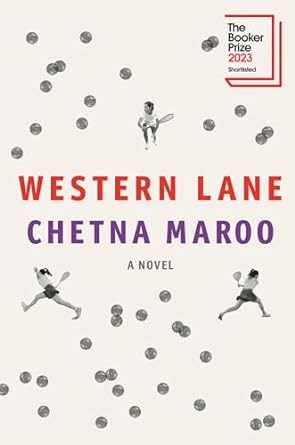
Western Lane by Chetna Maroo

Maybe it’s because I’m off Twitter, but I haven’t seen too much discourse about the Booker prize this year. I’m thinking about the years in which people whined about too many debut authors, because this shortlisted book struck me as very “debut-y” – or maybe it’s just me. 

Two trusted reviewers, the hosts of Novellas in November, who chose this book as a buddy read, don’t feel that way. Cathy found this story of a grieving eleven-year-old girl coping through a newfound love of squash, deep and satisfying:

“The narrative arc of Western Lane has all the staples of a standard Hollywood movie: rising from tragedy through sport, a romantic love interest and a thrilling climax of competition, but Maroo presents this recognisable story with a restraint and insight that elevates it beyond cliché.”

Rebecca found it illuminating in terms of “what is expected of young Gujarati women in England; on sisterhood and a bereaved family’s dynamic; but especially on what it is like to feel sealed off from life by grief”.

Rather than write a comment on their blogs about why I disagree, I thought I’d better review it myself. But I find that I can’t refute their points! The things I found trite or formulaic, they found “accessible with hidden depths” (that’s Rebecca.) I agree that the lack of “stylistic flair” (Rebecca again) is effective, and becomes a style of its own through repetition of certain metaphors. I just didn’t like the metaphors. 

My issue isn’t with any individual scene, or the style, but with the structure of the book as a whole. I felt like I could see the plot outline underneath the finished product, like if I could go back to an earlier draft, I’d see a note:  “insert squash metaphor here.” In fact, all eight chapters begin with a squash metaphor. They were well written, but to me, utterly obvious in what they were meant to convey about grief, and after the first few chapters I was sick of them. 

Had the writing not been restrained (as per Cathy,) this could have been a disaster. In between sports metaphors and the family members alternatively falling into or resisting gender and birth order roles, there were quietly powerful moments, some even illuminating. I gasped at a pivotal moment, when the young protagonist makes a decision that seems out of character, but actually reveals a lot about how grief and family turmoil have affected her. But even this moment makes me feel like I can see a ghostly Google doc comment like “put an obstacle in the character’s way before she gets to the final battle.”  

Cathy and Rebecca aren’t the only ones giving rave reviews. Canadian author David Chariandy calls Western Lane “a book of simmering intensities, reverberating silences, and exquisite literary timing.” This is an apt blurb, as his debut novella Brother touches on similar themes of grief, sibling relationships, and second generation immigrant experiences, with an overarching metaphor (music in his case). In my mind, Chariandy’s book was much stronger, as the structure wasn’t visible to me. Nothing felt repetitive or forced, and the musical metaphors, which I suppose were as obvious as the sports ones in Western Lane, were revealed at just the right moment to create a very emotional reading experience. 

But as my mom says, there’s no accounting for taste. We’ll find out what the Booker judges think soon enough!