Unlike my worst books of the year, I don’t see coherent themes in this list, nor is there a clear standout. None of these are perfect; they all annoyed me, just a little, in some way. In whittling the list down to ten, I tried to keep only the books where the annoyance is more about me than the book. In the order I read them:
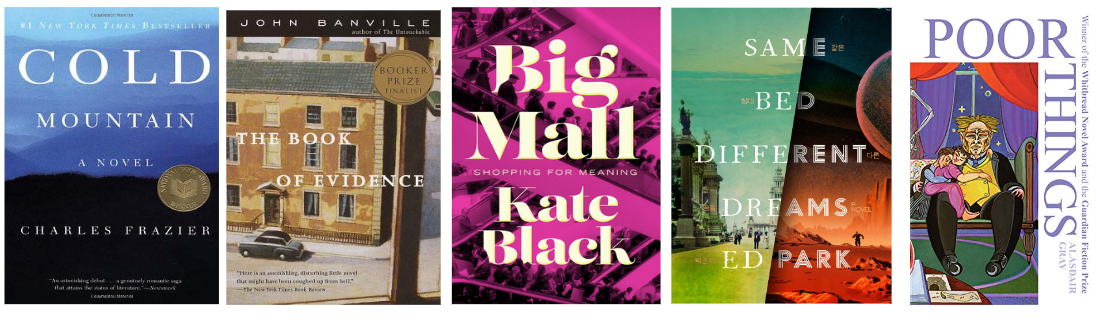
Cold Mountain by Charles Frazier. They don’t write them like this anymore. Sprawling historical love story based on The Odyssey. Bonus: gave us a great movie adaptation starring Jude Law at peak hotness.
The Book of Evidence by John Banville. This actually could be a standout. Pitch perfect, creepy as hell, and based on a true story, but this book does so much more than recount or sensationalize.
Big Mall by Kate Black. If you want to read about the intersection between resource extraction, colonialism, animal cruelty, violence, tourism, architecture, and your local shopping mall, this is probably your best (and only) bet. My review and interview here.
Same Bed Different Dreamsby Ed Park. This reminded me of Infinite Jest (complimentary) not only in content – sports, alternate history, Canadian subplot that I didn’t see coming- but in how it blew my fucking mind.
Poor Things by Alasdair Gray. Yes, it was a book first. Yes, the book is “better,” in that, there’s more there, and more of Bella Baxter in particular.
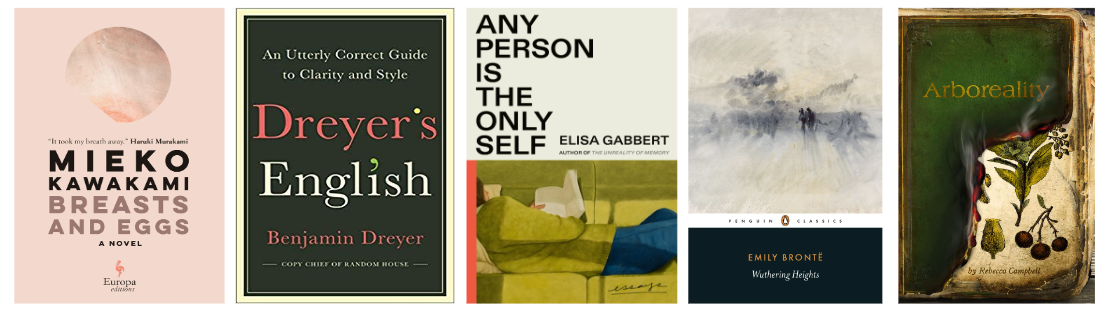
Breasts and Eggs by Mieko Kawakami, tr. Sam Bett and David Boyd. I stayed away from this one for too long because I had the impression that it was one of those very on-the-nose feminist “message” novels, but it’s not. It’s brilliant.
Dreyer’s English by Benjamin Dreyer. A rare case of an author’s social media presence selling me on a book. He vindicated my pickiness about Oxford commas and insistence on the proper use of “begs the question.” It’s the perfect book to read while falling asleep (complimentary.)
Any Person is the Only Self by Elisa Gabbert. This is what I was looking for in the handful of millennial woman writer/critic essay collections I read this year. Humour, literary criticism, and, notably lacking in the others I read this year, humility.
Wuthering Heights by Emily Bronte. If I reread WH in a given year, it will appear on my best books list.
Arboreality by Rebecca Campbell. A near-future climate disaster novel in which things start going downhill rapidly in 2025 might be a bit much right now, so I’m glad I read it in 2024.
I don’t need to ask for your best books, we’re all posting them. Keep them coming!
Code Dependent by Madhumita Murgia: I love a bit of tech skepticism, and the subtitle “Living in the Shadow of AI” seemed to fit the bill, but it was written in a very stilted manner and failed to connect any of its stories about people affected by AI. I could almost see the “[insert humanizing background story here]” at the beginning of each chapter. I wanted to get to the nitty gritty!
Pause, Rest, Be by Octavia Raheem: The subtitle, “Stillness Practices for Courage in Time of Change,” must have caught my eye in March, while I was emerging from survival mode after a house fire. The “practices” part was pretty good; there are detailed instructions and pictures on how to achieve restorative yoga poses, which would work for newbies and yogis alike. The narrative, however, is a mishmash of new age and Christian woo woo, and relies on the same tricks many other self-help-ish books use to seem substantial and profound, like repetition and a lot of white space.
Wintering by Katherine May: Another subtitle that got my ass! “The Power of Rest and Retreat in Difficult Times” echoes Pause, Rest, Be, and I read these almost back to back, which was a big mistake. Wintering pissed me off so much. The big reasons (the maddening vagueness about what exactly was making the times so “difficult,” the blithe manner in which she flaunts her staggering privilege, the lack of understanding or curiosity about what actual winter is like in northern climates) are dwarfed by something that’s so silly, but she’s basically a bitch eating crackers at this point (I can’t find a good link to what this means, iykyk). She recommends going to the grocery store right before Christmas as a self care strategy. Or more precisely, something like going to the “green grocers” for “jams and jellies,” and I laughed out loud. I can’t think of anything I associate LESS with “rest and retreat” than venturing out in -20 temps, driving on icy roads, battling the crowds at Walmart, and spending hundreds of dollars on inflated groceries. Not to gatekeep, but I don’t think you should be allowed to write a book about winter if you live in a place where the average winter lows are above freezing.
Short translated works, reviewed shortly:
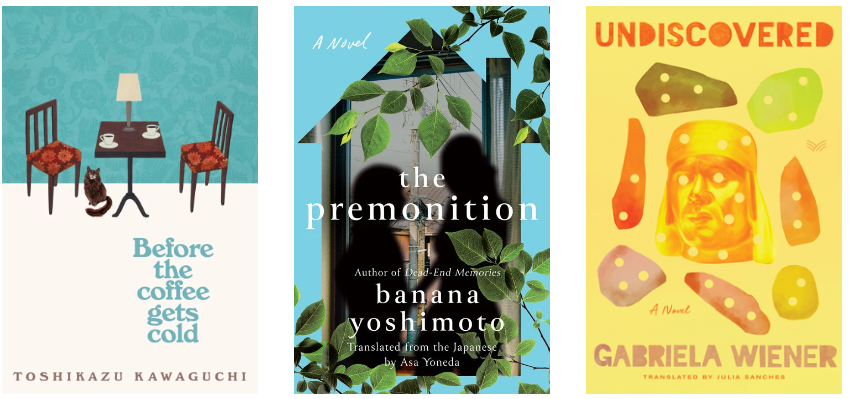
Before the Coffee Gets Cold by Toshikazu Kawaguchi tr. Geoffrey Trousselot: One day I’m going to accept that I like weird Japanese fiction, not cute Japanese fiction. And this isn’t even cute, unless you find rigid gender roles and vaguely anti-choice sentiment to be cute!
The Premonition by Banana Yoshimoto tr. Asa Yoneda: This started out more promising, no cuteness here, but revealed itself to be a lot of YA-style wish fulfilment and Holden Caulfield-style complaining about phonies.
Undiscovered by Gabriela Weiner tr. Julia Sanches: This is literally a personal essay, and not a very good one, but somehow got longlisted for my favourite fiction prize?
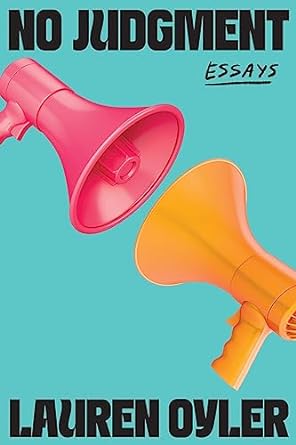
Lastly, and worstly, this one would fit under “nonfiction”, but, it doesn’t have a subtitle on the North American edition (the UK edition, inexplicably, does, “On Being Critical,” which, lol.) The author is a literary it girl known for her negative reviews, and more recently, for a novel that flopped: yes, it’s Lauren Oyler’s essay collection No Judgement. I wanted to write a full review, but sort of felt like it’s all beensaid. So let me take a moment to say just a little more.
The worst thing about this book is Oyler’s withering disdain for the reader, and it permeates every single essay. I mean “reader” in both senses: the particular reader holding the book, and the class of people who merely read, and aren’t writers themselves. This is pretty rich from someone who’s bibliography consists of a mediocre novel and a widely-panned essay collection.
While most of the essays are simply self-important and wanna-be edgy, it’s the essay about Goodreads that broke me. It’s not just cringy, it’s wildly inaccurate, in ways that are immediately obvious to us lowly readers in the Goodreads trenches. Kathleen Hale and Lauren Hough are uncritically presented as victims of “review bombing,” and this is stupid enough, but it’s also like… this is all drama that happened five to ten years ago. Who cares at this point? Is she just mad that Fake Accounts has an abysmal 2.83 Goodreads star rating? I cannot fathom what else could have sparked this essay in particular, or the book as a whole.
It’s unfortunate that Oyler’s best writing, her scathing reviews for Bookslut, are lost to the sands of time and bit rot. We needed the push back against Roxane Gay in 2014. We don’t need any of this in 2024.
Whew! Now, I haven’t done one of these “what about you” kickers in a while, but truly, I want to know what your worst books of the year are. Hit me up in the comments.
I don’t love the mountains, which is a controversial thing to say here in Alberta. Everyone goes to the mountains, and feels at peace, at home, in awe, or whatever. Many “leave their heart” there. Maybe it’s because I grew up in Vancouver, where it was normal to see mountains (and an ocean) but I need a little more than a large rock formation to get me speaking in clichés.
I’m also not easily impressed by so-called disaster woman stories. There’s got to be a little more going on than “this woman is weird and messy.”
Bad Land, thankfully, has got more going for it. In addition to a weird woman, there is also a weird little girl. And it’s not set in the mountains; it’s set in the one place in Alberta that actually does make me feel a sense of awe: the badlands.
“Then the puckered hills begin to swell out of the earth, growing higher, wider, baring their stripes of ancient rock and clay and ash, layer upon layer. As the Buick sinks into the valley, the hills knit together behind them, closing them in.”
That’s exactly how I feel driving into Drumheller. The landscape is not just majestic and imposing, it’s downright alien. It also contains a ton of fossils and other buried treasures, enough to capture any child’s imagination.
Henry in Drumheller circa 2018, with a stuffed dinosaur
Growing up there makes it a little less magical. Regina’s Drumheller childhood with her younger brother Ricky and German paleontologist mother, called “Mutti,” feels as stifling as you might expect. The book opens with adult Regina still there, living alone in her childhood home, estranged from her family, and working at the most stereotypically Drumheller place possible. She’s a character, known for taking her beloved bunny, Waldo, for walks around the neighbourhood, and for her imposing size. Regina is surprised to find Ricky on her doorstep after seven years of no contact, with a six-year-old daughter, Jez, in tow. The rest of the novel unravels the reasons for the estrangement, and tracks Regina’s bond with troubled Jez and her efforts to find and reconcile with Mutti.
A flashback illustrates Regina’s strained relationship with her mother. Young Regina tries to impress her mother by finding treasures in the badlands, thinking that Mutti would “gasp, praise my keen eye, and offer to take me out for ice cream” if she could just find a fossil, or a piece of amber. Regina eventually finds what she imagines is a dinosaur egg. When she breaks it open with a hammer and finds something even more magical – sparkling crystals – she imagines Mutti will “jump out of her stockings” and that they will be famous for their discovery. Of course, it’s just a geode, and Mutti is quick to tell her it’s nothing special, at least not anymore.
“It might have been worth something, you know. I think about four hundred dollars, maybe more. But there you’ve gone, smashing it to bits. Must you go around smashing everything, Regina?”
Chong has dug into strained mother-daughter relationships before, in her debut novel Belinda’s Rings. Both novels feature distant mothers with the kind of STEM jobs that little girls dream about (a marine biologist in Belinda’s Rings), absent fathers, fraught sibling relationships, and generational trauma and abuse. Sudden outbursts of violence feature in both books. The past is always just below the surface, threatening to break through. Bad Land is a more mature work, and takes more risks. It can be read as a thriller, full of twists and family secrets, culminating in a madcap road trip. Or, it can be read as an examination of one woman’s inner life, rich in metaphor and atmosphere, and mysterious in its conclusions about family and memory.
Maddeningly for such a propulsive read, Chong makes some choices that throw the reader out of the story. The most jarring was Regina’s analog lifestyle – no phone, no computer, and as far as we’re told, no media consumption at all. I was compelled to hunt for clues about her age and the year, hoping to justify this choice as something other than a plot contrivance – as with most fiction, it’s very helpful when characters can’t Google things- but Bad Land is mostly devoid of political and pop culture references. I eventually found enough to place the present-day narrative in 2016, and peg Regina at 36, which makes Regina’s inability to conduct a simple Google search strain credulity.
I flew through Bad Land, but upon finishing, I wasn’t sure how I felt, or how successful the novel was. So, I sought out reviews. Surely, a Giller Prize-nominated novel that was published mere weeks ago would have a couple of reviews to peruse. Other than an unfairly negative review in Publisher’s Weekly (which refers to Randy’s wife as Clara rather than Carla) and a positive review in a BC literary journal (which refers to Waldo as a childhood pet; he’s definitely not) there’s very little to go on. There are ten reviews on Goodreads, one of which is mine. This probably says more about the state of review culture than the book, but I was sorely disappointed!
Despite my uncertainty, I hope more people read Bad Land, mostly so I can read more perspectives on it. I want to know whether you think Regina’s character is supposed to reflect how childhood trauma becomes an adult fear of abandonment, and that her bond with Jez shows how trauma can be healed by the love of a child. Or, as I tend to think, that Regina is the “bunny lady” and Jez is lost in a dream world for reasons that aren’t so simple, or maybe for no reason at all.
Like a fossil is only an impression of the real thing, all we can know of Regina is what Chong shows us. Bad Land is haunting no matter which way you read it – and like a geode, whether you break it open the right way or not, it’s still beautiful.
The boys were convinced this rock was a dinosaur skull (circa 2017)
If you follow me on social media, you might know that in the immediate aftermath of the fire, my husband found our cat Perogy in a bad state and got her to an emergency vet, where she remained for three weeks. You might have missed the “Missing Cat” posts about Shirley, though, as they were only up for a day, until my husband found her too. She didn’t make it.
Shirley was three years old, a pandemic pet born in 2020 and adopted by us in 2021. The SPCA named her and we didn’t see any reason to change it. She was loud, lazy, a bit of a glutton, cuddly, soft, playful, a constant companion to anyone sitting on a couch or lying in a bed, and scared of everything. She would have been very scared that day – the noise, the smoke, the heat, people stomping around. The firefighters told me she most likely escaped the house and we’d find her later, that it happens all the time, but I didn’t believe them.
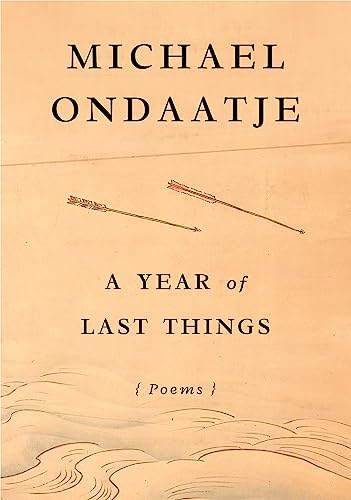
I’ve never lost a pet this way, only older pets who were ready to go and gave us time to prepare. I’ve also never lost a pet in the midst of a crisis – usually losing the pet is the crisis. I have mourned her, but alongside a bunch of other stuff, and seven months later, it can still feel awfully fresh; never more so than when I read the poem “November” in Michael Ondaajte’s new collection A Year of Last Things.
I’ve tried Ondaatje’s poetry before, and found it fairly impenetrable, with literary and cultural references that are beyond me. A lot of the poems in this collection are like that, though I got a hint of something different in this first line of the first poem, “Lock”:
Reading the lines he loves he slips them into a pocket, wishes to die with his clothes full of torn-free stanzas and the telephone numbers of his children in far cities
I love that line about carrying the telephone numbers of your children in your pocket. Old fashioned but relatable. Later, we are treated to prose poems – mini-essays, really- about the horrors of boarding school and confronting an abuser.
Where is my dear sixteen-year-old cat I wish to carry upstairs in my arms looking up at me and thinking be careful, dear human
Ondaatje addresses his cat, Jack, and remembers how he was adopted (“I found you as if an urchin in a snowstorm”), how he became a member of the family, (“learned the territories of the house”) and grew old (“Was it too soon or too late/that last summer of your life”). He despairs that he “cannot stand it,” this loss, and imagines meeting Jack again in a place “where language no longer exists”.
This poem has nothing much to say about my particular circumstances. “November” is about an old cat, and an old owner who can imagine meeting him again soon. Shirley was a young cat, and I am a (relatively) young owner who, if I believed in an afterlife, would anticipate waiting a long time for such a reunion. This poem doesn’t have anything particularly new to say about grief, either: it ends in a paraphrase of a 17th century haiku about the timelessness of nature, maybe, or the endless nature of grief?
It’s not a good poem because of what it says, but because of how it says it. It’s good because in ten stanzas (read them all here), it reminded me that my grief is real, and made me write about it here, making it even more real. It’s good because it made me think about my brother, who imagines his cat referring to people as “humans,” usually derogatory, and that made me smile. It’s good because the line near the end, “You no longer wait for us” took my breath away. Cats aren’t loyal and protective like dogs, but they do wait for you. I think about Shirley waiting for me that day. I knew she didn’t leave the house. She waited where she always did when she was scared, under the couch. That couch was just too close to the fire.
This is barely a review but it does remind me, and hopefully you, why it’s a good idea to read poetry: for those lines that takes you back to a place or a feeling, even one you cannot stand going back to.
Shirley, lying on top of someone’s legs as they lounged on the couch, as she was wont to do
I write this from a place of uncertainty, anxiety, and hope: the brief but interminable span of time between games six and seven of the 2024 Stanley Cup Final.
The fact that there will be a game seven at all is a minor miracle. If the Oilers win game seven, it will be a historic, statistically improbable, and miraculous comeback by a team that was at the bottom of the league earlier this season and was down 0-3 in this series. Edmonton hasn’t won the cup in 34 years. A Canadian team hasn’t won a cup in 30 years. It’s been nine years since the Oilers drafted Connor McDavid and began the long climb out of the decade of darkness and into the light.
“Hope Will Never Die” was a slogan coined by OilersNation and festooned across t-shirts and other merch to mark the occasion of McDavid’s first game. “Believe” is another popular slogan that’s used by many teams and sponsors. How does a sports fan endure ten years of lacklustre, playoff-missing hockey without hope? How does anyone wait for anything without believing they will get there eventually?
A “Hope Will Never Die” t-shirt at a playoff game (source: Edmonton Journal)
I’ve been reading about hope recently, and what I’ve read isn’t great. This isn’t surprising when you think about what happens when sports fans’ hopes are let down: riots, domestic violence, and depression.
Pema Chödrön writes in When Things Fall Apart, a collection of talks given by the Buddhist nun over several years:
Hope and fear come from feeling that we lack something, they come from a sense of poverty. We can’t simply relax with ourselves. We hold on to hope, and hope robs us of the present moment.
This chapter, “Hopelessness and Death”, is one of the most challenging in the collection, as it runs counter to a lot of the ways we frame things in the west. Chödrön sees hope as a manifestation of fear, and reminds us that all fear is rooted in a fear of death. Hope is a way of trying to make life feel secure and free from doubt, to deny the fact that you are mortal, to desperately try to avoid death, and so hope is destined to fail us. This idea resonated with me – some of my greatest moments of frustration in life have come from wishing (hoping) that things could be different, that I could be different.
Chödrön points out that all theistic religion is about hope: that if I do and say the right things, someone, some deity, will take care of me. Many religions also include an afterlife – an escape from death. It’s fitting that Oilers fans refer to McDavid, our great hope, as “McJesus.” Chödrön advocates for living with hopelessness:
When we talk about hopelessness and death, we’re talking about facing the facts. No escapism…Giving up hope is encouragement to stick with yourself, to make friends with yourself, to not run away from yourself, to return to bare bones, no matter what’s going on.
Hockey fans talk about hope, but the Oilers don’t, or not much. They talk about playing one game at a time, getting back to basics, and enjoying the moment. Kinda sounds like Chödrön, right? That’s no coincidence, as the Oilers have hired celebrity mindfulness coach George Mumford this season. The linked Instagram reel is short, but Mumford mentions fear, trying by not trying, and being present. His method is a little hard to discern (disclosure: have not read his books) so I’m not sure if he’s got the Oilers meditating daily or what, but whatever it is, it seems to be making a difference.
“There’s a Chance” sign at an outdoor Oilers watch party. Source: msn.com
Unlike Chödrön, Mumford doesn’t fit into a particular mindfulness tradition. His website cites “positive psychology, mindfulness, philosophy, neuroscience, the recovery movement, group and organizational dynamics, and spiritual traditions from around the world.” I don’t know what Chödrön thinks of this popular version of mindfulness, but I know that critic and author Becca Rothfeld would have a field day with it. In her recent essay collection All Things Are Too Small, she casts a withering glance on western-style mindfulness, which is divorced from its eastern origins and grew out of the “mind cures” and “positive thinking” movements of the twentieth century. It’s an interesting angle, but sadly, the weakest piece in the collection. Rothfeld sets up ridiculous straw man arguments – that meditation means you can never think or judge, that mindfulness is an all-or-nothing proposition – which is a shame, because she’s onto something in criticizing the commodified version of mindfulness that’s peddled on apps these days. I have no doubt she’d scoff at Mumford’s vague pronouncements and slick website.
And yet! Mumford must be on to something too, because I’ve been watching the Oilers for 25 years and this team, this year, feels different.
At this moment, despite what I’ve learned, and my years of on-and-off, half-assed mindfulness, I remain half agony, half hope.
Oilers in seven.
A healthier attitude: Win or Lose I’m Drinkin’ Booze. Source: Coppernblue.com, from the tail end of the decade of darkness
Are “short essay collections” a thing? Flash essays? Micro essays? I don’t know that I’ve ever read a collection like this before: 25 essays in 144 pages for an average of under 6 pages each. A couple of them come off as a little underdone, but most of them feel full: of odd characters, familiar places, and moments of catharsis and recognition. And humour! I laughed out loud at a joke about Balzac, Alberta, which does indeed sound like “ballsack” – as my kids will note every time we pass it on the way to Calgary.
Speaking of Alberta, I thought Big Mall would be the most locally and personally relevant book I’d read this year, but another millennial Albertan who eventually moved to Vancouver has entered the chat. Cole Nowicki grew up in Lac La Biche, Alberta, a town familiar to me because it’s close to a friend’s lake lot, where I would go camping (under duress) when the kids were small. Going to the Timmies, or the oddly-punctuated “The Bargain! Store” was a highlight of those trips.
It doesn’t really matter if you’ve been to Lac La Biche, though, or if you understand why it is a big deal that they have a Boston Pizza there. These are the best kind of personal essays, where the very specific experiences and interests of one person reveal something universal. You probably didn’t have a conversation with your mom about Blink-182 lyrics as a child, but you will recognize (I hope) the comfort to be found in the commiseration of a parent. You probably didn’t watch a parent go through a mental health crisis (I hope) but you will recognize the pain of growing up and realizing that your parents can’t or won’t commiserate with you the same way anymore.
I also enjoyed the essays that were a little less personal and more about the absurdities of the places we live, IRL and online. “The Big Dog in the Sky is Dirty”, about a sculpture of a poodle in Vancouver, doesn’t take an obvious position for or against public art, but exposes the class implications and bureaucracy around who gets to experience it. There are no pictures in these essays, but Nowicki also maintains a blog where you can read an earlier version of this essay and see the poodle in question.
There were other essays that could have been enhanced with pictures (“The Dark Lord of Vancouver Karaoke”, just to verify that “Arcanabyss” is a real guy, which he is) and one where I was very glad there weren’t (“A Brief History of People Finding Weird Shit in Their Ears”, which was horrifying in exactly the way you think). Early adopters of the internet will appreciate the lore around gail.com and “pooptime”, a website that I thought must have existed in the early aughts era, between “bathroom books” and social media, but was somehow still publishing content in 2018.
The only essay that fell a bit flat to me was the skateboarding one. The “well-worn cliche” of how skateboarding mirrors the growth and upheaval of adolescence is acknowledged early on, and for me, the essay didn’t overcome that. This tracks for me, as I regularly read Nowicki’s blog, Simple Magic, but skim over the hardcore skateboarding stuff. I keep coming back because I find so many gems (which are usually at least skateboarding-adjacent.)
This is the first of my 20 Books of Summer challenge. I enjoyed it so much that I immediately started another essay collection, No Judgement by Lauren Oyler, which is much bigger – in length, in scope, and in publicreaction. Laser Quit Smoking Massage is easily the better collection, in terms of choice of subject, use of humour, and respect for the reader’s time and attention (I’ll expand on the latter if I review No Judgement.) I don’t foresee any hit pieces in Bookforum for this one, I hope readers give it a chance anyway.
20 Books of Summer has always been more about the motivation to *actually review* books for me, not reducing my TBR, and never more so than this year. I don’t own 20 books, let alone 20 books I haven’t read before. Hence the shorter list.
This year is special though, as it’s the tenth anniversary of an event that started as a TBR challenge with 8 participants that now attracts upwards of 100 bloggers each year. No mean feat given the state of blogging today and the fact that this is a rather high-commitment event (with very relaxed rules to make it manageable.) Congratulations to Cathy for keeping the pages turning and the reviews rolling in since 2014.
My list of 15 has no theme other than “these are books in my house or that I might get into my house at some point this summer”:
Breasts and Eggs by Mieko Kawakami tr. Sam Bett and David Boyd (for Women in Translation month, perhaps)
The Wars by Timothy Findley (a CanLit classic)
A Tree Grows in Brooklyn by Betty Smith (an American classic)
The Netanyahus by Joshua Cohen (has been recommended to me many a time)
Agnes Grey by Anne Brontë (the book I was rereading at the time of our house fire, apologies to Edmonton Public Library for the lost copy!)
Jane Eyre by Charlotte Brontë (it’s in the edition I got in order to read Agnes)
Wuthering Heights by Emily Brontë (see above and it’s time for a reread anyway)
Ghosts by John Banville (the next in the Book of Evidence series)
Brooklyn by Colm Tóibín (a rare instance of “seen the movie, not read the book” and preparation for…)
Long Island by Colm Tóibín (the much-anticipated sequel)
Kairos by Jenny Erpenbeck tr. Michael Hofmann (my tradition of reading the International Booker Prize winners continues)
I’ve lived within a 15-minute drive of West Edmonton Mall for more than thirty years. With 800+ stores as a backdrop, I grew from a teenage mallrat to a mom doing the back-to-school shopping. I had my first kiss in a photo booth near the mini golf course, and shopped for a wedding dress in the wedding district (upstairs, Phase I) 15 years later. In 2002, I watched Canada win gold* on a TV in Vision Electronics while on a break from my job in Galaxyland (formerly Fantasyland, long story) and in peak 2022 fashion, I got stuck inside a drugstore during a lockdown drill while waiting for a COVID shot.
Still, I sometimes forget that this is what Edmonton is known for. Not Oilers hockey, not the river valley, not the time we tried to make “Take a risk, it’s the most Edmonton thing you can do” happen, but a building that we just call “the mall.” It makes me think: Really? Her?
Big Mall is a deeply researched and deeply personal book that says yes, her. Kate Black breaks down why malls exist in the first place, how they proliferated, why they’re dying, and what it all means, through the lens of someone who grew up in the shadow of the world’s one-time biggest.
My International Booker predictions were a bust, again! Not that I committed them to paper (or blog,) but I was very much expecting to see My Heavenly Favourite by previous winner Lucas Rijneveld, and was hoping to see some Japanese lit after a shut out last year. No such luck.
2024’s longlist is South America and Europe heavy, with a single Korean novel representing Asia. Africa and the Caribbean are shut out entirely. There are no French language novels, a first since I’ve been tracking.
I’m not sure what I expected from this jury, headed up by one of my favourite radio personalities, Eleanor Wachtel, but this wasn’t it. Apart from Jenny Erpenbeck, these are all totally new-to-me authors, so maybe I’ll find a find a new favourite, heavenly or otherwise…
Now, the reason you’re here: the updated “How to read the IBP in Canada” spreadsheet. Check it out for all the details on where to get the books in Canada (and the States – but prices are in CAD). The longlist is fairly accessible, if you’re looking to buy, and about half are available at my library (shout out to the two people who got holds in ahead of me on all seven available titles! I was slow on the draw). There’s not much in the way of audio, and the ebooks are a bit pricey, but overall, us Canadians can get a good start on things ahead of the shortlist announcement on April 9.
The trick is to have your house burn down. Instant TBR zero.
Of course you also lose all your other TB piles: To Be Worn, To Be Eaten, To Be Slept on, To Be Cooked with, To Be Remembered By…
My house caught on fire on December 18. It started in the kitchen (cause still being determined) and was contained and put out quickly. I’d only been out of the house for about 45 minutes when I started getting calls from neighbours. It’s a mindfuck, because my house didn’t actually burn down, and my books, along with most of our belongings, weren’t actually reduced to ash. The smoke, soot, water, and asbestos are what get you. Despite the house looking okay from the outside, we lost almost everything we owned.
BeforeAfter
I didn’t have a single book “pile” or shelf. I had books on, under and on top of shelves, as well as on desks, coffee tables, bedside tables, and in drawers and closets. I also, thankfully, had a Google Sheet with a complete and up-to-date listing of each one of those books, including origin and cost for the more recent ones. (Did I have an inventory of any other items in the house? Of course not. BUT YOU SHOULD. START ONE NOW. TRUST ME.)
I don’t even have a “TBR” tab in my spreadsheet. It’s not something I think about much. I have a “wishlist” of books I don’t own but might want to, based on reviews or recommendations – the most recent addition is Bouvard and Pécuchet by Flaubert, as recommended in the NYT’s “Read like the Wind” newsletter. I also have tabs related to various “projects,” like reading the works of Dostoyevsky, or the 1,001 Books list. These are all TBRs of sorts.
But what people usually mean by TBR is “books you own but haven’t read.” TBRs sometimes include unread ebooks, but usually don’t include books you have on hold at the library, or books you are thinking about buying. A TBR pile is a real thing that you spent money on. By filtering on “unread” and filtering out “Kindle” and “Kobo”, I see that I had a TBR pile of 108 books, as of the morning of December 18, anyway.
In online bookish circles, TBRs are often framed as a problem, or at least something to be managed, an indicator of consumerism at best and hoarding at worst. TBR challenges abound; people have plans to get to a zero TBR, or under 30, or under 100. They will do this in a year, or six months, or as long as it takes.
I confess, “TBR” content is among my least favourite bookish content (if you are someone who does TBR stuff online, I don’t mean you. I especially don’t mean Cathy!). There’s not much to say about a book you haven’t read, after all, and I find the accounting side of TBRs (books in, books out, monthly reckonings etc.) pretty tedious, unless it’s my own.
I read some TBR posts and watched some TBR videos for the purpose of writing this, and found that most of the “tips and tricks” for TBR challenges have to do with “reading more”, not “buying less”, and often it’s not even about finding more time to read, or speeding up your rate of reading (though that content is certainly out there too). It’s more about convincing yourself to read from your pile, through random chance (spins, jars) or incentives (no buying books until the TBR is under 100.)
TBR challenges don’t often get beyond the here and now, and into the existential question of how many books you will read before you die, or more to the point, how many books you will not read. I started reading from the 1001 Books You Must Read Before You Die list before I even started blogging, i.e. before I’d heard of a TBR, and it’s the kind of list you don’t ever really expect to finish, so I guess I’ve always taken the long view on this. A pile of 108 books is less daunting if you think of what you might read over the next 40 or 50 years. And I don’t think it’s something to beat yourself up for.
Let your TBR or other book lists be about anticipation instead. Anticipate the great books you’re going to read, and the ones so bad they’re good. Anticipate filling in the blanks on things you’re interested in, and going off on tangents into new topics. Anticipate reading an author’s complete works and then adding their biographies, letters, and criticism to your ever-growing and changing TBR. Document it, be honest about it, but let it be a positive thing.
My TBR pile is gone. But I still have plenty of books that are “to be read” – almost every book ever written, technically. And of course, two months on from the fire, my TBR has regenerated a bit. Here it is, in its entirety:
The Tenderness of Wolves by Stef Penney (from a Little Free Library and solely because the blurb, “Like Cold Mountain but colder”, made me laugh out loud)
My Heavenly Favourite by Lucas Rijneveld (my first post-fire purchase)
I have two more, non-TBR books in the house: A smoke-damaged, signed first edition of Freedom by Jonathan Franzen (recovered along with other sentimental items – I did NOT run back into the house for it) and The Birthday Party by Laurent Mauvignier, which had been sitting on my desk at work. We will rebuild – in 2025, or whenever I get back into my house!
Here’s my actual “one weird trick” for dealing with your TBR: Don’t worry about getting to zero, because you might get hit by a bus tomorrow – or your whole pile might go up in flames.