Tagged: pluribus
On the Calculation of Pluribus
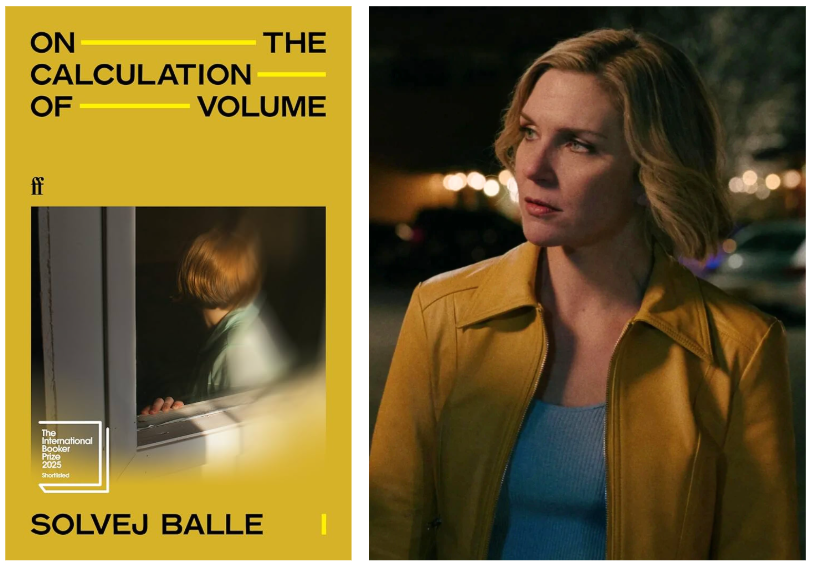
I swear this blog isn’t becoming a place to compare books and TV shows. This comparison came to me because I, like many others, am trying to figure out what these “On the Calculation of Volume” (OTCOV hereafter) books are actually about. Long gone are the Book I-era comparisons to Groundhog Day. These books are not funny, for one thing. And they’re not about finding love, or self-improvement, or a typical hero(ine)’s journey. In Books III and IV, they’re hardly about a single heroine at all.
At the beginning of Book III, Tara finally meets someone else who is living in the same day over and over. Henry Dale doesn’t “reset” every night, like everyone else; he remembers their previous November 18ths, and even disputes Tara’s day count (#1144 at the start of Book III; #1145 by Henry’s count). By the end of Book IV, they’ve found dozens more stuck people and moved into an abandoned house in Bremen, which becomes a kind of commune, with several satellite settlements throughout western and northern Europe.
I’ve previously speculated that the books are about aging, womanhood, or free will. Now that Tara is surrounded by other “loopers”, I think the books might be about community. Specifically, about how people might live if the things that structure our lives, like family, capitalism, and politics, were suddenly irrelevant. Not the typical dystopia, where these things are destroyed or forbidden or degraded – they simply don’t matter, because the vast majority of humanity is stuck repeating the same day, in the same body, for years on end by the end of Book IV, while the chosen few (we don’t know why or how they were chosen) continue to age and learn and grow, but cannot move forward to November 19th.
It’s an interesting question. As interesting as, say, how people might live if an alien force joined the vast majority of humanity into a single hivemind in a bid to build a large antennae to send itself to yet another planet. Luckily, Vince Gilligan of Breaking Bad and Better Call Saul fame is asking just that. In Pluribus, we similarly don’t know how or why thirteen people were spared from the plurbening (not the term used in the show but it’s more fun), but they similarly have a chance to start over and live differently. Time isn’t standing still, but with everyone you know either dead of housing the combined consciousness of every human on earth, it might as well be.
But wait, there’s more! Both stories are told from the perspectives of solitary, bookish, somewhat prickly women. Something that used to be plentiful gets reduced to just one – days for Tara, people for Carol. “E pluribus unum” (“out of many, one”, a sort of motto for the USA) would’ve worked as a title for either; and would have jived with Tara’s obsession with Ancient Rome.
Both are also seen as reactions to major global events, despite being conceived many years earlier: Tara is isolated and repeats the same day over and over, like some people in early Covid (can’t relate, I had young kids) and Carol doubts the that the sycophantic Plurbs have her best interests in mind, while everyone around her (all eleven of them) cheerfully accepts their fate – creator Vince Gilligan is a certified AI hater, but swears he came up with the idea years before ChatGPT started inducing psychosis.
But from there, the stories diverge sharply, and I can’t help but see the divide as a cultural one, between the American perspective of Pluribus and the European perspective of OTCOV.
Continue reading
