On the Calculation of Pluribus
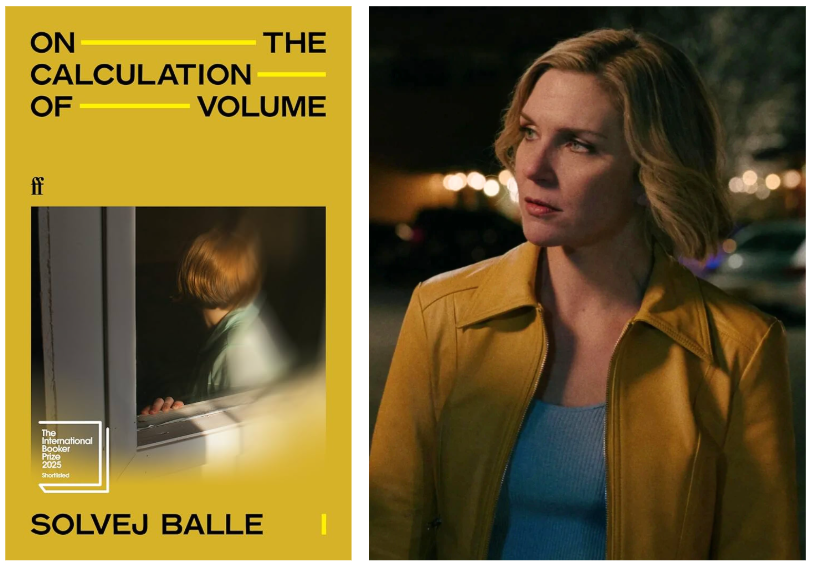
I swear this blog isn’t becoming a place to compare books and TV shows. This comparison came to me because I, like many others, am trying to figure out what these “On the Calculation of Volume” (OTCOV hereafter) books are actually about. Long gone are the Book I-era comparisons to Groundhog Day. These books are not funny, for one thing. And they’re not about finding love, or self-improvement, or a typical hero(ine)’s journey. In Books III and IV, they’re hardly about a single heroine at all.
At the beginning of Book III, Tara finally meets someone else who is living in the same day over and over. Henry Dale doesn’t “reset” every night, like everyone else; he remembers their previous November 18ths, and even disputes Tara’s day count (#1144 at the start of Book III; #1145 by Henry’s count). By the end of Book IV, they’ve found dozens more stuck people and moved into an abandoned house in Bremen, which becomes a kind of commune, with several satellite settlements throughout western and northern Europe.
I’ve previously speculated that the books are about aging, womanhood, or free will. Now that Tara is surrounded by other “loopers”, I think the books might be about community. Specifically, about how people might live if the things that structure our lives, like family, capitalism, and politics, were suddenly irrelevant. Not the typical dystopia, where these things are destroyed or forbidden or degraded – they simply don’t matter, because the vast majority of humanity is stuck repeating the same day, in the same body, for years on end by the end of Book IV, while the chosen few (we don’t know why or how they were chosen) continue to age and learn and grow, but cannot move forward to November 19th.
It’s an interesting question. As interesting as, say, how people might live if an alien force joined the vast majority of humanity into a single hivemind in a bid to build a large antennae to send itself to yet another planet. Luckily, Vince Gilligan of Breaking Bad and Better Call Saul fame is asking just that. In Pluribus, we similarly don’t know how or why thirteen people were spared from the plurbening (not the term used in the show but it’s more fun), but they similarly have a chance to start over and live differently. Time isn’t standing still, but with everyone you know either dead of housing the combined consciousness of every human on earth, it might as well be.
But wait, there’s more! Both stories are told from the perspectives of solitary, bookish, somewhat prickly women. Something that used to be plentiful gets reduced to just one – days for Tara, people for Carol. “E pluribus unum” (“out of many, one”, a sort of motto for the USA) would’ve worked as a title for either; and would have jived with Tara’s obsession with Ancient Rome.
Both are also seen as reactions to major global events, despite being conceived many years earlier: Tara is isolated and repeats the same day over and over, like some people in early Covid (can’t relate, I had young kids) and Carol doubts the that the sycophantic Plurbs have her best interests in mind, while everyone around her (all eleven of them) cheerfully accepts their fate – creator Vince Gilligan is a certified AI hater, but swears he came up with the idea years before ChatGPT started inducing psychosis.
But from there, the stories diverge sharply, and I can’t help but see the divide as a cultural one, between the American perspective of Pluribus and the European perspective of OTCOV.
In Pluribus’ America, there is a sudden, outside threat (which is, of course, first discovered by Americans), a band of scrappy outsiders who are left behind, and a hero’s journey. Carol is not your typical hero, but she is on a journey, from solitary misanthrope to savior. It’s probably not a coincidence that twelve others were spared from the plurbening: a saviour and her apostles. Wonder which one will betray Carol? Either way, in season one, they don’t come together much. Most of the group avoids Carol while living hedonistically in a world where not much matters – especially Diabaté, who, while not American, is a caricature of American excess, jetting around the world in Air Force One and living hedonistically in Las Vegas. Carol is eventually joined by the enigmatic Manousos, who might be even pricklier than she is. Carol and Manuso (and maybe Diabaté…) have a clear mission: stop the plurbening from claiming the last survivors. Literally, save humanity.
Over in Europe, the catastrophe is sudden but completely unexplained, and the scrappy outsiders, once they start to find each other, work together to live sustainably, in a world where they certainly don’t have to. There are unknown numbers; by the end of Book IV we’ve met dozens. Tara doesn’t have an antagonist. No one does. No one seems especially close either, of the dozens of healthy, young-to-middle-aged adults we meet, only two develop a romantic relationship. There’s nothing to “save”, no outside force exerting its will, and notably, zero religious undertones. Tara’s not on a typical hero’s journey, though there are undertones of The Odyssey and allusions to Roman roads. Tara and the rest of the loopers talk in loops too, endlessly rehashing the same issues: what words to use for various concepts, how to live sustainably, how to nudge time forward, say, by trying to grow potatoes.
Both are compelling, but the Pluribus world, I admit, is easier for me to understand, and not just because I’m a cranky, bookish, middled-aged woman myself. Maybe it’s because I’m (North) American and this is the kind of story I’m used to. Vince Gilligan loves an anti-hero, but he also loves high stakes, high action, and the self-made (wo)man + sidesick dynamic. I binge-watched Breaking Bad and Better Call Saul with my kids over the last couple of years, and though this show is quite different in its set up, Carol and Manuso against the Plurbs feels a lot like Walt and Jesse against the cartel, and Kim and Jimmy against Chuck or Howard (themselves, really.)
Tara and the loopers puzzle me. Okay, they actually drove me crazy in Book IV. Who *cares* whether the time loop is a “catastrophe” or an “anastrophe”? Or if you measure time in weeks, or blocks of ten days, or a hundred days? You guys have been stuck in a day for TEN YEARS. You are growing old. You are isolated from everyone you knew in your old life, and most of you aren’t even making new connections, not really. You don’t know how many people are experiencing the same thing; you don’t even know if it’s only happening in Europe. I desperately want a Manousos figure to get these people to take action. Or a Carol to tell them off.
It is, however, fascinating to see a group of people adjust their own behaviour in the face of the unthinkable, rather than fighting back or fighting amongst themselves. Americans would never. In OTCOV, the state, and other structures we’re used to, are literally “withering away” and being replaced by communal decision making – I’ve been reading Lenin’s The State and Revolution, and this is exactly what he (and Marx) said would happen once capitalism was over! And I’m very glad that a character in Book IV acknowledges that so far, the loopers are conveniently all young, healthy, and relatively unattached , right around the time I started getting annoyed about it. This unfortunately flies in the face of the fact that no one is fucking. I’m sorry, I don’t believe that a bunch of adults ranging from their early twenties to late forties would live together, in a place where time and family commitments have no meaning, and not be all over each other. I don’t think Marx said that everything withers away under communism.
With such crazy premises, and wildly different ways of approaching them, you wouldn’t think these stories would be boring, and yet, both have received some backlash in this vein. Critics love Pluribus, but viewers (mostly on Reddit) have complaints. Episode 7, “The Gap”, was especially divisive, as it featured little dialog and many drone shots of people driving. Carol slowly loses her mind after the Plurbs leave her on her own in Albuquerque while Manousos drives, then walks across the Darién Gap as he tries to reach Carol. The first five minutes are dedicated to Carol getting a Gatorade, and we hear a lot of Manousos practicing his English with a book on tape. We don’t learn anything new about the Plurbs, and Carol and Manousos don’t hatch any plans. We do see Carol break down and realize she can’t do this on her own, and we are shown the strength of Manousos’ convictions; he refuses any help from the Plurbs, even after he’s impaled by Chekhov’s chunga palm. It’s also visually and audibly striking – Carol howling along with the wolves in an abandoned city and Manousos cruising through the jungle in a vintage car weren’t exciting, but I loved watching. In a fast-paced show, I suppose we would’ve been spared all of this, but I’m thankful we weren’t. I kind of like the characters who are saving humanity to have a little humanity!
OTCOV, on the other hand, is never going to beat the boring allegations. Christine Smallwood makes a great case for this in her review for Bookforum, saying that not only are the books boring, they’re missing key facets of humanity, like tension, abuse, violence, even humour. The endless house meetings and discussions that go on into the night are strangely orderly and lacking in passion. No one is accused of eating the last box of oregano crackers; no one even fights the idea that they should eat the same bland, near-trash food day in and day out. People just don’t care about the things you would expect them to (art, sex, their phones), and care deeply about things that shouldn’t matter (bedspreads… seriously). I was upset enough to write “EXHAUSTING” in the margin when Tara describes a breakout group during a conference (I’m bored already) about a theory that an earthquake might have been behind the time loop:
“Along the way, many pointed out that our explorations lacked a theoretical foundation, that attempting to build hypotheses or explanations would be futile without a thorough understanding of the past theories of time – from the pre-Socratic period to the twenty-first century.”
Mind you, this is day #3446 and we’re still debating the theoretical foundations. And yes, the most concrete action in the fourth book was planning and hosting a conference. Compare and contrast with Pluribus’ cliffhanger finale, in which Carol has obtained a nuclear bomb and looks ready to use it. (OTCOV Book IV has a cliffhanger ending too, they always do, but it’s a little less, uh, explosive).
Neither story is over yet. We’ve got three more books and at least one more season to go. We don’t know if Balle or Gilligan is making it up as they go along, or if they’re lulling us with all these boring speeches and montages before hitting us with something big. They’ve both still got my interest, mostly because I don’t think all is as it seems… upon rereading OTCOV for this review, I started to notice “glitches” in the book, little details that are just a bit off. Like Henry’s day count being different than Tara’s, or Sonia and Peter in general: the only looper couple, who claim they found Tara after seeing a poster in Hamburg, though Tara says there were no posters in Hamburg, and who claim they witnessed a drowning that doesn’t recur like everything else. Something ain’t right!
And then I remembered that Pluribus is full of glitches, too. The whole premise is that a “glitch” in the Plurbening caused them to miss twelve people… and 33 hours later found out they had missed one more, Manousos, who is even more special than the rest (Gilligan not being subtle with the Jesus stuff here). We also see the Plurbs tell lies and do things that will harm Carol, which they’re not supposed to be able to do.
We won’t find out what it all means for Carol until 2028, and if NYRB sticks to the same publishing schedule and Balle finishes that last book (Books V and VI are already out in Danish), we are all hopeful that something will happen to Tara on November 18, 2027.


I’m going to ask my library system to order this series. Once I’ve caught up, I’ll come back to weigh in!
I have read books 1-3 but not 4 yet… will have to get to it soon. I am very intrigued as to where it will go to!
We need to stop being fooled by all these brokers and account managers. They scammed me out of over $100,000 of my investment capital; they kept on requesting extra funds before a withdrawal request could be accepted and processed, and in the end, I lost all my money. All efforts to reach out to their customer support desk were declined; I found it very hard to move on. I was researching and found a broadcast that teaches how scammed victims can recover their funds, I contacted the email provided for consultation, (support@boleynonline.com ) I got feedback after some minutes and I was asked to provide all legal details concerning my investment, I did exactly what they instructed me to do without delay, to my greatest surprise I was able to recover my money back including my profit which my capital generated. I said I would not keep this to myself but share it with the public so that all scam victims can get their funds back.