Tagged: Jonathan Franzen
Franzen in February
Welcome to Franzen in February. That’s right, in the off chance that I didn’t alienate my entire readership when I reviewed Purity thrice last year, I’ve decided to devote the whole month of February to the fabulous Mr. F. Here are just some of the goodies I have in store:
- My conspiracy theory regarding the Franzen/Weiner feud (I just watched episode #1 of the X-files reboot, so I am ready to go in on this. THE TRUTH IS OUT THERE.)
- Q&A with Franzen Fan Club President and author of The Wallcreeper and Mislaid Nell Zink (!!!!)
- Q&A with CanLit darling and Franzen fan Sigal Samuel, author of The Mystics of Mile End
- Q&A with the fanatic behind Franzenfreude
- Guests posts from a couple of Franzen newbies (your first Franzen is a very special experience)
Oh, yeah, I’m going to read stuff too. Maybe even review. Here’s the thing, though: I read three of Franzen’s books last year, and I’m not really in the mood to read another one right now. Write about them, yes. Read more of them…no. That could put a damper on the whole event.
I figured it out a way around it. Part of Franzen’s mystique is how everyone seems to have an opinion about him, and many authors have come out in support or on the attack. I’m going to read books by authors who love him, who hate him, who’ve been blurbed by him, and so on. FranzenFriends and FranzenFoes, if you will. Here’s my stack:

From top: Hates him, blurbed by him, blurbed by him, #1 fan
A couple friend & foe ideas for you:
- FranzenFriends: Nell Zink, Sigal Samuel, David Foster Wallace, Emily Gould, Jami Attenberg, Chico Buarque, Laura Miller
- FranzenFoes: Jennifer Weiner, Roxane Gay, Curtis Sittenfield, Jodi Picoult
Get involved: read a book by Franzen, or a friend/foe; pitch me a guest post; or just follow along and comment. I’m not messing around with sign-ups, prizes, or read-alongs. I want to spend my time writing up all these fun posts.
I don’t really have an agenda. I’ve read his three “big” novels plus his memoir, and rated them three or four stars. I don’t even count him in my top ten authors. And I don’t give a shit if you refuse to read him for whatever (probably misinformed) reason. He’s just so fun to talk about. He’s a force in modern literature, but he can be, to quote a heroine of classic lit, so adorably clueless.
Whether you’re a FranzenFriend or FranzenFoe, stay tuned, this’ll be fun.
Purity by Jonathan Franzen (Review #3)
Middlebrow and the Infinite Franzness
My pal Jason Purcell recently came out of hiatus with a discussion about the middlebrow:
This mini-review was going to be called “Infinite Franz” and was going to make some tenuous parallels between Purity and Infinite Jest, but once I got going, I found there weren’t as many as I thought. Then I watched Jason’s video, and got to thinking about how DFW and Franzen are often cited as examples of Great American Novelists, so they must both be highbrow, right?
Nope. Purity is way middlebrow. And that’s okay!
Purity is the most complex of Franzen’s big novels, but it’s still nowhere near as complex as Infinite Jest. Franzen’s strength is characters; DFW’s strength was, like, everything, so to see them both trotted out as “highbrow” is kind of weird! Infinite Jest is perceived as being inaccessible (my thoughts on that) and it’s certainly experimental. The only way to put the story together is to finish all 1,096 pages then go directly back to page 1, because the end is the beginning is the end. Purity is relatively linear. Like The Corrections and Freedom, there are multiple narrators, with some flashbacks and family history. There are more narrative threads in Purity, and more pieces to put together, and they don’t come together as easily, but it’s no trouble to follow the story.
Jason talks about Virginia Woolf’s assertion that the highbrow exists to reflect the lowbrow society, because those lowbrows can’t do it themselves. Franzen is known for writing about “big issues” and society and culture and all that. Like the narrative structure, I found that the “issues” in Purity were presented in more interesting ways than his previous novels. Chip’s Lithuanian adventures in The Corrections could only be satire. The child-free rants in Freedom could only be, well, rants. Purity mashes up German history and recent American scandal in a way that’s kind of outrageous but also realistic. The parallels between cold war Germany and the quasi-Wikileaks organization Purity works for aren’t shoved down our throats. All that said, Purity isn’t nearly as ambitious as Infinite Jest, which examines society in the 90s by comparing it to society in 2010, which is pretty crazy for a book published in 1996.
Franzen’s built up this highbrow persona (or, the media has,) but once you get into his work, it’s funnier, more accessible, and more comforting than you might expect. Reading DFW was more accessible than I thought it would be too, and more hilarious, but not comforting at all. I haven’t read a word of his since I read his short story Incarnations of Burned Children nearly two years ago, because I’m still reeling. SincePurity, my reading has been a veritable Franztravaganza: I read (not reread!) The Corrections and listened to The Discomfort Zone (read by the author) and am making plans to read How To Be Alone and/or Strong Motion soon.
If you really want me to prove Franzen’s middlebrow status, ask me to review The Corrections by comparing it to a Jennifer Weiner’s Fly Away Home. They’re basically the same story, minus the Lithuanians and lesbians: parents’ fuck-ups expose how fucked up their children are, mothers fixate on one last family gathering, sexual deviance and hilarity ensue. I think if they’d read each other’s books, they could put their whole feud to rest.
I guess this isn’t really a revelation. We knew it the minute Oprah chose him for her book club: Franzen writes excellent, readable, insightful, middlebrow fiction. And most days, like most people, I’ll take the middlebrow.
Purity by Jonathan Franzen (Review #2)
Fifty Shades of Franzen
Hey, did you know that Jonathan Franzen can’t write sex? He was even nominated for bad sex award a few years back.
You think I’d be all over this kind of criticism, but no. It’s stupid and lazy. Not just because the quotes are taken out of context and so rendered almost meaningless, but because it assumes that the only reason for a sex scene in a novel is to arouse the reader. Which… no. Sex can be bad. Gross. Awkward. Sometimes sex is a way to say goodbye, or a way to give in, or give up. It’s not always sexy. And novels? They’re just like real life! Sex scenes shouldn’t all be sexy and steamy and politically correct because life isn’t that way.
Anyway, those articles are about The Corrections and Freedom, which featured scatological fantasies and the C-word and such. The sex in Purity is a little different:
She could feel his hands trembling on her hips, feel his own excitement, and this was something – it was a lot. He seemed honestly to want her private thing. It was really this knowledge, more than the negocitos he was expertly transacting with his mouth, that caused her to come with such violent alacrity.
I don’t know how much intersection there is between readers of E.L. James and JFranz, so let me tell you: this is very Fifty Shades-esque. The “private thing” instead using her (C) words. The weirdly clinical, or in this case, business-like tone. The gee-whiz innocence of the heroine and experience of her “expert” partner.
There’s some quasi-BSDM in Purity (the BDSM in Fifty Shades is quasi at best too,) particularly between Pip and Andreas, who most clearly correspond to Ana and Christian, what with the power imbalances and the mind fucks and the innocent young girl/bad boy with a secret thing, but also between Pip’s mom Anabel and Tom, who share a memorable, not-really-consensual sex scene (see Zink’s review for a spoiler, whenever it’s back up) and have a freaky sex ritual that involves a stuffed bull named Leonard. The bull thing has nothing to do with BDSM but I had to mention it somehow.
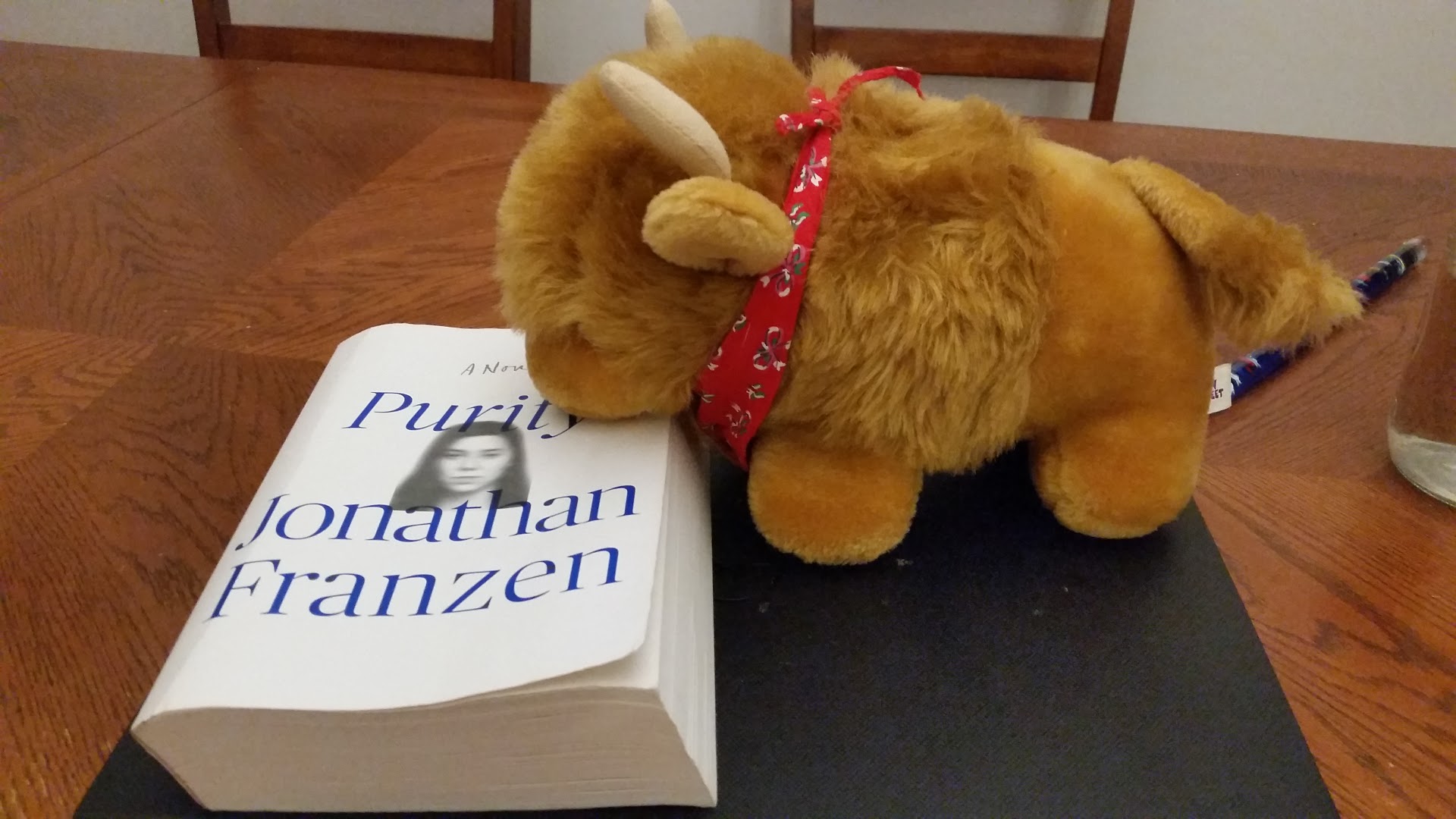
This stuffed buffalo does not approve.
And the Fifty Shades of Franzen don’t end with the sex scenes! Both feature a really clunky literary allusion; Purity to Great Expectations and Fifty Shades to Tess of the D’Ubervilles. Has anyone written about Fifty Shades and Tess? Am I going to have to do it? Another day, perhaps…
The point of this mini-review was not to suggest that Purity is on the same level of Fifty Shades, but rather, to show that the way we react to sex in literature (and allusions, too?) has a lot of do with how it’s marketed and who’s writing it. I didn’t make this up to be funny. There truly are parallels between the books, only with one, we snicker and roll our eyes because readers ARE getting off on it, and with the other, we snicker and roll our eyes because they AREN’T.
As for me, demographically speaking, I’m in the target market for both mommy porn and OMG Serious Literature. After reading both Purity and Fifty, I plan to read more Franzen, but won’t continue the adventures of Ana and Christian in Darker, Freed, or cash-grab Grey, mostly because they’re boring as hell. Talk to me when Ana is throwing around the C-word or Christian adds some stuffies to his playroom.
Purity by Jonathan Franzen (Review #1)
You know me. I love a clever title. I came up with three subtitles for my review of Purity, and can’t choose a favourite, so I’m subjecting you to a mini-reviews to go with each over the next few days:
- Review #1: Franziness. My basic review.
- Review #2: Fifty Shades of Franzen. A mostly-serious discussion of sexuality in literature.
- Review #3: Middlebrow and the Infinite Franz. A discussion of middlebrow literature.
Review #1: Franziness

Nailed it.
Publication date: September 1, 2015
My rating: 4 out of 5 stars
Read this if you like: Jonathan Franzen
Check out Purity on Goodreads
Thanks to: The fine people at Macmillian (FSG) for giving me and 199 other lucky Book Expo America attendees an advance reader’s copy.
Like Nell Zink, I won’t bother trying to convince you to read Purity, because you already know if you’re going to read it or not (her review is still offline, so you’ll have to take my word for it.) As my mom used to say, if you like this kind of thing, this is the kind of thing you will like. It’s got Franziness. See the end of this post for my incomplete list of Franziness indicators and add your own.
Franzen’s interviewer at Book Expo America made much of how “plotty” this book is, which is to say, things happen outside the family/personal realm. That’s true. The chapters set in Europe aren’t just a satirical sidebar, like they were in The Corrections. The affairs and sexual misconduct have larger implications for the characters than they did in Freedom. But Purity didn’t surprise me that much. It didn’t shake up my view of what a Franzen novel is.
I read The Corrections recently, and that helped me see what a step up Purity is. If you read his Big Three novels in order, you’d see them get better, smoother, less “I see what you did there.” The threads in Purity come together in a way that reminded me of The Luminaries; you almost don’t notice it till it’s done. There’s also a mystery and a murder, new territory for Franzen, but they don’t overwhelm the story. The characters are still in the forefront.
Speaking of, Purity demonstrates what Franzen’s strength has been all along: he creates characters the reader cares about. Not that we like, empathize with, or relate to (though you might do all those things,) but they keep you turning the pages and slogging through the parts that are sloggy and you miss them after you’re done. I miss Pip! She’s annoying and self-centred and predictable, but she got to me.
Purity is plotty, but it’s also pretty emotional. I don’t think I cried, but I felt real dread during the lead up to the murder, and felt impotent and icky during the seduction of, well, everyone who gets seduced. There were hilarious parts and weird parts and banal parts.
So, if you’re going to read Purity, you’re in for a treat, and if you’re not, please stand by, Reading in Bed will return to regular programming in a couple of days.
An incomplete list of things that have Franziness
- Birds
- Wariness of the internet
- Mommy issues
- Daddy issues
- Unlikable narrators
- Germany
- Weird/bad sex scenes
- Icky relationships between stunted man-child(ren) and younger, damaged women
- Poop
Book-loving hedonists and alienated intellectuals: why readers need to settle down about reading

READING FACT: Reading a book will transform you into Keira Knightly, traipsing the pristine English countryside.
I love book culture. I love book blogs (obviously?) and book festivals, and readings, and #FridayReads and #amreading. I do not love the way we book people talk about ourselves, though. The memes, infographics, think pieces, quotes and such that grind my gears fall into two categories:
- Readers are different
- Readers are better people
I’ve been thinking about these ideas lately, with help from a couple authors I’ve been lucky enough to see in person. Continue reading
Are Gwyneth Paltrow and Jonathan Franzen Wrong About Everything?
I’m pretty much recovered from last year’s celebrity encounters with Joseph Boyden and Joyce Carol Oates, so it’s time to get star struck again! Recently I met a few celebrities and made plans to meet another. Let’s review.
1. Gwyneth Paltrow
Calm down, I didn’t actually meet GP. But I did attend the launch party for Is Gwyneth Paltrow Wrong About Everything by Tim Caulfield and she was there in spirit, and also in cardboard cut-out form. At one point, the line up to take a “selfie” with 2D Gwyn was longer than the line to talk to the author. At this point pretend I say something profound about celebrity culture.
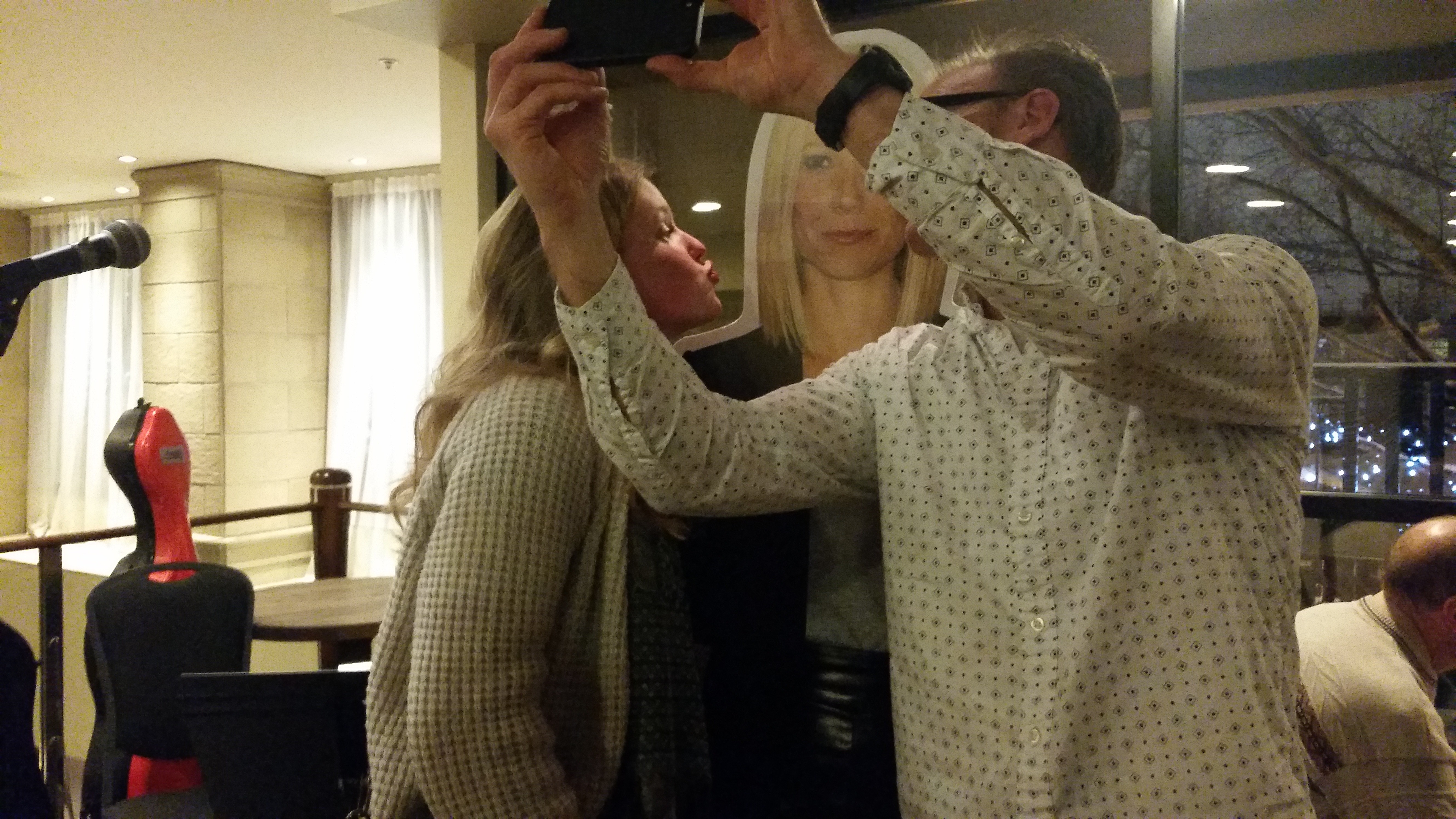
This kept happening

Goopy and Me
2. Tim Caulfield
The real reason I was there, Tim Caulfield is an author, the Canada Research Chair in Health Law and Policy, a father of four, and a local celebrity himself.

I can hardly call this a book launch. It was a fete. There was catering, live music, and free drinks. And it was weird being at a book thing without any book people – they were all University and health care types. Good thing I brought my sister as my date. She used to plan health care conferences and recognized many of the attendees as former speakers and delegates, including Caulfield. They didn’t recognize her though, and she wanted to keep it that way, so we retreated to a corner and she gave me the dirt on who’s a nightmare to work for and who only has their job because of family connections and so on. Just like celebrity gossip! With fewer nude leaks.
On Caulfield himself? “Everyone loves him. Especially women.” From what I saw that night? Absolutely true!

I’ve read the first chapter of the book, and I love that Caulfield is an unabashed consumer of celeb culture himself. It isn’t about scolding people, or looking down on the masses who read Star magazine. It’s about examining the reasons we trust celebrities in ways that we don’t trust scientists or ourselves. I do hope there’s some level of feminist perspective in the chapters to come, as a large portion of the type of health & beauty advice Caulfield’s writing about comes from female celebrities and is aimed at female consumers. We shall see.
This book’s going to be huge. The timing couldn’t be better, what with vaccine debates back in fashion (seriously, it’s like a parenting forum exploded all over the internet) and GP-endorsed uterus steam cleanings.
3. Jonathan Frazen
I know, I know. No one wants to hear a book blogger rant about Jonathan Frazen right now. But in writing about Goopy, I realized that she and JFranz are hated for the same reasons:
- They have big egos. Um. An actress and a writer have large egos? The hell you say! There is a segment of the population who kind of admire’s Franzen’s confidence, which I don’t hear too much about Goopy.
- They don’t deserve what they have. When Goopy uses a new catchphrase, or steam cleans her internal organs, the world takes notice. She made up “conscious uncoupling!” (she didn’t.) She hates working moms! (she doesn’t.) She steams her vagina! (I got nothin’.) And people resent that. Same thing for Franzen. Is it possible to write an article about him and not mention “best living American author?” Apparently not! Being a good actress or a good writer is a very subjective thing, so many people will disagree. In this case, sorry guys, Goopy gets a free pass for life for Seven and Sliding Doors and Franzen gets a free pass for The Corrections. They’re both legit, no matter how insufferable.
- They are oblivious. How can Goopy be so smug? So condescending? So full of unchecked privilege? Doesn’t she know how awful she is? I… think she does, actually. She probably knew exactly what was going to happen when she posted about “conscious uncoupling.” She’s crafting an image, it’s just not necessarily a likeable or relatable or even aspirational image. I feel the same way about Franzen. Every time he gives an interview, the same people make the same snide comments (myself included!) and as much as he lambasts Jennifer Weiner for “self-promoting,” he’s doing just the same. Like Goopy, he’s not oblivious. He knows what’s going to happen when he said YA isn’t morally ambiguous or that he hasn’t read any of Weiner’s books.
Speaking of self promoting, Franzen is headlining Book Expo America this year which is the main reason that I’m attending. Yes, I booked my flight on the very day that Franzen’s latest outrageous interview came out! It’s like he knew. Now, to try and get a selfie with him. Perhap there’ll be a cardboard cut-out for me to practise on.
Who’s the biggest celebrity author you’ve met? And bloggers: are you going to BEA this year?
Don’t Wanna Be A 19th Century Russian Idiot
The Idiot is #861 on the 1001 Books You Must Read Before You Die.
First things first. I know that I never post regularly, but this time I have an excuse. An adorable excuse!

Henry Keith Frey, born February 15th 2012.
With my first son, I didn’t read one word (other than baby books, which, yuck, that’s a whole other post) from about eight months pregnant to six months post partum. I also suffered from a severe case of mom brain. I used to think the whole baby brain/mom brain concept was sexist, but having experienced it, I can say that it’s true – pregnancy and child birth makes you dumber. That’s why I was so determined to reach 100 books, and to make #100 a doozy, before baby #2. I was afraid that this time, it would be worse. I might never read from the list again. I might have to start reading chick lit. Or The Hunger Games. Or 50 Shades of Grey. *shudder*
After triumphing over The Magic Mountain, I put the list aside, and ended up reading some great books (Half Blood Blues, Slammerkin, The Lover’s Dictionary) and some so-so books (The Virgin Cure, The Happiness Hypothesis, Juliet Naked, The Help). (Psst: Hover over titles for mini-reviews.) All this while in the end stages of pregnancy or with a very demanding newborn. And all thanks to TECHNOLOGY!

Not a great shot, but I will not risk him waking up to take another. That’s “The Idiot” on my Kobo. Trust me.
And I don’t even like my Kobo. The buttons are clunky, it’s slow to load, it’s a base model with no wireless and no touchscreen, and the free books don’t work. It doesn’t have the look and feel and smell of a real book. It makes Jonathan Frazen cranky. BUT I CAN READ WITH ONE HAND. And that has made all the difference in the world.
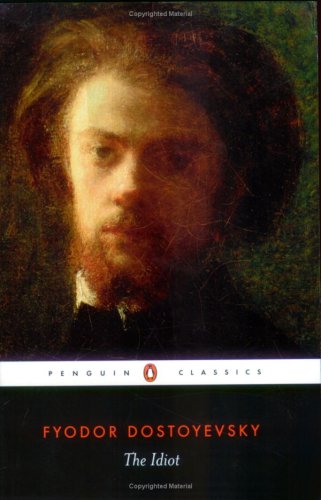
FYI, if you use Spark Notes, be prepared for spoilers. Yes, it’s still a spoiler even if it was written 150 years ago!
There is NO WAY I would be reading a heavy, thick book like Dostoyevsky’s The Idiot in traditional form. The only time I get “to myself” is while nursing (if you classify having another human being attached to you as time to yourself) and now I can read!
Until I started The Idiot, I was pretty smug about the mom brain thing – not this time, reading will keep my mind sharp. But the Russian names and complex plotting and character development are throwing me a bit. I’m having a hard time keeping the characters and their motivations straight. So now, I’ve got my Kobo in one hand, and SparkNotes on my phone so I can refer to the character list and read plot summaries. I’m not proud that I need this much help, but, I’m working on the list… on very limited sleep… and feeling pretty good about it.
I need to finish before I can fully comment, but, I’m finding similar themes as in The Magic Mountain – a naive young man meets and unconventional woman; corruption through drinking and disease; you know, light stuff. But more important that the ins and outs of this book – I won’t be an “idiot” on this maternity leave. I’m excited to get through even more great books in between Curious George and Little Critter’s adventures.
“A fool with a heart and no sense is just as unhappy as a fool with sense and no heart.”
Freedom! Horrible, Horrible Freedom!
The Corrections is #43 in the 2007 edition of The 1001 Books You Must Read Before You Die. Freedom is not on the list yet, but odds are it will be.
Freedom was only $10 on the Kobo, a steal compared to buying a hardcover and much faster than waiting for a hold at the library. But it’s really hard to blog about a book read on Kobo. I can’t flip back and find plot points and quotes. It’s been weeks since I finished and my memory is abysmal. I couldn’t remember the word “norm” tonight. And then I lost my keys. So, bear with me.
I am not nearly as impressed with Freedom as I feel I ought to be. I felt the same way about The Corrections (hardcover sitting on my bookshelf; Wee Book Inn score). Jonathan Franzen is a great writer, but I can just feel how hard he’s trying to say something smart/ironic/witty/whatever. I keep thinking, “oh, I see what you’re doing there”.
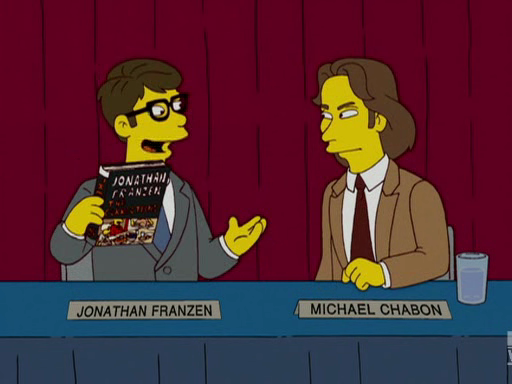
I am, however, impressed by any writer that guest stars on The Simpsons.
I wish the whole book was about Patty, a natural urban mama before it was cool to be one, and Richard, the hipster musician she loves and can’t have. Franzen uses their story to explore different meanings of “freedom” – from worry, from commitment, from love – and the whole thing is just drop dead romantic. He writes an album for her. Enough said!
But there’s a LONG interlude about her husband’s environmental crusade and affair with his young assistant. The environmental crusade becomes a bit of a soapbox for the childfree movement. I felt like I was reading Atlas Shrugged; I couldn’t tell if we were still on the story, or if I was now just reading someone’s political views (Franzen’s? He is childfree, but by default; it’s his wife who didn’t want kids). While this was all rather interesting, it was jarring and out of place. Or maybe, being a breeder and all, I don’t wanna think about how my precious babies will destroy the planet and just wanna read about loooove.
Weeks later, I’m struggling to remember everything important about this book, but the characters, particularly Patty, have stuck with me. I’m not as impressed as I ought to be, but I’m very impressed when a childfree guy like Jonathan Franzen creates such a real and complex character who happens to be a stay-at-home-mom.
“She had all day every day to figure out some decent and satisfying way to live, and yet all she ever seemed to get for all her choices and all her freedom was more miserable. The autobiographer is almost forced to the conclusion that she pitied herself for being so free.”
 Reading in Bed