Tagged: Book review
20 Books of Summer 2025

A refreshed 20 Books of Summer challenge is upon us! Unlike last year, I do have 20 books to choose from, but it’s more realistic for me to commit to ten. My most successful 20 Books of Summer was my first, in 2019, when I read and reviewed 14 books, but I’ve never come close to that again. I join this challenge as an intention: to read these books (eventually) and to spend time writing reviews during the summer.
This year, new hosts have taken over for Cathy. I for one welcome our new overlords, AnnaBookBel and Words and Peace.
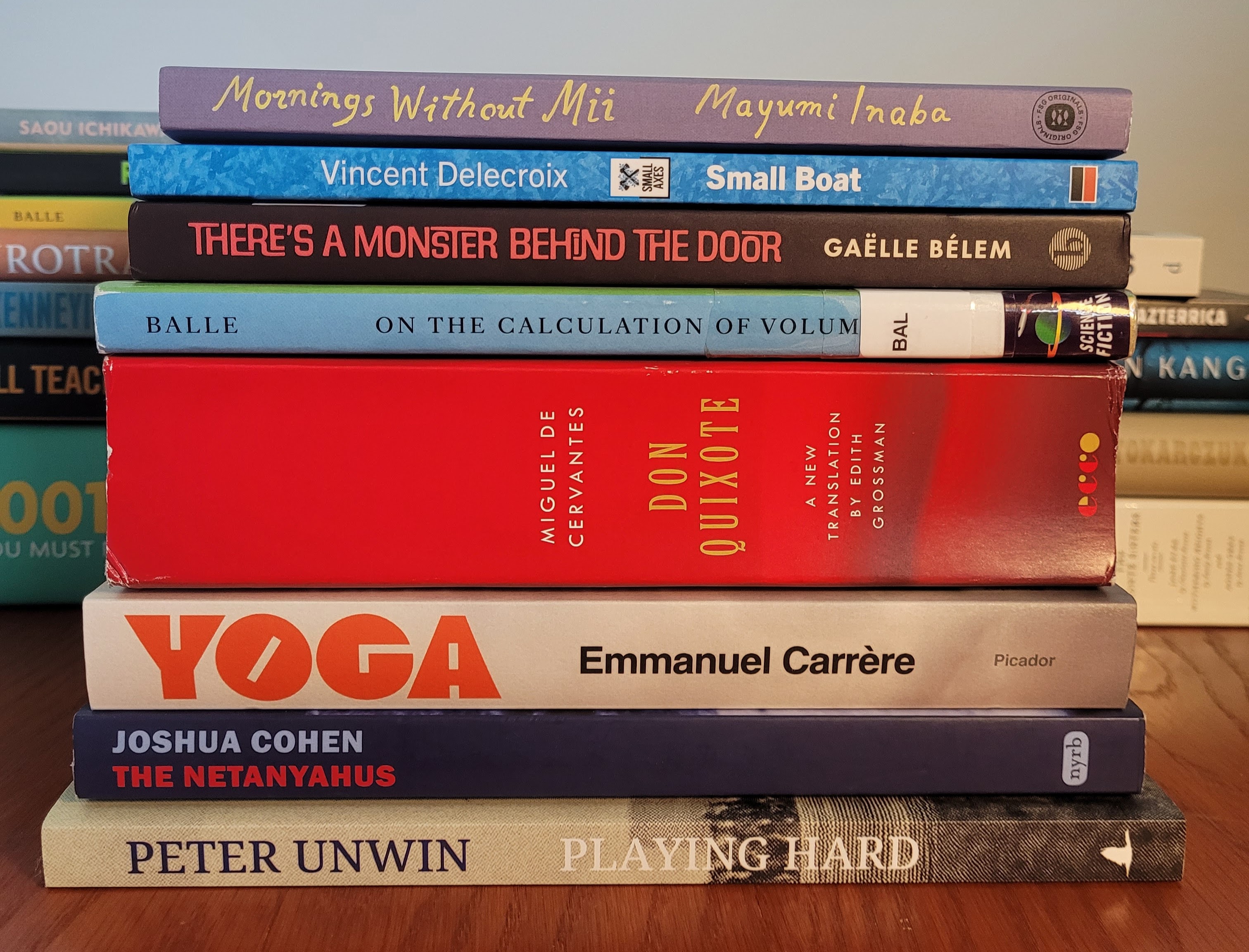
My list is another random assortment of books in my house or that could be in my house soon:
- Less by Andrew Sean Greer (cheating because I’m halfway through it now)
- The Netanyahus by Joshua Cohen (carry over from last year)
- Athena by John Banville (the last in the Book of Evidence series)
- Small Boat by Vincent Delacroix tr. Helen Stevenson (an IBP shortlister)
- There’s a Monster Behind the Door by Gaëlle Bélem tr. Karen Fleetwood and Laëtitia Saint-Loubert (an IBP longlister)
- Playing Hard by Peter Unwin (a review copy, a collection of essays about games and sports)
- Don Quixote by Cervantes tr. Edith Grossman (I thought about doing a read along but I’m too lazy)
- Mornings Without Mii by Mayumi Inaba tr. Ginny Tapley Takemori (cover buy!)
- Yoga by Emmanuel Carrère tr. John Lambert (been on my TBR since I read this review)
- On the Calculation of Volume II by Solvej Balle tr. Barbara Haveland (next in the septology)
Join in and let’s review some books! I promise to comment on yours if you promise to comment on mine.
Hunchback by Saou Ichikawa, translated by Polly Barton

In keeping with the spirit of this book, I will be brief.
Shaka is a wealthy middle aged woman with disabilities who lives in an assisted care facility. She says the following about holding a heavy book:
Holding in both hands an open book three or four centimetres in thickness took a greater toll on my back than any other activity. Being able to see; being able to hold a book; being able to turn its pages; being able to maintain a reading posture; being able to go to a bookshop to buy a book—I loathed the exclusionary machismo of book culture that demanded that its participants meet these five criteria of able-bodiedness. I loathed, too, the ignorant arrogance of all those self-professed book-lovers so oblivious to their privilege.
I found it ironic that many reviewers criticize the book for being too short, with underdeveloped characters and plot. To be fair, Hunchback is extra short, stretched over 90 pages in my edition due to wide margins and small pages. But I thought it was clever to have the form follow the spirit of Shaka’s complaint.
Ichikawa packs a ton into those pages – a frame narrative, excerpts from Shaka’s erotic fiction and tweets, literary allusions, some Covid commentary, and yes, a plot – a pretty shocking one!
The frame narrative stars Mikio, a persona Shaka uses to write erotic fiction, which we get to sample in the first few pages. At the end of the book, Mikio reappears and upends everything, in a way that I of course cannot describe here.
Shaka’s story, within this frame, is encapsulated in this anonymous tweet:
My ultimate dream is to get pregnant and have an abortion, just like a normal woman.
Shaka’s not serious at first – it’s more of a provocative commentary on rights for people with disabilities. But when she starts to act on this impulse, Hunchback becomes a story about class as well as disability. She finds a poor “beta male” who works in the assisted living facility to make her dream into reality.
And here’s where I had a little trouble. The scenario is a little far-fetched. The author has said that about 30 percent of Hunchback is based on her life. She asks the reader to believe a lot of convenient things, presumably the fictional 70 percent, to drive the plot and give it symbolic weight.
What ensues is a very twisted Normal People scenario in which a rich girl alternately wants to submit to, and assert her power over, a poor boy who is sort of her employee (this boy is no Connell though, alas). If Ichikawa appeased the critics and developed the story further into the future, or delved into Shaka’s past, it could have become even more artificial. As it stands, the somewhat-convenient plot is balanced by the strength of the writing and the astonishing ending.
The International Booker Prize jury found something compelling in short narratives this year. With the exception of Solenoid, each longisted book is under 300 pages, and most are under 200. Hunchback is not underdeveloped at all. The length works, thematically and structurally.
If I have a criticism, it’s that the narrator’s erotica and shitposts are pretty tame, and I’m not sure if that was intentional or not. But that might say more about my reading and scrolling habits than anything!
On the Calculation of Volume I by Solvej Balle, translated by Barbara Haveland
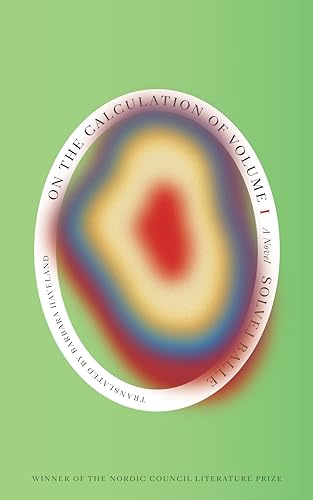
On the Calculation of Volume I is a compelling read, which is impressive, given that very little happens, and the end of the book is not the end of the story. It’s the beginning of a planned septology, and the last two or three books haven’t even been written yet.
Like The Unworthy, this is a novel written as a diary of a woman who is going through something strange, but unlike The Unworthy, that point of view is perfectly executed. You get the sense that the author has a bigger purpose, a structure that isn’t obvious yet, that needs to be played out in seven parts. I hope it’ll come together just like the calculation of volume came to Archimedes. Just know that there is no “Eureka!” moment in this first book.
Before we talk about what this narrator is going through, I recommend you read this review, in The Cut of all places, which provides some important background on how this book came to be. If you are, like me, annoyed by ambiguous timelines and convenient ways of circumventing technology, it’s helpful to know that Solvej “conceived of On the Calculation’s concept in 1987, then started writing in 1999.” I learned this after finishing the novel, and was instantly less annoyed by the fact that the narrator doesn’t try to use technology to figure out what’s happening to her. If there ever was a time to google “[problem] + reddit”, this is it…
The problem is that, as the story opens, Tara Selter has been living the same day, November 18th, over and over again, 121 times and counting, while the rest of the world is seemingly reset overnight and experiencing a normal, one-and-done day. Her diary takes us back to the first November 18th, the one that was preceded by November 17th, then through some of the intervening 120 November 18ths, and then forward through an entire year of them, without making the diary device feel forced or artificial.
Most of the book is given over to the practical problems of existing out of time, of which there are many. How many times can Tara explain her problem to her husband in the morning, get his help and advice through the day, just to wake up and have to explain it all over again? How long can she hide out in her own house, or other houses, to avoid him when it becomes clear that he’s holding her back? How much food can she eat before the empty cupboards in the house, and then the store shelves in town, are noted? How closely can she observe the world for deviations in how the day unfolds, whether in the movement of stars, or the way a person in a Paris hotel drops a piece of bread at the same time every day, and will those deviations lead her to a way out of November 18th, and back to the regular passing of time?
The most magical thing this book does is make one wonder who has it worse: Tara, stuck in one day, with no way to have a relationship with anyone or anything that lasts more than 24 hours; or everyone else, moving through their November 18th like automatons, unable to exercise free will or see beyond the ruts they run in. Only Tara can step back and try new routes and new angles, and see the possibilities that exist in one day.
One missing element did annoy me though. I kept wondering whether or not Tara gets periods or if she could get pregnant. Hubby’s always willing, no matter what iteration of November 18th we’re in or how far they get in their time travel investigations, and no birth control is mentioned. Other bodily functions seem to move forward, even though the days don’t. Nothing snaps a woman in line with time and seasons and cycles more than all that. But in addition to not knowing what year it is, we also don’t know how old Tara is, so I don’t really know how much of a factor this could be.
I guess we have six more books in which to figure that out, along with more pressing questions like why did this happen to Tara and how can she break free? I look forward to shouting “Eureka!” in a few years, once those last books are written and translated into English – assuming I don’t fall into a time warp before then.
Best Books of 2024
Unlike my worst books of the year, I don’t see coherent themes in this list, nor is there a clear standout. None of these are perfect; they all annoyed me, just a little, in some way. In whittling the list down to ten, I tried to keep only the books where the annoyance is more about me than the book. In the order I read them:
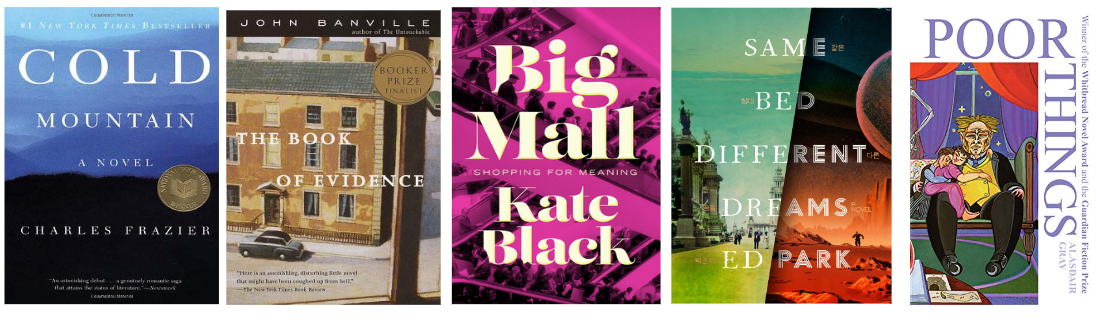
- Cold Mountain by Charles Frazier. They don’t write them like this anymore. Sprawling historical love story based on The Odyssey. Bonus: gave us a great movie adaptation starring Jude Law at peak hotness.
- The Book of Evidence by John Banville. This actually could be a standout. Pitch perfect, creepy as hell, and based on a true story, but this book does so much more than recount or sensationalize.
- Big Mall by Kate Black. If you want to read about the intersection between resource extraction, colonialism, animal cruelty, violence, tourism, architecture, and your local shopping mall, this is probably your best (and only) bet. My review and interview here.
- Same Bed Different Dreams by Ed Park. This reminded me of Infinite Jest (complimentary) not only in content – sports, alternate history, Canadian subplot that I didn’t see coming- but in how it blew my fucking mind.
- Poor Things by Alasdair Gray. Yes, it was a book first. Yes, the book is “better,” in that, there’s more there, and more of Bella Baxter in particular.
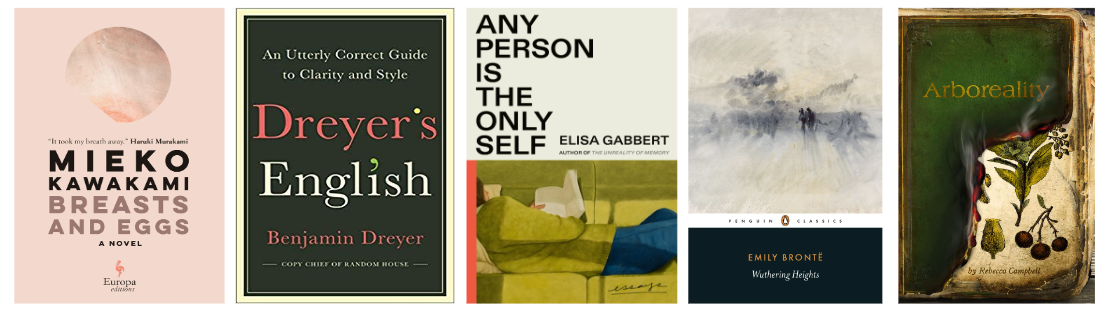
- Breasts and Eggs by Mieko Kawakami, tr. Sam Bett and David Boyd. I stayed away from this one for too long because I had the impression that it was one of those very on-the-nose feminist “message” novels, but it’s not. It’s brilliant.
- Dreyer’s English by Benjamin Dreyer. A rare case of an author’s social media presence selling me on a book. He vindicated my pickiness about Oxford commas and insistence on the proper use of “begs the question.” It’s the perfect book to read while falling asleep (complimentary.)
- Any Person is the Only Self by Elisa Gabbert. This is what I was looking for in the handful of millennial woman writer/critic essay collections I read this year. Humour, literary criticism, and, notably lacking in the others I read this year, humility.
- Wuthering Heights by Emily Bronte. If I reread WH in a given year, it will appear on my best books list.
- Arboreality by Rebecca Campbell. A near-future climate disaster novel in which things start going downhill rapidly in 2025 might be a bit much right now, so I’m glad I read it in 2024.
I don’t need to ask for your best books, we’re all posting them. Keep them coming!
Worst Books of 2024
It’s the most wonderful time of the year, even though I only make this kind of post every couple of years. In 2016, I was annoyed by The Glass Castle and The Dead Ladies Project. In 2018, I was exasperated by Sick and American War. In 2022, I was bored by The Autobiography of Alice B. Toklas and Cold Enough for Snow. This year, I’ve been annoyed, exasperated, and bored by a new crop of books:
Nonfiction that tricked me with clever subtitles:

- Code Dependent by Madhumita Murgia: I love a bit of tech skepticism, and the subtitle “Living in the Shadow of AI” seemed to fit the bill, but it was written in a very stilted manner and failed to connect any of its stories about people affected by AI. I could almost see the “[insert humanizing background story here]” at the beginning of each chapter. I wanted to get to the nitty gritty!
- Pause, Rest, Be by Octavia Raheem: The subtitle, “Stillness Practices for Courage in Time of Change,” must have caught my eye in March, while I was emerging from survival mode after a house fire. The “practices” part was pretty good; there are detailed instructions and pictures on how to achieve restorative yoga poses, which would work for newbies and yogis alike. The narrative, however, is a mishmash of new age and Christian woo woo, and relies on the same tricks many other self-help-ish books use to seem substantial and profound, like repetition and a lot of white space.
- Wintering by Katherine May: Another subtitle that got my ass! “The Power of Rest and Retreat in Difficult Times” echoes Pause, Rest, Be, and I read these almost back to back, which was a big mistake. Wintering pissed me off so much. The big reasons (the maddening vagueness about what exactly was making the times so “difficult,” the blithe manner in which she flaunts her staggering privilege, the lack of understanding or curiosity about what actual winter is like in northern climates) are dwarfed by something that’s so silly, but she’s basically a bitch eating crackers at this point (I can’t find a good link to what this means, iykyk). She recommends going to the grocery store right before Christmas as a self care strategy. Or more precisely, something like going to the “green grocers” for “jams and jellies,” and I laughed out loud. I can’t think of anything I associate LESS with “rest and retreat” than venturing out in -20 temps, driving on icy roads, battling the crowds at Walmart, and spending hundreds of dollars on inflated groceries. Not to gatekeep, but I don’t think you should be allowed to write a book about winter if you live in a place where the average winter lows are above freezing.
Short translated works, reviewed shortly:
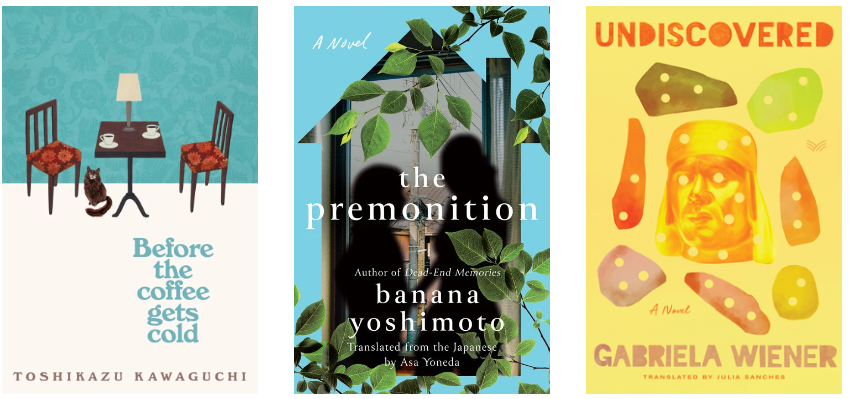
- Before the Coffee Gets Cold by Toshikazu Kawaguchi tr. Geoffrey Trousselot: One day I’m going to accept that I like weird Japanese fiction, not cute Japanese fiction. And this isn’t even cute, unless you find rigid gender roles and vaguely anti-choice sentiment to be cute!
- The Premonition by Banana Yoshimoto tr. Asa Yoneda: This started out more promising, no cuteness here, but revealed itself to be a lot of YA-style wish fulfilment and Holden Caulfield-style complaining about phonies.
- Undiscovered by Gabriela Weiner tr. Julia Sanches: This is literally a personal essay, and not a very good one, but somehow got longlisted for my favourite fiction prize?
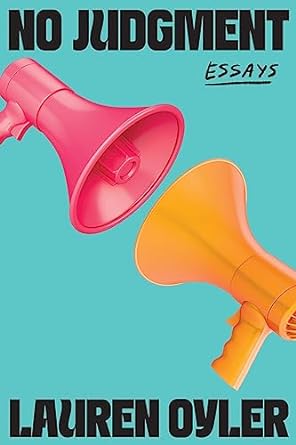
Lastly, and worstly, this one would fit under “nonfiction”, but, it doesn’t have a subtitle on the North American edition (the UK edition, inexplicably, does, “On Being Critical,” which, lol.) The author is a literary it girl known for her negative reviews, and more recently, for a novel that flopped: yes, it’s Lauren Oyler’s essay collection No Judgement. I wanted to write a full review, but sort of felt like it’s all been said. So let me take a moment to say just a little more.
The worst thing about this book is Oyler’s withering disdain for the reader, and it permeates every single essay. I mean “reader” in both senses: the particular reader holding the book, and the class of people who merely read, and aren’t writers themselves. This is pretty rich from someone who’s bibliography consists of a mediocre novel and a widely-panned essay collection.
While most of the essays are simply self-important and wanna-be edgy, it’s the essay about Goodreads that broke me. It’s not just cringy, it’s wildly inaccurate, in ways that are immediately obvious to us lowly readers in the Goodreads trenches. Kathleen Hale and Lauren Hough are uncritically presented as victims of “review bombing,” and this is stupid enough, but it’s also like… this is all drama that happened five to ten years ago. Who cares at this point? Is she just mad that Fake Accounts has an abysmal 2.83 Goodreads star rating? I cannot fathom what else could have sparked this essay in particular, or the book as a whole.
It’s unfortunate that Oyler’s best writing, her scathing reviews for Bookslut, are lost to the sands of time and bit rot. We needed the push back against Roxane Gay in 2014. We don’t need any of this in 2024.
Whew! Now, I haven’t done one of these “what about you” kickers in a while, but truly, I want to know what your worst books of the year are. Hit me up in the comments.
Laser Quit Smoking Massage by Cole Nowicki

Are “short essay collections” a thing? Flash essays? Micro essays? I don’t know that I’ve ever read a collection like this before: 25 essays in 144 pages for an average of under 6 pages each. A couple of them come off as a little underdone, but most of them feel full: of odd characters, familiar places, and moments of catharsis and recognition. And humour! I laughed out loud at a joke about Balzac, Alberta, which does indeed sound like “ballsack” – as my kids will note every time we pass it on the way to Calgary.
Speaking of Alberta, I thought Big Mall would be the most locally and personally relevant book I’d read this year, but another millennial Albertan who eventually moved to Vancouver has entered the chat. Cole Nowicki grew up in Lac La Biche, Alberta, a town familiar to me because it’s close to a friend’s lake lot, where I would go camping (under duress) when the kids were small. Going to the Timmies, or the oddly-punctuated “The Bargain! Store” was a highlight of those trips.
It doesn’t really matter if you’ve been to Lac La Biche, though, or if you understand why it is a big deal that they have a Boston Pizza there. These are the best kind of personal essays, where the very specific experiences and interests of one person reveal something universal. You probably didn’t have a conversation with your mom about Blink-182 lyrics as a child, but you will recognize (I hope) the comfort to be found in the commiseration of a parent. You probably didn’t watch a parent go through a mental health crisis (I hope) but you will recognize the pain of growing up and realizing that your parents can’t or won’t commiserate with you the same way anymore.
I also enjoyed the essays that were a little less personal and more about the absurdities of the places we live, IRL and online. “The Big Dog in the Sky is Dirty”, about a sculpture of a poodle in Vancouver, doesn’t take an obvious position for or against public art, but exposes the class implications and bureaucracy around who gets to experience it. There are no pictures in these essays, but Nowicki also maintains a blog where you can read an earlier version of this essay and see the poodle in question.
There were other essays that could have been enhanced with pictures (“The Dark Lord of Vancouver Karaoke”, just to verify that “Arcanabyss” is a real guy, which he is) and one where I was very glad there weren’t (“A Brief History of People Finding Weird Shit in Their Ears”, which was horrifying in exactly the way you think). Early adopters of the internet will appreciate the lore around gail.com and “pooptime”, a website that I thought must have existed in the early aughts era, between “bathroom books” and social media, but was somehow still publishing content in 2018.
The only essay that fell a bit flat to me was the skateboarding one. The “well-worn cliche” of how skateboarding mirrors the growth and upheaval of adolescence is acknowledged early on, and for me, the essay didn’t overcome that. This tracks for me, as I regularly read Nowicki’s blog, Simple Magic, but skim over the hardcore skateboarding stuff. I keep coming back because I find so many gems (which are usually at least skateboarding-adjacent.)
This is the first of my 20 Books of Summer challenge. I enjoyed it so much that I immediately started another essay collection, No Judgement by Lauren Oyler, which is much bigger – in length, in scope, and in public reaction. Laser Quit Smoking Massage is easily the better collection, in terms of choice of subject, use of humour, and respect for the reader’s time and attention (I’ll expand on the latter if I review No Judgement.) I don’t foresee any hit pieces in Bookforum for this one, I hope readers give it a chance anyway.
20 Books of Summer 2024
20 Books of Summer has always been more about the motivation to *actually review* books for me, not reducing my TBR, and never more so than this year. I don’t own 20 books, let alone 20 books I haven’t read before. Hence the shorter list.
This year is special though, as it’s the tenth anniversary of an event that started as a TBR challenge with 8 participants that now attracts upwards of 100 bloggers each year. No mean feat given the state of blogging today and the fact that this is a rather high-commitment event (with very relaxed rules to make it manageable.) Congratulations to Cathy for keeping the pages turning and the reviews rolling in since 2014.
My list of 15 has no theme other than “these are books in my house or that I might get into my house at some point this summer”:
- Breasts and Eggs by Mieko Kawakami tr. Sam Bett and David Boyd (for Women in Translation month, perhaps)
- The Wars by Timothy Findley (a CanLit classic)
- A Tree Grows in Brooklyn by Betty Smith (an American classic)
- The Netanyahus by Joshua Cohen (has been recommended to me many a time)
- Agnes Grey by Anne Brontë (the book I was rereading at the time of our house fire, apologies to Edmonton Public Library for the lost copy!)
- Jane Eyre by Charlotte Brontë (it’s in the edition I got in order to read Agnes)
- Wuthering Heights by Emily Brontë (see above and it’s time for a reread anyway)
- Ghosts by John Banville (the next in the Book of Evidence series)
- Brooklyn by Colm Tóibín (a rare instance of “seen the movie, not read the book” and preparation for…)
- Long Island by Colm Tóibín (the much-anticipated sequel)
- Kairos by Jenny Erpenbeck tr. Michael Hofmann (my tradition of reading the International Booker Prize winners continues)
- Laser Quit Smoking Massage by Cole Nowicki (a slim essay collection)
- A Year of Last Things by Michael Ondaatje (a slim poetry collection)
- When Things Fall Apart by Pema Chödrön (they sure have been)
- The Tenderness of Wolves by Stef Penney (a Little Free Library pick)

Join in and let’s get this TBR back down to zero, or at least review some books this summer!
Why I want to be friends with Imbolo Mbue (and a review of her novel Behold the Dreamers)
I have no time for Booktubers who apologize for not knowing how to pronounce an author’s name – look that shit up! And so I did for Imbolo Mbue (Em-boo-wey), author of Behold the Dreamers, and discovered that, in addition to having four letter names that are difficult to pronounce, we both worked in market research, and we both love Jonathan Franzen.
Today, I still work in market research, while Mbue is a famous novelist; and the closest I got to Franzen was being in the same room, while she shares an agent with him. But I’m not the jealous type. I totally think we could be friends.
I made friends with her novel and reviewed it here:
What author do you think you could be friends with?
 Reading in Bed