Let’s Get Infinite
Dave Eggars writes in the foreword to Infinite Jest, “This is not a book to be read with a child on your knee.” I’m paraphrasing, as I actually have a child on my knee right now and can’t get up to find the book. Continue reading
Two times this year, a book has let me down by not being dark enough. I felt like the authors held back to make things a little more palatable – The main characters got off too lightly. There wasn’t enough at stake. Things resolved themselves a little too neatly.
I don’t like it when a story feels reigned in. I want the characters to hit bottom and keep falling.
I do feel a little guilty about this. Why do I want bad things to happen to good characters, and why do I roll my eyes at a happy ending? Schadenfreude? Shock value? Or, am I not quite over my goth phase of 1996-1997? I think it’s a bit of all of those things. I need an emotional connection to really enjoy a story, and the dark and depressing route is the easiest way to my heart.
Here are the two examples that came up this year, the darker alternatives I found, and even more dark recommendations for the long winter nights ahead. BONUS: All four books featured below are by Canadian authors!
Reading in Winter is having a month-long first blogiversary celebration! This week’s feature is a profile of Edmonton book bloggers, including yours truly. Today, I’ve turned the tables and asked Kristilyn the same questions she asked each of us. Here’s a look at one of Edmonton’s most prolific readers and bloggers. Enjoy!
Psst… Are you a book blogger in the Edmonton area? Head on over to Reading in Winter and get in touch with Kristilyn if you’d like to be added to the Edmonton Book Bloggers Directory!
“There is no law past here.”
My husband (then boyfriend) and I passed the hand-lettered sign on a dark stretch of highway on Grand Manan Island, New Brunswick. The whale watching tour we’d planned was cancelled due to rain, so we decided to go off the tourist path to Dark Harbour. This side of the island was rough and isolated. After passing the sign, the road simply ended at a beach. This was not a tourist spot. The people there were working – getting on or off a boat while dulse was drying on racks. No one said hello or smiled. There was something about the situation that screamed “leave,” and we did.
The rest of our trip was all quaint B&Bs, cafes and gift shops. But we’d seen something else. Something that wasn’t meant for us. Some of my family had told us about a group of local vigilantes who burned a drug house down recently. Did the sign have something to do with that?
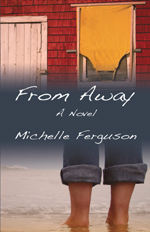
I thought about this experience as I read From Away. I share a lot in common with Marion, the main character. We are both from Alberta, but feel some claim on the East Coast, because “our people” are from there. Like Marion, I visit every couple of years and consider myself an honourary Maritimer. The premise of this book, an outsider trying to find her place in a small maritime
community, was interesting. Continue reading
So there is this article, in which guy-author Jeffrey Eugenides accuses lady-author Jodi Picoult of “belly-aching” about the fact that she doesn’t get any love from the New York Times. I hate how soundbites are taken out of context, so here is the full quote, emphasis mine:
I didn’t really know why Jodi Picoult is complaining. She’s a huge best-seller and everyone reads her books, and she doesn’t seem starved for attention, in my mind — so I was surprised that she would be the one belly-aching. There’s plenty of extremely worthy novelists who are getting very little attention. I think they have more right to complain. And it usually has nothing to do with their gender, but just the marketplace.
Hmm, you mean she wants to be commercially successful AND respected? How dare she! Complainer! And really, does ANYTHING have “nothing to do with gender?” My feminist spidey-sense are tingling…
Then I read this Jezebel article. Jezebel has a feminist perspective, and I was ready to be righteously outraged… but I totally wasn’t. The author doesn’t deal with the fact that Eugenides writes literary fiction while Picoult writes commercial fiction, so all the ranting about how ladies aren’t taken seriously is moot because literary fiction is more deserving of publicity and attention… isn’t it? Maybe Eugenides is right, it’s all about the marketplace…
I was feeling very conflicted and icky. I didn’t expect to agree with a guy who accuses a woman of “belly-aching” because she demands the same sort of respect her peers are getting. But then, I don’t see a situation in which I would ever read a Jodi Picoult book on purpose. Jeffrey Eugenides is brilliant and wrote one of my favourite books, The Virgin Suicides. So am I sexist, a book snob, or both?
Then I read this article (tweeted by @jenniferweiner. Follow her.) The author takes the time to research the background, present some actual data, and break down the issues. There are a couple of things going on:
The whole “belly aching” controversy seems like a smoke screen to distract from the real issues. Kind of like that whole “mom wars” silliness a few months ago. There is ABSOLUTELY sexism in publishing and in writing and in reading. I’ve been reading the classics for years, and it is a vast sea of dead white dudes. Think it’s not a problem today? Nearly all of the current New York Times hardcover bestsellers are by male authors. If you add e-books to the mix, suddenly half are by female authors – thanks to E.L. James are her ilk.
I’m trying to assuage my feminist guilt by stacking my Classics Club list in favour of female authors. I still only made it to 19/50 books, and that was difficult. Maybe I need to write a book.
Do you think the publishing industry is sexist? Do you make an effort to read female authors?
Who knew I could do enough book and bloggy things in one month to warrant an update?
September was a challenging month. Henry went through pink eye, thrush, teething, and colds. He still doesn’t sleep at night. Or ever. But, I feel like I’m getting back into a groove. My commitment to read every day helps a lot. There were a few days where it didn’t happen, but usually, if I tell myself “just one sentence,” I’ll end up reading a few pages. I may never be as prolific a reader and blogger as most, but this feels good.
I got books! And things!
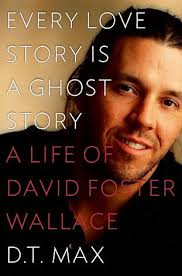
Won: Every Love Story is a Ghost Story by DT Max, a biography of the late David Foster Wallace. The Edmonton Journal’s book columnist Michael Hingston (@mhingston) had an extra copy to give away and I entered on a whim; I’ve never read any of DFW’s work. I was going to jump right in with Infinite Jest, but Michael suggested I start with something a little less ambitious, like Consider the Lobster. “Considering” that Infinite Jest is more than a thousand pages long, I think I’ll take that suggestion. Check out Michael’s blog for lots of local literary goodness.I read books! Yes, plural, BOOKS.
I did things on other blogs!
Here’s to an even more productive October. And hopefully some sleep.
I was so bothered by not having the exact quote I wanted for this post that I bought a myself a new hardcover copy of Love in the Time of Cholera. I could only find the first sentence of this passage online, and it was driving me nuts. Here it is in its entirety. I just love this!
It was also the time when he happened to find in one of his mother’s trunks a liter of cologne that the sailors from the Hamburg-American Line sold as contraband, and he could not resist the temptation to sample it in order to discover other tastes of his beloved. He continued to drink from the bottle until dawn, and he became drunk on Fermina Daza in abrasive swallows, first in the taverns around the port and then as he stared out to sea from the jetties where lovers without a roof over their heads made consoling love, until at last he succumbed to unconsciousness. Transito Ariza, who had waited for him until six o’clock in the morning with her heart in her mouth, searched for him in the most improbable hiding places, and a short while after noon she found him wallowing in a pool of fragrant vomit in a cove of the bay where drowning victims washed ashore.
I love that I have a brand new copy of this book. Now I’m on a mission to pick up nice hardcover editions of my favourite books. For Love in the Time of Cholera, I chose the first edition cover art. I was so not impressed when it arrived with the Oprah’s Book Club stamped on it. Ugh. Going to watch for that next time.
Do you buy special editions of your favouite books? Are you picky about book club logos? Am I being overly snobby or what?
Vineland by Thomas Pynchon is #176 in the 1,001 Books You Must Read Before You Die.
This isn’t a review of Vineland. I’m not ready for that yet. But I really want to talk about it, so I’ll begin with a shout out to Matt Bowes of This Nerding Life for bringing Vineland to #yegbookswap. I was one of the last to choose an adult book, and there wasn’t much left except for Pride and Prejudice (read it) and The Count of Monte Cristo (too long), and Vineland. I’d never heard of Vineland, and only had Matt’s reason for choosing it to go on. He wrote, “For some reason, I love ’60s burnouts. Hopefully you will too.”
Burnouts are just the beginning. There are also zombies, ninjas, and yuppie lumberjacks, to name a few. The narrative is layered with multiple flashbacks, flash-forwards, dream sequences, and narrators interrupting each other; and full of pop culture references both real and invented. It’s the kind of book you just want to devour. One night I informed my husband that he was in charge, walked to the park, and read for a solid hour, but apart from that, it was read in chunks of ten minutes here, and twenty minutes there. It was hard to keep the plot straight reading this way, so I looked for a reader’s guide, and found Babies of Wackiness.
Babies of Wackiness is not your typical SparksNotes-type reader’s guide. It was created in 1990 by Pynchon super-fans John Diebold and Michael Goodwin. They put the guide online in 1998 – and it shows. Old timers like me remember when most web pages looked like this.
Babies of Wackiness was exactly what I needed: succinct chapter summaries and a list of important passages, with a brief and accessible discussion on the major themes. I was so happy to see that my favourite passage was mentioned. I’ll leave you with that passage while I think about what else I want to say about this incredible book. Stay tuned.
The first time I read this, it took my breath away. I had to put the book down.
So the big bad Ninjamobile swept along on the great Ventura, among Olympic visitors from everywhere who teemed all over the freeway system in midday densities till far into the night, shined-up, screaming black motorcades that could have carried any of the several office seekers, cruisers heading for treed and more gently roaring boulevards, huge double and triple trailer rigs that loved to find Volkswagons laboring up grades and go sashaying around them gracefully and at gnat’s-ass tolerances, plus flirters, deserters, wimps and pimps, speeding like bullets, grinning like chimps, above the heads of TV watchers, lovers under the overpasses, movies at malls letting out, bright gas-station oases in pure fluorescent spill, canopied beneath palm trees, soon wrapped, down the corridors of the surface streets, in nocturnal smog, the adobe air, the smell of distant fireworks, the spilled, the broken world.
And, just because, here are my own babies of wackiness:
Occasionally, I am allowed to listen to the radio in the car between renditions of “Supercalifragilisticexpialidocious.” (Ben loves the “hum diddle iddle iddle hum diddle ay” part.) It’s important that I don’t play it too loud, or appear to be enjoying myself, lest Ben realize that we’re not listening to his music and demand that I “PUSH THE BUTTON.”
One day, when conditions were good, I was listening to the local modern rock station (Nirvana every hour, on the hour) when I heard the lyric, “She doesn’t know but when she’s gone I sit and drink her perfume.” I cranked the volume just long enough to figure out what we were listening to before switching over to Disney Soundtrack Hell, as it was clearly a reference to Love in the Time of Cholera, one of my all time favourite books.
“Sixteen Saltines” by Jack White is supposedly a big “eff you” to his former partner Meg White, but this lyric makes me think there’s more to it. In the book, unrequited lover Florentino Ariza drinks Fermina Daza’s perfume to literally make himself lovesick. It’s a powerful image, and I don’t think it was used accidentally. I would LOVE to provide a quote from the book, but I can’t find my copy. I’m a bad book owner.
I love literary allusions in music, and I especially love it when I find them myself, because then I get an “aren’t I clever” bonus. What are your favourite musical literary references?
A few asides:
I am in awe of blogs that have weekly summaries. Apparently, some people not only read a book a week (OR MORE,) but do other things, such as buy new books, take part in memes and challenges, and even blog. My pace is a little slower, but the end of summer feels right for an update and a look ahead.
How I Spent My Summer
What’s Up Next
It was motivating to have an end-of-year goal in 2011, even though I didn’t quite make it. This year, I’m on maternity leave, so I should have plenty of time to read, right? Hah! I have a very high-energy two year old who screeches when I’m not in his sight, and a six month old who doesn’t sleep. I’m in survival mode right now, and am lucky to read ten pages per day.
I recently came to an interesting (obvious?) realization; when I don’t read, I’m not happy. A few weeks ago, I was feeling burnt out to the point that I though I had postpartum depression again. I was also going days without picking up a book. Am I unhappy because I’m not reading, or am I not reading because I’m unhappy? Either way, I need to make reading a priority, but without a lot of pressure.
So, my 2012 goal is to read everyday. That’s it. Could be a chapter, a page, or a sentence.
Well, okay, there’s a little more to it than that. Here are some specific plans and goals for the rest of the year.
What are your reading goals for Fall?