I’ve lived within a 15-minute drive of West Edmonton Mall for more than thirty years. With 800+ stores as a backdrop, I grew from a teenage mallrat to a mom doing the back-to-school shopping. I had my first kiss in a photo booth near the mini golf course, and shopped for a wedding dress in the wedding district (upstairs, Phase I) 15 years later. In 2002, I watched Canada win gold* on a TV in Vision Electronics while on a break from my job in Galaxyland (formerly Fantasyland, long story) and in peak 2022 fashion, I got stuck inside a drugstore during a lockdown drill while waiting for a COVID shot.
Still, I sometimes forget that this is what Edmonton is known for. Not Oilers hockey, not the river valley, not the time we tried to make “Take a risk, it’s the most Edmonton thing you can do” happen, but a building that we just call “the mall.” It makes me think: Really? Her?
Big Mall is a deeply researched and deeply personal book that says yes, her. Kate Black breaks down why malls exist in the first place, how they proliferated, why they’re dying, and what it all means, through the lens of someone who grew up in the shadow of the world’s one-time biggest.
My International Booker predictions were a bust, again! Not that I committed them to paper (or blog,) but I was very much expecting to see My Heavenly Favourite by previous winner Lucas Rijneveld, and was hoping to see some Japanese lit after a shut out last year. No such luck.
2024’s longlist is South America and Europe heavy, with a single Korean novel representing Asia. Africa and the Caribbean are shut out entirely. There are no French language novels, a first since I’ve been tracking.
I’m not sure what I expected from this jury, headed up by one of my favourite radio personalities, Eleanor Wachtel, but this wasn’t it. Apart from Jenny Erpenbeck, these are all totally new-to-me authors, so maybe I’ll find a find a new favourite, heavenly or otherwise…
Now, the reason you’re here: the updated “How to read the IBP in Canada” spreadsheet. Check it out for all the details on where to get the books in Canada (and the States – but prices are in CAD). The longlist is fairly accessible, if you’re looking to buy, and about half are available at my library (shout out to the two people who got holds in ahead of me on all seven available titles! I was slow on the draw). There’s not much in the way of audio, and the ebooks are a bit pricey, but overall, us Canadians can get a good start on things ahead of the shortlist announcement on April 9.
The trick is to have your house burn down. Instant TBR zero.
Of course you also lose all your other TB piles: To Be Worn, To Be Eaten, To Be Slept on, To Be Cooked with, To Be Remembered By…
My house caught on fire on December 18. It started in the kitchen (cause still being determined) and was contained and put out quickly. I’d only been out of the house for about 45 minutes when I started getting calls from neighbours. It’s a mindfuck, because my house didn’t actually burn down, and my books, along with most of our belongings, weren’t actually reduced to ash. The smoke, soot, water, and asbestos are what get you. Despite the house looking okay from the outside, we lost almost everything we owned.
BeforeAfter
I didn’t have a single book “pile” or shelf. I had books on, under and on top of shelves, as well as on desks, coffee tables, bedside tables, and in drawers and closets. I also, thankfully, had a Google Sheet with a complete and up-to-date listing of each one of those books, including origin and cost for the more recent ones. (Did I have an inventory of any other items in the house? Of course not. BUT YOU SHOULD. START ONE NOW. TRUST ME.)
I don’t even have a “TBR” tab in my spreadsheet. It’s not something I think about much. I have a “wishlist” of books I don’t own but might want to, based on reviews or recommendations – the most recent addition is Bouvard and Pécuchet by Flaubert, as recommended in the NYT’s “Read like the Wind” newsletter. I also have tabs related to various “projects,” like reading the works of Dostoyevsky, or the 1,001 Books list. These are all TBRs of sorts.
But what people usually mean by TBR is “books you own but haven’t read.” TBRs sometimes include unread ebooks, but usually don’t include books you have on hold at the library, or books you are thinking about buying. A TBR pile is a real thing that you spent money on. By filtering on “unread” and filtering out “Kindle” and “Kobo”, I see that I had a TBR pile of 108 books, as of the morning of December 18, anyway.
In online bookish circles, TBRs are often framed as a problem, or at least something to be managed, an indicator of consumerism at best and hoarding at worst. TBR challenges abound; people have plans to get to a zero TBR, or under 30, or under 100. They will do this in a year, or six months, or as long as it takes.
I confess, “TBR” content is among my least favourite bookish content (if you are someone who does TBR stuff online, I don’t mean you. I especially don’t mean Cathy!). There’s not much to say about a book you haven’t read, after all, and I find the accounting side of TBRs (books in, books out, monthly reckonings etc.) pretty tedious, unless it’s my own.
I read some TBR posts and watched some TBR videos for the purpose of writing this, and found that most of the “tips and tricks” for TBR challenges have to do with “reading more”, not “buying less”, and often it’s not even about finding more time to read, or speeding up your rate of reading (though that content is certainly out there too). It’s more about convincing yourself to read from your pile, through random chance (spins, jars) or incentives (no buying books until the TBR is under 100.)
TBR challenges don’t often get beyond the here and now, and into the existential question of how many books you will read before you die, or more to the point, how many books you will not read. I started reading from the 1001 Books You Must Read Before You Die list before I even started blogging, i.e. before I’d heard of a TBR, and it’s the kind of list you don’t ever really expect to finish, so I guess I’ve always taken the long view on this. A pile of 108 books is less daunting if you think of what you might read over the next 40 or 50 years. And I don’t think it’s something to beat yourself up for.
Let your TBR or other book lists be about anticipation instead. Anticipate the great books you’re going to read, and the ones so bad they’re good. Anticipate filling in the blanks on things you’re interested in, and going off on tangents into new topics. Anticipate reading an author’s complete works and then adding their biographies, letters, and criticism to your ever-growing and changing TBR. Document it, be honest about it, but let it be a positive thing.
My TBR pile is gone. But I still have plenty of books that are “to be read” – almost every book ever written, technically. And of course, two months on from the fire, my TBR has regenerated a bit. Here it is, in its entirety:
The Tenderness of Wolves by Stef Penney (from a Little Free Library and solely because the blurb, “Like Cold Mountain but colder”, made me laugh out loud)
My Heavenly Favourite by Lucas Rijneveld (my first post-fire purchase)
I have two more, non-TBR books in the house: A smoke-damaged, signed first edition of Freedom by Jonathan Franzen (recovered along with other sentimental items – I did NOT run back into the house for it) and The Birthday Party by Laurent Mauvignier, which had been sitting on my desk at work. We will rebuild – in 2025, or whenever I get back into my house!
Here’s my actual “one weird trick” for dealing with your TBR: Don’t worry about getting to zero, because you might get hit by a bus tomorrow – or your whole pile might go up in flames.
Maybe it’s because I’m off Twitter, but I haven’t seen too much discourse about the Booker prize this year. I’m thinking about the years in which people whined about too many debut authors, because this shortlisted book struck me as very “debut-y” – or maybe it’s just me.
Two trusted reviewers, the hosts of Novellas in November, who chose this book as a buddy read, don’t feel that way. Cathy found this story of a grieving eleven-year-old girl coping through a newfound love of squash, deep and satisfying:
“The narrative arc of Western Lane has all the staples of a standard Hollywood movie: rising from tragedy through sport, a romantic love interest and a thrilling climax of competition, but Maroo presents this recognisable story with a restraint and insight that elevates it beyond cliché.”
Rebecca found it illuminating in terms of “what is expected of young Gujarati women in England; on sisterhood and a bereaved family’s dynamic; but especially on what it is like to feel sealed off from life by grief”.
Rather than write a comment on their blogs about why I disagree, I thought I’d better review it myself. But I find that I can’t refute their points! The things I found trite or formulaic, they found “accessible with hidden depths” (that’s Rebecca.) I agree that the lack of “stylistic flair” (Rebecca again) is effective, and becomes a style of its own through repetition of certain metaphors. I just didn’t like the metaphors.
My issue isn’t with any individual scene, or the style, but with the structure of the book as a whole. I felt like I could see the plot outline underneath the finished product, like if I could go back to an earlier draft, I’d see a note: “insert squash metaphor here.” In fact, all eight chapters begin with a squash metaphor. They were well written, but to me, utterly obvious in what they were meant to convey about grief, and after the first few chapters I was sick of them.
Had the writing not been restrained (as per Cathy,) this could have been a disaster. In between sports metaphors and the family members alternatively falling into or resisting gender and birth order roles, there were quietly powerful moments, some even illuminating. I gasped at a pivotal moment, when the young protagonist makes a decision that seems out of character, but actually reveals a lot about how grief and family turmoil have affected her. But even this moment makes me feel like I can see a ghostly Google doc comment like “put an obstacle in the character’s way before she gets to the final battle.”
Cathy and Rebecca aren’t the only ones giving rave reviews. Canadian author David Chariandy calls Western Lane“a book of simmering intensities, reverberating silences, and exquisite literary timing.” This is an apt blurb, as his debut novella Brother touches on similar themes of grief, sibling relationships, and second generation immigrant experiences, with an overarching metaphor (music in his case). In my mind, Chariandy’s book was much stronger, as the structure wasn’t visible to me. Nothing felt repetitive or forced, and the musical metaphors, which I suppose were as obvious as the sports ones in Western Lane, were revealed at just the right moment to create a very emotional reading experience.
But as my mom says, there’s no accounting for taste. We’ll find out what the Booker judges think soon enough!
Good news, everyone: my status as a Franzen completist is secure.
After finally achieving this status in late 2021, I unknowingly let it lapse for several months, after Franzen’s latest German translation was published in April of this year.
For reasons I cannot fathom, the Franzen tier ranking I published right at the end of 2021 has been my highest-performing blog post ever since. The stats page (like much else) on WordPress is pretty useless, no longer displaying many search terms or links or anything that would help me. Does anyone else know how to find out? Is a Franzen tier ranking really hitting some obscure SEO parameter?
Anyway, I updated the tier ranking, and as you might imagine, this one falls into the bottom tier along with Franzen’s other translation projects. Not to say they are bad,but they are not essential reading, in my view. I actually quite admire The Kraus Project. I just can’t, in good conscience, recommend it to anyone but a completist.
As for The Short End of the Sonnenallee, I sum it up in the tier ranking:
What if Spring Awakening was set in 1980s East Berlin, and the tone was “silly” rather than “tragic”? What if Franzen translated what is basically a YA novel, to add to his very mixed bag of translations? Read this novella to find out!
It is a rather silly book, about horny teens, but as Franzen points out in his introduction, that’s something of an accomplishment, given the very serious setting. These teens are living in the shadow of the Berlin Wall, harassed by guards and jeered at by gawkers from the West, with very limited possibilities for their futures. And I’m being a little silly myself when I call this YA. It is certainly concerned with youth, but we occasionally get glimpses into the post-reunification future. The parents and other adults, often played for laughs, have their moments too, as when Micha’s mother finds a Western passport of a much older woman, and attempts to make herself up to match the picture, but can’t follow through and actually leave. A running gag about asbestos is similarly played for laughs until it suddenly becomes serious.
The book didn’t really grab me. The tone was a bit too uneven, the focus a little too adolescent, but it is short and sweet, and great for Novellas in November. I’m also seriously thinking about a Purity reread, now knowing that Brussig inspired the section on 1980s East Germany. And that’s saying something, since Purity is only a B-tier book.
The title “Extremely Online” gave me the wrong idea about this book from the start. To be “extremely online” means not only to be online all the time, but to be steeped in the deep lore, to know who the “main character” is on any given day, to know a “bean dad” from a “wife guy”. After thirty years on the net, I would count myself as part of that group. I’ve posted on plain-text message boards in the 1990s, had a TikTok comment go mildly viral in the 2020s, and posted (or at least lurked) on many platforms in between.
But this book is not about posters or lurkers. Extremely Online is about “creators” – the people who are online to make money. The “extremely” part describes their reach and earnings. Lorenz profiles the creators in the 0.1%, who got in early, took undisclosed sponsorships, then legit ads and brand deals, sold branded merch, made millions, burned out publicly, were redeemed, or not, and spawned scads of imitators. They’re people I’ve heard of, maybe, but not the ones on my For You Page. Think Logan Paul and Mr. Beast.
The first section, on the roots of creator culture, did spark some fond memories. Socialite Rank is cited as an early example of the virality that “creators” today strive for. I was obsessed with that site and it makes a great case study. But after that, when the fates of creators become inextricably tied to social platforms like YouTube, Tumblr, Instagram, and Vine, the book becomes a dull litany of names, platforms, management companies, subscriber counts, and brand deals.
A boring nonfiction book can still be informative, especially for people new to a subject. But for me, this book misses the point entirely. Lorenz’s premise is that creators don’t get respect, and that she is here to give them their due. She marvels that platforms don’t “get” creators, don’t value them, won’t cater to them. She seems so close to taking this line of thinking a step further, and acknowledging that social platforms don’t exist to cater to creators, or users, or anyone except advertisers. They exist to capture attention and data and serve it back to you as ads. The content, and those creating it, isn’t the point and it never was.
November brings a variety of great book blogging events, and I’m lucky if I properly participate in just one. This year I’m going to attempt to join two of my favourites: Novellas in November, hosted by Cathy and Rebecca, and Nonfiction November, with a new slate of hosts, including Liz and this week’s host Heather.
Both events are organized by weekly themes, the first of which is: celebrate your year in nonfiction/novellas. Forgive me for grouping the weekly posts, but this is the only way I have a hope in hell!
My Year in Nonfiction
I’ve read nine nonfiction books this year, or about 20% of my total. That’s a little low for me, but a few were standouts (good and bad).
I Used to Live HereOnce by Miranda Seymour is a biography of Jean Rhys and while Rhys is a strong interest of mine, the book itself hasn’t stuck with me.
Run Toward the Danger by Sarah Polley is a memoir presented as essays. I didn’t have a special interest in Polley or her iconic role as Anne of Green Gables, but this one absolutely stuck with me. I will never look at a child actor the same way.
Run, Hide, Repeat by Paula Dakin is another memoir, more traditionally presented than Polley’s, that compelled me with its maddening story of family dysfunction and delusion.
The Life of Charlotte Brontë by Elizabeth Gaskell is a groundbreaking and emotionally complex biography. What it lacks in candidness (at times) it makes up for in empathy and care. Mini-review here.
Bliss More: How to Succeed in Meditation Without Really Trying by Light Watkins is more practical than literary, but I have kept up a pretty consistent meditation practice since reading it.
How to Calm Your Mind: Finding Presence and Productivity in Anxious Times by Chris Bailey was not groundbreaking by any means; more of a comfort read for those of us who are into productivity culture.
Easy Money: Cryptocurrency, Casino Capitalism, and the Golden Age of Fraud by Ben McKenzie with Jacob Silverman was also not groundbreaking but a fun read for those of us into crypto schadenfreude. Review here.
The Drowned and the Saved by Primo Levi is a sort of meta-memoir in essays, including many reflections on the Holocaust, and it was by far the most challenging of these books. Review to come.
Extremely Online: The Untold Story of Fame, Influence, and Power on the Internet by Taylor Lorenz is about a fascinating subject, but I was let down by how it merely skimmed the surface of influencer culture. Review in progress – pray for me, the author already blasted me on Twitter for simply sharing someone else’s negative review!
My year in novellas
I’ve read four novellas this year, plus a surprising number of novels with just over 200 pages – but those don’t count. I hope to increase this total in November!
McGlue by Ottessa Moshfegh concluded my reading of all her novels. This one was delightfully depraved (aren’t they all!)
The Ladybird by D.H. Lawrence was also pretty depraved, though a little more restrained than McGlue.
Revenge of the Scapegoat by Caren Beilin was the weirdest book I’ve read this year, which is saying something (see: McGlue)
The Nun by Denis Diderot rounds out the theme, with a weird and wonderful tale of sadistic and amorous nuns. Review to come.
We’re off and running! See you for another weekly post soon and hopefully a review or two besides.
I’ve learned a lot about crypto over the past few years, from various articles, tweets, and podcasts, but this is the first book I’ve read on the subject (no, Bitcoin Widow doesn’t count.) Ben McKenzie (yes, that Ben McKenzie) proves a pretty apt narrator. He’s skeptical by nature, educated in finance, at loose ends due to the pandemic, and just enough of a “name” that he can randomly reach out to an established tech reporter (Jacob Silverman) and convince him to embark on a years-long project. Easy Money is full of insider access (notably, an interview with a pre-indictment Sam Bankman-Fried) with an outsiders’ point of view – but I didn’t learn a lot about crypto itself that I didn’t already know.
That’s not McKenzie’s fault. If you’ve heard one crypto story, you’ve heard them all – they’re all Ponzi schemes, and they always collapse – then the founders disappear (or die?), or get arrested, or move on to the next scam. Like gambling, the key is knowing when to walk away.
More interesting, to me, were the insinuations made in this Bookforum review – the gossipy one, that perhaps McKenzie and Silverman had a falling out (a bit tenuous, based on this tweet), and the observation that this book was probably meant to serve as an eventual film project.
Thank goodness we get a couple months off in between 20 Books of Summer and Novellas in November. I must have needed it, seeing as I’ve only posted once in the interim (so far). One year I’ll have the stamina to do Victober in between, but this year is not that year. Here are my plans:
The recent additions: These books are newly borrowed or acquired, and just happen to be under 200 pages. They also happen to all be in translation.
Boulder by Eva Baltasar, translated by Julia Sanches. A straggler on my 2023 International Booker Prize reading list.
The Nun by Denis Diderot, translated by Leonard Tancock. A 1001 Books pick that I may have already started…
The Short End of the Sonnenallee by Thomas Brussig, translated by Jonathan Franzen and Jenny Watson. I need to maintain my Franzen completist status.
The Drowned and the Saved by Primo Levi, translated by Raymond Rosenthal. Inspired by the title of a Law and Order episode, of all things, but might be a timely read.
The TBR: Recent additions to my ever-growing TBR – meaning I haven’t acquired these yet but would like to.
A Month in the Country by J.L. Carr. I couldn’t begin to tell you have many times I’ve heard people sing the praises of this book. Here is the most recent.
Offshore by Penelope Fitzgerald. This was in the “references” section of recent Giller and Booker nominee Study for Obedience, and that’s all I need to know.
Night Walks by Charles Dickens. Based on this review; perhaps I’ll do a little Victobering after all.
The official group reads: Our hosts chose these books as the group reads this year. I approve.
A Room of One’s Own by Virginia Woolf. I already owned this, in a bind up with Three Guineas. I probably haven’t read it in twenty years.
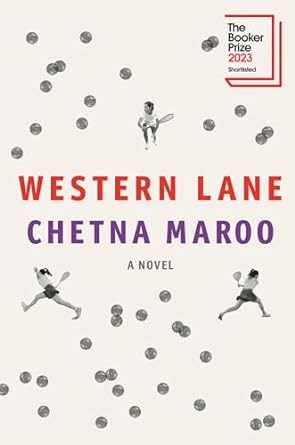
Western Lane by Chetna Maroo. I bought this as a brand new hardcover, despite knowing little about it. Living on the edge!
Thank you as always to Cathy and Rebecca, who have posted their own, truly intimidating TBRs!
The fact that Letterboxd still bills itself as “GoodReads for movies” on their about page is hilarious to me, and not just because they’ve inexplicably styled “Goodreads” with a capital “R”. Letterboxd surpasses Goodreads in almost every way: user experience, functionality, aesthetics, not being owned by Amazon… and while Goodreads members outnumber Letterboxd users ten-to-one, surely the potential is there – how many people do you know who watched a movie in the last month? How many who read a book? And which do people talk about more?
Goodreads has a stranglehold on the book-tracking market, despite not serving anyone particularly well – readers, authors, or publishers – and despite persistent bad press. Is it just network effects? First mover advantage? I spent a little time investigating why things have been allowed to get this bad, and then had some fun imagining what a “Letterboxd for books” would be like.
Why is Goodreads the way that it is
There was nothing wrong with Goodreads when it launched in 2007. In a web 1.0, barely-social world (Facebook had just opened to the public) it was a boon to readers.The problem is that the site has barely changed since then.
My homepage. Ignore my circa 2009 profile pic
The founders, a couple who met at Stanford and later married, had tech and journalism backgrounds, but they strike me as readers first and developers second. They sold to Amazon after rapid growth in the early 2010s and have since stepped away from the site. According to this recent Washington Post article, Amazon never intended to do much with Goodreads, apart from mine its data. Insiders claim that Goodreads is built on such old code and infrastructure, it would cost too much to update – I work in “digital transformation” in the public sector, so I get it – but if Jeffrey Bezos can’t afford to update some old technology, who can? Amazon decided it wasn’t worth it, and by letting it limp along into 2023 with 125 million members, they’ve made sure no one else has a chance make something better.







 Reading in Bed