What I’ve learned from five years of blogging

#1. That I will always click on a post titled “what blogging has taught me” or “blogger confessions” or “blogging life lessons,” even though:

#2 Those posts always say the same fucking things.

So this is not that. I’m not going to tell you to have an editorial calendar or to be consistent or to do guest posts or to use SEO techniques.

Life lessons were on my mind when I was asked to appear on Seen and Heard in Edmonton. The premise of Seen and Heard is brilliant, and will probably take off in other cities before you know it. Karen Unland interviews local bloggers about what they do, and why, and where they’re going. Not only is it fascinating for bloggers, but it’s a great way for people to find local perspectives on whatever they’re into. I’m guest #5. The other four have included bloggers who write about theater, business, food, and history. Seen and Heard also rounds up the best weekly blogs and podcasts every Monday morning, which is just a great way to start the week.

So – what wisdom could I impart to the Seen and Heard audience? I thought back to my biggest blogging moment this year, attending Book Expo America. Then I read this interview with burnt-out mega-blogger Dooce about why she’s quitting:

In 2004-5, I was the first personal website to take advertising. Now it’s why you start one. If you’re doing it for fun there’s nothing to worry about. If you’re looking to make an income, this is not a good way.

I rolled my eyes a lot at the BEA blogger con. So many panels about growing your audience and doing sponsorship and MORE content FASTER… featuring panelists who do not making money from blogging. The only ones making a living either work for Book Riot or spun their blogs into books. I heard “fun money” and “champagne money.” I heard bloggers admit that they were uncomfortable with affiliate links and that they didn’t even make any money from them. And book bloggers burn out all the time due to demanding schedules and publishers and expectations.

What’s the point? If you’re a hobbyist, like the vast, vast majority of book bloggers are, why kill yourself to post weekly, or get all the latest ARCs? Why not post when you want, when you really have something to say? Unless you’re out to make serious money or advance a career in the same field as your blog, none of this stuff matters.

If it all gets too heavy, just remember... (from Douglas Coupland's new book The Age of Earthquakes.)

If it all gets too heavy, just remember… (from Douglas Coupland’s new book The Age of Earthquakes.)

Click here to listen to Karen interview me and to read my list of blogger/podcast recommendations. Also check out the first half hour of the latest Write Reads podcast for more in this vein – Kirt and Tania talk to recently-burnt-out Rick of Canon Fodder/Through the Pages about what’s wrong with book blogging, and I wanted to jump through the computer screen and say “yes!” to all of it.

Okay, one Life Lesson: Whatever you’re worried about when it comes to your blog, no one cares as much as you. Do you think the blogosphere will grind to a halt if you don’t post that weekly meme? Do you think your readership will unfollow and denounce you on social media if you don’t participate in the latest hashtag? I promise you no one will notice. Keep blogging when you can, until you don’t want to anymore. That’s my plan.

Purity by Jonathan Franzen (Review #3)

Middlebrow and the Infinite Franzness

My pal Jason Purcell recently came out of hiatus with a discussion about the middlebrow:

This mini-review was going to be called “Infinite Franz” and was going to make some tenuous parallels between Purity and Infinite Jest, but once I got going, I found there weren’t as many as I thought. Then I watched Jason’s video, and got to thinking about how DFW and Franzen are often cited as examples of Great American Novelists, so they must both be highbrow, right?

Nope. Purity is way middlebrow. And that’s okay!

Purity is the most complex of Franzen’s big novels, but it’s still nowhere near as complex as Infinite Jest. Franzen’s strength is characters; DFW’s strength was, like, everything, so to see them both trotted out as “highbrow” is kind of weird! Infinite Jest is perceived as being inaccessible (my thoughts on that) and it’s certainly experimental. The only way to put the story together is to finish all 1,096 pages then go directly back to page 1, because the end is the beginning is the end. Purity is relatively linear. Like The Corrections and Freedom, there are multiple narrators, with some flashbacks and family history. There are more narrative threads in Purity, and more pieces to put together, and they don’t come together as easily, but it’s no trouble to follow the story.

Jason talks about Virginia Woolf’s assertion that the highbrow exists to reflect the lowbrow society, because those lowbrows can’t do it themselves. Franzen is known for writing about “big issues” and society and culture and all that. Like the narrative structure, I found that the “issues” in Purity were presented in more interesting ways than his previous novels. Chip’s Lithuanian adventures in The Corrections could only be satire. The child-free rants in Freedom could only be, well, rants. Purity mashes up German history and recent American scandal in a way that’s kind of outrageous but also realistic. The parallels between cold war Germany and the quasi-Wikileaks organization Purity works for aren’t shoved down our throats. All that said, Purity isn’t nearly as ambitious as Infinite Jest, which examines society in the 90s by comparing it to society in 2010, which is pretty crazy for a book published in 1996.

Franzen’s built up this highbrow persona (or, the media has,) but once you get into his work, it’s funnier, more accessible, and more comforting than you might expect. Reading DFW was more accessible than I thought it would be too, and more hilarious, but not comforting at all. I haven’t read a word of his since I read his short story Incarnations of Burned Children nearly two years ago, because I’m still reeling. SincePurity, my reading has been a veritable Franztravaganza: I read (not reread!) The Corrections and listened to The Discomfort Zone (read by the author) and am making plans to read How To Be Alone and/or Strong Motion soon.

If you really want me to prove Franzen’s middlebrow status, ask me to review The Corrections by comparing it to a Jennifer Weiner’s Fly Away Home. They’re basically the same story, minus the Lithuanians and lesbians: parents’ fuck-ups expose how fucked up their children are, mothers fixate on one last family gathering, sexual deviance and hilarity ensue. I think if they’d read each other’s books, they could put their whole feud to rest.

I guess this isn’t really a revelation. We knew it the minute Oprah chose him for her book club: Franzen writes excellent, readable, insightful, middlebrow fiction. And most days, like most people, I’ll take the middlebrow.

Purity by Jonathan Franzen (Review #2)

Fifty Shades of Franzen

Hey, did you know that Jonathan Franzen can’t write sex? He was even nominated for bad sex award a few years back.

You think I’d be all over this kind of criticism, but no. It’s stupid and lazy. Not just because the quotes are taken out of context and so rendered almost meaningless, but because it assumes that the only reason for a sex scene in a novel is to arouse the reader. Which… no. Sex can be bad. Gross. Awkward. Sometimes sex is a way to say goodbye, or a way to give in, or give up. It’s not always sexy. And novels? They’re just like real life! Sex scenes shouldn’t all be sexy and steamy and politically correct because life isn’t that way.

Anyway, those articles are about The Corrections and Freedom, which featured scatological fantasies and the C-word and such. The sex in Purity is a little different:

She could feel his hands trembling on her hips, feel his own excitement, and this was something – it was a lot. He seemed honestly to want her private thing. It was really this knowledge, more than the negocitos he was expertly transacting with his mouth, that caused her to come with such violent alacrity.

I don’t know how much intersection there is between readers of E.L. James and JFranz, so let me tell you: this is very Fifty Shades-esque. The “private thing” instead using her (C) words. The weirdly clinical, or in this case, business-like tone. The gee-whiz innocence of the heroine and experience of her “expert” partner.

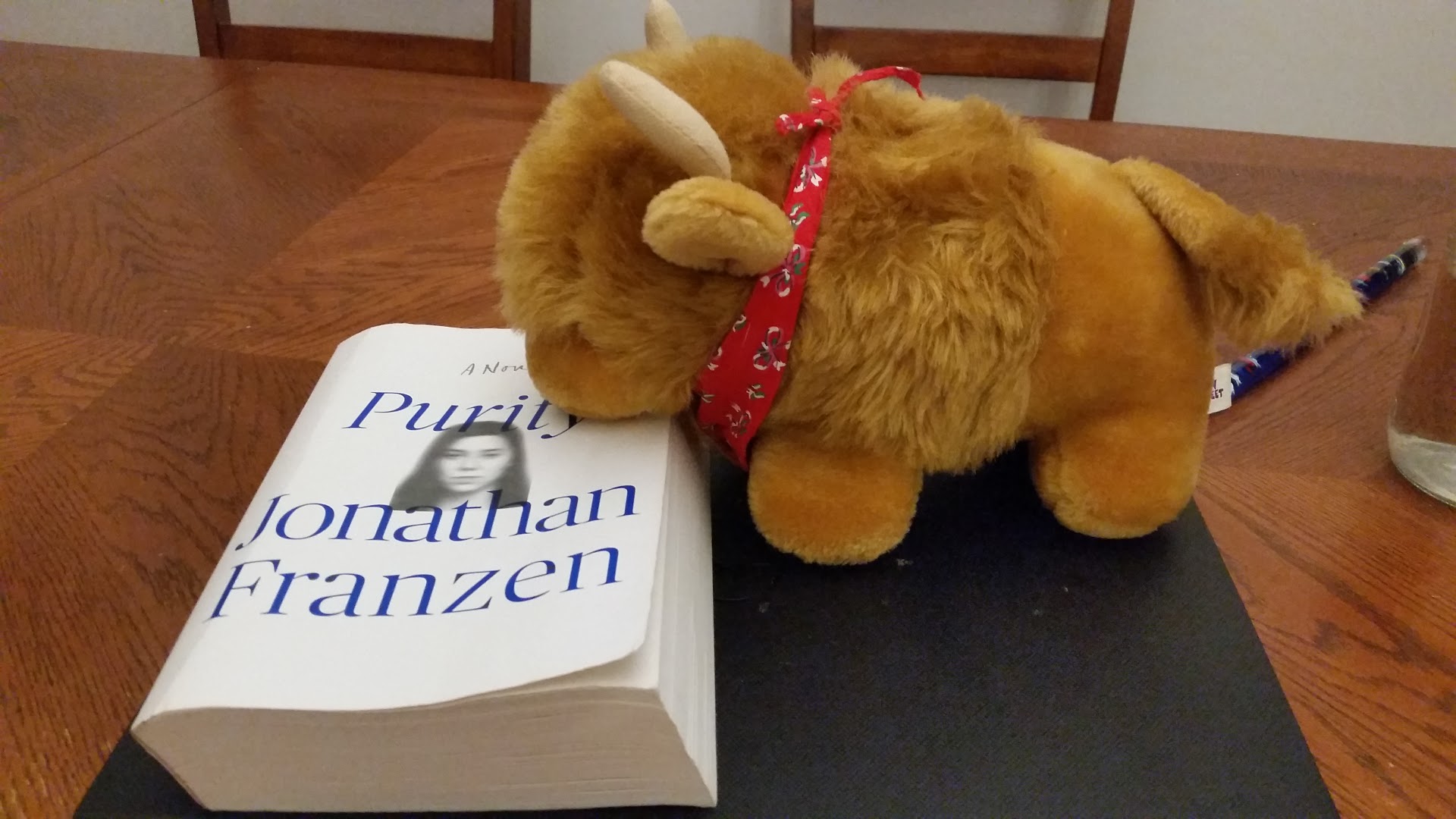
There’s some quasi-BSDM in Purity (the BDSM in Fifty Shades is quasi at best too,) particularly between Pip and Andreas, who most clearly correspond to Ana and Christian, what with the power imbalances and the mind fucks and the innocent young girl/bad boy with a secret thing,  but also between Pip’s mom Anabel and Tom, who share a memorable, not-really-consensual sex scene (see Zink’s review for a spoiler, whenever it’s back up) and have a freaky sex ritual that involves a stuffed bull named Leonard. The bull thing has nothing to do with BDSM but I had to mention it somehow.

This stuffed buffalo does not approve.

This stuffed buffalo does not approve.

And the Fifty Shades of Franzen don’t end with the sex scenes! Both feature a really clunky literary allusion; Purity to Great Expectations and Fifty Shades to Tess of the D’Ubervilles. Has anyone written about Fifty Shades and Tess? Am I going to have to do it? Another day, perhaps…

The point of this mini-review was not to suggest that Purity is on the same level of Fifty Shades, but rather, to show that the way we react to sex in literature (and allusions, too?) has a lot of do with how it’s marketed and who’s writing it. I didn’t make this up to be funny. There truly are parallels between the books, only with one, we snicker and roll our eyes because readers ARE getting off on it, and with the other, we snicker and roll our eyes because they AREN’T.

As for me, demographically speaking, I’m in the target market for both mommy porn and OMG Serious Literature. After reading both Purity and Fifty, I plan to read more Franzen, but won’t continue the adventures of Ana and Christian in Darker, Freed, or cash-grab Grey, mostly because they’re boring as hell. Talk to me when Ana is throwing around the C-word or Christian adds some stuffies to his playroom.

Purity by Jonathan Franzen (Review #1)

You know me. I love a clever title. I came up with three subtitles for my review of Purity, and can’t choose a favourite, so I’m subjecting you to a mini-reviews to go with each over the next few days:

Review #1: Franziness

Nailed it.

Nailed it.

Publication date: September 1, 2015
My rating: 4 out of 5 stars
Read this if you like: Jonathan Franzen
Check out Purity on Goodreads
Thanks to: The fine people at Macmillian (FSG) for giving me and 199 other lucky Book Expo America attendees an advance reader’s copy.

Like Nell Zink, I won’t bother trying to convince you to read Purity, because you already know if you’re going to read it or not (her review is still offline, so you’ll have to take my word for it.) As my mom used to say, if you like this kind of thing, this is the kind of thing you will like. It’s got Franziness. See the end of this post for my incomplete list of Franziness indicators and add your own.

Franzen’s interviewer at Book Expo America made much of how “plotty” this book is, which is to say, things happen outside the family/personal realm. That’s true. The chapters set in Europe aren’t just a satirical sidebar, like they were in The Corrections. The affairs and sexual misconduct have larger implications for the characters than they did in Freedom. But Purity didn’t surprise me that much. It didn’t shake up my view of what a Franzen novel is.

I read The Corrections recently, and that helped me see what a step up Purity is. If you read his Big Three novels in order, you’d see them get better, smoother, less “I see what you did there.” The threads in Purity come together in a way that reminded me of The Luminaries; you almost don’t notice it till it’s done. There’s also a mystery and a murder, new territory for Franzen, but they don’t overwhelm the story. The characters are still in the forefront.

Speaking of, Purity demonstrates what Franzen’s strength has been all along: he creates characters the reader cares about. Not that we like, empathize with, or relate to (though you might do all those things,) but they keep you turning the pages and slogging through the parts that are sloggy and you miss them after you’re done. I miss Pip! She’s annoying and self-centred and predictable, but she got to me.

Purity is plotty, but it’s also pretty emotional. I don’t think I cried, but I felt real dread during the lead up to the murder, and felt impotent and icky during the seduction of, well, everyone who gets seduced. There were hilarious parts and weird parts and banal parts.

So, if you’re going to read Purity, you’re in for a treat, and if you’re not, please stand by, Reading in Bed will return to regular programming in a couple of days.

An incomplete list of things that have Franziness

  • Birds
  • Wariness of the internet
  • Mommy issues
  • Daddy issues
  • Unlikable narrators
  • Germany
  • Weird/bad sex scenes
  • Icky relationships between stunted man-child(ren) and younger, damaged women
  • Poop

A correction

You know that feeling when you decide to reread a book after many years? You know how you look forward to a comforting, familiar read, perhaps with new insights this time round, but mostly, you want to revel in a familiar story? You know how you start the reread and think, I barely remember the beginning, it’s like reading it for the first time! You know the creeping realization that you have not actually read this book? That you owned it, gave it a rating on Goodreads, referenced it in one of your first blog posts, and mentioned it on social media as recently as this week, but you did not actually read the thing?

Bookish confession coming up:
Continue reading

Your input is required.

When I sit down to blog, (say, because my friends cancelled on me for girl’s night, but I’d be damned if I was giving up a get-out-of-doing-bedtime-free card, so I went to Starbucks alone,) how do I choose what to devote my limited time to? I don’t do many challenges or memes, and I don’t accept review books with deadlines (see: time, limited) so it’s all up to me.

Or you.

survey

I’m going to share my in-progress posts (coming up with a title totally counts as progress)  and my to-review list, and you tell me what I should work on next.

I ask people to participate in surveys for a living, and this subject line and plea is the best I can come up with. All I’m saying is: Let me know what you’d like to see next on Reading in Bed. And remember, your opinion is important to us.


The best way to end any survey is to solicit open-ended comments; that is, if you enjoy poor grammar, off-topic rants, and people writing “nothing” instead of just literally writing nothing. Just kidding, I know you guys won’t do that. But do tell me what you’d like to see more or less of here. Thanks for your time.

Behind the scenes of a Booktube debut, and a review of Bone & Bread by Saleema Nawaz

I reviewed Saleema Nawaz’s Bone & Bread for Hello Hemlock this month. While it’s not the very first book video I’ve ever made, it is the first one that includes music, and titles, and editing of any kind. So, I’m calling it my BookTube debut. Check it out, then read on for my behind-the-scenes revelations.

Continue reading

Empathy for the devil: The People in the Trees by Hanya Yanagihara

The People in the Trees coverIn my last post, I considered empathy as a supposed outcome of reading fiction. I didn’t consider whether being empathetic was a worthy goal. The People in the Trees forced me to consider just that.

Is empathy a good thing? Is it useful? Is everyone worthy of empathy, or only certain people? Does empathy even have a “target,” or is the empathetic person just empathizing with everyone, all the time? Even with people engaged in taboo behaviour? Even with people who use a position of power to prey on the weak? What are the limits of empathy?

If you don’t want to be spoiled, stop here, but tell me if you’ve ever empathized with an evil fictional character. Also, go read Naomi’s spoiler-free review at Consumed by Ink. We read this book together and exchanged many emails as we tried to make sense of it. We both recommend it highly.

Continue reading

Book-loving hedonists and alienated intellectuals: why readers need to settle down about reading

READING FACT: Reading a book will transform you into Keira Knightly, traipsing the pristine English countryside.

READING FACT: Reading a book will transform you into Keira Knightly, traipsing the pristine English countryside.

I love book culture.  I love book blogs (obviously?) and book festivals, and readings, and #FridayReads and #amreading. I do not love the way we book people talk about ourselves, though. The memes, infographics, think pieces, quotes and such that grind my gears fall into two categories:

  1. Readers are different
  2. Readers are better people

I’ve been thinking about these ideas lately, with help from a couple authors I’ve been lucky enough to see in person. Continue reading

Books I grabbed at #BEA15

I plan to write about a couple BEA-related things, but if I know you guys, you just want to see the BOOKS.

Day 1: BuzzedDay 1

Day one was all about Blogger Con, so I wasn’t on the show floor at all. I did make it to the Editor’s Buzz Panel, though, and elbowed my way to the table full of galleys:

City on Fire by Garth Risk Hallberg (Knopf) aka The Two Million Dollar Book. Nuff said?

In a Dark, Dark Wood by Ruth Ware (Scout) aka the next Gone Girl? I read this one on the way home but I haven’t read GG, so I can’t tell you if the comparison is apt.

Home is Burning by Dan Marshall (Flat Iron Books) aka A Heartbreaking Work of Holy Shit It Already Has a Movie Deal. Dave Eggers meets The Royal Tannenbaums, maybe.

Eileen by Ottessa Moshfegh (Penguin Press) aka The Dark Horse – dark cover, dark subject matter, and for me, the one I was least interested in – but I grabbed it, because it’s BEA.

Day 2: Line up, line up, as if you have a choice

Day two was spent on the show floor and therefore in line-ups big and small.

Welcome to Night Vale by Joseph Fink and Jeffrey Cranor (Harper Perennial): One hour line up full of excited young’uns and bewildered olds.

The Secret Chord by Geraldine Brooks (Viking): Half hour line up full of middle aged moms. My people!

Purity by Jonathan Franzen (Farrar, Straus and Giroux): Tickets, multiple line-ups, general confusion. And he wasn’t even signing!

The Wake by Paul Kingsnorth (Graywolf Press): No line up here, but probably the strangest of the books I took home. Like Home is Burning and City on Fire, the film rights are already sold – to Mark Rylance aka Cromwell in Wolf Hall! Check him out reading from the book here, and you’ll see what I mean.

Lost Boi by Sassafras Lowrey (Aresenal Pulp) and The Scamp by Jennifer Pashley (Tin House): Snagged there from an indie publisher’s party that CJ and I were intensely uncomfortable at. Lost Boi was on my TBR, and The Scamp appears to be Ablutions with a young female protagonist, so, score!

Also, some kids books and stuff

Also, some kids books and stuff

Day 3Day 3: Flailing

Do I have enough books? Should I run around the show floor aimlessly and grab a few more? Yes, let’s do that.

Pillow by Andrew Battershill (Coach House Books) because I’m a sucker for damaged male protaganists, and for chocolate.

Everybody Rise by Stephanie Clifford (St. Martin’s Press) because it’s a “Bonfire of the Vanities for the 21st Century” and BofV blew my mind as a teenager.

And that’s it! No extra suitcase needed. Stay tuned for more on the Franztravaganza, the blogger’s con, and where to get pizza in Hell’s Kitchen and not get judged for coming back three hours later.