Frankenstein in Baghdad by Ahmed Saadawi: Man Booker International Prize Review


frankenstein

I picked up Frankenstein in Baghdad because it was the most accessible book on the longlist (in stock at Chapters!), not because I was excited to read about war. My last war book, Canada Reads contender American War, didn’t go so well, and right off the bat, I noticed similarities. Frankenstein opens with a leaked government document, a top secret report on the activities of the “Tracking and Pursuit Department” in Iraq. American War actually makes great use of leaked documents, transcripts, and newspaper clippings to frame its time-hopping narrative. The author is a former journalist, and probably got a feel for what government documents look like, so they feel really authentic. I didn’t buy it in Frankenstein, though. The language was too plain. Even the “Top Secret” stamp looked amateur.

Luckily, that’s the only such document in the book. The rest is a straight-up narrative set in contemporary Iraq. Frankenstein distinguishes itself from American War in one more important way: it leave room for the reader to think. Continue reading

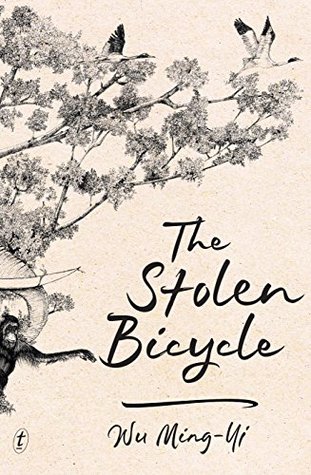
The Stolen Bicycle by Wu Ming-Yi – #MBI2018 Review

If you have pivoted to video, check out my rambling on this book here.

The Stolen Bicycle

Those who have followed me for a long time know that I’m an ebook (and audio book) advocate. While I acknowledge that the brain processes words differently depending on the source, I maintain that it’s the words, not the format, that matter most when it comes to reading. (And yes, I’m familiar with “the medium is the message”.)

Arguments against reading on screens, and hand-wringing about whether ebooks or audio books “count” as reading, tend to come from a fairly out-of-touch, even ableist place. Also, I don’t like the smell of old books. There, I said it.

HOWEVER. Once in a while there comes a book that’s so attractive in print, that even I question my choices. I bought the ebook edition of The Stolen Bicycle because the print isn’t out in Canada till April 20 (see my previous post for more #MBI2018 options in Canada). Then, I saw what the print edition looks like: Continue reading

The Seventh Function of Language by Laurent Binet – #MBI2018 Review

seventhfunction

The Seventh Function of Language is often described as “The Da Vinci Code Meets _________” (fill in the blank with something higher brow than The Da Vinci Code). I have one too: The Seventh Function of Language is what would happen if David Foster Wallace wrote The Da Vinci Code. Google tells me that David Foster Wallace and Dan Brown attended the same creative writing class at Amherst college, so this collaboration isn’t even as far fetched as it sounds!

The Seventh Function of Language is a buddy cop-murder mystery-political thriller, but it’s also a satirical-but-loving look at French critical theory and post-structuralism in the 1980s. If put on the spot, I would not be able to give a satisfactory definition of either of those things, but one concept that’s relatively easy to grasp is Roland Barthes’ “death of the author”, introduced in his 1967 essay of the same name, that argues that the author’s intentions don’t matter as much as the reader’s. The book opens with the literal death of Barthes – he was run over by a laundry truck in 1980, just after he met with François Mitterrand, who went on to be President of France. In the real world, Barthes’ death was ruled an accident, but Binet asks us to imagine that it wasn’t, that instead it was an assassination, and that every prominent thinker, linguist, writer, and political figure of the time might be involved in a race to learn the secret “seventh function of language”, which would allow the practitioner to persuade anyone to do anything.

Car chases, bombings, poison umbrella stabbings, orgies, and dismemberment ensue. Continue reading

Canada Reads: Who should win, who could win

It’s that time of year again! No, not spring. This is Canada. It’s beautiful in Edmonton today, but the forecast for later this week includes a low of -18 (that’s about zero degrees for you Americans) and snow. No, friends, it is time for Canada Reads.

The drama! The bickering! The relatively-high production values! The distinctly early-aughts reality show vibe!

If you need a primer about what Canada Reads is all about, please visit my YouTube channel where I break it down (short version: Canada Reads = Survivor + Who Wants to be a Millionaire + books)

Here are my picks for who should and could win, based on my previous experience with this show, and this year’s theme: one book to open your eyes. Continue reading

The Man Booker International Prize 2018: Readers to watch

mbi2018-logo

The Man Booker International Prize is a slightly more obscure prize than, say, The Women’s Prize, The Giller Prize, or the plain ol’ Man Booker Prize. That’s partly why I am keen to follow it – it’s not as overwhelming. There are plenty of other #mbi2018 readers, though. Here are a few I’m following. If I missed you, let me know!

The Man Booker International Prize Shadow Jury

These are the cool kids of #mbi2018. They are already posting longlist reviews! Actually, I’ve followed several of them for years, and they are super nice. Here is the full list of shadow jurors. In particular, I recommend Dolce Bellezza for thoughtful reviews and reading challenges galore; and Tony’s Reading List for his sense of humour and commitment to translated fiction (and the best book blog tagline in the game: “Too lazy to be a writer – Too egotistical to be quiet”). Continue reading

How to follow a UK Prize from Canada or my foray into the Man Booker International Prize

mbi2018-logo

I made a snap decision today: I’ve decided to follow the Man Booker International Prize. I came to my decision, oh, about a half hour before the longlist was announced this morning. In my excitement, I filmed two videos before work: one about why I’m following the prize, and one reacting to the longlist. Scroll down to watch, if you wish.

Since my early morning burst of activity, though, I’ve learned some harsh lessons about following a UK prize from overseas: you can’t get the books.

Well, you *can*. And I knew it would be a pain – this isn’t my first rodeo (or my first Booker). But the combination of UK publication dates, translations, and this particular longlist’s preponderance of small press books makes the 2018 MBIP a real challenge. So, I did some research. Continue reading

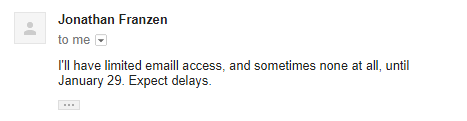
Jonathan Franzen’s Away Message

away

This time of year, I’d usually be kicking off another round of Franzen in February, but due to my unplanned, two-month blogging hiatus, I don’t have my shit together.

So, sadly, this year I will not be bringing you any new Franzen conspiracy theories, nor will I be peer pressuring anyone into reading their First Franzen (which has generally not gone well).

But I just remembered, the most amazing Franzen-related incident of my life occurred during my hiatus, and while I regaled everyone on social media, YouTube, and even IRL, I haven’t shared it with you, dear readers.

Continue reading

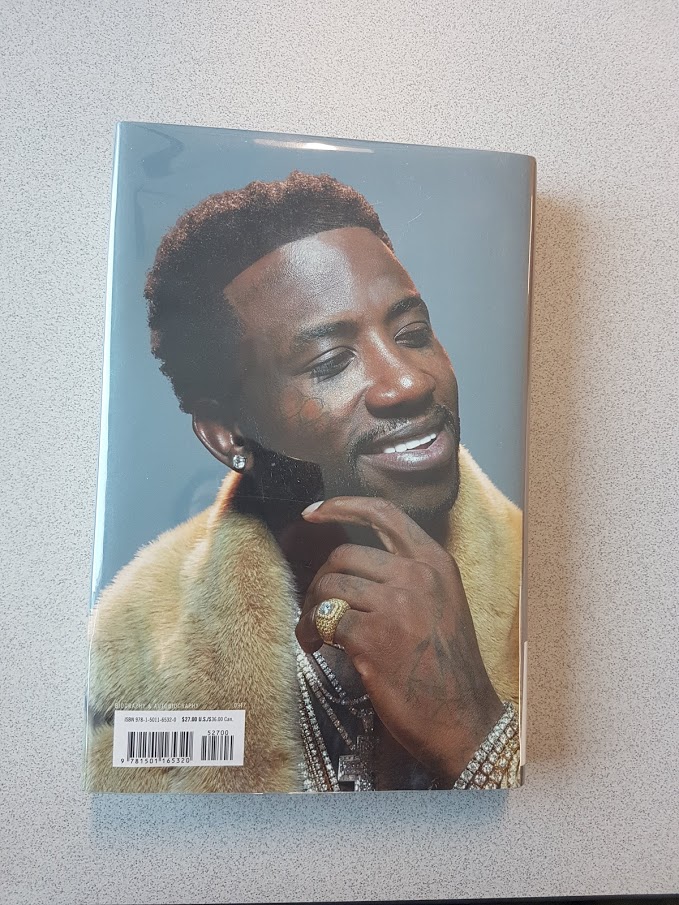
The Autobiography of Gucci Mane

gucci

Now That’s What I Call An Author Photo

Much as I relish a negative book review, negative reviews of memoirs can be cringe-inducing. What should be a critique of a book too often becomes a critique of a life, of choices made or flaws revealed. This kind of criticism confuses me. Should the writer lie about their own lives (more than they, presumably, already do)? Or should only people with spotless records write memoirs?

And why do we read memoirs in the first place? Must there be a life lesson to impart, or a record to set straight, two very common themes in this genre? I recently read The Autobiography of Gucci Mane, and at first glance, his story would seem to fall in the latter theme. He has several records, criminal and otherwise, to clear up. But the book became more than that for me, and made me understand what can make a celebrity memoir more than a PR puff piece.

I had no idea who or what a “Gucci Mane” was before picking up this memoir. If you are also old/uncool: He’s an Atlanta rapper known for facial tattoos, erratic behaviour, stints in jail, and inspiring the “Bitch I might be” meme a few years back (see below for a book blogger friendly version). He had a couple mainstream hits in 2009, but somehow I missed them. He’s also credited with creating (or at least popularizing) “trap music”, a phrase I’d vaguely heard of and associated with stuff like Biggie’s Ten Crack Commandments (nope, way too upbeat.) I had so much to learn.

Image result for harry potter bitch i might be

Continue reading

Three ways to get into poetry

I’m a fairly well read person. No, this post isn’t about what it means to be well read. Just take my word for it. I’ve read across many formats and genres, and many traditions and eras. I do have a weak spot though: poetry.

I remember learning exactly two poems in school. One was A Valediction: Forbidding Mourning by John Donne and the other was To His Coy Mistress by Andrew Marvell, and both are about dead white dudes who were feeling horny. Jeez, is it any wonder I wasn’t taken with it?

I’ve read three poetry collections so far this year, and I loved each of them. I’m not good at saying why, exactly, but I can tell you how I found my way in. Continue reading

Learning about Residential Schools for every level (ft. Benjamin on Booktube)

Many Canadians are disappointed in our slow progress towards the 94 calls to action set out in the Truth and Reconciliation Report. See Ian Mosby’s Twitter feed for updates (and a nonsensical reply from Joseph Boyden, if you dig for it):

However, I am pleased to find that my kids, in grades one and two, are learning about residential schools. Most of the learning happened on Orange Shirt Day, but hopefully this will become a regular part of the curriculum.

It can’t just end at school, though. I could tell from the questions they asked me that they didn’t quite understand what happened, and why. So I got them some books. I also happened to read a short story collection touching on residential schools at the same time. Here are three ways to learn more about residential schools in Canada, for whatever level you are at.

Continue reading