Category: Uncategorized
Small Boat by Vincent Delecroix, translated by Helen Stevenson

Welcome to Novellas in November 2025, in which I try to catch up on reviews by tackling the novellas I’ve read so far this year.
This novella stuck with me, not only because it is so good, but because my interpretation of it seems to be a rare one, and maybe a wrong one. So, to the extent that a philosophical novel based on true events which I may have interpreted incorrectly can be spoiled, beware of spoilers ahead.
Continue readingYoga by Emmanuel Carrère, translated by John Lambert

This book has been called a lot of things – devastating, a tour de force, exceptional; but also generic treacle. Molly Young, who wrote one of two reviews of this book for the New York Times (published days apart; would love to know how this happened there) acknowledges the extreme opinions, and says that “If you don’t like Carrère now, you never will.” In the spirit of what Young calls Carrère’s “extreme candor,” I will tell you straight away that I don’t like him now, and (presumably) never will.
Saying this feels wrong. I don’t like “him”? I don’t know the man, though after reading this book, a 2017 New York Times profile, and several articles about the dissolution of his marriage, I feel pretty confident saying that I don’t like his whole deal: his approach to writing, his perspective on fiction, his smugness, and especially his mixture of mindfulness and obliviousness.
Yoga is classified as nonfiction in North America, but as a novel in France. Maybe we can split the difference with autofiction, which is generally understood to be writing based on real life, with few attempts to conceal names, places, and dates, but written in the style of fiction, with some liberties taken to make a more coherent story, or emphasize a theme or two. In my opinion, Yoga goes beyond a few liberties into something more sinister and more annoying. Yoga is also written from an assumption that the reader is extremely interested in Carrère’s writing process, down to how fast he can type. Given his stature in French literature, that might be true for some readers. Not for me.
Continue reading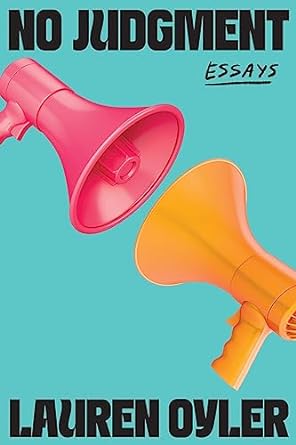
Worst Books of 2024
It’s the most wonderful time of the year, even though I only make this kind of post every couple of years. In 2016, I was annoyed by The Glass Castle and The Dead Ladies Project. In 2018, I was exasperated by Sick and American War. In 2022, I was bored by The Autobiography of Alice B. Toklas and Cold Enough for Snow. This year, I’ve been annoyed, exasperated, and bored by a new crop of books:
Nonfiction that tricked me with clever subtitles:

- Code Dependent by Madhumita Murgia: I love a bit of tech skepticism, and the subtitle “Living in the Shadow of AI” seemed to fit the bill, but it was written in a very stilted manner and failed to connect any of its stories about people affected by AI. I could almost see the “[insert humanizing background story here]” at the beginning of each chapter. I wanted to get to the nitty gritty!
- Pause, Rest, Be by Octavia Raheem: The subtitle, “Stillness Practices for Courage in Time of Change,” must have caught my eye in March, while I was emerging from survival mode after a house fire. The “practices” part was pretty good; there are detailed instructions and pictures on how to achieve restorative yoga poses, which would work for newbies and yogis alike. The narrative, however, is a mishmash of new age and Christian woo woo, and relies on the same tricks many other self-help-ish books use to seem substantial and profound, like repetition and a lot of white space.
- Wintering by Katherine May: Another subtitle that got my ass! “The Power of Rest and Retreat in Difficult Times” echoes Pause, Rest, Be, and I read these almost back to back, which was a big mistake. Wintering pissed me off so much. The big reasons (the maddening vagueness about what exactly was making the times so “difficult,” the blithe manner in which she flaunts her staggering privilege, the lack of understanding or curiosity about what actual winter is like in northern climates) are dwarfed by something that’s so silly, but she’s basically a bitch eating crackers at this point (I can’t find a good link to what this means, iykyk). She recommends going to the grocery store right before Christmas as a self care strategy. Or more precisely, something like going to the “green grocers” for “jams and jellies,” and I laughed out loud. I can’t think of anything I associate LESS with “rest and retreat” than venturing out in -20 temps, driving on icy roads, battling the crowds at Walmart, and spending hundreds of dollars on inflated groceries. Not to gatekeep, but I don’t think you should be allowed to write a book about winter if you live in a place where the average winter lows are above freezing.
Short translated works, reviewed shortly:
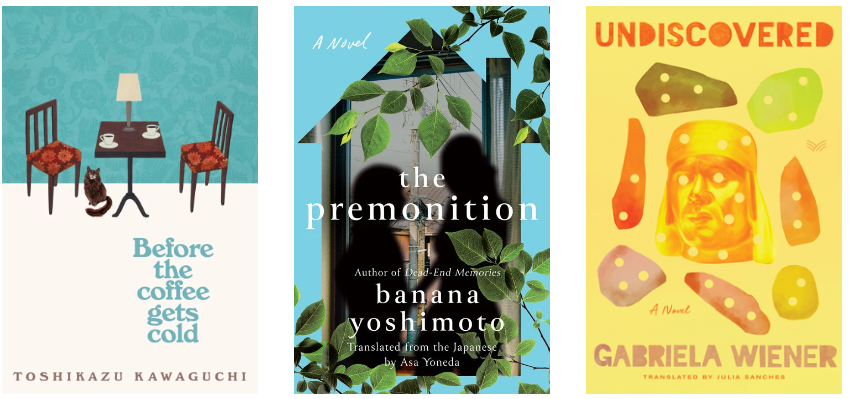
- Before the Coffee Gets Cold by Toshikazu Kawaguchi tr. Geoffrey Trousselot: One day I’m going to accept that I like weird Japanese fiction, not cute Japanese fiction. And this isn’t even cute, unless you find rigid gender roles and vaguely anti-choice sentiment to be cute!
- The Premonition by Banana Yoshimoto tr. Asa Yoneda: This started out more promising, no cuteness here, but revealed itself to be a lot of YA-style wish fulfilment and Holden Caulfield-style complaining about phonies.
- Undiscovered by Gabriela Weiner tr. Julia Sanches: This is literally a personal essay, and not a very good one, but somehow got longlisted for my favourite fiction prize?
Lastly, and worstly, this one would fit under “nonfiction”, but, it doesn’t have a subtitle on the North American edition (the UK edition, inexplicably, does, “On Being Critical,” which, lol.) The author is a literary it girl known for her negative reviews, and more recently, for a novel that flopped: yes, it’s Lauren Oyler’s essay collection No Judgement. I wanted to write a full review, but sort of felt like it’s all been said. So let me take a moment to say just a little more.
The worst thing about this book is Oyler’s withering disdain for the reader, and it permeates every single essay. I mean “reader” in both senses: the particular reader holding the book, and the class of people who merely read, and aren’t writers themselves. This is pretty rich from someone who’s bibliography consists of a mediocre novel and a widely-panned essay collection.
While most of the essays are simply self-important and wanna-be edgy, it’s the essay about Goodreads that broke me. It’s not just cringy, it’s wildly inaccurate, in ways that are immediately obvious to us lowly readers in the Goodreads trenches. Kathleen Hale and Lauren Hough are uncritically presented as victims of “review bombing,” and this is stupid enough, but it’s also like… this is all drama that happened five to ten years ago. Who cares at this point? Is she just mad that Fake Accounts has an abysmal 2.83 Goodreads star rating? I cannot fathom what else could have sparked this essay in particular, or the book as a whole.
It’s unfortunate that Oyler’s best writing, her scathing reviews for Bookslut, are lost to the sands of time and bit rot. We needed the push back against Roxane Gay in 2014. We don’t need any of this in 2024.
Whew! Now, I haven’t done one of these “what about you” kickers in a while, but truly, I want to know what your worst books of the year are. Hit me up in the comments.
My Year of Last Things
This is a book blog, not a personal blog, but I do write about life events here, and sometimes things don’t feel real until I do.
The births of my children are here. Moving into our house, briefly. My sister moving to the States. Then the fire happened, and I wrote about what it’s like to lose all your books, but I didn’t write about what it’s like to lose a pet.
If you follow me on social media, you might know that in the immediate aftermath of the fire, my husband found our cat Perogy in a bad state and got her to an emergency vet, where she remained for three weeks. You might have missed the “Missing Cat” posts about Shirley, though, as they were only up for a day, until my husband found her too. She didn’t make it.
Shirley was three years old, a pandemic pet born in 2020 and adopted by us in 2021. The SPCA named her and we didn’t see any reason to change it. She was loud, lazy, a bit of a glutton, cuddly, soft, playful, a constant companion to anyone sitting on a couch or lying in a bed, and scared of everything. She would have been very scared that day – the noise, the smoke, the heat, people stomping around. The firefighters told me she most likely escaped the house and we’d find her later, that it happens all the time, but I didn’t believe them.
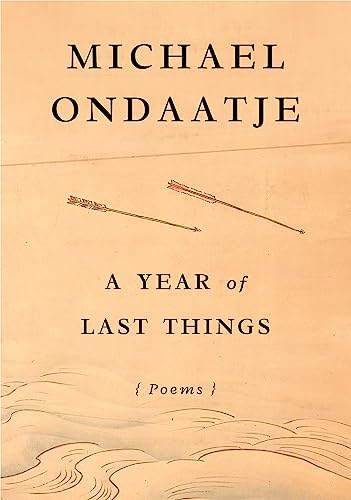
I’ve never lost a pet this way, only older pets who were ready to go and gave us time to prepare. I’ve also never lost a pet in the midst of a crisis – usually losing the pet is the crisis. I have mourned her, but alongside a bunch of other stuff, and seven months later, it can still feel awfully fresh; never more so than when I read the poem “November” in Michael Ondaajte’s new collection A Year of Last Things.
I’ve tried Ondaatje’s poetry before, and found it fairly impenetrable, with literary and cultural references that are beyond me. A lot of the poems in this collection are like that, though I got a hint of something different in this first line of the first poem, “Lock”:
Reading the lines he loves
he slips them into a pocket,
wishes to die with his clothes
full of torn-free stanzas
and the telephone numbers
of his children in far cities
I love that line about carrying the telephone numbers of your children in your pocket. Old fashioned but relatable. Later, we are treated to prose poems – mini-essays, really- about the horrors of boarding school and confronting an abuser.
And then there’s “November“:
Where is my dear sixteen-year-old cat
I wish to carry upstairs in my arms
looking up at me and thinking
be careful, dear human
Ondaatje addresses his cat, Jack, and remembers how he was adopted (“I found you as if an urchin in a snowstorm”), how he became a member of the family, (“learned the territories of the house”) and grew old (“Was it too soon or too late/that last summer of your life”). He despairs that he “cannot stand it,” this loss, and imagines meeting Jack again in a place “where language no longer exists”.
This poem has nothing much to say about my particular circumstances. “November” is about an old cat, and an old owner who can imagine meeting him again soon. Shirley was a young cat, and I am a (relatively) young owner who, if I believed in an afterlife, would anticipate waiting a long time for such a reunion. This poem doesn’t have anything particularly new to say about grief, either: it ends in a paraphrase of a 17th century haiku about the timelessness of nature, maybe, or the endless nature of grief?
It’s not a good poem because of what it says, but because of how it says it. It’s good because in ten stanzas (read them all here), it reminded me that my grief is real, and made me write about it here, making it even more real. It’s good because it made me think about my brother, who imagines his cat referring to people as “humans,” usually derogatory, and that made me smile. It’s good because the line near the end, “You no longer wait for us” took my breath away. Cats aren’t loyal and protective like dogs, but they do wait for you. I think about Shirley waiting for me that day. I knew she didn’t leave the house. She waited where she always did when she was scared, under the couch. That couch was just too close to the fire.
This is barely a review but it does remind me, and hopefully you, why it’s a good idea to read poetry: for those lines that takes you back to a place or a feeling, even one you cannot stand going back to.

Shirley, lying on top of someone’s legs as they lounged on the couch, as she was wont to do
20 Books of Summer 2024
20 Books of Summer has always been more about the motivation to *actually review* books for me, not reducing my TBR, and never more so than this year. I don’t own 20 books, let alone 20 books I haven’t read before. Hence the shorter list.
This year is special though, as it’s the tenth anniversary of an event that started as a TBR challenge with 8 participants that now attracts upwards of 100 bloggers each year. No mean feat given the state of blogging today and the fact that this is a rather high-commitment event (with very relaxed rules to make it manageable.) Congratulations to Cathy for keeping the pages turning and the reviews rolling in since 2014.
My list of 15 has no theme other than “these are books in my house or that I might get into my house at some point this summer”:
- Breasts and Eggs by Mieko Kawakami tr. Sam Bett and David Boyd (for Women in Translation month, perhaps)
- The Wars by Timothy Findley (a CanLit classic)
- A Tree Grows in Brooklyn by Betty Smith (an American classic)
- The Netanyahus by Joshua Cohen (has been recommended to me many a time)
- Agnes Grey by Anne Brontë (the book I was rereading at the time of our house fire, apologies to Edmonton Public Library for the lost copy!)
- Jane Eyre by Charlotte Brontë (it’s in the edition I got in order to read Agnes)
- Wuthering Heights by Emily Brontë (see above and it’s time for a reread anyway)
- Ghosts by John Banville (the next in the Book of Evidence series)
- Brooklyn by Colm Tóibín (a rare instance of “seen the movie, not read the book” and preparation for…)
- Long Island by Colm Tóibín (the much-anticipated sequel)
- Kairos by Jenny Erpenbeck tr. Michael Hofmann (my tradition of reading the International Booker Prize winners continues)
- Laser Quit Smoking Massage by Cole Nowicki (a slim essay collection)
- A Year of Last Things by Michael Ondaatje (a slim poetry collection)
- When Things Fall Apart by Pema Chödrön (they sure have been)
- The Tenderness of Wolves by Stef Penney (a Little Free Library pick)

Join in and let’s get this TBR back down to zero, or at least review some books this summer!
Nonfiction and Novellas in November: Week 1

November brings a variety of great book blogging events, and I’m lucky if I properly participate in just one. This year I’m going to attempt to join two of my favourites: Novellas in November, hosted by Cathy and Rebecca, and Nonfiction November, with a new slate of hosts, including Liz and this week’s host Heather.
Both events are organized by weekly themes, the first of which is: celebrate your year in nonfiction/novellas. Forgive me for grouping the weekly posts, but this is the only way I have a hope in hell!
My Year in Nonfiction
I’ve read nine nonfiction books this year, or about 20% of my total. That’s a little low for me, but a few were standouts (good and bad).
- I Used to Live Here Once by Miranda Seymour is a biography of Jean Rhys and while Rhys is a strong interest of mine, the book itself hasn’t stuck with me.
- Run Toward the Danger by Sarah Polley is a memoir presented as essays. I didn’t have a special interest in Polley or her iconic role as Anne of Green Gables, but this one absolutely stuck with me. I will never look at a child actor the same way.
- Run, Hide, Repeat by Paula Dakin is another memoir, more traditionally presented than Polley’s, that compelled me with its maddening story of family dysfunction and delusion.
- The Life of Charlotte Brontë by Elizabeth Gaskell is a groundbreaking and emotionally complex biography. What it lacks in candidness (at times) it makes up for in empathy and care. Mini-review here.
- Bliss More: How to Succeed in Meditation Without Really Trying by Light Watkins is more practical than literary, but I have kept up a pretty consistent meditation practice since reading it.
- How to Calm Your Mind: Finding Presence and Productivity in Anxious Times by Chris Bailey was not groundbreaking by any means; more of a comfort read for those of us who are into productivity culture.
- Easy Money: Cryptocurrency, Casino Capitalism, and the Golden Age of Fraud by Ben McKenzie with Jacob Silverman was also not groundbreaking but a fun read for those of us into crypto schadenfreude. Review here.
- The Drowned and the Saved by Primo Levi is a sort of meta-memoir in essays, including many reflections on the Holocaust, and it was by far the most challenging of these books. Review to come.
- Extremely Online: The Untold Story of Fame, Influence, and Power on the Internet by Taylor Lorenz is about a fascinating subject, but I was let down by how it merely skimmed the surface of influencer culture. Review in progress – pray for me, the author already blasted me on Twitter for simply sharing someone else’s negative review!
My year in novellas
I’ve read four novellas this year, plus a surprising number of novels with just over 200 pages – but those don’t count. I hope to increase this total in November!
- McGlue by Ottessa Moshfegh concluded my reading of all her novels. This one was delightfully depraved (aren’t they all!)
- The Ladybird by D.H. Lawrence was also pretty depraved, though a little more restrained than McGlue.
- Revenge of the Scapegoat by Caren Beilin was the weirdest book I’ve read this year, which is saying something (see: McGlue)
- The Nun by Denis Diderot rounds out the theme, with a weird and wonderful tale of sadistic and amorous nuns. Review to come.
We’re off and running! See you for another weekly post soon and hopefully a review or two besides.
“Goodreads for movies”? How about a Letterboxd for books?
The fact that Letterboxd still bills itself as “GoodReads for movies” on their about page is hilarious to me, and not just because they’ve inexplicably styled “Goodreads” with a capital “R”. Letterboxd surpasses Goodreads in almost every way: user experience, functionality, aesthetics, not being owned by Amazon… and while Goodreads members outnumber Letterboxd users ten-to-one, surely the potential is there – how many people do you know who watched a movie in the last month? How many who read a book? And which do people talk about more?
Goodreads has a stranglehold on the book-tracking market, despite not serving anyone particularly well – readers, authors, or publishers – and despite persistent bad press. Is it just network effects? First mover advantage? I spent a little time investigating why things have been allowed to get this bad, and then had some fun imagining what a “Letterboxd for books” would be like.
Why is Goodreads the way that it is
There was nothing wrong with Goodreads when it launched in 2007. In a web 1.0, barely-social world (Facebook had just opened to the public) it was a boon to readers. The problem is that the site has barely changed since then.

The founders, a couple who met at Stanford and later married, had tech and journalism backgrounds, but they strike me as readers first and developers second. They sold to Amazon after rapid growth in the early 2010s and have since stepped away from the site. According to this recent Washington Post article, Amazon never intended to do much with Goodreads, apart from mine its data. Insiders claim that Goodreads is built on such old code and infrastructure, it would cost too much to update – I work in “digital transformation” in the public sector, so I get it – but if Jeffrey Bezos can’t afford to update some old technology, who can? Amazon decided it wasn’t worth it, and by letting it limp along into 2023 with 125 million members, they’ve made sure no one else has a chance make something better.
Continue reading20 Books of Summer 2023
After skipping last year, I’m back at it again, joining Cathy in creating an overly-ambitious, unrealistic plan to read and review twenty books this summer. Though perhaps I shouldn’t sell myself short. Reviewing my past record, there’s a decent chance I’ll get to these, eventually… of my 20 books of summer 2019, I’ve now read 19. This year’s list is a combination of carryovers from summers past, prize winners and longlisters, review copies, and the few remaining 1001 Books that are sitting unread on my shelf (or books by authors who appear on that list.) Guess I’ll have to visit a used bookstore soon to replenish!
- The Crying of Lot 49 by Thomas Pynchon (1001 Books, previous on a 20 Books list)
- Hard Times by Charles Dickens (1001 Books, previous on a 20 Books list)
- The Blind Assassin by Margaret Atwood (1001 Books, previous on a 20 Books list)
- Howard’s End by E.M. Forster (1001 Books)
- The Ambassadors by Henry James (1001 Books)
- [Holding this space for another 1001 Books pick, pending a trip to Wee Book Inn]
- The Life of Charlotte Brontë by Elizabeth Gaskell (1001 Books adjacent)
- The Ladybird by D.H. Lawrence (1001 Books adjacent)
- Abigail by Magda Szabó, translated by Len Rix (on a previous 20 Books list)
- Green Darkness by Anya Seton (on a previous 20 Books list)
- Portrait in Sepia by Isabel Allende, translated by Margaret Sayers Peden (on a previous 20 Books list)
- Scattered All Over the Earth by Yoko Tawada, translated by Margaret Mitsutani (one of the books I bought in a Covid-induced haze last year)
- You Made a Fool of Death with Your Beauty by Akwakae Emezi (another Covid book)
- Tomb of Sand by Geetanjali Shree, translated by Daisy Rockwell (2022 International Booker Prize winner)
- Boulder by Eva Baltasar, translated by Julia Sanches (2023 International Booker Prize shortlister)
- [Holding this space for the 2023 International Booker Prize winner, in case I haven’t read it]
- I (Athena) by Ruth DyckFehderau (a review book from this year)
- The Last Samurai by Helen DeWitt (just a plain old “been on my TBR forever”)
- Milkman by Anna Burns (Booker prize winner)
- Self-Portrait with Boy by Rachel Lyon (cheating as I’m about to read this)
Join in at 746 Books and hold me accountable!
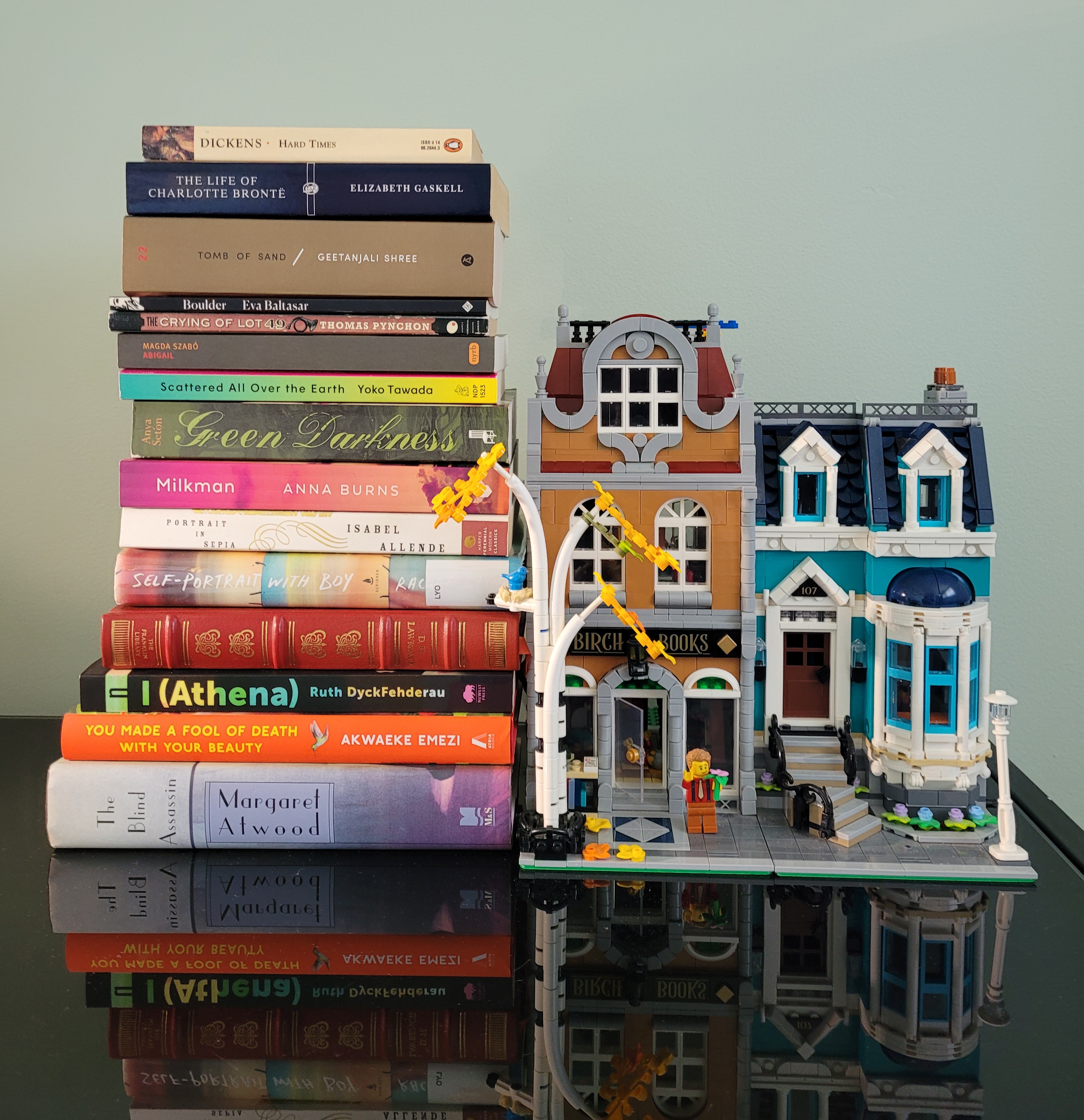
Memories, modems, and martinis
This is a short piece I wrote for Hungry Zine‘s special edition “Mall Food”, a full issue dedicated to food culture in West Edmonton Mall. You can buy the issue here.

In the year 2000, West Edmonton Mall was at its peak: Phase IV was complete, the dragon in Silver City was breathing fire at regular intervals, Playdium had just opened, and Nickleback played a show at Red’s — when it was still called Red’s, and they were still a local band. These are just a few of the things that made West Ed what it was at the dawn of the new millennium, but one tenant stands above the rest as the most Y2K-coded thing the mall has ever known. Offering a heady mix of martinis, cigars, and high-speed internet access: Bytes Internet Cafe.
The “internet” or “cyber” cafe had a brief moment in the late 1990s and early 2000s, when home computers weren’t a given and dial-up was unreliable. It’s a food and drink concept that doesn’t really exist anymore. Now, we have our phones out, maybe face down on the table if we’re being polite, whether we’re at a humble Boston Pizza (Phase II), a trendy hand-pulled noodle place (Mogouyan, Phase III), or the swanky, Fantasyland Hotel-adjacent L2 Grill (Phase I). Every cafe is an internet cafe.
But in the Y2K era, going online was not just novel, but also a very contained experience. “Surfing the net” usually took place in a dedicated computer room or lab — not the best places to eat and drink, Mountain Dew and Doritos aside. (If you were truly online in this period, perhaps you were sipping an electric-blue Bawls soda, with its 64 mg of caffeine.) Sitting down to check your email while sipping a latte was something special.
Continue readingHow translated should a book be?
Pyre by Perumal Murugan, tr. Aniruddhan Vasudevan and The Birthday Party by Laurent Mauvignier, tr. Daniel Levin Becker

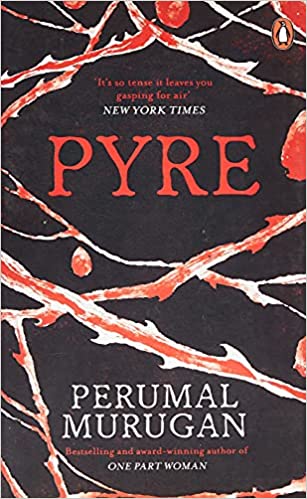
Pyre was the most accessible of the International Booker Prize longlist, availabilty-wise. My ebook hold came in almost right away. It’s quite short and sparse, and it’s a propulsive story with an inevitable conclusion that still manages to be shocking. But I’m left with questions, some specifically about the characters, and some about the accessibility of translated works in general. How much can a person reading in English understand the author’s intentions? How much hand-holding should a translator do?
In Pyre, Kumaresan, a young man from a tiny village in southern India, moves to a nearby city to work. He meets a girl, Saroja, and they elope, with plans to settle back in his home village. Saroja leaves her whole life behind, on a promise that she will be accepted by Kumaresan’s family and village, eventually. They eloped because they are from different castes, and neither family would have been in favour of the marriage, but they both seem to believe that when presented as a fait accompli, people will come around.
People do not come around. Not only are the couple not accepted, but they are instantly, continuously, relentlessly, and violently rejected, most vehemently by Kumaresan’s mother, but also by close family members, friends, and village officials, who consider cancelling a planned festival until Saroja can be cast out.
As a reader, am I to believe that Kumaresan, who grew up in this village and in this culture, had no idea this would happen? Is he very naive? Or was he blinded by love (or lust?) Or was he influenced by his time in the city, where rules around caste are more loosely observed? It was never clear to me, so I had a hard time understanding how annoyed I should be at this guy because Saroja, of course, bears the brunt of the villagers’ ire.
Apart from that (rather major) unknowable element of Pyre, much of the language was obscure to me. Names for food, clothing, and such were often presented in Tamil, and probably for good reason, but even my Kobo couldn’t help me out – no dictionary definitions, not even Wikipedia entries in many cases. Had I read a paper copy, I would have figured out sooner that there was a translator’s note and glossary in the back, but even those were pretty thin.
I’m not saying that translated books need to hold my hand. I can google as well as anyone, though after a few attempts at searching “Tamil castes”, “Nadu castes”, and so on, I was not much wiser as to how much Kumaresan should have know. This story, which is otherwise told in a very straightforward manner, remains impenetrable to me on some levels.
On the other hand, IBP longlister The Birthday Party feels a little over translated. I don’t think Three Lone Girls is a real place in France, but if it was, surely it would be Trois Filles Seules. Nor do I think that Stories of the Night, the book Marion reads to her daughter at bedtime, is real, but if it was, it would surely be called Histoires de la Nuit – and that’s the title of this book in French. “The Birthday Party” is a very literal title, since the setup is Marion’s fortieth birthday, and we first meet her husband Patrice, neighbour Christine, and daughter Ida as they prepare for her party. Histoires de la Nuit or Stories of the Night is much more suggestive.
Even the dog’s name is changed from Radjah to Rajah – Radjah seems to be a variant spelling that’s more popular in French. I promise I would have understood that the dog’s name is roughly Prince – though maybe I should just be glad it wasn’t rendered as “Prince”!
All this Anglicization annoys me. I wonder if that’s because I’m overconfident in my French reading abilities due to my Duo Lingo streak, or, if the characters just feel more familiar. I don’t think I’ve pissed off anyone enough to have my home invaded (mild spoiler, but don’t worry, I’m on page 300 and have NO idea where this is going to end up), but I am, like Marion, a working mom who met my husband on a first-generation dating website. I also understand the context of contemporary, Gilet jaunes-era France a bit better than I understand caste-related violence in 1980s India. But I wonder what cues and references I am missing?
I have a feeling I’ll be doing a little more research on both of these books – Pyre to illuminate the characters and plot points I may have missed or misinterpreted, and The Birthday Party just to see what other readers think of this complex and thrilling story. Here’s a review for Pyre that helped me understand a bit more about the author; I learned that he’s written a book from the point of view of a goat, which was given a rave review by Parul Seghal, for one thing! As for The Birthday Party, I tried to read the first chapter in French with an ebook sample, but it was not happening. Perhaps I could read a review in French though?
 Reading in Bed