Category: Reviews
Fall 2015 Preview Part III: BEA Books
I’m about halfway through my BEA stack. Many of these books will be in the spotlight this Fall. Let’s see what lives up to the hype, shall we? Full reviews to come on some of these.
The Good
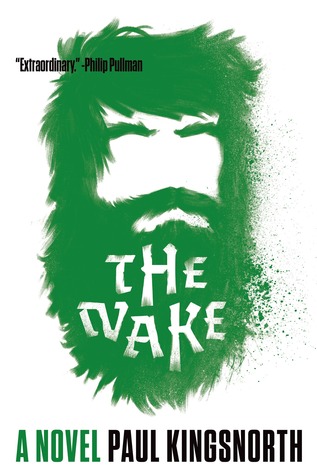


The Wake by Paul Kingsnorth: Don’t let the whole “Anglo-Saxon shadow tongue” thing scare you. I had to read aloud for the first quarter or so to get the language, but after that it was a snap. You should let Buccmaster scare you though. I was shaking by the end.
When you think of colonizers, you think of the British, right? It was weird and jarring to watch them get colonized a thousand years ago. I blame the Canadian education system for the fact that I didn’t know one thing about the Norman invasion except the year 1066 (and I’m pretty sure I learned that in Billy Madison.) Now I know better. By the end of this book, you’ll question what you know about everything.
Eileen by Ottessa Moshfegh: I almost didn’t grab this. I was almost an idiot. This story was totally unexpected and everything I love – weird, dark, seedy, with a main character I want to know and save and shake violently. Reviews are starting to trickle in around the blogosphere; check out blogger Ryan Reads for excellent GIFs and Booktuber Just a Dust Jacket for the short and sweet of it.
Purity by Jonathan Franzen: Reviewed here and here and here.
The Bad


In a Dark, Dark Wood by Ruth Ware: This could be a genre thing; my mother in law is a voracious reader of mysteries and she liked it. I didn’t care enough about the outcome, which I saw coming a mile away. I did love the settings; the woods were creepy and the glass house was probably symbolic of many things but still felt real.
Home is Burning by Dan Marshall: Why people in their twenties shouldn’t write memoirs exhibit #172. Yes, Marshall is in his thirties now, but this memoir only goes up till his mid-twenties. It’s supposed to be funny but I found it to be trying way too hard. I should have known when I saw the Jenny Lawson blurb on the cover; I also found Let’s Pretend This Never Happened deeply unfunny.
Welcome to Night Vale by Joseph Fink and Jeffrey Cranor: There were some good one-liners, making fun of literary conventions, but it didn’t add up to much for me.
The TBR
City on Fire by Garth Risk Hallberg: I’m gonna read this 900 pager before the end of the year. Promise.
The Secret Chord by Geraldine Brooks: Almost picked this up several times. I’m resisting because it feels so serious. But, um, so was her novel Year of Wonders (about the black plague) and I love that, so, I need to get over myself!
Lost Boi by Sassafras Lowrey: I could pair this with a Peter Pan movie night with the kids.
The Scamp by Jennifer Pashley: Started, didn’t grab me, will try again.
Pillow by Andrew Battershill as seen in my CanLit preview.
Everybody Rise by Stephanie Clifford: I read Crazy Rich Asians recently and have had my fill of social climbers. Will revisit later.
Undermajordomo Minor: Patrick deWitt stays weird

Publication date: September 5, 2015
My rating: ?? out of 5 stars
Read this if you like: Dark comedy, dark fairy tales, darkness, happy endings
Check out Undermajordomo Minor on Goodreads
Thanks to: House of Anansi Press for the review copy and CJ for the “in.”
Patrick deWitt writes some weird shit. His writing has been described as dark, intense, grim, poetic, bold, and funny. Undermajordomo Minor is all of those things, but also nothing like his previous two novels, Ablutions and The Sisters Brothers. The covers all look the same, and the title plays with opposites in the same way The Sisters Brothers did (brother/sister, major/minor) but if you are expecting The Sisters Brothers set in a castle, or Ablutions with a butler rather than a bartender, hoo boy, you better sit down. Continue reading
My pick for the 2015 Alberta Readers’ Choice Award

The Alberta Readers’ Choice Award is exactly what it sounds like: we vote, an Alberta author wins $10,000. With two weeks left, things are heating up; each night this week, Edmonton Public Library is hosting a Twitter chat dedicated to one of the short-listed titles. Check out #AlbertaReadersChoice at 7:00 pm Monday through Friday this week and vote here. Here are my mini-reviews, in order of Twitter chat appearance.
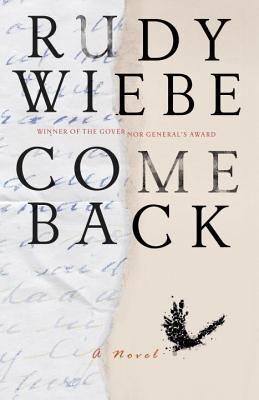 Come Back by Rudy Wiebe: Twitter chat Mon. Aug. 17 | Goodreads | Edmonton Public Library
I wasn’t interested in this book when it came out. I thought the title meant *Come* Back, as in, “don’t call it a.” When I realized it meant Come *Back* as in, a grieving father calling to a long lost son, and when I saw Wiebe speak about losing his own son to suicide 30 years ago, everything changed. I had to read this book.
This story moves between Hal’s stream of consciousness and his son’s journals. Hal’s mental state is a little disjointed to begin with (aren’t ours all) and as he follows his son’s thoughts through the months before his suicide, he has moments of clarity, but there’s no tidy ending here. Hal is reading the journals, finally, because, impossibly, he saw long-dead Gabe walking down the street, and slipping away into the crowd, just out of reach. It’s an irresistible premise and the story didn’t go where I thought it would, at all.
This book is challenging and tragic and confusing. There are plenty of Edmonton references and landmarks for the local reader. I’m just glad I finally discovered this prolific Edmonton author.
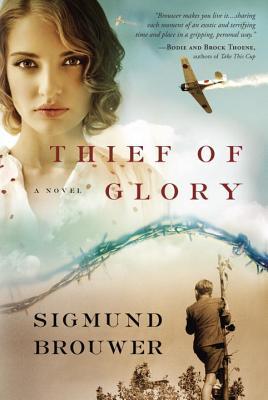 Thief of Glory by Sigmund Brouwer: Twitter chat Tues. Aug. 18 | Goodreads | Edmonton Public Library
I had a lot of problems with this book and couldn’t finish. I was interested in the premise, which, like Wiebe’s, is semi-autobiographical: a boy comes of age in the Dutch East Indies during the WWII Japanese occupation. He becomes his mother’s and siblings’ protector in a Japanese concentration camp. Brouwer’s father endured something similar.
However. I knew I was in trouble when I realized it was an “Inspirational” novel and that “Inspirational” was even a genre. I gave it a chance… I mean, I read novels with religious overtones all the time. David Adams Richards is one of my favourite authors, after all. But the writing is just not good. It’s repetitive, and the foreshadowing is constant and clunky. The story was hard to take, too. Insta-love is bad enough, but when it’s a ten year old, it strains credulity. I noticed some grammatical oddities as I read, and when I came across a paragraph that was clearly copied and pasted incorrectly (a thought ends mid-sentence and is repeated two lines later,) I was done.
Who by Fire by Fred Stenson: Twitter chat Wed. Aug. 19 | Goodreads | Edmonton Public Library
This is the last hold I’m waiting for at the library. I’ve heard good things, though this is not a book I would pick up on my own. If I can squeeze it in before Aug. 31, I will!
 Winterkill by Kate A. Boorman: Twitter chat Thur. Aug. 20 | Goodreads | Edmonton Public Library
You could describe this as Pilgrimage by Diana Davidson for the YA set. Even the snow-white covers are similar. But rather than Davidson’s realism, Boorman has a very interesting premise for her story of settlers and Metis getting through the Alberta winter: An alternative history in which colonization in the West is a failure. The few surviving Metis, English settlers, and French settlers retreat to a fortified village and are completely cut off from the rest of the world for nearly 100 years.
I’ve noticed that a lot of YA is told from a single, first-person perspective. I find it limits the story. I could have done with the perspective of a village elder or a someone of a different caste within the village. As it stands, we have Emmeline, beautiful and kind, but marked by a physical disability and by a family secret. She will find out the truth about the outside world. She will expose the corruption of the village Elders. She will also kiss the cute boy.
I liked the writing and the premise a lot. I didn’t like the old-timey language that was charming at first, but inconsistent and a bit much later on. The story was at times very compelling and original, and at times bogged down in YA cliches. A bit uneven, but I’m glad I read it, and would recommend to fans of YA/historical/dystopian fiction.
 The Social Life of Ink by Ted Bishop: Twitter chat Fri. Aug. 21 | Goodreads | Edmonton Public Library
I’ve seen Bishop speak about this book so many times, I feel like I’ve read it. I’m only 10% through, and so far, I do recognize a few of the anecdotes, but his style is very conversational and smart, so it is far from boring. I’m not much for object biographies (yet) and I’m not much for the exaltation of paper and ink over ereaders (I’m reading this on my ereader!) so it’s hard to say where this one will land. Bishop’s slick though – he was the only one handing out swag at the author event, and they were Ink-branded temporary tattoos. That’s brilliant!
I won’t vote till I finish at least one more of the books, but here’s my early pick:
Yes, I chose the literary fiction. Shocking!
Purity by Jonathan Franzen (Review #3)
Middlebrow and the Infinite Franzness
My pal Jason Purcell recently came out of hiatus with a discussion about the middlebrow:
This mini-review was going to be called “Infinite Franz” and was going to make some tenuous parallels between Purity and Infinite Jest, but once I got going, I found there weren’t as many as I thought. Then I watched Jason’s video, and got to thinking about how DFW and Franzen are often cited as examples of Great American Novelists, so they must both be highbrow, right?
Nope. Purity is way middlebrow. And that’s okay!
Purity is the most complex of Franzen’s big novels, but it’s still nowhere near as complex as Infinite Jest. Franzen’s strength is characters; DFW’s strength was, like, everything, so to see them both trotted out as “highbrow” is kind of weird! Infinite Jest is perceived as being inaccessible (my thoughts on that) and it’s certainly experimental. The only way to put the story together is to finish all 1,096 pages then go directly back to page 1, because the end is the beginning is the end. Purity is relatively linear. Like The Corrections and Freedom, there are multiple narrators, with some flashbacks and family history. There are more narrative threads in Purity, and more pieces to put together, and they don’t come together as easily, but it’s no trouble to follow the story.
Jason talks about Virginia Woolf’s assertion that the highbrow exists to reflect the lowbrow society, because those lowbrows can’t do it themselves. Franzen is known for writing about “big issues” and society and culture and all that. Like the narrative structure, I found that the “issues” in Purity were presented in more interesting ways than his previous novels. Chip’s Lithuanian adventures in The Corrections could only be satire. The child-free rants in Freedom could only be, well, rants. Purity mashes up German history and recent American scandal in a way that’s kind of outrageous but also realistic. The parallels between cold war Germany and the quasi-Wikileaks organization Purity works for aren’t shoved down our throats. All that said, Purity isn’t nearly as ambitious as Infinite Jest, which examines society in the 90s by comparing it to society in 2010, which is pretty crazy for a book published in 1996.
Franzen’s built up this highbrow persona (or, the media has,) but once you get into his work, it’s funnier, more accessible, and more comforting than you might expect. Reading DFW was more accessible than I thought it would be too, and more hilarious, but not comforting at all. I haven’t read a word of his since I read his short story Incarnations of Burned Children nearly two years ago, because I’m still reeling. SincePurity, my reading has been a veritable Franztravaganza: I read (not reread!) The Corrections and listened to The Discomfort Zone (read by the author) and am making plans to read How To Be Alone and/or Strong Motion soon.
If you really want me to prove Franzen’s middlebrow status, ask me to review The Corrections by comparing it to a Jennifer Weiner’s Fly Away Home. They’re basically the same story, minus the Lithuanians and lesbians: parents’ fuck-ups expose how fucked up their children are, mothers fixate on one last family gathering, sexual deviance and hilarity ensue. I think if they’d read each other’s books, they could put their whole feud to rest.
I guess this isn’t really a revelation. We knew it the minute Oprah chose him for her book club: Franzen writes excellent, readable, insightful, middlebrow fiction. And most days, like most people, I’ll take the middlebrow.
Purity by Jonathan Franzen (Review #2)
Fifty Shades of Franzen
Hey, did you know that Jonathan Franzen can’t write sex? He was even nominated for bad sex award a few years back.
You think I’d be all over this kind of criticism, but no. It’s stupid and lazy. Not just because the quotes are taken out of context and so rendered almost meaningless, but because it assumes that the only reason for a sex scene in a novel is to arouse the reader. Which… no. Sex can be bad. Gross. Awkward. Sometimes sex is a way to say goodbye, or a way to give in, or give up. It’s not always sexy. And novels? They’re just like real life! Sex scenes shouldn’t all be sexy and steamy and politically correct because life isn’t that way.
Anyway, those articles are about The Corrections and Freedom, which featured scatological fantasies and the C-word and such. The sex in Purity is a little different:
She could feel his hands trembling on her hips, feel his own excitement, and this was something – it was a lot. He seemed honestly to want her private thing. It was really this knowledge, more than the negocitos he was expertly transacting with his mouth, that caused her to come with such violent alacrity.
I don’t know how much intersection there is between readers of E.L. James and JFranz, so let me tell you: this is very Fifty Shades-esque. The “private thing” instead using her (C) words. The weirdly clinical, or in this case, business-like tone. The gee-whiz innocence of the heroine and experience of her “expert” partner.
There’s some quasi-BSDM in Purity (the BDSM in Fifty Shades is quasi at best too,) particularly between Pip and Andreas, who most clearly correspond to Ana and Christian, what with the power imbalances and the mind fucks and the innocent young girl/bad boy with a secret thing, but also between Pip’s mom Anabel and Tom, who share a memorable, not-really-consensual sex scene (see Zink’s review for a spoiler, whenever it’s back up) and have a freaky sex ritual that involves a stuffed bull named Leonard. The bull thing has nothing to do with BDSM but I had to mention it somehow.
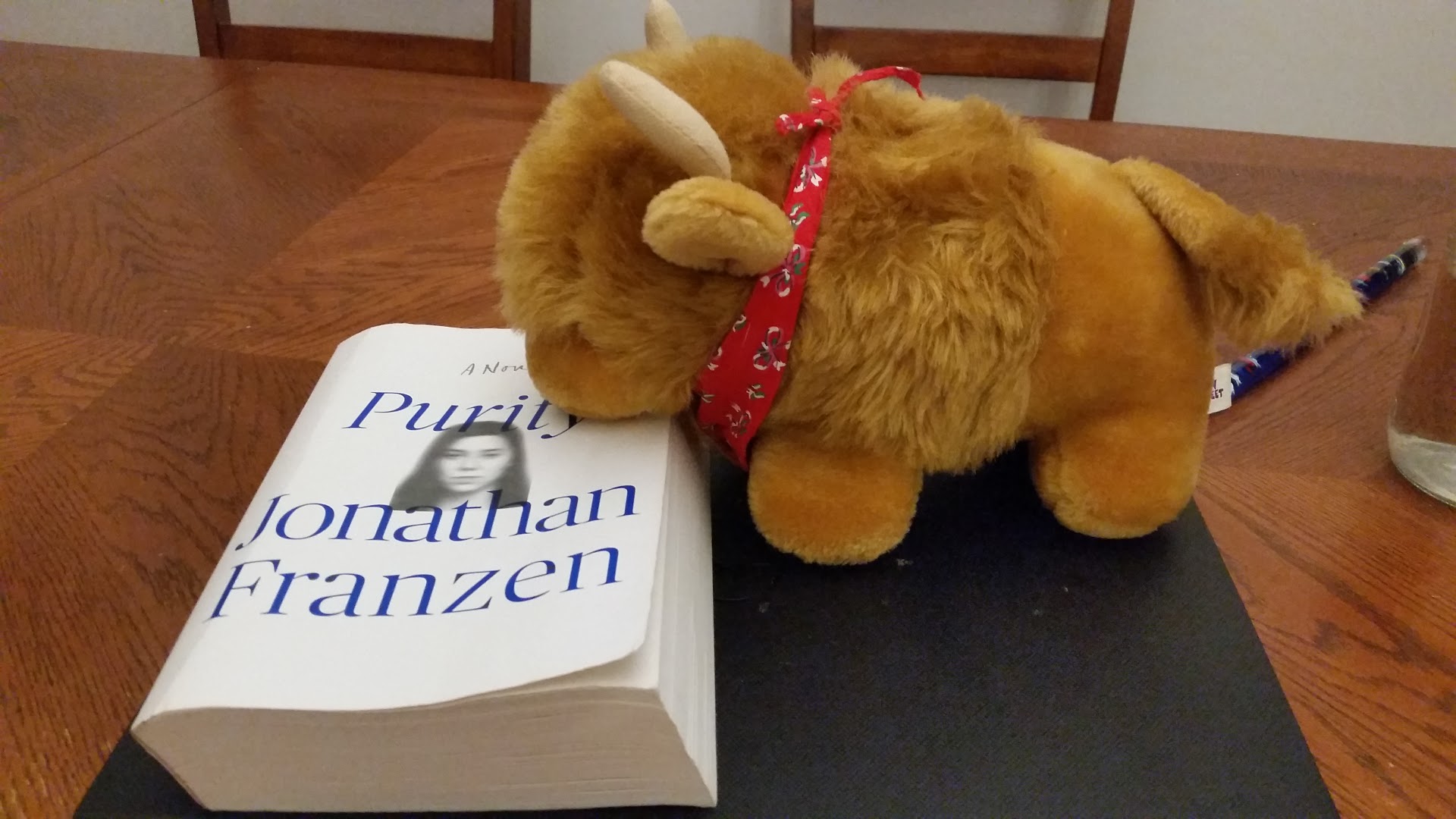
This stuffed buffalo does not approve.
And the Fifty Shades of Franzen don’t end with the sex scenes! Both feature a really clunky literary allusion; Purity to Great Expectations and Fifty Shades to Tess of the D’Ubervilles. Has anyone written about Fifty Shades and Tess? Am I going to have to do it? Another day, perhaps…
The point of this mini-review was not to suggest that Purity is on the same level of Fifty Shades, but rather, to show that the way we react to sex in literature (and allusions, too?) has a lot of do with how it’s marketed and who’s writing it. I didn’t make this up to be funny. There truly are parallels between the books, only with one, we snicker and roll our eyes because readers ARE getting off on it, and with the other, we snicker and roll our eyes because they AREN’T.
As for me, demographically speaking, I’m in the target market for both mommy porn and OMG Serious Literature. After reading both Purity and Fifty, I plan to read more Franzen, but won’t continue the adventures of Ana and Christian in Darker, Freed, or cash-grab Grey, mostly because they’re boring as hell. Talk to me when Ana is throwing around the C-word or Christian adds some stuffies to his playroom.
Purity by Jonathan Franzen (Review #1)
You know me. I love a clever title. I came up with three subtitles for my review of Purity, and can’t choose a favourite, so I’m subjecting you to a mini-reviews to go with each over the next few days:
- Review #1: Franziness. My basic review.
- Review #2: Fifty Shades of Franzen. A mostly-serious discussion of sexuality in literature.
- Review #3: Middlebrow and the Infinite Franz. A discussion of middlebrow literature.
Review #1: Franziness

Nailed it.
Publication date: September 1, 2015
My rating: 4 out of 5 stars
Read this if you like: Jonathan Franzen
Check out Purity on Goodreads
Thanks to: The fine people at Macmillian (FSG) for giving me and 199 other lucky Book Expo America attendees an advance reader’s copy.
Like Nell Zink, I won’t bother trying to convince you to read Purity, because you already know if you’re going to read it or not (her review is still offline, so you’ll have to take my word for it.) As my mom used to say, if you like this kind of thing, this is the kind of thing you will like. It’s got Franziness. See the end of this post for my incomplete list of Franziness indicators and add your own.
Franzen’s interviewer at Book Expo America made much of how “plotty” this book is, which is to say, things happen outside the family/personal realm. That’s true. The chapters set in Europe aren’t just a satirical sidebar, like they were in The Corrections. The affairs and sexual misconduct have larger implications for the characters than they did in Freedom. But Purity didn’t surprise me that much. It didn’t shake up my view of what a Franzen novel is.
I read The Corrections recently, and that helped me see what a step up Purity is. If you read his Big Three novels in order, you’d see them get better, smoother, less “I see what you did there.” The threads in Purity come together in a way that reminded me of The Luminaries; you almost don’t notice it till it’s done. There’s also a mystery and a murder, new territory for Franzen, but they don’t overwhelm the story. The characters are still in the forefront.
Speaking of, Purity demonstrates what Franzen’s strength has been all along: he creates characters the reader cares about. Not that we like, empathize with, or relate to (though you might do all those things,) but they keep you turning the pages and slogging through the parts that are sloggy and you miss them after you’re done. I miss Pip! She’s annoying and self-centred and predictable, but she got to me.
Purity is plotty, but it’s also pretty emotional. I don’t think I cried, but I felt real dread during the lead up to the murder, and felt impotent and icky during the seduction of, well, everyone who gets seduced. There were hilarious parts and weird parts and banal parts.
So, if you’re going to read Purity, you’re in for a treat, and if you’re not, please stand by, Reading in Bed will return to regular programming in a couple of days.
An incomplete list of things that have Franziness
- Birds
- Wariness of the internet
- Mommy issues
- Daddy issues
- Unlikable narrators
- Germany
- Weird/bad sex scenes
- Icky relationships between stunted man-child(ren) and younger, damaged women
- Poop
Behind the scenes of a Booktube debut, and a review of Bone & Bread by Saleema Nawaz
I reviewed Saleema Nawaz’s Bone & Bread for Hello Hemlock this month. While it’s not the very first book video I’ve ever made, it is the first one that includes music, and titles, and editing of any kind. So, I’m calling it my BookTube debut. Check it out, then read on for my behind-the-scenes revelations.
Empathy for the devil: The People in the Trees by Hanya Yanagihara
 In my last post, I considered empathy as a supposed outcome of reading fiction. I didn’t consider whether being empathetic was a worthy goal. The People in the Trees forced me to consider just that.
Is empathy a good thing? Is it useful? Is everyone worthy of empathy, or only certain people? Does empathy even have a “target,” or is the empathetic person just empathizing with everyone, all the time? Even with people engaged in taboo behaviour? Even with people who use a position of power to prey on the weak? What are the limits of empathy?
If you don’t want to be spoiled, stop here, but tell me if you’ve ever empathized with an evil fictional character. Also, go read Naomi’s spoiler-free review at Consumed by Ink. We read this book together and exchanged many emails as we tried to make sense of it. We both recommend it highly.
Things You’ve Inherited From Your Mother by Hollie Adams: A review with Twitter pairings

Things You’ve Inherited From Your Mother by Hollie Adams. Thanks to NeWest Press for the review copy. 2015. 170 pages.
I think this novel would have worked better as a Twitter account.
Settle down, that’s not an insult! I love Twitter. I love comedy on Twitter. I love “weird twitter.” I love how well exaggeration works when you’re limited in other ways, say, to 140 characters. This novel is weird and full of exaggerations. It’s funny. But at 150 pages (in the ARC, anyway) it felt a little thin.
There are a couple of reasons I had Twitter in mind while reading this book:
- The author was profiled by University of Windsor and mentions that she’s writing a novel “which will “ravenously consume a variety of forms inherent in web-based composition in an attempt to capture the experience of living and reading in the digital world.” This piqued my interest, because a pet peeve of mine is when contemporary stories either ignore digital communications or create improbably situations to avoid dealing with them.
- Twitter is mentioned a few times in a book, but more generally, Adams plays with different narrative forms, like memoir, stand-up comedy, self-help, and choose-your-own-adventure. Taken together, it’s kind of satirizing what Twitter is today. Think about those “Twitter personality” people, you know, the ones with thousands of followers and dozens of tweets per day. They probably embody those types of writing too.
- You can easily dip in and out of this book, but you’ll want to keep going. It’s kind of like finding a Twitter account that’s all gold, so you go to their page and read all their tweets from the past six months in one sitting.
The story is reminiscent of Ali Bryan’s Roost: a bereaved single mother deals with the ridiculousness of parenthood and eventually gets their shit together. But where Bryan balanced the laughs with many poignant and uncomfortable moments, Adams stays closer to the slapstick side of things. I was left wanting more about the relationships – more about Carrie’s mom, her boyfriend, and her daughter. Not that I minded being in Carrie’s head, I quite enjoyed her cynicism and off-kilter humour, but I wasn’t that invested in her.
If you’re a regular reader here, you know that my genre kryptonite (TM Book Riot) is teen pregnancy. I appreciate stories that reminds us that there are more than three possible outcomes (1. Abortion 2. Adoption 3. Give up your dreams and become a mom.) Carrie’s mother plays a very active role in raising her granddaughter, allowing Carrie to be both a mom and a typical University student all at once. Carrie’s breakdown probably has something to do with Carrie trying to integrate her outward and “teenage mom” selves and failing without the bridge her mom provided.
I had a hard time rating this book. I liked it, but I don’t know if I’d recommend it because I don’t think a traditional novel was the best vehicle for what Adams wanted to say. I got nothing against novellas (I dedicate a whole month to them!) but this book is marketed and priced as a novel, and it wasn’t quite what I expected. I easily read it in a day. The book was featured on TLC blog tours, and the reviews are very interesting – some readers “get it” right away and love it, and some hate it. I’m somewhere in between.
When I say this book could have worked as (or with) a Twitter account, here are some examples of what I mean. Please follow all these women immediately, and give this book a try, too. Let me know what you think.
@MortimusGerbil for the absurdity of parenting:
@officialbuup for the absuridity of working in an office:
@smickable for the absurdity of dating among other things:
Things You’ve Inherited From Your Mother by Hollie Adams is published by NeWest Press, who kindly gave me a copy to review. It’s available now. Check it out on Goodreads.
Angela’s Acid: The Other Controversy in When Everything Feels Like the Movies
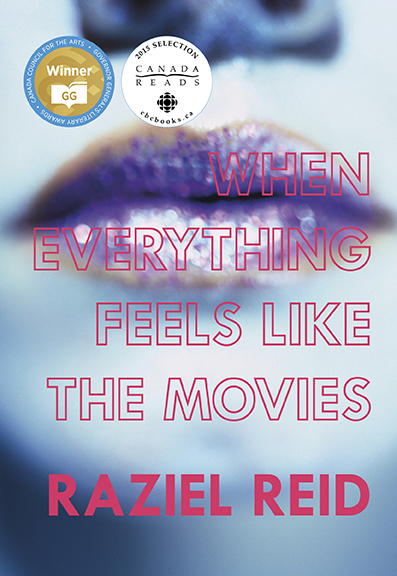 When Everything Feels Like the Movies has pretty much entered the YA canon, in Canada at least. People read it and either wish it had been around when they were a teen, or want to get it into the hands of today’s teens. Yes, there are those other people who wish it to be banned and stripped of its Governor General’s Award, but I’m not here to talk about them or explain why this book shouldn’t be banned. Others have done so very eloquently, notably Lainey Lui* on this year’s Canada Reads.
Before I even read the book, I noticed something odd about the controversy. No one was saying “ban this book because the main character is gay” or even “ban this book because of explicit gay sex,” exactly. There were lots of “graphic” this and “sexualized” that, but it was all very vague.
Then I read the book and I met Angela. Jude’s sidekick/thwarted crush/betrayer, it was Angela who pulled me into the story because it so closely resembled my own. I don’t mean that literally, though I did buy acid from a guy in a photo booth once. But between me and my friends, we did all this stuff: we stole our parents’ prescriptions, smoked pot, did mushrooms, dropped acid, drank, smoked; had sex with people we didn’t love (and some that we did;) made lists of our conquests; used abortions as birth control. Some girls were open about abortions, some tried to hide them. You could usually tell by looking for a bruise on the top of the hand; that’s where the IV goes in.
(Aside: What are you using an abortion for, if not birth control? This phrase as a pejorative really pisses me off.)
Do I sound blasé? Does Angela? I have the distance of years but Angela’s in the thick of it. Why isn’t she more sad, more ashamed, like a victim should be? Noted well-digger and Canada Reads contestant Craig Kielburger can barely contain his sputtering outage when he asks Lainey to read this passage:
“How’d it go this time?” I asked her.
“I asked the doctor if he could suck out some fat when he took the fetus, and he looked at me like I was masturbating with a crucifix.”
It’s telling that much of the defense of WEFLTM is that it shines a light on important issues like homophobia and bullying, but Craig directs our attention to a passage about a heterosexual girl’s abortion. No homosexuality or bullying here. So what’s controversial? That she doesn’t feel shame? That she makes a joke? How shallow a reader must you be to take Angela a face value. Did Craig consider that perhaps a 14 year old doesn’t have the language to express her feelings about having an abortion and makes a joke instead?
If you’re outraged by this excerpt, it’s because you don’t think Angela is suffering enough, and that’s kind of fucked up.
In addition to not being sad/contrite/ashamed enough, Angela also has no excuse. We can accept Jude’s substance abuse and fantasy life because his real life is terrible – a violent, unstable home; bullying at school; and a toxic best friend. In Angela, we are confronted with a outwardly normal, privileged teenage girl making poor choices and we demand to know why. Is it abuse? Mental illness? The parents’ fault?
How about: drinking, drugs, and sex are fun? (You know, until they’re not.) I grew up in a stable home with great parents and many advantages, and I’m not just saying that because my mom reads the blog now (HI MOM) but because it’s very rare to see a character like Angela, who is fucked up and *not* made sympathetic with a hard knock back story, or put on “a journey” to overcome some big struggle. Sometimes there is no reason why. That’s real life. That was my life.

Me, 16ish, pissed off about something.
WEFLTM could be a lifesaver for LGBTQ teens. It could also be important to all the Angelas out there. Is the need as dire? Nope. Contrary to what Jude thinks, many Angelas grow up to be boring suburban moms who cut loose by having a second glass of wine on a Saturday night. But that ubiquitous bookish quote, “we read to know that we are not alone,”applies to us, too. When Angela slapped Jude across the face after he called he a “come dumpter” (oh, the profanity!) I cheered. I wish I’d had Angela when I was 15, and I hope many teenagers and adults of all genders and sexuality read this book.
*I still really, really need to know what lipstick Lainey was wearing on Canada Reads. The perfect red. It haunts me.
 Reading in Bed