On the Calculation of Volume I by Solvej Balle, translated by Barbara Haveland
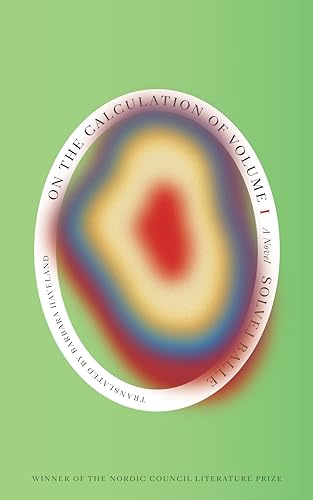
On the Calculation of Volume I is a compelling read, which is impressive, given that very little happens, and the end of the book is not the end of the story. It’s the beginning of a planned septology, and the last two or three books haven’t even been written yet.
Like The Unworthy, this is a novel written as a diary of a woman who is going through something strange, but unlike The Unworthy, that point of view is perfectly executed. You get the sense that the author has a bigger purpose, a structure that isn’t obvious yet, that needs to be played out in seven parts. I hope it’ll come together just like the calculation of volume came to Archimedes. Just know that there is no “Eureka!” moment in this first book.
Before we talk about what this narrator is going through, I recommend you read this review, in The Cut of all places, which provides some important background on how this book came to be. If you are, like me, annoyed by ambiguous timelines and convenient ways of circumventing technology, it’s helpful to know that Solvej “conceived of On the Calculation’s concept in 1987, then started writing in 1999.” I learned this after finishing the novel, and was instantly less annoyed by the fact that the narrator doesn’t try to use technology to figure out what’s happening to her. If there ever was a time to google “[problem] + reddit”, this is it…
The problem is that, as the story opens, Tara Selter has been living the same day, November 18th, over and over again, 121 times and counting, while the rest of the world is seemingly reset overnight and experiencing a normal, one-and-done day. Her diary takes us back to the first November 18th, the one that was preceded by November 17th, then through some of the intervening 120 November 18ths, and then forward through an entire year of them, without making the diary device feel forced or artificial.
Most of the book is given over to the practical problems of existing out of time, of which there are many. How many times can Tara explain her problem to her husband in the morning, get his help and advice through the day, just to wake up and have to explain it all over again? How long can she hide out in her own house, or other houses, to avoid him when it becomes clear that he’s holding her back? How much food can she eat before the empty cupboards in the house, and then the store shelves in town, are noted? How closely can she observe the world for deviations in how the day unfolds, whether in the movement of stars, or the way a person in a Paris hotel drops a piece of bread at the same time every day, and will those deviations lead her to a way out of November 18th, and back to the regular passing of time?
The most magical thing this book does is make one wonder who has it worse: Tara, stuck in one day, with no way to have a relationship with anyone or anything that lasts more than 24 hours; or everyone else, moving through their November 18th like automatons, unable to exercise free will or see beyond the ruts they run in. Only Tara can step back and try new routes and new angles, and see the possibilities that exist in one day.
One missing element did annoy me though. I kept wondering whether or not Tara gets periods or if she could get pregnant. Hubby’s always willing, no matter what iteration of November 18th we’re in or how far they get in their time travel investigations, and no birth control is mentioned. Other bodily functions seem to move forward, even though the days don’t. Nothing snaps a woman in line with time and seasons and cycles more than all that. But in addition to not knowing what year it is, we also don’t know how old Tara is, so I don’t really know how much of a factor this could be.
I guess we have six more books in which to figure that out, along with more pressing questions like why did this happen to Tara and how can she break free? I look forward to shouting “Eureka!” in a few years, once those last books are written and translated into English – assuming I don’t fall into a time warp before then.
 Reading in Bed
Yours is the second enticing review I’ve read of this book. I’ve got it on reserve at the library but they haven’t actually got a copy of it yet so #TapsFootImpatiently I’m having to wait till it’s available. (I think this is a case of no retailer in Australia being aware of the book before the prize nomination, and a quick scramble to get copies from overseas from a small publisher who probably only did a small print run.)
I could get a Kindle edition from Amazon, but (a) I’d rather read a print edition and (b) Amazon is always The Absolute Last Resort for me.
I loved this book. Loved Vol II, too. And then I went to see when Vol III is available . . . and loled.
Should be illegal!! See also books 2 and 3 in Franzen’s Crossroads trilogy…
Wow, this sounds good. I love time travel nonsense of all kinds – but literary time travel nonsense, what’s not to like!
polished! 42 2025 On the Calculation of Volume I by Solvej Balle, translated by Barbara Haveland astonishing
The problem is an unprecedented one for Tara. Even the readers are stuck at a point of amazement or bewilderment as to how it all happened to the narrator and as to how she will get out of it.
However, the narrative is excellent and the diction is just poetic. The narrative has to move form all directions to convey the inner workings of the narrator, her predicament and her wonderings. The prose is soft, solid and poetic.
The narrator’s existential crisis entices the readers to a gripping bind with the twists and turns in the psychological layers of the narrator, while there is nothing happening outside world showcasing Tara’s angst.