Tagged: fiction
Hunchback by Saou Ichikawa, translated by Polly Barton

In keeping with the spirit of this book, I will be brief.
Shaka is a wealthy middle aged woman with disabilities who lives in an assisted care facility. She says the following about holding a heavy book:
Holding in both hands an open book three or four centimetres in thickness took a greater toll on my back than any other activity. Being able to see; being able to hold a book; being able to turn its pages; being able to maintain a reading posture; being able to go to a bookshop to buy a book—I loathed the exclusionary machismo of book culture that demanded that its participants meet these five criteria of able-bodiedness. I loathed, too, the ignorant arrogance of all those self-professed book-lovers so oblivious to their privilege.
I found it ironic that many reviewers criticize the book for being too short, with underdeveloped characters and plot. To be fair, Hunchback is extra short, stretched over 90 pages in my edition due to wide margins and small pages. But I thought it was clever to have the form follow the spirit of Shaka’s complaint.
Ichikawa packs a ton into those pages – a frame narrative, excerpts from Shaka’s erotic fiction and tweets, literary allusions, some Covid commentary, and yes, a plot – a pretty shocking one!
The frame narrative stars Mikio, a persona Shaka uses to write erotic fiction, which we get to sample in the first few pages. At the end of the book, Mikio reappears and upends everything, in a way that I of course cannot describe here.
Shaka’s story, within this frame, is encapsulated in this anonymous tweet:
My ultimate dream is to get pregnant and have an abortion, just like a normal woman.
Shaka’s not serious at first – it’s more of a provocative commentary on rights for people with disabilities. But when she starts to act on this impulse, Hunchback becomes a story about class as well as disability. She finds a poor “beta male” who works in the assisted living facility to make her dream into reality.
And here’s where I had a little trouble. The scenario is a little far-fetched. The author has said that about 30 percent of Hunchback is based on her life. She asks the reader to believe a lot of convenient things, presumably the fictional 70 percent, to drive the plot and give it symbolic weight.
What ensues is a very twisted Normal People scenario in which a rich girl alternately wants to submit to, and assert her power over, a poor boy who is sort of her employee (this boy is no Connell though, alas). If Ichikawa appeased the critics and developed the story further into the future, or delved into Shaka’s past, it could have become even more artificial. As it stands, the somewhat-convenient plot is balanced by the strength of the writing and the astonishing ending.
The International Booker Prize jury found something compelling in short narratives this year. With the exception of Solenoid, each longisted book is under 300 pages, and most are under 200. Hunchback is not underdeveloped at all. The length works, thematically and structurally.
If I have a criticism, it’s that the narrator’s erotica and shitposts are pretty tame, and I’m not sure if that was intentional or not. But that might say more about my reading and scrolling habits than anything!
Best Books of 2024
Unlike my worst books of the year, I don’t see coherent themes in this list, nor is there a clear standout. None of these are perfect; they all annoyed me, just a little, in some way. In whittling the list down to ten, I tried to keep only the books where the annoyance is more about me than the book. In the order I read them:
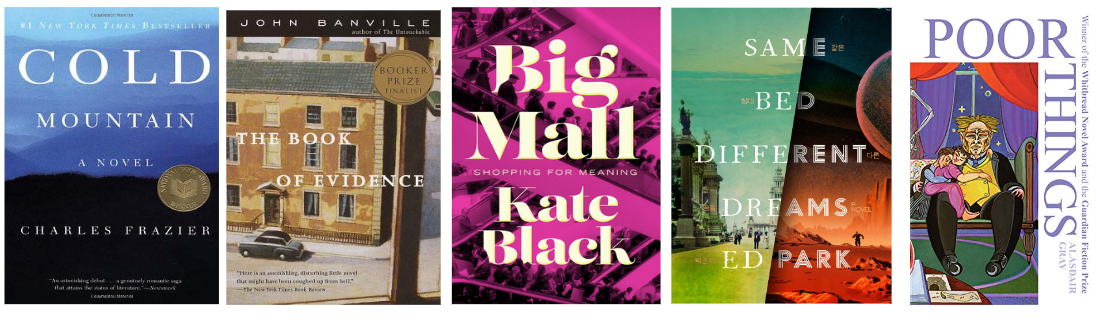
- Cold Mountain by Charles Frazier. They don’t write them like this anymore. Sprawling historical love story based on The Odyssey. Bonus: gave us a great movie adaptation starring Jude Law at peak hotness.
- The Book of Evidence by John Banville. This actually could be a standout. Pitch perfect, creepy as hell, and based on a true story, but this book does so much more than recount or sensationalize.
- Big Mall by Kate Black. If you want to read about the intersection between resource extraction, colonialism, animal cruelty, violence, tourism, architecture, and your local shopping mall, this is probably your best (and only) bet. My review and interview here.
- Same Bed Different Dreams by Ed Park. This reminded me of Infinite Jest (complimentary) not only in content – sports, alternate history, Canadian subplot that I didn’t see coming- but in how it blew my fucking mind.
- Poor Things by Alasdair Gray. Yes, it was a book first. Yes, the book is “better,” in that, there’s more there, and more of Bella Baxter in particular.
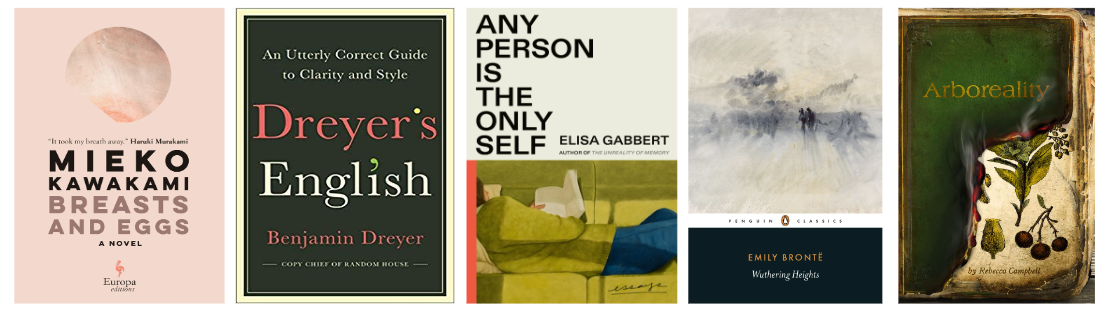
- Breasts and Eggs by Mieko Kawakami, tr. Sam Bett and David Boyd. I stayed away from this one for too long because I had the impression that it was one of those very on-the-nose feminist “message” novels, but it’s not. It’s brilliant.
- Dreyer’s English by Benjamin Dreyer. A rare case of an author’s social media presence selling me on a book. He vindicated my pickiness about Oxford commas and insistence on the proper use of “begs the question.” It’s the perfect book to read while falling asleep (complimentary.)
- Any Person is the Only Self by Elisa Gabbert. This is what I was looking for in the handful of millennial woman writer/critic essay collections I read this year. Humour, literary criticism, and, notably lacking in the others I read this year, humility.
- Wuthering Heights by Emily Bronte. If I reread WH in a given year, it will appear on my best books list.
- Arboreality by Rebecca Campbell. A near-future climate disaster novel in which things start going downhill rapidly in 2025 might be a bit much right now, so I’m glad I read it in 2024.
I don’t need to ask for your best books, we’re all posting them. Keep them coming!
 Reading in Bed