Tagged: 20booksofsummer
On the Calculation of Volume II by Solvej Balle, translated by Barbara Haveland
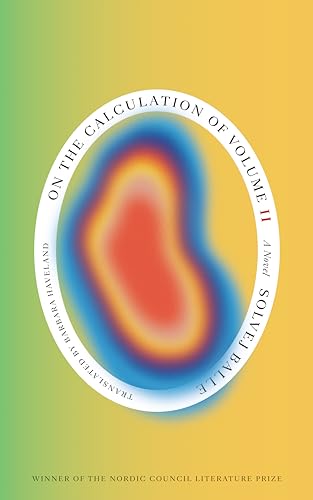
On the Calculation of Volume II didn’t feel as magic as Book I (read my review if you aren’t familiar with the premise of this series). It took me weeks to read, when it should have only taken days. After a year of gloomy continental November 18s, Tara decides to impose some seasonality. She travels north to experience winter, then south for spring and summer, finally settling in Düsseldorf. Once she was done chasing the seasons, I started to feel the magic again, but while she travelled around, getting into various scrapes (a sprained ankle, a mugging), I found myself pondering things, like, how many November 18s she’s really lived through. We know she’s done 367 in a row when this book opens, and about 1,000 of them by the end, but how many before all this? Or to put it explicitly, how old is she?
I thought I had found a definitive answer, but when I came back to grab a link for this review, the links are dead, only the result previews linger.

The search results preview still says she is 29, but clicking through to the Goodreads page today, I find no mention of her age at all. The same preview-to-page disparity exists on Net Galley and the Booker International Prize reading guide, which I swear to god said “29” when I clicked through a few weeks ago, but now says Tara is in her “late 20s.”
It’s an eerie feeling. Not as eerie as Tara noticing a hotel guest dropping a piece of bread in the same exact way, at the exact same time, day after day, of course. It’s eerie in the opposite way – I can’t re-create what I saw. I can still see it, but it’s just out of reach.
All this pondering led to even more pondering: which November 18 is Tara reliving? We know (?) that she’s 29, and these books were published in Danish in 2020, so Tara could be a Millennial born in 1990, reliving November 18, 2019. We also know that Balle conceived of the idea in 1987, so Tara could be a Boomer born in 1958, reliving November 18, 1987, making her roughly Balle’s age. But smart phones exist in Tara’s world, though they aren’t ubiquitous, and Tara carries information on a USB stick, not in the cloud, which puts her squarely at the end of the aughts or the early 2010s. Tara is in fact an Xennial. My age.
This threw me for a loop at first, but it makes sense. A tech-averse antiquarian book dealer circa 2010 is probably just the type of young person who could live off the grid like this. Tara doesn’t turn to the internet for answers or resources during her travels, and she’s able to “forget” to charge her phone, eventually tossing it. I can’t relate, but in 2010 it was still possible.
I could relate to Tara’s obsession with Rome – I love a good Wikipedia rabbit hole. A Roman coin she obtains in an early November 18 acts like a talisman, and around day #900, it becomes a fixation. She gets back online to see if the key to her time warp is somewhere in the ancient world. Learning about Rome replaces her fixation on seasons and weather that drove most of this volume, which replaced her fixation on the calendar year and the rotation of the planets which drove the first.
Eventually, Tara takes her obsession offline and audits a Roman history class at a local university, where she seems to meet some fellow travellers in a last-page cliffhanger.
At this point, 29-year-old Tara is also 32-year-old Tara, having lived through nearly three years’ worth of November 18s. By the time Book III comes out (on November 18, of course!) and we find out what happens next, 44-year-old me will be 45, with only one additional November 18 under my belt. I only wish it could be November 18, 2010, as I was on my first maternity leave, and my emails suggest I was mostly concerned with Kindermusic classes and exchanging recipes with my sister (in one exchange I asked her “wtf is sriracha” – these were primitive times!)
If this book had been as magical as the first, I still would have thought whether Tara is a fellow Xennial (generations are my hyper-fixation), but it wouldn’t have derailed my reading. I got exhausted thinking about it all – the timeline, her ambivalence towards technology, the logistics of her travels – and put the book down for days at a time. There are also passages that felt oddly repetitive, which is a funny thing to complain about in a book about living the same day over and over. I have to believe that the repetitiveness and the vague timeline are purposeful, and that I, like Tara, just can’t see the big picture yet.
I got close to glimpsing something bigger near the end. Not the obvious themes around climate change and whatnot, but an extended riff on containers, of all things. There is no way for me to properly quote this, as it sprawls over several pages, but I have done my best:
#1021
I have discovered something alarming. Or at least, it’s not a big discovery, but I do now find it alarming: everything in the Roman world is a container.
It’s not only all that freshly blown glass, all those Roman cups and flacons and vases… A house has become a container, with light falling into the centre and water flowing down into a pool when it rains…Like a bowl the harbor endeavors to contain the sea…The temples too have become containers…the entire empire is now a container, the Roman container, and the walls define the empire… That is what scares me. That everything has become a container. The boundless empire has been walled in, it is a bowl, a vessel, and the Romans get no further… I want to know why. I search for answers but I have fallen into the Roman’s container.
As someone who loves to think in hierarchies and taxonomies, and to assign significance to things that might just be random, this hit real hard. Books I and II are a container for my feelings about womanhood, ageing, and technology. With five more books to go, who knows what else they can contain?
Hard Times by Charles Dickens
Hard Times is #888 on the 1001 Books You Must Read Before You Die list. See the whole list and my progress here. This summer, I’m reading from the list for my 20 Books of Summer challenge, and instead of straight reviews, I’m going to compare the 1001 Books write ups with my own impressions.

Hard Times is one of the lesser known Dickens novels. It’s been on my shelf for 10+ years, and I’ve started it more than once, without getting much farther than the schoolroom chapters, where the teacher is named “Mr. McChokemchild.” A library ebook helped me get past the small font in my Penguin Popular Classics edition, and I soon wondered why no one told me this book has so much more than school children. It’s a classic Victorian social novel, tackling class, unionization, alcohol abuse, gambling, infidelity, and more. It’s sort of a North and South, with more humour and less romance.
Well, someone did try to tell me. The 1001 Books Hard Times write up not only mentions Gaskell (in an unfavourable comparison) but the entry is right beside the entry for North and South, highlighting the fact that these stories were being serialized at pretty much the exact same time – what a time to be alive! You know, if you weren’t a factory worker… or a woman…
The write up also would have helped me make the connection to utilitarianism, a philosophy I’ve been interested in since reading The Brothers Karamazov (and since going down several rabbit holes related to the current crop of tech-bro philosophers who are rebranding it as Effective Altruism). This theme is first explored in this early classroom scenes – what is an education for? What’s the point of “wondering” when you can memorize facts?
The write up portrays Hard Times as a bit of an unfocused look at these various social issues, and I guess it is, but compared to Dickens’ known works like A Tale of Two Cities, I found this one more satisfying. It read faster (not only because it’s significantly shorter), the characters were more varied, and while some were one-dimensional “bad guys”, most had some depth and showed some growth, even some of the female characters. And it’s just very funny. The circus ringmaster, Mr. Sleary, with his lisp and his rolling glass eye, was played for comic relief, but he speaks the line that sums up the book:
‘People must be amuthed, Thquire, thomehow…they can’t be alwayth a working, nor yet they can’t be alwayth a learning. Make the betht of uth; not the wurth.’
Chapter VI
To me, that’s as good as “It is a far, far better thing that I do, than I have ever done; it is a far, far better rest that I go to than I have ever known” (though perhaps not as good as “the best of times” etc.) I’m glad I finally read this. For me, that’s four down, six to go for the 1001 Books-worthy Dickens novels.


The Road by Cormac McCarthy
The Road had a profound effect on me. Not because of McCarthy’s writing style, this being my first encounter with it; or because of the audaciousness of his post-apocalyptic vision, the only one I’ve read without a shred of hope; or the biblical references, of which I am always slow on the uptake. I know all of these things are there but I can’t read The Road as anything other than an allegory for parenting, and here I could add, “in a time of crisis” or “in the modern world” or something but it’s not necessary, the world’s always in crisis and parenting exists outside of time, which is exactly the feeling this story gives me.
Continue reading
Norma by Sofi Oksanen, The Prison Book Club by Ann Walmsley, and Arlington Park by Rachel Cusk
Yes, it’s the dreaded mini-review round up. Things are not looking great for my #20BooksofSummer challenge. This post will bring me to 10/20 books reviewed, and I just started reading #13. Anyone else plan to just keep going after September 3?
Continue reading
The Fishermen by Chigozie Obioma
Goodreads is generally trash, but it is good for one thing: looking up reviews when you’re stuck on writing your own. Or, more to the point, you need to shore up your opinion about a book that seems to go against the grain. My first impression of The Fishermen was that it’s a good book that does several things quite well, but doesn’t really come together and feels a bit unfinished. I was uncertain: did I just not get it? Was it the cultural context?
Continue reading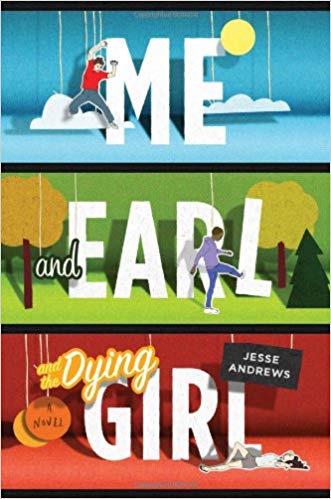
Me and Earl and the Dying Girl by Jesse Andrews
Me and Earl and the Dying Girl could have been a great book.
This is starting out very much like my review of The Fault in our Stars:
The Fault in Our Stars is a great book.
The most popular book review I’ve ever written, other than the one that was about sexy Sleeping Beauty
If they hadn’t been published in the same calendar year, I’d think that Me and Earl was a direct response to TFioS. Both Me and Earl and TFioS feature cancer, friendship, high school, inappropriate authority figures, sex, and, I think, oblique references to Infinite Jest? I covered the parallels between TFioS and IJ in my review of the former. In Me and Earl, parallels include the inclusion of a filmography, references to a brain fungus and, most directly, a film that “caused an actual death” so I don’t think I’m imagining this.
Continue reading Reading in Bed