Tagged: 20 books of summer 2024
My Year of Last Things
This is a book blog, not a personal blog, but I do write about life events here, and sometimes things don’t feel real until I do.
The births of my children are here. Moving into our house, briefly. My sister moving to the States. Then the fire happened, and I wrote about what it’s like to lose all your books, but I didn’t write about what it’s like to lose a pet.
If you follow me on social media, you might know that in the immediate aftermath of the fire, my husband found our cat Perogy in a bad state and got her to an emergency vet, where she remained for three weeks. You might have missed the “Missing Cat” posts about Shirley, though, as they were only up for a day, until my husband found her too. She didn’t make it.
Shirley was three years old, a pandemic pet born in 2020 and adopted by us in 2021. The SPCA named her and we didn’t see any reason to change it. She was loud, lazy, a bit of a glutton, cuddly, soft, playful, a constant companion to anyone sitting on a couch or lying in a bed, and scared of everything. She would have been very scared that day – the noise, the smoke, the heat, people stomping around. The firefighters told me she most likely escaped the house and we’d find her later, that it happens all the time, but I didn’t believe them.
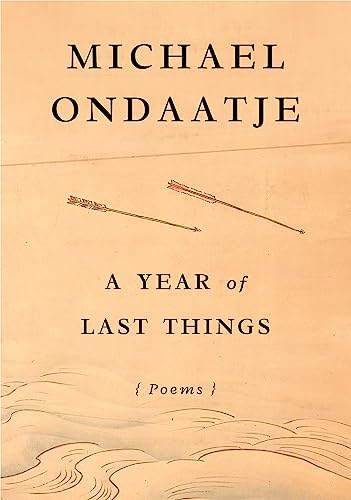
I’ve never lost a pet this way, only older pets who were ready to go and gave us time to prepare. I’ve also never lost a pet in the midst of a crisis – usually losing the pet is the crisis. I have mourned her, but alongside a bunch of other stuff, and seven months later, it can still feel awfully fresh; never more so than when I read the poem “November” in Michael Ondaajte’s new collection A Year of Last Things.
I’ve tried Ondaatje’s poetry before, and found it fairly impenetrable, with literary and cultural references that are beyond me. A lot of the poems in this collection are like that, though I got a hint of something different in this first line of the first poem, “Lock”:
Reading the lines he loves
he slips them into a pocket,
wishes to die with his clothes
full of torn-free stanzas
and the telephone numbers
of his children in far cities
I love that line about carrying the telephone numbers of your children in your pocket. Old fashioned but relatable. Later, we are treated to prose poems – mini-essays, really- about the horrors of boarding school and confronting an abuser.
And then there’s “November“:
Where is my dear sixteen-year-old cat
I wish to carry upstairs in my arms
looking up at me and thinking
be careful, dear human
Ondaatje addresses his cat, Jack, and remembers how he was adopted (“I found you as if an urchin in a snowstorm”), how he became a member of the family, (“learned the territories of the house”) and grew old (“Was it too soon or too late/that last summer of your life”). He despairs that he “cannot stand it,” this loss, and imagines meeting Jack again in a place “where language no longer exists”.
This poem has nothing much to say about my particular circumstances. “November” is about an old cat, and an old owner who can imagine meeting him again soon. Shirley was a young cat, and I am a (relatively) young owner who, if I believed in an afterlife, would anticipate waiting a long time for such a reunion. This poem doesn’t have anything particularly new to say about grief, either: it ends in a paraphrase of a 17th century haiku about the timelessness of nature, maybe, or the endless nature of grief?
It’s not a good poem because of what it says, but because of how it says it. It’s good because in ten stanzas (read them all here), it reminded me that my grief is real, and made me write about it here, making it even more real. It’s good because it made me think about my brother, who imagines his cat referring to people as “humans,” usually derogatory, and that made me smile. It’s good because the line near the end, “You no longer wait for us” took my breath away. Cats aren’t loyal and protective like dogs, but they do wait for you. I think about Shirley waiting for me that day. I knew she didn’t leave the house. She waited where she always did when she was scared, under the couch. That couch was just too close to the fire.
This is barely a review but it does remind me, and hopefully you, why it’s a good idea to read poetry: for those lines that takes you back to a place or a feeling, even one you cannot stand going back to.

Shirley, lying on top of someone’s legs as they lounged on the couch, as she was wont to do
Laser Quit Smoking Massage by Cole Nowicki

Are “short essay collections” a thing? Flash essays? Micro essays? I don’t know that I’ve ever read a collection like this before: 25 essays in 144 pages for an average of under 6 pages each. A couple of them come off as a little underdone, but most of them feel full: of odd characters, familiar places, and moments of catharsis and recognition. And humour! I laughed out loud at a joke about Balzac, Alberta, which does indeed sound like “ballsack” – as my kids will note every time we pass it on the way to Calgary.
Speaking of Alberta, I thought Big Mall would be the most locally and personally relevant book I’d read this year, but another millennial Albertan who eventually moved to Vancouver has entered the chat. Cole Nowicki grew up in Lac La Biche, Alberta, a town familiar to me because it’s close to a friend’s lake lot, where I would go camping (under duress) when the kids were small. Going to the Timmies, or the oddly-punctuated “The Bargain! Store” was a highlight of those trips.
It doesn’t really matter if you’ve been to Lac La Biche, though, or if you understand why it is a big deal that they have a Boston Pizza there. These are the best kind of personal essays, where the very specific experiences and interests of one person reveal something universal. You probably didn’t have a conversation with your mom about Blink-182 lyrics as a child, but you will recognize (I hope) the comfort to be found in the commiseration of a parent. You probably didn’t watch a parent go through a mental health crisis (I hope) but you will recognize the pain of growing up and realizing that your parents can’t or won’t commiserate with you the same way anymore.
I also enjoyed the essays that were a little less personal and more about the absurdities of the places we live, IRL and online. “The Big Dog in the Sky is Dirty”, about a sculpture of a poodle in Vancouver, doesn’t take an obvious position for or against public art, but exposes the class implications and bureaucracy around who gets to experience it. There are no pictures in these essays, but Nowicki also maintains a blog where you can read an earlier version of this essay and see the poodle in question.
There were other essays that could have been enhanced with pictures (“The Dark Lord of Vancouver Karaoke”, just to verify that “Arcanabyss” is a real guy, which he is) and one where I was very glad there weren’t (“A Brief History of People Finding Weird Shit in Their Ears”, which was horrifying in exactly the way you think). Early adopters of the internet will appreciate the lore around gail.com and “pooptime”, a website that I thought must have existed in the early aughts era, between “bathroom books” and social media, but was somehow still publishing content in 2018.
The only essay that fell a bit flat to me was the skateboarding one. The “well-worn cliche” of how skateboarding mirrors the growth and upheaval of adolescence is acknowledged early on, and for me, the essay didn’t overcome that. This tracks for me, as I regularly read Nowicki’s blog, Simple Magic, but skim over the hardcore skateboarding stuff. I keep coming back because I find so many gems (which are usually at least skateboarding-adjacent.)
This is the first of my 20 Books of Summer challenge. I enjoyed it so much that I immediately started another essay collection, No Judgement by Lauren Oyler, which is much bigger – in length, in scope, and in public reaction. Laser Quit Smoking Massage is easily the better collection, in terms of choice of subject, use of humour, and respect for the reader’s time and attention (I’ll expand on the latter if I review No Judgement.) I don’t foresee any hit pieces in Bookforum for this one, I hope readers give it a chance anyway.
20 Books of Summer 2024
20 Books of Summer has always been more about the motivation to *actually review* books for me, not reducing my TBR, and never more so than this year. I don’t own 20 books, let alone 20 books I haven’t read before. Hence the shorter list.
This year is special though, as it’s the tenth anniversary of an event that started as a TBR challenge with 8 participants that now attracts upwards of 100 bloggers each year. No mean feat given the state of blogging today and the fact that this is a rather high-commitment event (with very relaxed rules to make it manageable.) Congratulations to Cathy for keeping the pages turning and the reviews rolling in since 2014.
My list of 15 has no theme other than “these are books in my house or that I might get into my house at some point this summer”:
- Breasts and Eggs by Mieko Kawakami tr. Sam Bett and David Boyd (for Women in Translation month, perhaps)
- The Wars by Timothy Findley (a CanLit classic)
- A Tree Grows in Brooklyn by Betty Smith (an American classic)
- The Netanyahus by Joshua Cohen (has been recommended to me many a time)
- Agnes Grey by Anne Brontë (the book I was rereading at the time of our house fire, apologies to Edmonton Public Library for the lost copy!)
- Jane Eyre by Charlotte Brontë (it’s in the edition I got in order to read Agnes)
- Wuthering Heights by Emily Brontë (see above and it’s time for a reread anyway)
- Ghosts by John Banville (the next in the Book of Evidence series)
- Brooklyn by Colm Tóibín (a rare instance of “seen the movie, not read the book” and preparation for…)
- Long Island by Colm Tóibín (the much-anticipated sequel)
- Kairos by Jenny Erpenbeck tr. Michael Hofmann (my tradition of reading the International Booker Prize winners continues)
- Laser Quit Smoking Massage by Cole Nowicki (a slim essay collection)
- A Year of Last Things by Michael Ondaatje (a slim poetry collection)
- When Things Fall Apart by Pema Chödrön (they sure have been)
- The Tenderness of Wolves by Stef Penney (a Little Free Library pick)

Join in and let’s get this TBR back down to zero, or at least review some books this summer!
 Reading in Bed