One Hundred

The Magic Mountain is #706 on the 1001 Books You Must Read Before You Die, and #9 on the Novel 100.

They made a movie! In Germany, I guess.

Finishing Thomas Mann’s “The Magic Mountain” means that I have read 10% of the 1001 Books You Must Read Before You Die. Okay, 9.99%. Still. I’ve read 100 of the best books ever written. According to some people, anyway!

I’ve been choosing short books for months now to help me reach my goal, so this 850 page clunker was daunting. It took me nearly two months to read, and I was glossing over some of the boring parts.

Yes, even great books have boring parts. My sister just finished “The Count of Monte Cristo” and now claims that every book written before 1940 has a bunch of boring , wordy crap in the middle. It does feel that way sometimes.

“The Magic Mountain” has a series of philosophical debates between two supporting characters. It was reminiscent of the asides in Atlas Shrugged. This is not a good thing. They come out of nowhere and leave you thinking “What?? What about the characters, what’s happening to them?”

The introduction (by one of my favourite authors ever, A.S. Byatt) addresses these issues.  What happens to the characters isn’t really the point. This book is about personal discovery, it’s about Europe, it’s about time and space and sickness and health and on and on. I would have loved to write an essay on this book, you could pick any topic you wanted!

I *wanted* more of the love story, but the female lead sort of fades away near the end of the book. Apparently Thomas Mann himself said that you must read this book twice to truly understand it. I’m not sure if I’ll take him up on that.

For now, my big push for 100 of the 1001 books is done. Baby #2 is due in about two weeks, so the coming months are going to be about survival, in general, and in reading. I’m stepping away from goals and plans and will consider ANY reading to be great success. After baby #1, I didn’t read for six months. I’m hoping to keep reading and keep my sanity this time.

While I sit at home on sick leave, I’m reading another book about Germans, Half Blood Blues. I’ll get back to the list sometime, but till then, I’m reading what I want! FREEDOM!

I’ve leave you with some dirty talk, Thomas Mann style:

“The body, love, death, are simply one and the same. Because the body is sickness and depravity, it is what produces death, yes, both of them, love and death, are carnal, and that is the source of their great terror and magic… Consider the marvelous symmetry of the human frame, the shoulders and the ribs arranged in pairs, and the navel set amid the supply belly, and the dark sexual organs between the thighs… Let me take in the exhalation of your pores, and brush the down – oh, my human image made of water and protein, destined for the contours of the grave, let me perish, my lips against yours!”

It’s Good to Have Goals

Reading is bed is dangerous. I called this blog “Reading in Bed” after an Emily Haines song, and also because I do 99% of my reading in bed. Most nights I read in bed until my eyes begin to cross and words start to blur.

The danger is that I forget at least the last page or two of what I’ve read, and, that I never blog about my reading because I lose consciousness immediately after I’m done. I often think to myself “oo! Must blog about this book/chapter/passage/line” but when I wake up, the motivation is gone.

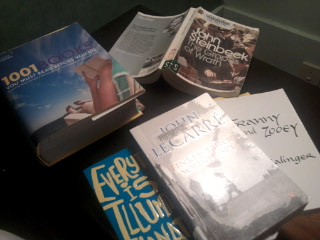
So, I haven’t been blogging, but I have been reading. I am on #94 in my quest to read 100 of the 1,001 Books You Must Read Before You Die before the end of the year.  And I’m really excited about what I’m reading now (The Grapes of Wrath) and what I’m going to be reading soon:

Reading and To Read

Good reads coming up!

I’m going to be really proud of myself if I reach 100 books by the end of the year. When I set my goal I didn’t count on getting pregnant, with the attendant exhaustion and stupidity. I didn’t count on us moving and all the craziness that will (hopefully) ensue. It’s going to be a tough go but maybe I can save my hormone-addled brain with a few- say, six- good books.

The Merchant of Venice: Quick Summary

Guys: Life sucks. I’m going to die. So it goes.
Girls: Um let’s just trick everyone and save our dumb husbands
Everyone: Jews are evil

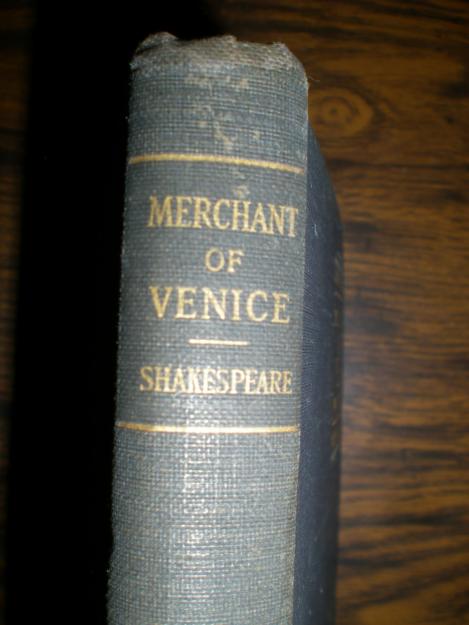
The only other thing I have to say about this book is that I read a 1903 edition, and it is staying on my bedside table even though I’m finished because we’re trying to sell the house and I think it makes me look smart.

Merchant of Venice 1903 Edition

Old-Timey!

Ma

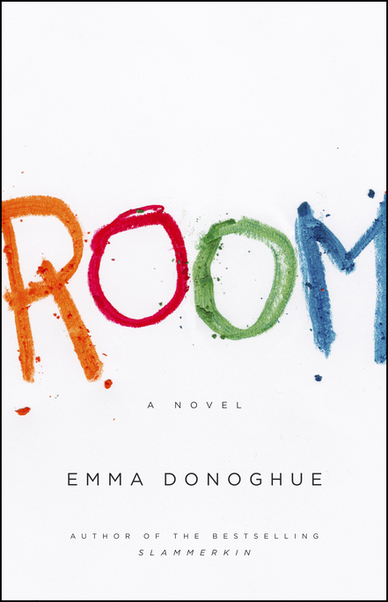
Room is an “it book” at the moment. Everyone I know is reading it, just finished reading it, or wants to read it. It’s an easy sell – a sensational, ripped-from-the-headlines situation, great pacing, compelling characters, all wrapped up in a quick and easy-to-read package.

The basic, spoiler-free premise: Five year old Jack is our narrator, and his is the only perspective we are privy to. His “Ma” has been locked up in a small room for about seven years by the mysterious “Old Nick”. Jack has spent his entire life in “Room” and doesn’t know that there is a world on the other side of the walls, or that there is anything there is anything unique about his situation.

The book is all ostensibly all about Jack, but for me it is all about Ma.

On a superficial level, when my son is getting on my last nerve, I think about Ma and realize I don’t have it so bad. I go to work during the week. I go to yoga classes some evenings. I have date nights with my husband. I have a support network of friends, family and daycare workers I can lean on. Ma has none of these things. She has been in the same room as her son for five years. This truly makes me shudder when I think about it too hard!

On a deeper level, Ma challenges the martyr-mommy archetype. There’s an pervasive notion out there that moms should put their family’s needs ahead of their own, at all times, and anything less is failure.

Spoilers follow…

Continue reading

Emo Quotes

“There is no trap so deadly as the trap you set for yourself”
Raymond Chandler, The Long Goodbye

The Long Goodbye is full of fantastic one-liners. This is my favourite so far. I love this because it’s completely spot on for the character, yet it’s something I could have written in my diary as a fifteen-year old. You know, had I been a brilliant writer.

Freedom! Horrible, Horrible Freedom!

The Corrections is #43 in the 2007 edition of The 1001 Books You Must Read Before You Die. Freedom is not on the list yet, but odds are it will be.

Freedom was only $10 on the Kobo, a steal compared to buying a hardcover and much faster than waiting for a hold at the library. But it’s really hard to blog about a book read on Kobo. I can’t flip back and find plot points and quotes. It’s been weeks since I finished and my memory is abysmal. I couldn’t remember the word “norm” tonight. And then I lost my keys. So, bear with me.

I am not nearly as impressed with Freedom as I feel I ought to be. I felt the same way about The Corrections (hardcover sitting on my bookshelf; Wee Book Inn score). Jonathan Franzen is a great writer, but I can just feel how hard he’s trying to say something smart/ironic/witty/whatever. I keep thinking, “oh, I see what you’re doing there”.

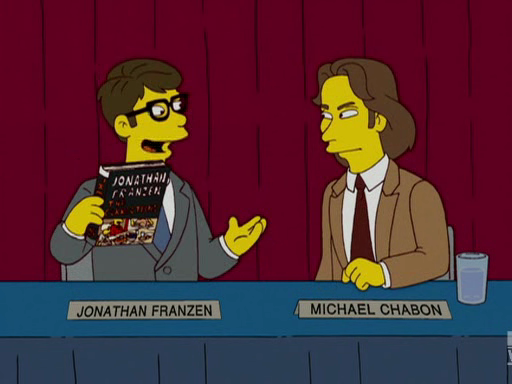
Jonathan Frazen on The Simpsons

I am, however, impressed by any writer that guest stars on The Simpsons.

I wish the whole book was about Patty, a natural urban mama before it was cool to be one, and Richard, the hipster musician she loves and can’t have. Franzen uses their story to explore different meanings of “freedom” – from worry, from commitment, from love – and the whole thing is just drop dead romantic. He writes an album for her. Enough said!

But there’s a LONG interlude  about her husband’s environmental crusade and affair with his young assistant. The environmental crusade becomes a bit of a soapbox for the childfree movement. I felt like I was reading Atlas Shrugged; I couldn’t tell if we were still on the story, or if I was now just reading someone’s political views (Franzen’s? He is childfree, but by default; it’s his wife who didn’t want kids). While this was all rather interesting, it was jarring and out of place. Or maybe, being a breeder and all, I don’t wanna think about how my precious babies will destroy the planet and just wanna read about loooove.

Weeks later, I’m struggling to remember everything important about this book, but the characters, particularly Patty, have stuck with me.  I’m not as impressed as I ought to be, but I’m very impressed when  a childfree guy like Jonathan Franzen creates such a real and complex character who happens to be a stay-at-home-mom.

“She had all day every day to figure out some decent and satisfying way to live, and yet all she ever seemed to get for all her choices and all her freedom was more miserable. The autobiographer is almost forced to the conclusion that she pitied herself for being so free.”

Library Fail

I am so smrt

I used to wear this on a t-shirt in my “gifted” classes. AND NOW IT’S ALL TRUE.

The Age of Innocence is #726 in the 2007 Edition of 1001 Books You Must Read Before You Die.

So, I finished my “had to read” book, and went to the library to get back on track with The List.

I went to my neighbourhood branch, so the selection isn’t that great, but I perused the shelves looking for classics. You can usually spot them by their rather boring covers!

First I selected “Child of God” by Cormac McCarthy. Never heard of the book, but he is the author of “All the Pretty Horses”; a book I have heard of, and was made into a movie. So, I gave it about a 75% chance this other book would be on The List.

Then I spotted one of my favourite books, The Age of Innocence by Edith Wharton. Pure soapy drama, but devastatingly sad and funny and rich. I thought I’d grab another of her books, The House of Mirth, as I was 100% is was on The List, AND I really want to read more by her.

I get home, and lo and behold – poor Mr. McCarthy is not on The List at all! The book sounds intriguing, and it’s fairly short, so I may give it a shot anyway, after The House of Mirth… but… on closer inspection…  I grabbed The Age of Innocence by mistake in my excitement.

And so, I am reading Aesop’s Fables for free on my Kobo. That will be a whole other post, but man, do I feel stupid. Does “baby brain” have an expiry date? This doesn’t bode well for me actually breaking 100 out of the 1001 books this year!

Writing in the Margins

Heart of Darkness is #780 in the 2007 Edition of 1001 Books You Must Read Before You Die. The Stone Angel and Mercy Among the Children are not on the list, but should be.

I’m reading a book right now because I have to. Not because it’s on The List, but because I have to, for work (I`m going to an event where the keynote speech will be about Clay Shirky’s `”Cognitive Surplus”).

It’s a been a long time since I “had” to read something. It got me thinking about reading for pleasure vs. reading for school or for work. Sometimes, I think analyzing a book to death can ruin the experience. I read Heart of Darkness by Joseph Conrad in Grade 12 English, and years later, I can’t just read it; I can only see it in bits and pieces – oh, yeah, here’s an example of racist colonial attitudes. Here`s an example of the untamed jungle symbolizing… whatever (it`s been a while). I *know* it`s a great book.  But I just can`t see it.

But, I read Wuthering Heights in the same class and it`s stuck with me as one of my all-time favourites, despite endlessly cataloguing the ways in which weather parallels the character`s personalities. Seriously… it rains a lot, and everyone is depressed, and I GET IT. I also remember reading The Stone Angel by Margret Laurence in Grade 11, but I don`t remember writing the paper. I don`t really remember much about that English class at all, except for the day that the teacher told me to “be the heroine of [my] own life”  (like the main character, Hagar is – she’s the model of a tough broad). That encapsulates the whole novel for me, and I thought it was super profound at the time. Okay, I still do!

Then there are books I wish I’d read in school. I just don’t have the time or brain power to really think them through anymore. I would have loved to have heard what an English teacher thinks about David Adams Richard’s Mercy Among the Children. It’s in my top ten, and I still don’t fully get it. Gist of the story: man makes a pact to never do harm to another human being.  This simple choice destroys his life and the lives of his family, but he can’t let go of his promise. But what does it all *mean*?

Sigh!

And I really miss highlighting and making notes in the margin! I can’t be the only one. I pretty much read library books now, and it makes me sad that I can’t mark them up. I’m probably dating myself. Do “kids these days” even mark up books? How is this going to work with e-readers? So many questions!

Anyways. Did English class ruin books for you? Or did it give you a chance to really get into them in a way you can’t today? Or did you skip out and go to the mall?

I probably used this quote in my Grade 12 HoD paper. Descriptions of nature *always* symbolize something. “Nature herself had tried to ward off intruders; in and out of rivers, streams of death in life, whose banks were rotting into mud, whose waters, thickened into slime, invaded the contorted mangroves, that seemed to writhe at us in the extremity of an impotent despair.”