Category: Reviews
Irish Twins: The Sea by John Banville and The Secret Scripture by Sebastian Barry
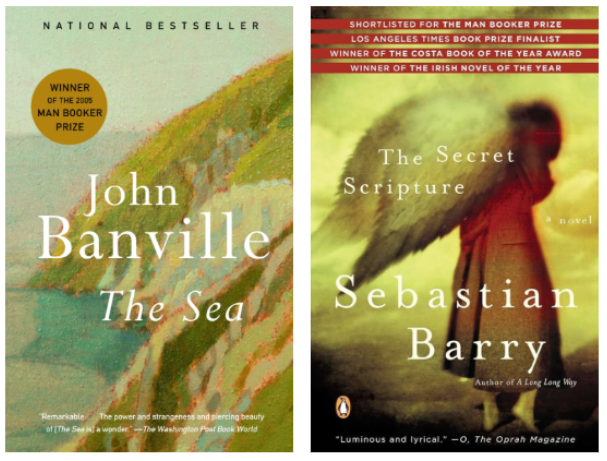
Welcome to Reading Ireland Month, hosted by Cathy of 746 Books! My participation is a fluke (or luck of the Irish?), as I just happened to finish two Irish books recently. Let’s go with luck, as both these books were great and had surprising parallels, so it’s like I was meant to read them back-to-back. In lieu of a real review, which would take me longer than we have days left in March, let me tell you how Banville and Barry ended up writing very similar stories, within a few years of each other.
I read The Sea first. This is my fourth Banville, and the first that isn’t part of the Frames trilogy, so I thought this would be something completely different from those books, that were full of murder, sex, and art. Not so much – the protagonist Max Morden is a little older and much milder man than Freddie Montgomery, but he’s an art writer (Freddie was an appraiser), and we learn much (too much?) about his sexual awakening, as a childhood obsession with an older woman quickly gets transferred to her more age-appropriate daughter during a summer vacation. In the current-day thread, Max is mourning the loss of his wife, and is driven to visit the site of these past dalliances. We learn that the marriage was a little complicated, and there’s an almost-estranged daughter in the mix as well. The unreliability of memory and impossibility of learning the truth about the past are the main things here, but there is also a mystery to solve, and a revelation near the end gave me the delicious readerly sensation of being both surprised, but also believing this is the only way for the story to end.
Then I read The Secret Scripture. This is my second Barry, and part of a different series than Days Without End, which I read when it was up for the Booker (another commonality of these authors: they are often up for the Booker, and occasionally win). Barry is a little less seedy than Banville, but there are many parallels: a man in his sixties, recently widowed after a complicated marriage, no children this time, but nearing the end of his career in psychiatry. Both men’s stories are told in the form of a diary, sort of – we understand that Max is writing about his life instead of what he should be writing, the manuscript of his next book, while Dr. Grene is writing in his “Commonplace Book” instead of what he should be writing, a psychiatric assessment of a 100-year-old patient in his care, Roseanne. Dr. Grene must find placements for all his patients, as the hospital is about to be demolished. Roseanne has been institutionalized for about sixty years, outliving anyone who could tell Dr. Grene why she was put there in the first place. At the same time, Roseanne is writing an account of her life – a “Testimony of Herself”. There’s no parallel narrative in The Sea, though there are certainly women and girls who transgress norms in a repressive culture that punishes women who don’t fall in line. The Secret Scripture is also more overtly about Irish history – it can’t help but be, with a character who was born around 1910 in Sligo. Roseanne’s father, husband, and brothers-in-law are historical actors in various ways, but it’s Roseanne who survives and tells all of their stories.
Dr. Grene could have admitted Roseanne to a hospital and been done with it, but he becomes obsessed with unravelling the mystery of her life. Likewise, Roseanne would be forgiven for giving up, after living through unimaginable hardship, historical and personal, but she is just as driven to unravel things. Though it’s her own life, it’s no less mysterious. Like The Sea, the mystery comes together in a way that would have been contrived in the hands of almost any other writer.
The last-minute revelations, I’ll admit, prevented these novels from being my favourite from either author. There is something a little too neat here, even though the stories are expertly written and the endings feel “earned”, and, especially in the case of the Barry, cathartic. But a middling Barry or Banville novel is better than almost anything else out there, so I’m not complaining.
It’s Always Sunny in La Mancha

I discovered two beloved and durable classics in 2025, but only one counts towards my 1,001 Books challenge: Don Quixote by Cervantes, translated by Edith Grossman.
Don Quixote’s length means it becomes an undertone to whatever else is going on in your life during the weeks (okay, months) you are reading it. For critic Ariel Dorfman, Don Quixote is forever linked to the coup in Chile, as she and 30 other refugees read it to each other in 1973 while hiding in an embassy. Ed Simon, an editor at LitHub, connects Cervante’s imprisonment and themes of freedom in the book with the kidnapping and imprisonment of immigrants in modern America.
As for me, I read Don Quixote (DQ hereafter unless I mean the character) while binge-watching It’s Always Sunny in Philadelphia (IASIP hereafter), and now, it is inextricably linked with The Gang’s adventures.
This is perhaps not as meaningful as others’ experiences, but as I watched and read, I started to suspect that Cervantes invented the sitcom, rather than the novel, which he is often credited with. This feels significant, as sitcoms are dying out, after overtaking novels as a dominant narrative form in the twentieth century*. So while I’m interested in what Cervantes has to say about freedom, imagination, and the dying days of the Spanish empire, my brain was primed to see him inventing the form that eventually led to Danny DeVito writhing on the floor, naked and covered in hand sanitizer.
So rather than write a review of DQ, as you hardly need me to tell you if you should read it, I’m going to look at all the ways in which DQ is echoed in IASIP, a show that premiered exactly four hundred years after the First Part of the Ingenious Gentleman Don Quixote of La Mancha was published in 1605.
Continue readingSmall Boat by Vincent Delecroix, translated by Helen Stevenson

Welcome to Novellas in November 2025, in which I try to catch up on reviews by tackling the novellas I’ve read so far this year.
This novella stuck with me, not only because it is so good, but because my interpretation of it seems to be a rare one, and maybe a wrong one. So, to the extent that a philosophical novel based on true events which I may have interpreted incorrectly can be spoiled, beware of spoilers ahead.
Continue readingOn the Calculation of Volume II by Solvej Balle, translated by Barbara Haveland
On the Calculation of Volume II didn’t feel as magic as Book I (read my review if you aren’t familiar with the premise of this series). It took me weeks to read, when it should have only taken days. After a year of gloomy continental November 18s, Tara decides to impose some seasonality. She travels north to experience winter, then south for spring and summer, finally settling in Düsseldorf. Once she was done chasing the seasons, I started to feel the magic again, but while she travelled around, getting into various scrapes (a sprained ankle, a mugging), I found myself pondering things, like, how many November 18s she’s really lived through. We know she’s done 367 in a row when this book opens, and about 1,000 of them by the end, but how many before all this? Or to put it explicitly, how old is she?
I thought I had found a definitive answer, but when I came back to grab a link for this review, the links are dead, only the result previews linger.

The search results preview still says she is 29, but clicking through to the Goodreads page today, I find no mention of her age at all. The same preview-to-page disparity exists on Net Galley and the Booker International Prize reading guide, which I swear to god said “29” when I clicked through a few weeks ago, but now says Tara is in her “late 20s.”
It’s an eerie feeling. Not as eerie as Tara noticing a hotel guest dropping a piece of bread in the same exact way, at the exact same time, day after day, of course. It’s eerie in the opposite way – I can’t re-create what I saw. I can still see it, but it’s just out of reach.
All this pondering led to even more pondering: which November 18 is Tara reliving? We know (?) that she’s 29, and these books were published in Danish in 2020, so Tara could be a Millennial born in 1990, reliving November 18, 2019. We also know that Balle conceived of the idea in 1987, so Tara could be a Boomer born in 1958, reliving November 18, 1987, making her roughly Balle’s age. But smart phones exist in Tara’s world, though they aren’t ubiquitous, and Tara carries information on a USB stick, not in the cloud, which puts her squarely at the end of the aughts or the early 2010s. Tara is in fact an Xennial. My age.
This threw me for a loop at first, but it makes sense. A tech-averse antiquarian book dealer circa 2010 is probably just the type of young person who could live off the grid like this. Tara doesn’t turn to the internet for answers or resources during her travels, and she’s able to “forget” to charge her phone, eventually tossing it. I can’t relate, but in 2010 it was still possible.
I could relate to Tara’s obsession with Rome – I love a good Wikipedia rabbit hole. A Roman coin she obtains in an early November 18 acts like a talisman, and around day #900, it becomes a fixation. She gets back online to see if the key to her time warp is somewhere in the ancient world. Learning about Rome replaces her fixation on seasons and weather that drove most of this volume, which replaced her fixation on the calendar year and the rotation of the planets which drove the first.
Eventually, Tara takes her obsession offline and audits a Roman history class at a local university, where she seems to meet some fellow travellers in a last-page cliffhanger.
At this point, 29-year-old Tara is also 32-year-old Tara, having lived through nearly three years’ worth of November 18s. By the time Book III comes out (on November 18, of course!) and we find out what happens next, 44-year-old me will be 45, with only one additional November 18 under my belt. I only wish it could be November 18, 2010, as I was on my first maternity leave, and my emails suggest I was mostly concerned with Kindermusic classes and exchanging recipes with my sister (in one exchange I asked her “wtf is sriracha” – these were primitive times!)
If this book had been as magical as the first, I still would have thought whether Tara is a fellow Xennial (generations are my hyper-fixation), but it wouldn’t have derailed my reading. I got exhausted thinking about it all – the timeline, her ambivalence towards technology, the logistics of her travels – and put the book down for days at a time. There are also passages that felt oddly repetitive, which is a funny thing to complain about in a book about living the same day over and over. I have to believe that the repetitiveness and the vague timeline are purposeful, and that I, like Tara, just can’t see the big picture yet.
I got close to glimpsing something bigger near the end. Not the obvious themes around climate change and whatnot, but an extended riff on containers, of all things. There is no way for me to properly quote this, as it sprawls over several pages, but I have done my best:
#1021
I have discovered something alarming. Or at least, it’s not a big discovery, but I do now find it alarming: everything in the Roman world is a container.
It’s not only all that freshly blown glass, all those Roman cups and flacons and vases… A house has become a container, with light falling into the centre and water flowing down into a pool when it rains…Like a bowl the harbor endeavors to contain the sea…The temples too have become containers…the entire empire is now a container, the Roman container, and the walls define the empire… That is what scares me. That everything has become a container. The boundless empire has been walled in, it is a bowl, a vessel, and the Romans get no further… I want to know why. I search for answers but I have fallen into the Roman’s container.
As someone who loves to think in hierarchies and taxonomies, and to assign significance to things that might just be random, this hit real hard. Books I and II are a container for my feelings about womanhood, ageing, and technology. With five more books to go, who knows what else they can contain?
Less by Andrew Sean Greer

In April 2018, I was following the International Booker Prize (then Man Booker) for the first time, reading political books translated from Arabic and Chinese, post-post modern books translated from Korean and Polish, and some stuff I can’t even explain translated from Hungarian. Less, a novel about an American man’s midlife crisis, wasn’t really on my radar, despite winning the Pulitzer Prize that very month.
I vaguely remember seeing the cover and thinking, that looks like chick lit. These days, I would probably assume it was a “spicy” romance, but these were more innocent times. More specifically, the cover reminded me of a Sophie Kinsella novel, perhaps a gender-swapped Shopaholic. Turns out I wasn’t far off!
Continue readingHunchback by Saou Ichikawa, translated by Polly Barton

In keeping with the spirit of this book, I will be brief.
Shaka is a wealthy middle aged woman with disabilities who lives in an assisted care facility. She says the following about holding a heavy book:
Holding in both hands an open book three or four centimetres in thickness took a greater toll on my back than any other activity. Being able to see; being able to hold a book; being able to turn its pages; being able to maintain a reading posture; being able to go to a bookshop to buy a book—I loathed the exclusionary machismo of book culture that demanded that its participants meet these five criteria of able-bodiedness. I loathed, too, the ignorant arrogance of all those self-professed book-lovers so oblivious to their privilege.
I found it ironic that many reviewers criticize the book for being too short, with underdeveloped characters and plot. To be fair, Hunchback is extra short, stretched over 90 pages in my edition due to wide margins and small pages. But I thought it was clever to have the form follow the spirit of Shaka’s complaint.
Ichikawa packs a ton into those pages – a frame narrative, excerpts from Shaka’s erotic fiction and tweets, literary allusions, some Covid commentary, and yes, a plot – a pretty shocking one!
The frame narrative stars Mikio, a persona Shaka uses to write erotic fiction, which we get to sample in the first few pages. At the end of the book, Mikio reappears and upends everything, in a way that I of course cannot describe here.
Shaka’s story, within this frame, is encapsulated in this anonymous tweet:
My ultimate dream is to get pregnant and have an abortion, just like a normal woman.
Shaka’s not serious at first – it’s more of a provocative commentary on rights for people with disabilities. But when she starts to act on this impulse, Hunchback becomes a story about class as well as disability. She finds a poor “beta male” who works in the assisted living facility to make her dream into reality.
And here’s where I had a little trouble. The scenario is a little far-fetched. The author has said that about 30 percent of Hunchback is based on her life. She asks the reader to believe a lot of convenient things, presumably the fictional 70 percent, to drive the plot and give it symbolic weight.
What ensues is a very twisted Normal People scenario in which a rich girl alternately wants to submit to, and assert her power over, a poor boy who is sort of her employee (this boy is no Connell though, alas). If Ichikawa appeased the critics and developed the story further into the future, or delved into Shaka’s past, it could have become even more artificial. As it stands, the somewhat-convenient plot is balanced by the strength of the writing and the astonishing ending.
The International Booker Prize jury found something compelling in short narratives this year. With the exception of Solenoid, each longisted book is under 300 pages, and most are under 200. Hunchback is not underdeveloped at all. The length works, thematically and structurally.
If I have a criticism, it’s that the narrator’s erotica and shitposts are pretty tame, and I’m not sure if that was intentional or not. But that might say more about my reading and scrolling habits than anything!
On the Calculation of Volume I by Solvej Balle, translated by Barbara Haveland
On the Calculation of Volume I is a compelling read, which is impressive, given that very little happens, and the end of the book is not the end of the story. It’s the beginning of a planned septology, and the last two or three books haven’t even been written yet.
Like The Unworthy, this is a novel written as a diary of a woman who is going through something strange, but unlike The Unworthy, that point of view is perfectly executed. You get the sense that the author has a bigger purpose, a structure that isn’t obvious yet, that needs to be played out in seven parts. I hope it’ll come together just like the calculation of volume came to Archimedes. Just know that there is no “Eureka!” moment in this first book.
Before we talk about what this narrator is going through, I recommend you read this review, in The Cut of all places, which provides some important background on how this book came to be. If you are, like me, annoyed by ambiguous timelines and convenient ways of circumventing technology, it’s helpful to know that Solvej “conceived of On the Calculation’s concept in 1987, then started writing in 1999.” I learned this after finishing the novel, and was instantly less annoyed by the fact that the narrator doesn’t try to use technology to figure out what’s happening to her. If there ever was a time to google “[problem] + reddit”, this is it…
The problem is that, as the story opens, Tara Selter has been living the same day, November 18th, over and over again, 121 times and counting, while the rest of the world is seemingly reset overnight and experiencing a normal, one-and-done day. Her diary takes us back to the first November 18th, the one that was preceded by November 17th, then through some of the intervening 120 November 18ths, and then forward through an entire year of them, without making the diary device feel forced or artificial.
Most of the book is given over to the practical problems of existing out of time, of which there are many. How many times can Tara explain her problem to her husband in the morning, get his help and advice through the day, just to wake up and have to explain it all over again? How long can she hide out in her own house, or other houses, to avoid him when it becomes clear that he’s holding her back? How much food can she eat before the empty cupboards in the house, and then the store shelves in town, are noted? How closely can she observe the world for deviations in how the day unfolds, whether in the movement of stars, or the way a person in a Paris hotel drops a piece of bread at the same time every day, and will those deviations lead her to a way out of November 18th, and back to the regular passing of time?
The most magical thing this book does is make one wonder who has it worse: Tara, stuck in one day, with no way to have a relationship with anyone or anything that lasts more than 24 hours; or everyone else, moving through their November 18th like automatons, unable to exercise free will or see beyond the ruts they run in. Only Tara can step back and try new routes and new angles, and see the possibilities that exist in one day.
One missing element did annoy me though. I kept wondering whether or not Tara gets periods or if she could get pregnant. Hubby’s always willing, no matter what iteration of November 18th we’re in or how far they get in their time travel investigations, and no birth control is mentioned. Other bodily functions seem to move forward, even though the days don’t. Nothing snaps a woman in line with time and seasons and cycles more than all that. But in addition to not knowing what year it is, we also don’t know how old Tara is, so I don’t really know how much of a factor this could be.
I guess we have six more books in which to figure that out, along with more pressing questions like why did this happen to Tara and how can she break free? I look forward to shouting “Eureka!” in a few years, once those last books are written and translated into English – assuming I don’t fall into a time warp before then.
The Unworthy by Agustina Bazterrica, translated by Sarah Moses

There’s a TikTok trend (which will probably be over by the time you read this) which is meant to look like a first-person horror video game with captions like “POV: YOU WAKE UP DURING THE BLACK PLAGUE (1351)” and “POV you wake up as a worker in Titanic in 1912”. There are milder and sillier examples, but most have a scary, historical vibe. This is one of the few instances of “POV” being used correctly on the app, rather than used as a lazy setup for a punchline.
First-person perspective is much more common in literature, and while you can’t really do it “wrong,” you can do it badly. Brandon Taylor wrote a scathing essay about this. His beef is more broad and nuanced than mine. My bar is pretty low: if I’m reading a story told in first-person narration, I just need to understand WHY I am reading it. Like, is this character talking to me? How? Are they writing the story down? Why? When? Are they telling the story to another character? Reminiscing to themselves? It usually boils down to “WHO ARE YOU TALKING TO”?
So I’ll give The Unworthy this: we know who the unnamed first person narrator is talking to, and how, and why. She is writing in a diary. And not just any diary: a forbidden diary made of foraged materials that must be hidden every night. A diary she writes to and for herself, to “remember who [she] was,” but later imagines someone (us, I guess) might find and read.
However. The first-person point of view in The Unworthy is very limiting. Taylor notes that many such narrators are “lacking both explanatory power and the impulse toward explication itself.” This is a problem in any kind of fiction, but in speculative fiction, it’s particularly frustrating. Bazterrica has to build two worlds simultaneously: the outside world, afflicted by plague and climate disaster and war; and the cloistered world of the House of the Sacred Sisterhood, in which our narrator has found refuge. The reader needs a sense of why anyone would stick around, eating crickets and being tortured, and why the rank and file of this House, the titular Unworthy, want so badly to be elevated to the ranks of the Chosen.
The narrator’s diary has to keep the reader apprised of the present-day plot inside the House, and the backstory of how society collapsed. But our narrator is not really a main player in either. She is an observer. She relays the goings-on in the House, where young women are segregated into castes and tortured by a sexually sadistic Superior Sister and a mysterious man known only has “Him,” while through her memories, we find out what it was like to survive the collapse of society, but never get an idea of what exactly happened, or how fast, or when. And I never got a sense of how any of it felt, for the narrator or anyone else.
There are some interesting elements here. The writing is repetitive, but in a good way: it’s incantatory and reminiscent of chanting, which sets the right culty mood. I love the way He constantly warns the women against worshipping “the erroneous God, the false son, the negative mother,” (though as a lapsed Catholic, it sounds a little strange to talk about a mother rather than a holy spirit) and I love the House’s unofficial motto, “without faith, there is no refuge”.
I question the narrator’s need to transcribe that motto quite so many times though. The Unworthy leans a little too hard into the diary thing, the narrator constantly stopping mid-sentence when she’s scared of being caught, and crossing out dangerous thoughts. But it also commits the cardinal sin of epistolary novels: including shit a real person would never bother to write down. We’re almost in “Castle AUGHHHH” territory. You’d think if you were writing in ink made from scrounged materials, and sometimes your own BLOOD, you would simply not write the same words over and over again. Or, say, keep those super-subversive thoughts in your head rather than writing them down just to cross them out. At the very least, not include quite so many parenthetical asides.
Speaking of blood, given this author’s reputation for gross-out writing (her previous novel featured cannibalism), I was expecting a lot more from the violent scenes. The various castes within the monastery are disfigured to denote their status (eyes sewn shut, eardrums perforated, tongue cut out, etc.) and the Superior Sister loves a good torture sesh for anyone who gets out of line. But because nothing bad happens to our narrator -no one sews her eyes shut or sticks a needle in her nipple or whips her or hangs her (I’m leaving out the one actually kind of cool/disgusting punishment, but even it is glossed over) – we are kept at a remove. We can only access the shocking stuff through her perspective, mediated by a diary.
Leaving aside the diary conceit and perspective, The Unworthy also suffers because none of this is new, and many have done it better. I recently read Arboreality by Rebecca Campbell, a scary-realistic account of climate change-driven societal collapse and recovery that offers real insight into a possible future. If you’re looking for violence, degradation, lesbian panic, and religious trauma, you can go all the way back to the 18th century and read The Nun by Denis Diderot or The Monk by Matthew Lewis. I promise you, there are scenes in both that will disturb you more than anything this sacred sisterhood gets up to. If you’re looking for a book about cloistered young women trying to stay safe in an uncertain world, who experience mystical shit and bully each other, try Abigail by Magda Szabó. Each of these books make the best of their genres (speculative fiction, gothic x2, and YA, respectively) and are original and insightful. The Unworthy falls right into the pitfalls of its genres (YA, dystopian) and its first-person, epistolary perspective.
Brandon Taylor likens the glut of first person novels to reality TV, calling them “casting tape fiction.” The Unworthy is even worse: it’s TikTok fiction. “POV: You Wake up in a Weird BDSM Cult after Surviving Climate Disaster.” If I wanted that, I’d go to my for you page.
Bad Land by Corinna Chong

I don’t love the mountains, which is a controversial thing to say here in Alberta. Everyone goes to the mountains, and feels at peace, at home, in awe, or whatever. Many “leave their heart” there. Maybe it’s because I grew up in Vancouver, where it was normal to see mountains (and an ocean) but I need a little more than a large rock formation to get me speaking in clichés.
I’m also not easily impressed by so-called disaster woman stories. There’s got to be a little more going on than “this woman is weird and messy.”
Bad Land, thankfully, has got more going for it. In addition to a weird woman, there is also a weird little girl. And it’s not set in the mountains; it’s set in the one place in Alberta that actually does make me feel a sense of awe: the badlands.
“Then the puckered hills begin to swell out of the earth, growing higher, wider, baring their stripes of ancient rock and clay and ash, layer upon layer. As the Buick sinks into the valley, the hills knit together behind them, closing them in.”
That’s exactly how I feel driving into Drumheller. The landscape is not just majestic and imposing, it’s downright alien. It also contains a ton of fossils and other buried treasures, enough to capture any child’s imagination.

Growing up there makes it a little less magical. Regina’s Drumheller childhood with her younger brother Ricky and German paleontologist mother, called “Mutti,” feels as stifling as you might expect. The book opens with adult Regina still there, living alone in her childhood home, estranged from her family, and working at the most stereotypically Drumheller place possible. She’s a character, known for taking her beloved bunny, Waldo, for walks around the neighbourhood, and for her imposing size. Regina is surprised to find Ricky on her doorstep after seven years of no contact, with a six-year-old daughter, Jez, in tow. The rest of the novel unravels the reasons for the estrangement, and tracks Regina’s bond with troubled Jez and her efforts to find and reconcile with Mutti.
A flashback illustrates Regina’s strained relationship with her mother. Young Regina tries to impress her mother by finding treasures in the badlands, thinking that Mutti would “gasp, praise my keen eye, and offer to take me out for ice cream” if she could just find a fossil, or a piece of amber. Regina eventually finds what she imagines is a dinosaur egg. When she breaks it open with a hammer and finds something even more magical – sparkling crystals – she imagines Mutti will “jump out of her stockings” and that they will be famous for their discovery. Of course, it’s just a geode, and Mutti is quick to tell her it’s nothing special, at least not anymore.
“It might have been worth something, you know. I think about four hundred dollars, maybe more. But there you’ve gone, smashing it to bits. Must you go around smashing everything, Regina?”
Chong has dug into strained mother-daughter relationships before, in her debut novel Belinda’s Rings. Both novels feature distant mothers with the kind of STEM jobs that little girls dream about (a marine biologist in Belinda’s Rings), absent fathers, fraught sibling relationships, and generational trauma and abuse. Sudden outbursts of violence feature in both books. The past is always just below the surface, threatening to break through. Bad Land is a more mature work, and takes more risks. It can be read as a thriller, full of twists and family secrets, culminating in a madcap road trip. Or, it can be read as an examination of one woman’s inner life, rich in metaphor and atmosphere, and mysterious in its conclusions about family and memory.
Maddeningly for such a propulsive read, Chong makes some choices that throw the reader out of the story. The most jarring was Regina’s analog lifestyle – no phone, no computer, and as far as we’re told, no media consumption at all. I was compelled to hunt for clues about her age and the year, hoping to justify this choice as something other than a plot contrivance – as with most fiction, it’s very helpful when characters can’t Google things- but Bad Land is mostly devoid of political and pop culture references. I eventually found enough to place the present-day narrative in 2016, and peg Regina at 36, which makes Regina’s inability to conduct a simple Google search strain credulity.
I flew through Bad Land, but upon finishing, I wasn’t sure how I felt, or how successful the novel was. So, I sought out reviews. Surely, a Giller Prize-nominated novel that was published mere weeks ago would have a couple of reviews to peruse. Other than an unfairly negative review in Publisher’s Weekly (which refers to Randy’s wife as Clara rather than Carla) and a positive review in a BC literary journal (which refers to Waldo as a childhood pet; he’s definitely not) there’s very little to go on. There are ten reviews on Goodreads, one of which is mine. This probably says more about the state of review culture than the book, but I was sorely disappointed!
Despite my uncertainty, I hope more people read Bad Land, mostly so I can read more perspectives on it. I want to know whether you think Regina’s character is supposed to reflect how childhood trauma becomes an adult fear of abandonment, and that her bond with Jez shows how trauma can be healed by the love of a child. Or, as I tend to think, that Regina is the “bunny lady” and Jez is lost in a dream world for reasons that aren’t so simple, or maybe for no reason at all.
Like a fossil is only an impression of the real thing, all we can know of Regina is what Chong shows us. Bad Land is haunting no matter which way you read it – and like a geode, whether you break it open the right way or not, it’s still beautiful.

Hope Will Never Die (but you will)

I write this from a place of uncertainty, anxiety, and hope: the brief but interminable span of time between games six and seven of the 2024 Stanley Cup Final.
The fact that there will be a game seven at all is a minor miracle. If the Oilers win game seven, it will be a historic, statistically improbable, and miraculous comeback by a team that was at the bottom of the league earlier this season and was down 0-3 in this series. Edmonton hasn’t won the cup in 34 years. A Canadian team hasn’t won a cup in 30 years. It’s been nine years since the Oilers drafted Connor McDavid and began the long climb out of the decade of darkness and into the light.
“Hope Will Never Die” was a slogan coined by OilersNation and festooned across t-shirts and other merch to mark the occasion of McDavid’s first game. “Believe” is another popular slogan that’s used by many teams and sponsors. How does a sports fan endure ten years of lacklustre, playoff-missing hockey without hope? How does anyone wait for anything without believing they will get there eventually?

I’ve been reading about hope recently, and what I’ve read isn’t great. This isn’t surprising when you think about what happens when sports fans’ hopes are let down: riots, domestic violence, and depression.
Pema Chödrön writes in When Things Fall Apart, a collection of talks given by the Buddhist nun over several years:
Hope and fear come from feeling that we lack something, they come from a sense of poverty. We can’t simply relax with ourselves. We hold on to hope, and hope robs us of the present moment.
This chapter, “Hopelessness and Death”, is one of the most challenging in the collection, as it runs counter to a lot of the ways we frame things in the west. Chödrön sees hope as a manifestation of fear, and reminds us that all fear is rooted in a fear of death. Hope is a way of trying to make life feel secure and free from doubt, to deny the fact that you are mortal, to desperately try to avoid death, and so hope is destined to fail us. This idea resonated with me – some of my greatest moments of frustration in life have come from wishing (hoping) that things could be different, that I could be different.
Chödrön points out that all theistic religion is about hope: that if I do and say the right things, someone, some deity, will take care of me. Many religions also include an afterlife – an escape from death. It’s fitting that Oilers fans refer to McDavid, our great hope, as “McJesus.” Chödrön advocates for living with hopelessness:
When we talk about hopelessness and death, we’re talking about facing the facts. No escapism…Giving up hope is encouragement to stick with yourself, to make friends with yourself, to not run away from yourself, to return to bare bones, no matter what’s going on.
Hockey fans talk about hope, but the Oilers don’t, or not much. They talk about playing one game at a time, getting back to basics, and enjoying the moment. Kinda sounds like Chödrön, right? That’s no coincidence, as the Oilers have hired celebrity mindfulness coach George Mumford this season. The linked Instagram reel is short, but Mumford mentions fear, trying by not trying, and being present. His method is a little hard to discern (disclosure: have not read his books) so I’m not sure if he’s got the Oilers meditating daily or what, but whatever it is, it seems to be making a difference.

Unlike Chödrön, Mumford doesn’t fit into a particular mindfulness tradition. His website cites “positive psychology, mindfulness, philosophy, neuroscience, the recovery movement, group and organizational dynamics, and spiritual traditions from around the world.” I don’t know what Chödrön thinks of this popular version of mindfulness, but I know that critic and author Becca Rothfeld would have a field day with it. In her recent essay collection All Things Are Too Small, she casts a withering glance on western-style mindfulness, which is divorced from its eastern origins and grew out of the “mind cures” and “positive thinking” movements of the twentieth century. It’s an interesting angle, but sadly, the weakest piece in the collection. Rothfeld sets up ridiculous straw man arguments – that meditation means you can never think or judge, that mindfulness is an all-or-nothing proposition – which is a shame, because she’s onto something in criticizing the commodified version of mindfulness that’s peddled on apps these days. I have no doubt she’d scoff at Mumford’s vague pronouncements and slick website.
And yet! Mumford must be on to something too, because I’ve been watching the Oilers for 25 years and this team, this year, feels different.
At this moment, despite what I’ve learned, and my years of on-and-off, half-assed mindfulness, I remain half agony, half hope.
Oilers in seven.

 Reading in Bed