Category: Features
These are my heart books

I’ve been Reading in Bed for fifteen years. After five years, I offered some blogging wisdom. After ten, I shared some of my favourite blogging moments. Now, inspired by Weezer’s “Heart Songs“, a Red Album track that was deemed “cringe*” by my 14-year-old (he’s a Pinkerton fan), I present to you my heart books. To paraphrase Rivers Cuomo, these are the books I keep readin’.
Early works (or: Wuthering Heights and things like Wuthering Heights)
- Wuthering Heights by Emily Brontë: If I had to pick one, it would be this one. I read this when I was 16 and in love for the first time; I didn’t have a chance.
- The Stone Angel by Margaret Laurence: turned me into a “real” reader, whatever that means. Read around the same time as WH, without the benefit of seeming relatable, it had to stand on the strength of the writing.
- Villette by Charlotte Brontë: If pressed, I will admit that this is a better book than WH.
- Love in the Time of Cholera by Gabriel García Márquez: This is what people think WH is: a sweeping epic romance.
- The Crimson Petal and the White by Michel Faber: If you must insert grittiness into your Victorian novels, do it right. You hear me, Ms. Fennell?
Later works (or: things I read after starting the blog/having kids)
- The Bear by Claire Cameron: Completely riveting and changed my mindset about that old “kids are resilient” saying.
- Infinite Jest by David Foster Wallace: Proved to myself that I could still read a book after a severe case of baby brain.
- Rooster and Coq by Ali Bryan: Rooster is hilarious if you have young kids and the sequel kept me sane(ish) the night after my house burned down.
- The Cat’s Table by Michael Ondaatje: A minor work but happens to contain one of my favourite lines in all of literature. And a child narrator that I can get on board with, no pun intended (he’s on a boat)
- Wolf Hall by Hilary Mantel: A major work with the best opening line in literature.
*The only cringe part for me is when he sings “Debbie Gibson/Tell me that you think/We’re all alone” because obviously that was Tiffany. I know this is a joke, but as a Debbie Gibson girl, it’s not funny!
20 Books of Summer 2025

A refreshed 20 Books of Summer challenge is upon us! Unlike last year, I do have 20 books to choose from, but it’s more realistic for me to commit to ten. My most successful 20 Books of Summer was my first, in 2019, when I read and reviewed 14 books, but I’ve never come close to that again. I join this challenge as an intention: to read these books (eventually) and to spend time writing reviews during the summer.
This year, new hosts have taken over for Cathy. I for one welcome our new overlords, AnnaBookBel and Words and Peace.
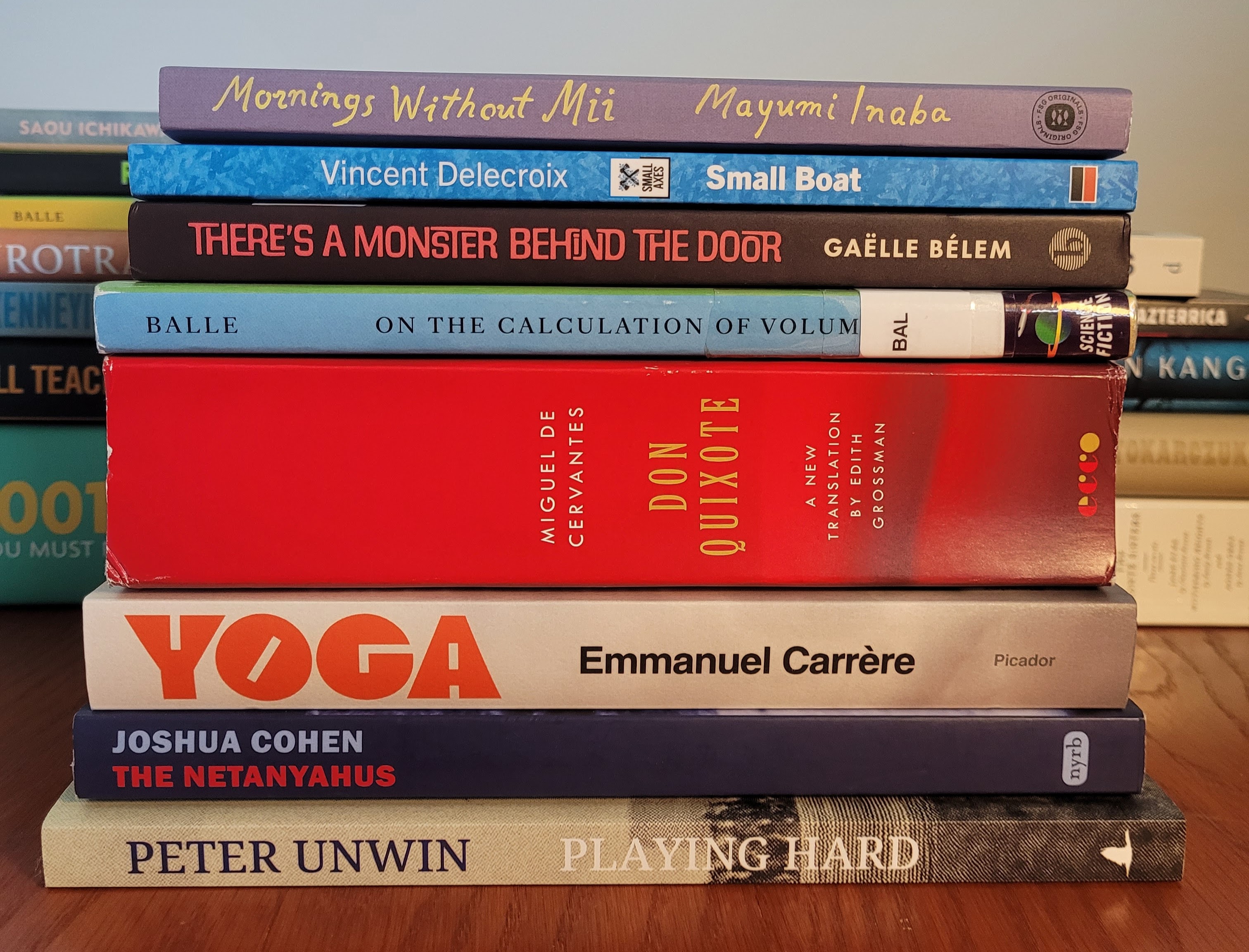
My list is another random assortment of books in my house or that could be in my house soon:
- Less by Andrew Sean Greer (cheating because I’m halfway through it now)
- The Netanyahus by Joshua Cohen (carry over from last year)
- Athena by John Banville (the last in the Book of Evidence series)
- Small Boat by Vincent Delacroix tr. Helen Stevenson (an IBP shortlister)
- There’s a Monster Behind the Door by Gaëlle Bélem tr. Karen Fleetwood and Laëtitia Saint-Loubert (an IBP longlister)
- Playing Hard by Peter Unwin (a review copy, a collection of essays about games and sports)
- Don Quixote by Cervantes tr. Edith Grossman (I thought about doing a read along but I’m too lazy)
- Mornings Without Mii by Mayumi Inaba tr. Ginny Tapley Takemori (cover buy!)
- Yoga by Emmanuel Carrère tr. John Lambert (been on my TBR since I read this review)
- On the Calculation of Volume II by Solvej Balle tr. Barbara Haveland (next in the septology)
Join in and let’s review some books! I promise to comment on yours if you promise to comment on mine.
How to read the 2025 International Booker longlist in Canada
Like last year, the 2025 International Booker Prize longlist is out of left field. Former winners, who I thought were a lock, were shut out (Han Kang, Olga Tokarczuk, László Krasznahorkai) and some of these translations were published in North America before the UK, which is unusual. But the most surprising thing about this longlist is that every author is an IBP first-timer. Past longlisters like Yoko Ogawa were shut out too.
I have to think this was on purpose, and I’m not sure how I feel about it. Does Han Kang need this, months after winning the Nobel? Surely not. Is each of these 13 books better than her latest, We Do Not Part, which I read because I was so certain it would be longlisted? Highly unlikely.
2025’s longlist is diverse, representing ten original languages and eleven nationalities. There are a couple of short story collections, several novellas (the shortest of which is practically a short story itself at 112 pages,) and one near-700 page chunkster. The list is skewed towards women (9 of 13) and boomers (6 of 13), and trends a bit older in general. There is no Gen Z representation at all, and the millennials are of the elder variety.
Find these stats and everything you need to know about obtaining these books in Canada in the updated “How to read the IBP in Canada” spreadsheet, or if you’re in a hurry, you can refer to the plain-text longlist below.
The longlist is fairly accessible in Canada. By the end of March, all the books will be available from Blackwell’s for the bargain price of $337.23 CAD. If you prefer to spend your money locally (elbows up and all that) most of them will be available through Canadian retailers too, with the exception of Small Boat and There’s A Monster Behind the Door. I’m just disappointed that my library system has none of these in ebook format. If Kobo thinks I’m going to spend $25.99 on a 192-page ebook (Eurotrash), they’ve got another thing coming.
I don’t quite know what to make of the longlist, but I’ve already read one (On the Calculation of Volume I, the first in a septology, but not the first partial septology to be longlisted!) and have another seven on the way, either from Blackwells, Magpie Books, or the library. In the meantime, the IBP Shadow Panel has created a Substack to round up their reviews. They are without their usual leader, Tony from Tony’s Reading List – he’s still blogging though, so if you want to see what’s going on in translated lit outside of this list, he’s your guy.
If you want to know my thoughts, well, let’s see if I can crank out a few reviews. First challenge: say something about On the Calculation of Volume, a story about a woman who wakes up to the same day over and over again, without mentioning Groundhog Day.
- The Book of Disappearance by Ibtisam Azem, translated from the Arabic by Sinan Antoon
- On the Calculation of Volume I by Solvej Balle, translated from the Danish by Barbara J. Haveland
- There’s a Monster Behind the Door by Gaëlle Bélem, translated from the French by Karen Fleetwood and Laëtitia Saint-Loubert
- Solenoid by Mircea Cărtărescu, translated from the Romanian by Sean Cotter
- Reservoir Bitches by Dahlia de la Cerda, translated from the Spanish by Heather Cleary and Julia Sanches
- Small Boat by Vincent Delecroix, translated from the French by Helen Stevenson
- Hunchback by Saou Ichikawa, translated from the Japanese by Polly Barton
- Under the Eye of the Big Bird by Under the Eye of the Big Bird, translated from the Japanese by Asa Yoneda
- Eurotrash by Christian Kracht, translated from the German by Daniel Bowles
- Perfection by Vincenzo Latronico, translated from the Italian by Sophie Hughes
- Heart Lamp by Banu Mushtaq, translated from the Kannada by Deepa Bhasthi
- On a Woman’s Madness by Astrid Roemer, translated from the Dutch by Lucy Scott
- A Leopard-Skin Hat by Anne Serre, translated from the French by Mark Hutchinson
Best Books of 2024
Unlike my worst books of the year, I don’t see coherent themes in this list, nor is there a clear standout. None of these are perfect; they all annoyed me, just a little, in some way. In whittling the list down to ten, I tried to keep only the books where the annoyance is more about me than the book. In the order I read them:
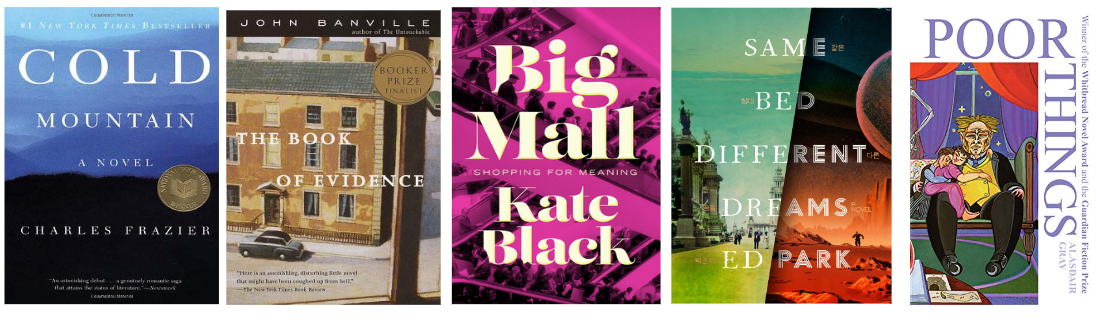
- Cold Mountain by Charles Frazier. They don’t write them like this anymore. Sprawling historical love story based on The Odyssey. Bonus: gave us a great movie adaptation starring Jude Law at peak hotness.
- The Book of Evidence by John Banville. This actually could be a standout. Pitch perfect, creepy as hell, and based on a true story, but this book does so much more than recount or sensationalize.
- Big Mall by Kate Black. If you want to read about the intersection between resource extraction, colonialism, animal cruelty, violence, tourism, architecture, and your local shopping mall, this is probably your best (and only) bet. My review and interview here.
- Same Bed Different Dreams by Ed Park. This reminded me of Infinite Jest (complimentary) not only in content – sports, alternate history, Canadian subplot that I didn’t see coming- but in how it blew my fucking mind.
- Poor Things by Alasdair Gray. Yes, it was a book first. Yes, the book is “better,” in that, there’s more there, and more of Bella Baxter in particular.
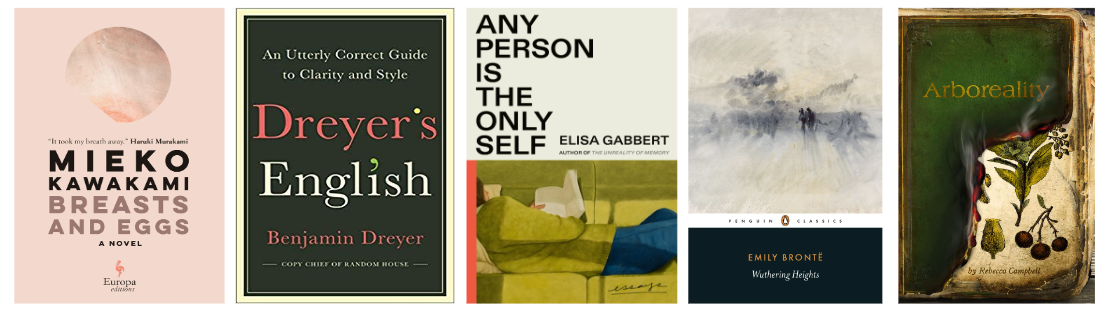
- Breasts and Eggs by Mieko Kawakami, tr. Sam Bett and David Boyd. I stayed away from this one for too long because I had the impression that it was one of those very on-the-nose feminist “message” novels, but it’s not. It’s brilliant.
- Dreyer’s English by Benjamin Dreyer. A rare case of an author’s social media presence selling me on a book. He vindicated my pickiness about Oxford commas and insistence on the proper use of “begs the question.” It’s the perfect book to read while falling asleep (complimentary.)
- Any Person is the Only Self by Elisa Gabbert. This is what I was looking for in the handful of millennial woman writer/critic essay collections I read this year. Humour, literary criticism, and, notably lacking in the others I read this year, humility.
- Wuthering Heights by Emily Bronte. If I reread WH in a given year, it will appear on my best books list.
- Arboreality by Rebecca Campbell. A near-future climate disaster novel in which things start going downhill rapidly in 2025 might be a bit much right now, so I’m glad I read it in 2024.
I don’t need to ask for your best books, we’re all posting them. Keep them coming!
How to read the 2024 International Booker Prize longlist in Canada
My International Booker predictions were a bust, again! Not that I committed them to paper (or blog,) but I was very much expecting to see My Heavenly Favourite by previous winner Lucas Rijneveld, and was hoping to see some Japanese lit after a shut out last year. No such luck.
2024’s longlist is South America and Europe heavy, with a single Korean novel representing Asia. Africa and the Caribbean are shut out entirely. There are no French language novels, a first since I’ve been tracking.
I’m not sure what I expected from this jury, headed up by one of my favourite radio personalities, Eleanor Wachtel, but this wasn’t it. Apart from Jenny Erpenbeck, these are all totally new-to-me authors, so maybe I’ll find a find a new favourite, heavenly or otherwise…
Now, the reason you’re here: the updated “How to read the IBP in Canada” spreadsheet. Check it out for all the details on where to get the books in Canada (and the States – but prices are in CAD). The longlist is fairly accessible, if you’re looking to buy, and about half are available at my library (shout out to the two people who got holds in ahead of me on all seven available titles! I was slow on the draw). There’s not much in the way of audio, and the ebooks are a bit pricey, but overall, us Canadians can get a good start on things ahead of the shortlist announcement on April 9.
Continue readingGet your TBR pile down to zero with this one weird trick
The trick is to have your house burn down. Instant TBR zero.
Of course you also lose all your other TB piles: To Be Worn, To Be Eaten, To Be Slept on, To Be Cooked with, To Be Remembered By…
My house caught on fire on December 18. It started in the kitchen (cause still being determined) and was contained and put out quickly. I’d only been out of the house for about 45 minutes when I started getting calls from neighbours. It’s a mindfuck, because my house didn’t actually burn down, and my books, along with most of our belongings, weren’t actually reduced to ash. The smoke, soot, water, and asbestos are what get you. Despite the house looking okay from the outside, we lost almost everything we owned.


I didn’t have a single book “pile” or shelf. I had books on, under and on top of shelves, as well as on desks, coffee tables, bedside tables, and in drawers and closets. I also, thankfully, had a Google Sheet with a complete and up-to-date listing of each one of those books, including origin and cost for the more recent ones. (Did I have an inventory of any other items in the house? Of course not. BUT YOU SHOULD. START ONE NOW. TRUST ME.)
I don’t even have a “TBR” tab in my spreadsheet. It’s not something I think about much. I have a “wishlist” of books I don’t own but might want to, based on reviews or recommendations – the most recent addition is Bouvard and Pécuchet by Flaubert, as recommended in the NYT’s “Read like the Wind” newsletter. I also have tabs related to various “projects,” like reading the works of Dostoyevsky, or the 1,001 Books list. These are all TBRs of sorts.
But what people usually mean by TBR is “books you own but haven’t read.” TBRs sometimes include unread ebooks, but usually don’t include books you have on hold at the library, or books you are thinking about buying. A TBR pile is a real thing that you spent money on. By filtering on “unread” and filtering out “Kindle” and “Kobo”, I see that I had a TBR pile of 108 books, as of the morning of December 18, anyway.
In online bookish circles, TBRs are often framed as a problem, or at least something to be managed, an indicator of consumerism at best and hoarding at worst. TBR challenges abound; people have plans to get to a zero TBR, or under 30, or under 100. They will do this in a year, or six months, or as long as it takes.
I confess, “TBR” content is among my least favourite bookish content (if you are someone who does TBR stuff online, I don’t mean you. I especially don’t mean Cathy!). There’s not much to say about a book you haven’t read, after all, and I find the accounting side of TBRs (books in, books out, monthly reckonings etc.) pretty tedious, unless it’s my own.
I read some TBR posts and watched some TBR videos for the purpose of writing this, and found that most of the “tips and tricks” for TBR challenges have to do with “reading more”, not “buying less”, and often it’s not even about finding more time to read, or speeding up your rate of reading (though that content is certainly out there too). It’s more about convincing yourself to read from your pile, through random chance (spins, jars) or incentives (no buying books until the TBR is under 100.)
TBR challenges don’t often get beyond the here and now, and into the existential question of how many books you will read before you die, or more to the point, how many books you will not read. I started reading from the 1001 Books You Must Read Before You Die list before I even started blogging, i.e. before I’d heard of a TBR, and it’s the kind of list you don’t ever really expect to finish, so I guess I’ve always taken the long view on this. A pile of 108 books is less daunting if you think of what you might read over the next 40 or 50 years. And I don’t think it’s something to beat yourself up for.
Let your TBR or other book lists be about anticipation instead. Anticipate the great books you’re going to read, and the ones so bad they’re good. Anticipate filling in the blanks on things you’re interested in, and going off on tangents into new topics. Anticipate reading an author’s complete works and then adding their biographies, letters, and criticism to your ever-growing and changing TBR. Document it, be honest about it, but let it be a positive thing.
My TBR pile is gone. But I still have plenty of books that are “to be read” – almost every book ever written, technically. And of course, two months on from the fire, my TBR has regenerated a bit. Here it is, in its entirety:
- The Tenderness of Wolves by Stef Penney (from a Little Free Library and solely because the blurb, “Like Cold Mountain but colder”, made me laugh out loud)
- My Heavenly Favourite by Lucas Rijneveld (my first post-fire purchase)
I have two more, non-TBR books in the house: A smoke-damaged, signed first edition of Freedom by Jonathan Franzen (recovered along with other sentimental items – I did NOT run back into the house for it) and The Birthday Party by Laurent Mauvignier, which had been sitting on my desk at work. We will rebuild – in 2025, or whenever I get back into my house!
Here’s my actual “one weird trick” for dealing with your TBR: Don’t worry about getting to zero, because you might get hit by a bus tomorrow – or your whole pile might go up in flames.
Nonfiction and Novellas in November: Week 1

November brings a variety of great book blogging events, and I’m lucky if I properly participate in just one. This year I’m going to attempt to join two of my favourites: Novellas in November, hosted by Cathy and Rebecca, and Nonfiction November, with a new slate of hosts, including Liz and this week’s host Heather.
Both events are organized by weekly themes, the first of which is: celebrate your year in nonfiction/novellas. Forgive me for grouping the weekly posts, but this is the only way I have a hope in hell!
My Year in Nonfiction
I’ve read nine nonfiction books this year, or about 20% of my total. That’s a little low for me, but a few were standouts (good and bad).
- I Used to Live Here Once by Miranda Seymour is a biography of Jean Rhys and while Rhys is a strong interest of mine, the book itself hasn’t stuck with me.
- Run Toward the Danger by Sarah Polley is a memoir presented as essays. I didn’t have a special interest in Polley or her iconic role as Anne of Green Gables, but this one absolutely stuck with me. I will never look at a child actor the same way.
- Run, Hide, Repeat by Paula Dakin is another memoir, more traditionally presented than Polley’s, that compelled me with its maddening story of family dysfunction and delusion.
- The Life of Charlotte Brontë by Elizabeth Gaskell is a groundbreaking and emotionally complex biography. What it lacks in candidness (at times) it makes up for in empathy and care. Mini-review here.
- Bliss More: How to Succeed in Meditation Without Really Trying by Light Watkins is more practical than literary, but I have kept up a pretty consistent meditation practice since reading it.
- How to Calm Your Mind: Finding Presence and Productivity in Anxious Times by Chris Bailey was not groundbreaking by any means; more of a comfort read for those of us who are into productivity culture.
- Easy Money: Cryptocurrency, Casino Capitalism, and the Golden Age of Fraud by Ben McKenzie with Jacob Silverman was also not groundbreaking but a fun read for those of us into crypto schadenfreude. Review here.
- The Drowned and the Saved by Primo Levi is a sort of meta-memoir in essays, including many reflections on the Holocaust, and it was by far the most challenging of these books. Review to come.
- Extremely Online: The Untold Story of Fame, Influence, and Power on the Internet by Taylor Lorenz is about a fascinating subject, but I was let down by how it merely skimmed the surface of influencer culture. Review in progress – pray for me, the author already blasted me on Twitter for simply sharing someone else’s negative review!
My year in novellas
I’ve read four novellas this year, plus a surprising number of novels with just over 200 pages – but those don’t count. I hope to increase this total in November!
- McGlue by Ottessa Moshfegh concluded my reading of all her novels. This one was delightfully depraved (aren’t they all!)
- The Ladybird by D.H. Lawrence was also pretty depraved, though a little more restrained than McGlue.
- Revenge of the Scapegoat by Caren Beilin was the weirdest book I’ve read this year, which is saying something (see: McGlue)
- The Nun by Denis Diderot rounds out the theme, with a weird and wonderful tale of sadistic and amorous nuns. Review to come.
We’re off and running! See you for another weekly post soon and hopefully a review or two besides.
Novellas in November 2023 planning

Thank goodness we get a couple months off in between 20 Books of Summer and Novellas in November. I must have needed it, seeing as I’ve only posted once in the interim (so far). One year I’ll have the stamina to do Victober in between, but this year is not that year. Here are my plans:
The recent additions: These books are newly borrowed or acquired, and just happen to be under 200 pages. They also happen to all be in translation.
- Boulder by Eva Baltasar, translated by Julia Sanches. A straggler on my 2023 International Booker Prize reading list.
- The Nun by Denis Diderot, translated by Leonard Tancock. A 1001 Books pick that I may have already started…
- The Short End of the Sonnenallee by Thomas Brussig, translated by Jonathan Franzen and Jenny Watson. I need to maintain my Franzen completist status.
- The Drowned and the Saved by Primo Levi, translated by Raymond Rosenthal. Inspired by the title of a Law and Order episode, of all things, but might be a timely read.
The TBR: Recent additions to my ever-growing TBR – meaning I haven’t acquired these yet but would like to.
- A Month in the Country by J.L. Carr. I couldn’t begin to tell you have many times I’ve heard people sing the praises of this book. Here is the most recent.
- Offshore by Penelope Fitzgerald. This was in the “references” section of recent Giller and Booker nominee Study for Obedience, and that’s all I need to know.
- Night Walks by Charles Dickens. Based on this review; perhaps I’ll do a little Victobering after all.
The official group reads: Our hosts chose these books as the group reads this year. I approve.
- A Room of One’s Own by Virginia Woolf. I already owned this, in a bind up with Three Guineas. I probably haven’t read it in twenty years.
- Western Lane by Chetna Maroo. I bought this as a brand new hardcover, despite knowing little about it. Living on the edge!
Thank you as always to Cathy and Rebecca, who have posted their own, truly intimidating TBRs!
International Booker Prize 2023 mini reviews
Here are my brief thoughts on the books I’ve read so far, and my plans heading into the home stretch. It’s been nice to get back into the IBP this year, after a half-hearted 2022, skipping 2021 entirely, and getting derailed after a strong start in March of 2020. Not all the books have been nice though!
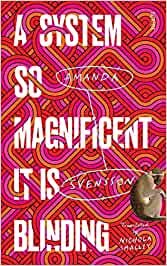

A System So Magnificent It Is Blinding by Amanda Svensson, translated from the Swedish by Nichola Smalley
This book is trying to be so many things, but ends up being a big old mess. I saw a reviewer compare Svensson to Franzen and yes, there are some similar themes around family, activism, and shadowy bureaucracy, but that’s not all there is to this book. Svennson adds: triplets! Babies switched at birth! Possible incest! Suicide! Cults! Monkeys! Infidelity! Depression! Eating disorders! Synesthesia! Child actresses! Peacock feathers! I’m sure I missed several recurring themes. All this stuff took attention away from the main family unit, which, Franzen would never.
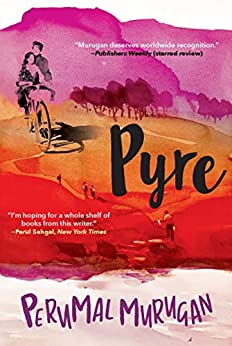
Pyre by Perumal Murugan, translated from the Tamil by Aniruddhan Vasudevan
I said what I needed to say in this post. This story was too opaque for me, so I felt a remove, but I would try more from the author, particularly The Story of a Goat.
The Birthday Party by Laurent Mauvignier, translated from the French by Daniel Levin Becker
People talk about this book like it’s a thriller but it’s a lot more… but also a lot less. More because of the complex language and extremely close narration, and less because when the story finally tips over from expectation and dread to action, it kind of falls apart. The meandering style works very well for revealing shocking parts of the character’s thought process and history, but a lot less well for shocking violence and split-second decisions. Then, the ending left me with more questions than answers, and not in a good way.
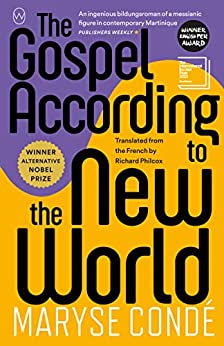
The Gospel According to the New World by Maryse Condé, translated from the French by Richard Philcox
I was hyped for this book because I’ve enjoyed both Caribbean literature and Bible retellings in the past. Then I read some reviews that said this was too close of a retelling, with not much new to say. That might be true, but, I loved it. At times funny and absurd, it was mostly just calming and meditative. Reading this felt like a respite from life. Which is sort of how my religious grandparents would talk about their faith, so, there’s that! Condé is a fascinating person, and I wish I could find an English translation of her Wuthering Heights retelling (which is the equivalent of the Bible for me).
On deck, I have copies of Is Mother Dead by Vigdis Hjorth, translated from the Norwegian by Charlotte Barslund, and Time Shelter by Georgi Gospodinov, translated from the Bulgarian by Angela Rodel out from the library. Is Mother Dead didn’t make the shortlist, but it’s a shorter (and beautiful, with full colour endpapers) book so I will try to get through it. I’ve read a few raves about Time Shelter. My copy of Boulder by Eva Baltasar, translated from the Catalan by Julia Sanches finally arrived, and I’m waiting on Whale by Cheon Myeong-kwan, translated from the Korean by Chi-Young Kim… and that’ll do it for me, unless something not listed here takes the prize, as I always like to read the winner!
How to read the 2023 International Booker Prize longlist in Canada
2023 will go down as the year everyone’s International Booker Prize predictions were wrong. I was surprised not to see Mieko Kawakami, Han Kang, Yōko Tawada, or Sayaka Murata, and I was so sure we’d see the new Can Xue, Barefoot Doctor, that I shelled out nearly $30 for the ebook!
I love this list though. It’s the most accessible one I’ve seen in years, meaning that even in Canada, you can read the whole longlist ahead of the prize being awarded, if you want to. You could buy half the longlist right now from Canadian retailers. You could buy the whole longlist from Blackwell’s for $332.77 CAD.
These insights and more are available in my annual spreadsheet. It includes a bit of demographic info, but mostly helps you figure out where to obtain these books in Canada for the best price. My sources are noted, but generally, Canadian cover prices are from Glass Bookshop, library availability refers to Edmonton Public Library, and UK editions are from Blackwell’s. All prices are in CAD and include shipping. I didn’t bother linking to publisher’s websites this time, because for once, it’s not necessary.
I’m happy to see a nice range of languages (Tamil, Bulgarian, Catalan, and Norwegian, in addition to the usual suspects – but notably, no Japanese!) and a nice range of ages (the youngest writer is 35-year-old Amanda Svensson, while the oldest, and the oldest ever to make the list, is 89-year-old Maryse Condé – or is she 86, as Wikipedia claims?) though it’s skewing a little older this year, and very heavy on Gen X writers (seven out of 13).
I got a lot of traction (i.e. almost 100 likes) on a tweet complaining about the “creative” way book prizes present their longlists. The International Booker Prize gave us the courtesy of a text-based list, but even then, you have to click through to see the authors and translator names, so for your convenience, here’s your plain-text, detailed longlist*:
- Ninth Building by Zou Jingzhi, translated from the Chinese by Jeremy Tiang
- A System So Magnificent It Is Blinding by Amanda Svensson, translated from the Swedish by Nichola Smalley
- Still Born by Guadalupe Nettel, translated from the Spanish by Rosalind Harvey
- Pyre by Perumal Murugan, translated from the Tamil by Aniruddhan Vasudevan
- While We Were Dreaming by Clemens Meyer, translated from the German by Katy Derbyshire
- The Birthday Party by Laurent Mauvignier, translated from the French by Daniel Levin Becker
- Jimi Hendrix Live in Lviv by Andrey Kurkov, translated from the Russian by Reuben Woolley
- Is Mother Dead by Vigdis Hjorth, translated from the Norwegian by Charlotte Barslund
- Standing Heavy by GauZ’, translated from the French by Frank Wynne
- Time Shelter by Georgi Gospodinov, translated from the Bulgarian by Angela Rodel
- The Gospel According to the New World by Maryse Condé, translated from the French by Richard Philcox
- Whale by Cheon Myeong-kwan, translated from the Korean by Chi-Young Kim
- Boulder by Eva Baltasar, translated from the Catalan by Julia Sanches
And shout out to Bookstagrammer time4reading who posted her own simple list of books plus where to source them in Canada – she’s Toronto-based, so if your library or prefered bookstore is in TO, check her out.
As always, follow the IBP Shadow Panel for reviews and Eric Karl Anderson for a peek behind the scenes (he usually gets to go to the awards ceremony, I think!)
*Not seeing any official sources for the original languages so I took my best guess!
 Reading in Bed