Extremely Online: The Untold Story of Fame, Influence, and Power on the Internet by Taylor Lorenz

The title “Extremely Online” gave me the wrong idea about this book from the start. To be “extremely online” means not only to be online all the time, but to be steeped in the deep lore, to know who the “main character” is on any given day, to know a “bean dad” from a “wife guy”. After thirty years on the net, I would count myself as part of that group. I’ve posted on plain-text message boards in the 1990s, had a TikTok comment go mildly viral in the 2020s, and posted (or at least lurked) on many platforms in between.
But this book is not about posters or lurkers. Extremely Online is about “creators” – the people who are online to make money. The “extremely” part describes their reach and earnings. Lorenz profiles the creators in the 0.1%, who got in early, took undisclosed sponsorships, then legit ads and brand deals, sold branded merch, made millions, burned out publicly, were redeemed, or not, and spawned scads of imitators. They’re people I’ve heard of, maybe, but not the ones on my For You Page. Think Logan Paul and Mr. Beast.
The first section, on the roots of creator culture, did spark some fond memories. Socialite Rank is cited as an early example of the virality that “creators” today strive for. I was obsessed with that site and it makes a great case study. But after that, when the fates of creators become inextricably tied to social platforms like YouTube, Tumblr, Instagram, and Vine, the book becomes a dull litany of names, platforms, management companies, subscriber counts, and brand deals.
A boring nonfiction book can still be informative, especially for people new to a subject. But for me, this book misses the point entirely. Lorenz’s premise is that creators don’t get respect, and that she is here to give them their due. She marvels that platforms don’t “get” creators, don’t value them, won’t cater to them. She seems so close to taking this line of thinking a step further, and acknowledging that social platforms don’t exist to cater to creators, or users, or anyone except advertisers. They exist to capture attention and data and serve it back to you as ads. The content, and those creating it, isn’t the point and it never was.
Extremely Online presents the escalating commercialization of the internet as an unqualified good. Instagram becoming an endless feed of sponsored posts is progress, and a reason to celebrate – which makes sense if you’re a creator, but what about the people viewing those posts, who at best are subjected to a feed full of bland advertisements instead of updates from friends, and at worst are being manipulated and spied on without their knowledge?
Of course there’s a downside to all this for creators too. I thought Lorenz was going to address the dark side when she mentioned notorious mommy blogger Dooce’s recent suicide, but after a very matter-of-fact statement (“on May 9, 2023, after relapsing at her home in Salt Lake City, she took her own life. She died at age forty-seven.”) she pivots to praising her and other blogger’s commercial success in the very next paragraph (they “created the model that content creators and platforms cultivated in the decades that followed.”) The juxtaposition is jarring.
Without addressing these points, or offering alternative ones to explain why creators have had a hard time gaining respect and finding stability in their careers, or why they tend to burn out so spectacularly, this book doesn’t have a lot to offer.
At this point I must disclose that I went into this book with a bit of bad faith due to an “extremely online” experience I had with the author herself, right after the book’s release. She deletes tweets and I plan on deactivating soon (for unrelated reasons!) So here’s the link while it works and screen shots for insurance:

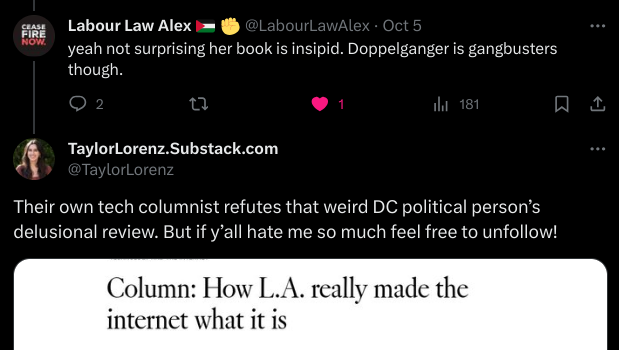
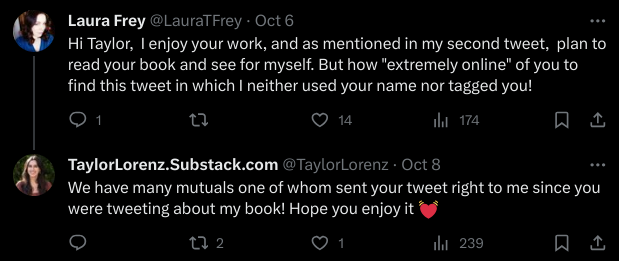
Now I don’t expect Lorenz to be familiar with my lore, but I’ve used variations on the phrase “I love a scathing review in the morning” at least 25 times over my Twitter career, and it’s nothing more than a way to share one of my favourite literary forms: the negative book review. This one is by Alexander Nazaryan, writing in the L.A. Times. His main beef with the book is its “conspicuous lack of original insight” and, well, I agree. I thought the review was balanced and incisive, if a little snarky. This passage, for example, is a bit over the top, but he’s got a point:
“That there is something profoundly disturbing about turning a generation into the technostate’s willing influencers never seems to disturb Lorenz. More than once, she struck me as less an internet explorer than a digital prisoner, making “Extremely Online” a kind of Stockholm syndrome manifesto.”
And yes, he’s a “DC political person”, but he’s also written about books for The New Yorker, The Paris Review, The New Republic, and more. I’d say he’s qualified to have an opinion, even a negative one.
I can forgive the strangeness of replying to my tweet (she doesn’t follow me, I didn’t tag her.) Chalk it up to the stress of publication week. But I have a problem with her use of “delusional” here. Actual criticism in book reviewing is rare enough without authors calling out reviewers (or the people who share their reviews!) publicly. And in this case, it’s hard to defend, since several other reviewers make similar points:
- Dan Kois says Lorenz “seldom engages in any truly critical way with the events she recounts in her book, rarely interrogates or seems to think deeply about them” and describes her interviews with creators as “content-free hype bombs delivered utterly sincerely and reprinted by Lorenz with an uncannily blank affect.” (Slate)
- Reema Saleh likens the reading experience to “crawling through Wikipedia pages of long-forgotten tech CEOs but offers little else beyond these histories” and criticizes its “nearly-always impressed view of influencers.” (Chicago Review of Books)
- The most-liked Goodreads review notes that “Lorenz doesn’t really weave any connective ideas between chapters, it’s just a more or less linear narrative, so you’re sort of left to intuit how the different pieces fit together.”
- Kirkus Reviews calls it “dated and dull.”
Several of these reviewers also comment on the writing, Nazaryan describing it as like a “glorified press release.” I too found it tired and rife with cliches. Creators ride out storms, hit brick walls, aren’t paid a dime. A chapter actually ends with the line “Nothing will ever be the same.” Business jargon like “engagement” and “scaling” are thrown around without any explanation of what that means (“make money,” usually.)
To be fair, the reviews were not all bad. The most prominent review of all, from a big name (Clay Shirky) in a big publication (The New York Times) says that Lorenz “excels at identifying relatively obscure events as turning points” and appreciates the book’s “breadth” as it “demonstrates a new cultural logic emerging out of 21st-century media chaos.”
Ironically, the positive review that Lorenz shared with me, that supposedly “refutes” Nazaryan’s review, actually reinforces it in my mind. Brian Merchant, a tech columnist who Lorenz recently appeared with at an event, writes:
“Critics have knocked Lorenz’s book for being overly sympathetic to the influencers fighting their way to the top in this new ecosystem, but I’ve found the book to be rather agnostic in its approach — reporting on a new frontier of entertainment that may sound foreign to many, but that is an undeniable force in cultural and economic life.”
Forgive me for using a dictionary definition, but “agnostic” means “a person who believes that nothing is known or can be known of the existence or nature of God or of anything beyond material phenomena,” and that’s just it, in Extremely Online, the “material phenomena” of money and influence are taken at face value.
It’s fitting that Nazaryan’s review is in the book section, while Merchant’s is in the business section. As a chronicle of business deals, Extremely Online succeeds. As a literary endeavour, not so much.
Despite all this baggage, I went into Extremely Online with some optimism. I’ve long followed Lorenz on multiple platforms and enjoy her voice and enthusiasm, and her expertise. Upon actually reading the book, I was surprised by how distant she seems from her subject. I expected her to have a strong perspective, based on her many stints as a “main character” in her own right. She has gone viral for things as innocuous as office temperatures to things as charged as masking and covid denialism (not linking to any of the stories as they’re all rage bait), and more recently, has become an all-purpose trigger for the “extremely online” far right after exposing one of their main agitators. It’s understandable that she didn’t give the trolls more fodder by framing this book as a memoir, but it is strange for an author with a well-documented and personal history with her topic to remain so detached in her writing.
In the meantime, after thirty years of being extremely online, I’m taking a (small, twitter-sized) step back. If you’re thinking of doing the same, this book won’t fill the social media void, but it might convince you that “online” isn’t all that interesting of a place after all. Doppelganger is up next!
 Reading in Bed
This is a great review and I enjoyed reading your thoughts! I would also have expected a book called “Extremely Online” to be more analytical about the impact of the social media ecosystem on participants/consumers. And yes, when a reviewer actually engages with and critiques the substance of a book, that’s surely a good thing (though it might feel bad to the author) and going after them doesn’t help! Perhaps it’s partly because of the nature of my job, but I have *such* a hard time getting (some) students to engage with the substance of a paper and think critically about it. When I actually see criticality in reviews, I’m always glad.
Same, I don’t like every critical review, but those that back up their claims with evidence AND are a little snarky/funny? The best. I don’t know if you’re looking for snark from your students thought 🙂
I also love a good critical book review, and I enjoyed this one!
All too rare. Someone needs to make an anthology of the best *bad* reviews…
What a peculiar thing for an author to do. And it sounds like she missed a trick with the book. My go-to Internet-describer in book form is Jia Tolentino’s Trick Mirror, which won’t be unhorsed anytime soon.
Now there’s an interesting comparison, Tolentino was also quite an online personality herself and got embroiled in some dramas. Has she stepped away from social entirely? I wonder how Trick Mirror holds up, I remember liking it.
What a strange interaction on Twitter! Yours isn’t the only review I’ve read of this that isn’t positive. I would have been interested but I think I will give it a miss now.
Did you read any negative reviews on book blogs? I was looking, but couldn’t find many reviews at all. But I think the search function on WordPress is not that great. If you saw any, send them my way!
I think I saw a negative one on Laura Tisdall’s blog? I’ll have a check, but she wasn’t overly impressed either if I remember rightly.
I wouldn’t have picked this book up as I don’t consider myself “extremely online”. I’m not even familiar with half the jargon you use in your review. But, your reviews are always interesting to read whether I plan to read the book or not. I even learned a few things! 🙂
I hope you have learned what NOT to do on Twitter 😉 I actually deactivated my account today, wish me luck in sticking to it!
Good luck! 🙂
Interesting stuff! I keep an account on Twitter just to be able to keep in touch with particular people and let authors know (selectively!) when I’ve amplified their voice on my blog. I don’t think I’ll read this one but it’s good to have your excellent review to help me make that decision. Have you read Because Internet by um … Gretchen something? She goes through all the generations of Internet interactors right back to those first newsgroups and email lists.
Oh, it does make me laugh when people complain that no one understands or “gets” content creators. Try being a copy writer or editor … everyone thinks you click your fingers and suddenly this beautiful content miraculously appears, when it’s actually hard work that requires skill and thoughtfulness. But it’s undervalued everywhere. It will always be undervalued because it’s an easily consumed product with next to no supply chain costs and is given away, usually for free.
I loved reading your review. Im not “extremely online” so don’t know this author and I quit Twitter almost two years ago. I don’t think I have missed out 😆
hello
Recording the success in Cryptocurrency, Bitcoin is not not just buying and holding till when bitcoin sky-rocks, this has been longed abolished by intelligent traders ,mostly now that bitcoin bull is still controlling the market after successfully defended the $60,000 support level once again and this is likely to trigger a possible move towards $100,000 resistance area However , it’s is best advice you find a working strategy by hub/daily signals that works well in other to accumulate and grow a very strong portfolio ahead. I have been trading with Mr Bernie Doran daily signals and strategy, on his platform, and his guidance makes trading less stressful and more profit despite the recent fluctuations. I was able to recover my funds and Recover my losses and easily increase my portfolio in just 3weeks of trading with his daily signals, growing my $3000 to $35,000 profits. Mr Bernie’s daily signals are very accurate and yields a great positive return on investment. I really enjoy trading with him and I’m still trading with him, He is available to give assistance to anyone who love crypto trading and beginners on the trade market , he can also help you recover/retrieve lost or stolen cryptocurrencies, you contact him on Gmail : BERNIEDORANSIGNALS@ GMAIL . COM for inquiries , Crypto is taking over the world