Tagged: Wuthering Heights
Self-Portrait With Boy by Rachel Lyon
Wuthering Heights is #902 on the 1001 Books You Must Read Before You Die list. See the whole list and my progress here. This summer, I’m reading from the list for my 20 Books of Summer challenge, and instead of straight reviews, I’m going to compare the 1001 Books write ups with my own impressions – or in this case, I’m going to compare one of my 20 Books to a book on the 1001 list.


I am once again drawing parallels between two books based on what very well may be coincidences. Hear me out on this one, though. If I’m wrong, at the very least, take this as a sign that if you are a Wuthering Heights fan, you will probably like Self-Portrait With Boy by Rachel Lyon, too.
I have found no evidence that Rachel Lyon has even read Wuthering Heights, let alone been influenced by it. She tends to recommend modern writers, and talks about real-life inspiration for this novel. But look, it’s a story about a motherless girl living in a sprawling, ramshackle building who is haunted by a ghost that knocks on and eventually breaks her window. My heights are officially wuthered!
Then there are the copious details that could be pulled from any number of gothic novels of Brontë’s time: filthy living conditions (including a memorable scene with a family of rats), evil landlords, orphans, grieving parents, a closed society (the 1990s NYC art scene), clearly defined class structure (poor Lu even becomes an art teacher for wealthy children, a modern day governess), a beautiful woman in distress…
But the most important parallel didn’t become clear until the very last line, and it’s a feature of Wuthering Heights that I tend to discount, and even forget in between rereadings: the frame story.
In a story full of literal frames (art, window) the literary frame in Self-Portrait is conventional enough: an old(er) woman looking back at her life. It’s unobtrusive at first. The story of Lu capturing a photograph of a child falling to his death, a moment that will define her career if it doesn’t tear her apart, is so compelling that it’s easy to forget that we are reading the thoughts of a self-aware, middle-aged woman looking back on it all, until the story catches up with itself at the end.
The frame in Wuthering Heights feels a bit more dated (as it should, 200ish years on): someone is being told a story. And it’s not subtle at all. On every reread, I forget how much of Lockwood’s perspective we have to get through before Nelly Dean gives him (and us) the goods on Cathy and Heathcliff.
These frames are totally necessary though. They allow both books to end on a haunting and devastating note. In Wuthering Heights, Lockwood wondering “how anyone could ever imagine unquiet slumbers, for the sleepers in that quiet earth” would not hit the same if it was just some omniscient narrator, or one of the remaining Lintons or Earnshaws. It has to be an outsider who’s slowly come to understand the tragedy that played out on these moors, alongside the reader. In Self-Portrait, the last line (which I won’t quote – spoilers apply to novels from 2018) is similarly devastating, and would not make sense coming from twenty-something Lu; she doesn’t have the insight yet. The reader feels the truth of it, and the weight of the time that’s passed, all in that final sentence.
If Wuthering Heights is the epitome of Georgian gothic (yes, it was written in the Victorian era, but it’s a historical novel, set a generation or two in the past, just like Self-Portrait), then Self-Portrait With Boy has a strong claim on late 20th century NYC gothic. Or whatever that era eventually gets called.
The Full Monte Read-Along Chapters 41-80ish: I Need a Hero
If you have trouble maneuvering your ship into port at Marseilles, steer yourself over to the master post.
I need a hero in two senses:
- A hero who can get me back on track with this read-along
- A hero in this story so I can have feelings about it
I don’t mean a hero I can “root for” (ugh, hate that phrase.) And I don’t mean the archetypal hero, like, an Odysseus type. I don’t need a hero’s journey and I don’t need Dantès to be more virtuous.
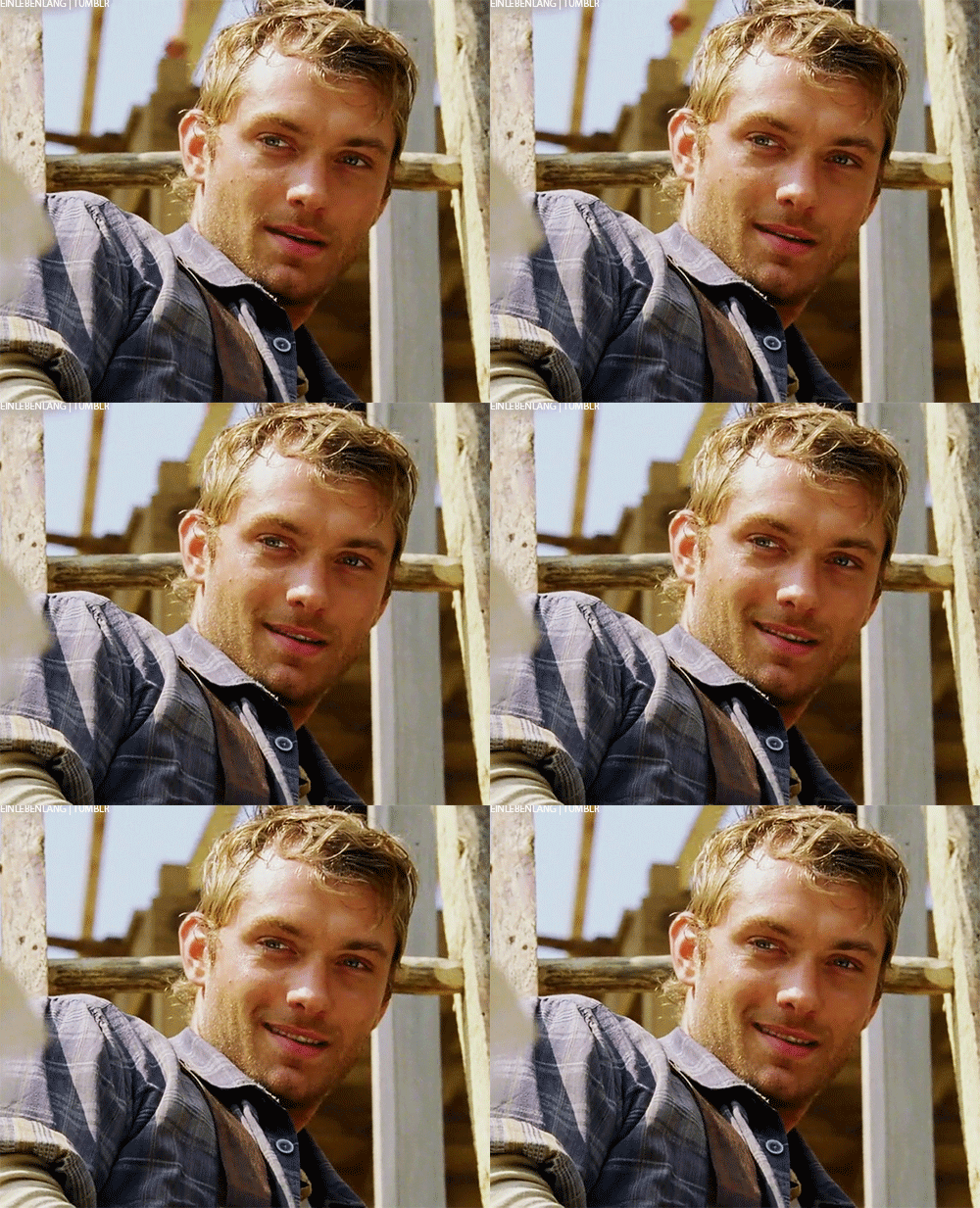
Unless the Odysseus part is played by Jude Law, as in loose-Odyssey-adaptation Cold Mountain. Then I’m here for it.
I need him to be wrong sometimes, to go too far. I need him to get what he wants and realize he wanted the wrong thing. I need him to have a fatal flaw.
I need him to have some passion, damn it!
Words With Friends
Book blogger extraordinaire Kristilyn (@readinginwinter) wrote a fantastic piece about making bookish friends. She inspired me to write about last month’s yegbookswap.
Credit for yegbookswap goes to Andy (@agrabia) and Vanessa Grabia (@vgrabia). From the event website:
Time for an old-fashioned book swap. Here’s the lowdown:
1) Everyone brings three books. One they loved as a child. One they loved as a teenager. One they loved as an adult.
2) Used or new paperback books are encouraged, to keep down costs. Just make sure the used copies are in decent, readable shape.
3) All the books go on a table, we socialize and talk books for a while, and then everyone goes home with three new books.
And that’s that.
I was super excited to have a few hour’s worth of adult conversation. Meeting fellow book lovers was just a huge bonus. I had my four-month old in tow, but he’s pretty docile. I wisely left the two-year old at home. Apart from picking up some great new books for free, I met up with friends old and new, online and “real life”, and met people who I had no connection to at all. A huge thanks to Andy and Vanessa for putting this event together.
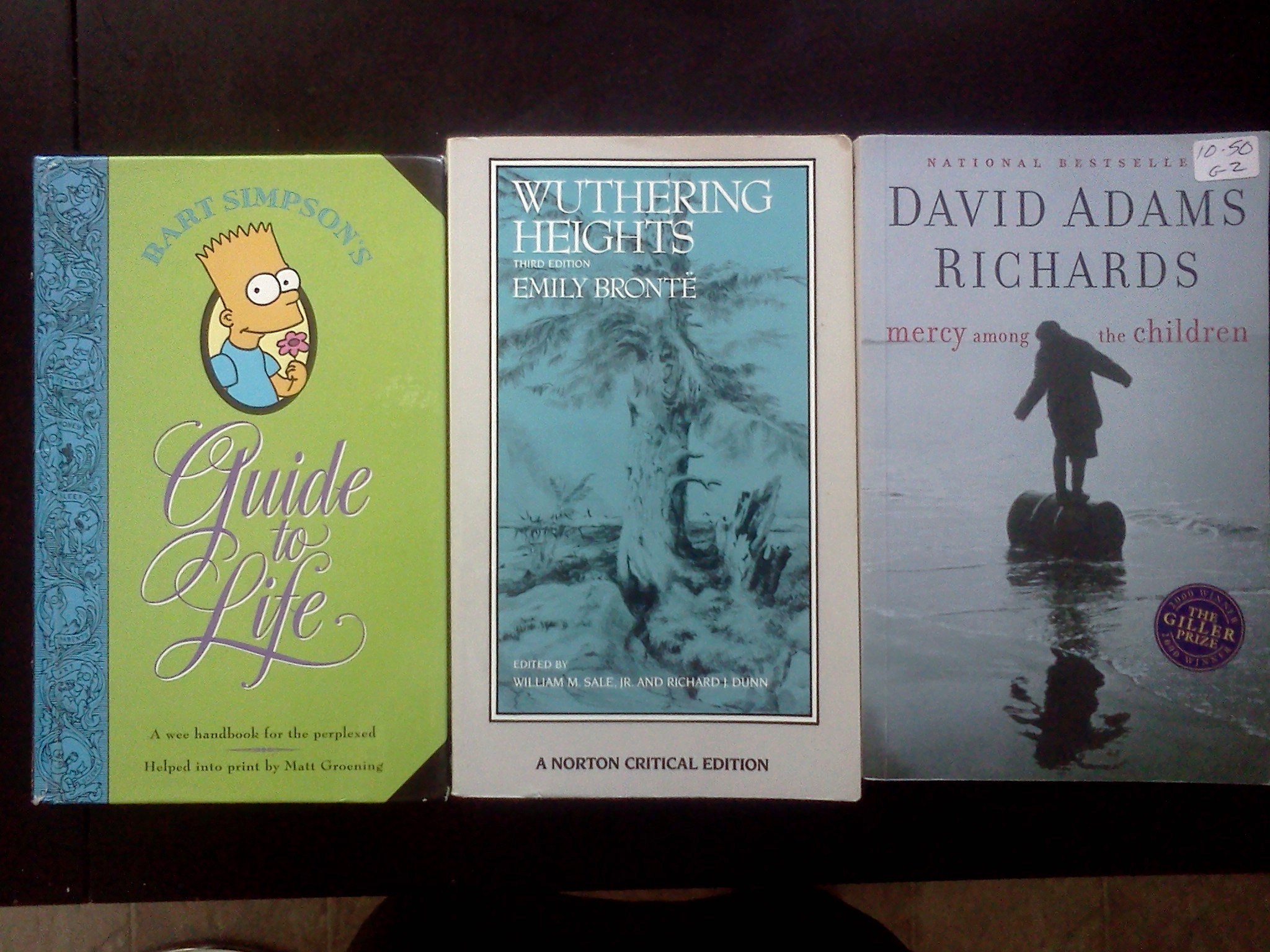
The books I brought to swap
Kind of like TLC’s CrazySexyCool except FunnyCrazyDepressing
- Child pick: Bart Simpson’s Guide to Life
- Teen pick: Wuthering Heights
- Adult pick: Mercy Among the Children
The funny thing about my child/teen/adult choices is that I read them all in my teens. I remember buying Bart Simpson’s Guide to Life when I was 13, I read Wuthering Heights for English in grade 11, and I read Mercy Among the Children when I was 19. I was a late bloomer and pretty much a child at 13, and though certainly not mature at 19, I remember thinking that this was such an “adult” book. Meaning I didn’t really understand it. I’ve reread it a few times since then.
The books I took home

A mixed bag!
- Child pick: Where the Wild Things Are
- Teen pick: The Long Dark Tea Time of the Soul
- Adult pick: Vineland
I had never read Where the Wild Things Are. I looked through it before reading it to Benjamin, and thought, huh, what’s the big deal? But Benjamin was taken with it right away. He calls it “The Jungle Book,” and I suppose one day he’ll learn about the other Jungle Book, but for how, he loves reciting the lines and talking about the “monsters.”
I’m nearly finished Douglas Adam’s The Long Dark Tea Time of the Soul, and it’s a perfect, light, funny book with a wild plot that I can’t imagine being resolved in the 50 or so remaining pages!
I know nothing about Thomas Pynchon or Vineland, except that it is actually one of the 1001 Books You Must Read Before You Die! Bonus!!
So? Do you have a good group of bookish friends? How do you make more?
And, If you were at yegbookswap, I would love to read your review of the event!
 Reading in Bed