Tagged: The Secret Scripture
Irish Twins: The Sea by John Banville and The Secret Scripture by Sebastian Barry
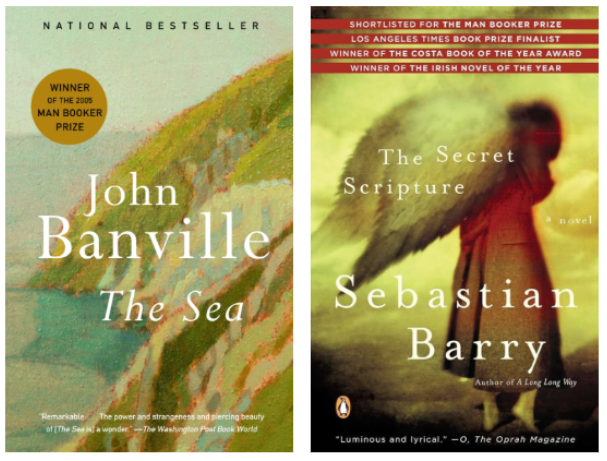
Welcome to Reading Ireland Month, hosted by Cathy of 746 Books! My participation is a fluke (or luck of the Irish?), as I just happened to finish two Irish books recently. Let’s go with luck, as both these books were great and had surprising parallels, so it’s like I was meant to read them back-to-back. In lieu of a real review, which would take me longer than we have days left in March, let me tell you how Banville and Barry ended up writing very similar stories, within a few years of each other.
I read The Sea first. This is my fourth Banville, and the first that isn’t part of the Frames trilogy, so I thought this would be something completely different from those books, that were full of murder, sex, and art. Not so much – the protagonist Max Morden is a little older and much milder man than Freddie Montgomery, but he’s an art writer (Freddie was an appraiser), and we learn much (too much?) about his sexual awakening, as a childhood obsession with an older woman quickly gets transferred to her more age-appropriate daughter during a summer vacation. In the current-day thread, Max is mourning the loss of his wife, and is driven to visit the site of these past dalliances. We learn that the marriage was a little complicated, and there’s an almost-estranged daughter in the mix as well. The unreliability of memory and impossibility of learning the truth about the past are the main things here, but there is also a mystery to solve, and a revelation near the end gave me the delicious readerly sensation of being both surprised, but also believing this is the only way for the story to end.
Then I read The Secret Scripture. This is my second Barry, and part of a different series than Days Without End, which I read when it was up for the Booker (another commonality of these authors: they are often up for the Booker, and occasionally win). Barry is a little less seedy than Banville, but there are many parallels: a man in his sixties, recently widowed after a complicated marriage, no children this time, but nearing the end of his career in psychiatry. Both men’s stories are told in the form of a diary, sort of – we understand that Max is writing about his life instead of what he should be writing, the manuscript of his next book, while Dr. Grene is writing in his “Commonplace Book” instead of what he should be writing, a psychiatric assessment of a 100-year-old patient in his care, Roseanne. Dr. Grene must find placements for all his patients, as the hospital is about to be demolished. Roseanne has been institutionalized for about sixty years, outliving anyone who could tell Dr. Grene why she was put there in the first place. At the same time, Roseanne is writing an account of her life – a “Testimony of Herself”. There’s no parallel narrative in The Sea, though there are certainly women and girls who transgress norms in a repressive culture that punishes women who don’t fall in line. The Secret Scripture is also more overtly about Irish history – it can’t help but be, with a character who was born around 1910 in Sligo. Roseanne’s father, husband, and brothers-in-law are historical actors in various ways, but it’s Roseanne who survives and tells all of their stories.
Dr. Grene could have admitted Roseanne to a hospital and been done with it, but he becomes obsessed with unravelling the mystery of her life. Likewise, Roseanne would be forgiven for giving up, after living through unimaginable hardship, historical and personal, but she is just as driven to unravel things. Though it’s her own life, it’s no less mysterious. Like The Sea, the mystery comes together in a way that would have been contrived in the hands of almost any other writer.
The last-minute revelations, I’ll admit, prevented these novels from being my favourite from either author. There is something a little too neat here, even though the stories are expertly written and the endings feel “earned”, and, especially in the case of the Barry, cathartic. But a middling Barry or Banville novel is better than almost anything else out there, so I’m not complaining.
 Reading in Bed