Tagged: pet loss
My Year of Last Things
This is a book blog, not a personal blog, but I do write about life events here, and sometimes things don’t feel real until I do.
The births of my children are here. Moving into our house, briefly. My sister moving to the States. Then the fire happened, and I wrote about what it’s like to lose all your books, but I didn’t write about what it’s like to lose a pet.
If you follow me on social media, you might know that in the immediate aftermath of the fire, my husband found our cat Perogy in a bad state and got her to an emergency vet, where she remained for three weeks. You might have missed the “Missing Cat” posts about Shirley, though, as they were only up for a day, until my husband found her too. She didn’t make it.
Shirley was three years old, a pandemic pet born in 2020 and adopted by us in 2021. The SPCA named her and we didn’t see any reason to change it. She was loud, lazy, a bit of a glutton, cuddly, soft, playful, a constant companion to anyone sitting on a couch or lying in a bed, and scared of everything. She would have been very scared that day – the noise, the smoke, the heat, people stomping around. The firefighters told me she most likely escaped the house and we’d find her later, that it happens all the time, but I didn’t believe them.
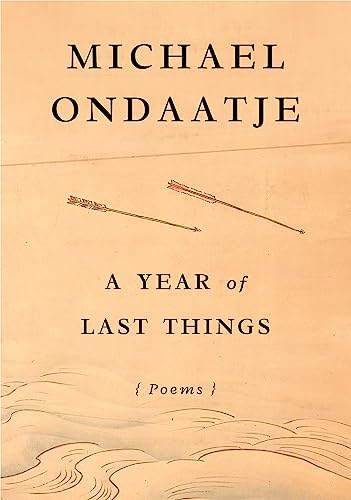
I’ve never lost a pet this way, only older pets who were ready to go and gave us time to prepare. I’ve also never lost a pet in the midst of a crisis – usually losing the pet is the crisis. I have mourned her, but alongside a bunch of other stuff, and seven months later, it can still feel awfully fresh; never more so than when I read the poem “November” in Michael Ondaajte’s new collection A Year of Last Things.
I’ve tried Ondaatje’s poetry before, and found it fairly impenetrable, with literary and cultural references that are beyond me. A lot of the poems in this collection are like that, though I got a hint of something different in this first line of the first poem, “Lock”:
Reading the lines he loves
he slips them into a pocket,
wishes to die with his clothes
full of torn-free stanzas
and the telephone numbers
of his children in far cities
I love that line about carrying the telephone numbers of your children in your pocket. Old fashioned but relatable. Later, we are treated to prose poems – mini-essays, really- about the horrors of boarding school and confronting an abuser.
And then there’s “November“:
Where is my dear sixteen-year-old cat
I wish to carry upstairs in my arms
looking up at me and thinking
be careful, dear human
Ondaatje addresses his cat, Jack, and remembers how he was adopted (“I found you as if an urchin in a snowstorm”), how he became a member of the family, (“learned the territories of the house”) and grew old (“Was it too soon or too late/that last summer of your life”). He despairs that he “cannot stand it,” this loss, and imagines meeting Jack again in a place “where language no longer exists”.
This poem has nothing much to say about my particular circumstances. “November” is about an old cat, and an old owner who can imagine meeting him again soon. Shirley was a young cat, and I am a (relatively) young owner who, if I believed in an afterlife, would anticipate waiting a long time for such a reunion. This poem doesn’t have anything particularly new to say about grief, either: it ends in a paraphrase of a 17th century haiku about the timelessness of nature, maybe, or the endless nature of grief?
It’s not a good poem because of what it says, but because of how it says it. It’s good because in ten stanzas (read them all here), it reminded me that my grief is real, and made me write about it here, making it even more real. It’s good because it made me think about my brother, who imagines his cat referring to people as “humans,” usually derogatory, and that made me smile. It’s good because the line near the end, “You no longer wait for us” took my breath away. Cats aren’t loyal and protective like dogs, but they do wait for you. I think about Shirley waiting for me that day. I knew she didn’t leave the house. She waited where she always did when she was scared, under the couch. That couch was just too close to the fire.
This is barely a review but it does remind me, and hopefully you, why it’s a good idea to read poetry: for those lines that takes you back to a place or a feeling, even one you cannot stand going back to.

Shirley, lying on top of someone’s legs as they lounged on the couch, as she was wont to do
 Reading in Bed