Tagged: on beauty
Howards End by E.M. Forster
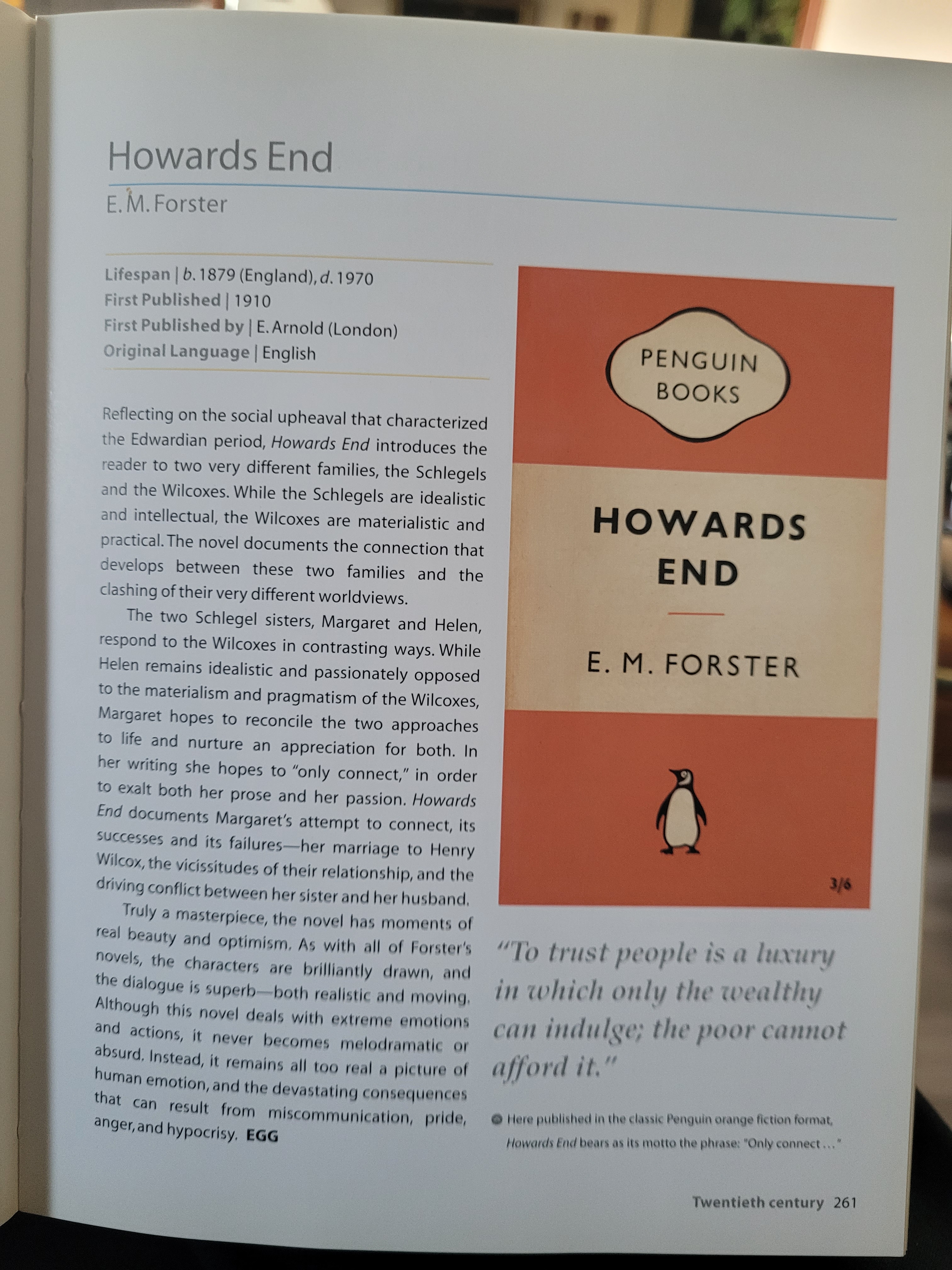
Howards End is #754 on the 1001 Books You Must Read Before You Die list. See the whole list and my progress here. This summer, I’m reading from the list for my 20 Books of Summer challenge, and instead of straight reviews, I’m going to compare the 1001 Books write ups with my own impressions.

If you’re my age (an ageing Millennial or a youthful GenXer, depending who you ask) you might have seen that genre of TikTok that points out that the way we thought about the 1960s as teenagers is the way teenagers today think about the 1990s (i.e. as ancient history.) This made me think about the classic lit equivalent: the way we thought about Victorian literature as teens is the way we should think about Edwardian literature today.
The metaphor doesn’t really work, because my microgeneration felt like whatever was going on in the 90s was fresh and new, whereas Victorian and Edwardian literature have only even felt “old”. But the fact remains: when I was a teenager getting into classic lit, books from 100-125 years ago were Victorian, and now books that old are Edwardian. Maybe it’s time to stop obsessing about the Brontës and Dickens and see what those Edwardians were up to*.
Howards End is the perfect place to start, written 113 years ago, navigating feminism, politics, and those newfangled “motors” that were taking over the roads. I enjoyed it thoroughly, though Forster (this is my first) does tend to get a little… off track at times. A lot of random philosophizing when I just wanted to know how the family was going to deal with Helen’s latest scandal.
The 1001 Books write up is on the bland side, so I started flipping through the adjacent pages, to see what else was happening circa 1910. Plenty of fellow modernists like Woolf, Lawrence, and Mann, but also the more traditional John Galsworthy. The write up for The Forsyte Saga (1906) could have applied to Howards End in that it mentions Beauty (with a capital B) and the urge to possess it, and how the family unit can stand in for society. It also calls it a “monument to the Edwardians.”
These books are both great depictions of the last gasps of Victorian-era morals and the emergence of Edwardian concerns. Forster contrasts the artistic Schlegels with the practical Wilcoxes, while Galsworthy gives us Soames Forsyte, representing the pursuit of property and power, while cousin Jolyon and wife Irene represent the pursuit of love and feeling. Galsworthy wanted to “only connect the prose and the passion” as much as Forster did, he just didn’t come up with such an eloquent way of putting it (and sorry, but legally, you have to quote this line in a review of Howards End.)
But they offer a pretty limited view of the lower classes. In both books, artistic, passionate men of a lower class are brought in to cause a commotion among the wealthy characters, and then they (spoiler alert) immediately die. Women of the lower classes are even more incidental – servants or prostitutes, mostly. There’s nothing to connect there. Why don’t we get a prosaic poor person to contrast with the passionate Leonard Bast in Howards End, or with Irene’s lover Philip Bosinney?
After perusing the 1910 era of the 1001 Books, I flipped all the way to the end. #4, On Beauty by Zadie Smith, is a loose retelling of Howards End, and while I read it too long ago to cite the details, I’m pretty sure it addressed the class shortcomings. The write up says it’s a novel about “art, love, race, class, family” which sounds about right. I looked up an ebook preview to see how Smith adapted Forster’s opening chapter that begins “One may as well begin with Helen’s letters to her sister.” (yep, with email transcripts). A reread might be in order.
As for which adaptation is better, please stand by: a DVD of the 1992 Howards End is on hold for me at the library. Don’t hold your breath though, The Forsyte Saga (2002) is one of my favourite historical mini-series ever!
*I do not actually plan to stop obsessing about the Brontës
 Reading in Bed