Category: Reading in Edmonton
Preview: LitFest. Edmonton’s Nonfiction Festival
 LitFest starts tomorrow! If you are thinking, “But Laura, it’s a nonfiction festival, and you barely read any nonfiction,” rest assured, LitFest organizers are pretty flexible about including authors who write all types of books, and, as a blogger, I can (maybe, almost) call myself a nonfiction writer too. Plus, I was fortunate enough to win tickets to a couple of events, so it’s a no-brainer! Here are the events I’m attending, and my top three picks for the rest of the festival.
I’m attending these events:
- ME ME ME! From the website: Finally. An event about the most important person in the world — YOU! Get your very own one-sentence biography from a professional author, have a photo shoot, and hear bits of brilliant memoir that will be featured later at LitFest. Your host is the extraordinary Bridget Ryan. Oct. 16, 5:30 pm, at Bohemia.
This is sorely needed, as my go-to pictures online are a blurry selfie and a picture from about four years ago. I’m also terrible at bios.
-

Lawrence HIll. via litfestalberta.com
Writing in Blood: From the website: A writer’s family is both rich source material and a minefield, especially when the material remains nonfiction instead of being transformed into fiction. This panel – Jenna Butler, Lawrence Hill and Jessica Kluthe, with moderator Elizabeth Withey – discusses their personal experiences, and offers their thoughts for others shaping a family memoir. Oct. 26, 2pm, Stanley Milner Theatre
I’m reading Hill’s The Book of Negros right now and it’s blowing me away. I will be purchasing a paper copy so I can get it signed. I’m excited to see the other authors too. Jessica Kluthe, of course, wrote the powerful memoir Rosina the Midwife. I heard Jenna Butler read from her book of poetry, Seldom Seen Road, at the NeWest Press Spring Spectacular earlier this year. And I love Elizabeth Withey’s One Hundred Widows project – stories about earrings with no mates. Sounds weird but the execution is beautiful.

My picks of the other events:
- CLC Brown Bag Reading Series featuring Todd Babiak on Wednesday Oct. 23, and Lawrence Hill on Friday Oct. 25, both at noon, both in the student lounge at the Old Arts Building, University of Alberta. No explanation needed, right? It’s free and it’s two awesome authors! I hope to make it to one or both of these.
- Dan Savage. Oct. 21, 7pm, Winspear Centre. I used to read his column in Vue (or was it See?) along with Josey Vogels’ “My Messy Bedroom” while riding the bus to and from University, hoping that people didn’t think I was checking out the escort ads. I’d love to see Savage say “DTMF” in person.
- Digital Tools for Writers with Omar Mouallem, Saturday Oct. 26 at 10am, Stanley Milner Library. Really sad I’m going to miss this one. Someone go and take notes, okay? It’s free!
See you there, #yegwrites peeps!
Love Letters of the Angels of Death by Jennifer Quist

Love Letters of the Angels of Death by Jennifer Quist | Published in 2013 by Linda Leith | Paperback: 202 pages | Source: Review copy from publisher
My rating: 4/5 stars
Synopsis:
A breathtaking literary debut, Love Letters of the Angels of Death begins as a young couple discover the remains of his mother in her mobile home. The rest of the family fall back, leaving them to reckon with the messy, unexpected death. By the time the burial is over, they understand this will always be their role: to liaise with death on behalf of people they love. They are living angels of death. All the major events in their lives – births, medical emergencies, a move to a northern boomtown, the theft of a veteran’s headstone – are viewed from this ambivalent angle. In this shadowy place, their lives unfold: fleeting moments, ordinary occasions, yet on the brink of otherworldliness. In spare, heart-stopping prose, the transient joys, fears, hopes and heartbreaks of love, marriage, and parenthood are revealed through the lens of the eternal, unfolding within the course of natural life. This is a novel for everyone who has ever been happily married — and for everyone who would like to be.
I thought this was going to be another one of those books that hits home, and it was, but not for the reasons I thought. I knew that the main character’s mother dies and that we learn about how his wife is able to support him by tuning into his needs. Quist says this of that opening scene (read the whole interview at her publisher’s web site):
The fact is, the opening scene is based on a real experience my husband and I shared when his father died unexpectedly and alone. During that disaster, I coped with my own shock and grief by making my husband’s feelings and perceptions the only things that mattered to me. It was a desperate strategy meant to get both of us through the experience as undamaged as possible. I went back into that hyper-empathetic frame of mind to write the first chapter of the novel. I’d been there before. The rest of the book – the fiction – evolved out of that truth.
I figured it was the story of a happy marriage made even happier by a traumatic event. That’s… not how it works for me. My husband lost his father four years ago, just three weeks before the birth of our first child, which was traumatic and accompanied by postpartum depression. We turned inward rather than toward each other. Neither of us were good spouses during that time. So, I was prepared for a literary smack upside the head – why didn’t this make us stronger? Why couldn’t I put my needs aside when my husband was grieving? Why couldn’t he see that I was struggling too?
But the book wasn’t about smack downs at all. Nor was it a marriage manual (though Quist gives some great pointers here.) It was, duh, a story, and once I got over the second-person perspective I was immersed and not worrying about the state of my marriage. Love Letters speaks directly to my tastes in many ways – the prairie and maritime settings, the morbidity, the Catholic relics, the heroine who is most definitely a feminist and shares my incapacitating fear of bugs (if I ever see a tar sand beetle I will die.) Continue reading
Reading Roundup: September 2013

My poor books are sitting in a laundry basket. Someone come put my new IKEA bookshelves together, please!
September: The Most Bookish of Months. Book events were attended, long-awaited books were released, and award long-lists were revealed. Let’s get to it!
Book Events:
I attended four book events this month, including one on my husband’s birthday, in case you were curious about my priorities in life.
- The Dilettantes was up first, and it was like my Twitter stream had come to life, complete with awkward “do I know you” moments. The Edmonton Book Bloggers were there in full force. Author Michael Hingston read his book and it was even funnier read aloud. Maybe do an audio version?
- Diana Davidson‘s launch for Pilgrimage drew a similar crowd and I hear her book sold out. My review is coming soon.
- You can read about Jennifer Quist‘s tour of Alberta for Love Letters of the Angels of Death here. Her event at drew a smaller crowd, but it made for an intimate reading – kind of appropriate for the subject matter. You should also know that Jennifer and I are on a hugging basis now.
- Todd Babiak‘s event for Come Barbarians was weird. No reading, and a much different crowd than the first three: older and better dressed. Kristilyn and I felt a little awkward. But Todd is a great speaker, and he knew who I was AND he told me that book bloggers will take over the world. Total fangirl moment – I guess I better read one of his books now! Oh and you NEED to watch his book trailer. Even if you aren’t from Edmonton and have no idea who he is. Just do it.
- The bookish events keep coming! Shout out to Yegwrites for keeping Edmonton’s literary calendar up to date. In October I’ll be attending LitFest, including an event with Jessica Kluthe and Lawrence Hill, and hope to get more books signed on Oct. 9th with Meredith Quartermain and Fran Kimmel.
Blog News:
- The Agnes Grey read-along has finished. This was a pretty low key read-along, where participants just comment on one master post, rather than create their own weekly posts. Gotta say, I prefer doing weekly posts. There’s more to comment on and to be honest, a bit of a competitive aspect – can I make my post funnier/weirder/more insightful/more laden with gifs than the other read-alongers? (No, I probably can’t, but it’s fun to try.)
- Speaking of weird and read-alongs: The Dragon Bound Read-along begins. I have read the first section and I’m enjoying it, though I keep having Feminist Moral Dilemmas but that’s true of almost everything I read, not just romances.
- I upped my reading goal from 25 to 50 books. No pressure. Continue reading
Rosina, The Midwife by Jessica Kluthe

Rosina, the Midwife by Jessica Kluthe | Published in 2013 by Brindle & Glass | Paperback: 216 pages | Source: LitFest
My rating: 4/5 stars
Goodreads
Synopsis:
Between 1870 and 1970, twenty-six million Italians left their homeland and travelled to places like Canada, Australia, and the United States, in search of work. Many of them never returned to Italy.
Rosina, the Midwife traces the author’s family history, from their roots in Calabria in the south of Italy to their new home in Canada. Against this historic background, comes the story of Rosina, a Calabrian matriarch and the author’s great-great-grandmother, the only member of the Russo family to remain in Italy after the mass migration of the 1950s. With no formal training, but plenty of experience, Rosina worked as a midwife in an area where there was only one doctor to serve three villages. She was given the tools needed to deliver and baptize babies by the doctor and the local priest, and, over the course of her long career, she helped bring hundreds of infants into the world.
Enhancing the stories and memories passed down through her family with meticulous research, Kluthe has, with great insight, created not only Rosina’s story, but also the entire Russo family’s. We see her great-grandfather Generoso labouring through the harsh Edmonton winter to save enough money to buy passage to Canada for his wife and children; we glimpse her grandmother Rose huddled in a third-class cabin, sick from the motion of the boat that will carry her to a new land; and we watch, teary-eyed, as her great-great-grandmother Rosina is forced to say goodbye, one by one, to the people she loves.
I recently wrote about books that hit home and I mentioned a couple of books that talk about teen pregnancy and miscarriage, but this is The One that inspired the post, and the one I couldn’t review until I talked about That.
That said, there’s more to this book than pregnancy. Actually, pregnancy and childbirth didn’t play as big a role as I thought they would. I was expecting something like The Birth House. Pregnancy, birth, and loss all play a part, but this is really a story about identity and home.
I was also expecting fiction. I didn’t know Rosina was a memoir until I was offered a copy by the staff at LitFest, a non-fiction festival. It reads very much like fiction. I kept forgetting, and thinking “I wonder why she chose this setting,” or, “I wonder what the purpose of this character is,” then realizing that the setting was really where it happened and the character was a real person. Those questions are still valid though. In non-fiction, the author still chooses what to describe in detail, and what to gloss over. She chooses who has a voice – in this case, herself, and her great great grandmother Rosina – and who stays in the background.
Kluthe chooses to give a voice to a woman who stayed behind when her family left for Canada, who lost her husband as a young woman with young children, and who brought innumerable other babies into the world. I love hearing another side of history like this (though I admit, I knew little about Italian immigration from traditional sources, either.)
These women could be snapped off the tree like the walnut branches, and soon no one would know they existed.
The themes in this book reminded me of a lecture I attended by CanLit superstar Esi Edugyan. She spoke about her experience as a Canadian going “home” to Ghana, though she’d never lived in Ghana, and how her expectations about finding a place to belong were not quite satisfied – she was still an outsider, just in a different way. Kluthe goes though a similar journey as she visits Italy in a bid to understand her ancestor Rosina, to tie together the snippets and whispers she’s heard over the years. Of course, it’s not as easy as getting on a plane. Kluthe’s relatives speak Italian and even with a translator, you get a sense that she’s removed from the real conversation. I had trouble keeping all the relatives straight at times for the same reason – we’re kept at arm’s length.
There’s an air of mystery and secretiveness surrounding Rosina. Some of the relatives aren’t willing to speak. There were difficulties locating her grave. She always seems a few steps out of reach. The silence and shame surrounding Rosina are reflected in the author’s experience with an unplanned pregancy.
I imagined secrets swirling around the burgundy-stained glass. I felt like this secret was a serious one, and I knew I couldn’t ask any more questions
The writing has been described as lyrical, but it’s also really understated and simple, which worked well. Kluthe does a great job tying together the different time periods and settings, and the straightforward memoir with the imagined day-to-day life of Rosina.
Kluthe eventually makes some important discoveries about Rosina, but I wondered how much resolution she felt. This is real life, so it’s not all tied up in a neat little package. I found myself kind of bereft at the end, wondering, now that she knows about her ancestors, her home, how does that play out in her life? Does it help her move on from her loss? Well, a cool thing about reading non-fiction is that Kluthe is a real person so there’s a chance we’ll find out.
I’ve talked a bit about how this book hit home for me. I’ll leave you with this description of that time between thinking and knowing you are pregnant. That stillness and inertia is just how I remember it, too.
The snow stopped. What had fallen had hardened into one crisp layer across the ground. I knew I had to go tot the doctor; it had been almost three months since I had had a period. I had to drive down the highway and into the city to the clinic. I had to pass by the familiar houses, fields, and farms, curve under the overpass and pass the golf course, and wonder if, on my way back, this world would look different. I had already imagined the trip several times, switching between possible outcomes, possible feelings. If I told Mom, she would make me go to the doctor. If I told Karl, we would go together. He’d sit there with me and wait. On the way, he’d adjust the mirrors, the fans. Reset the trip dial.
Thank you to LitFest for the book! Come see Jessica Kluthe this October at LitFest events Writing in Blood (I’ll be there!) and the Writers’ Cabaret for Literacy.
Visit Jessica Kluthe at her website or on Twitter.
Where Do You Sit on the Shelf?
In The Dilettantes, Alex Belmont agonizes over where his future novel will sit on the shelf in a bookstore:
His (as yet unwritten) book would inevitably be shelved immediately next to those of Saul Bellow. What self-respecting reader would look at the two of them, and then go with the untested, overwrought young punk?… Well, he thought, for every titan of literature, there are two lesser writers who will forever be remembered as their bookends.
I remembered this while I was at Audreys Books for the launch of The Dilettantes this past Saturday, and thought I’d see where my (unplanned, unwritten, unlikely) novel would sit. See if I have anything to be nervous about!
Here is where Laura Frey would sit at Audreys:
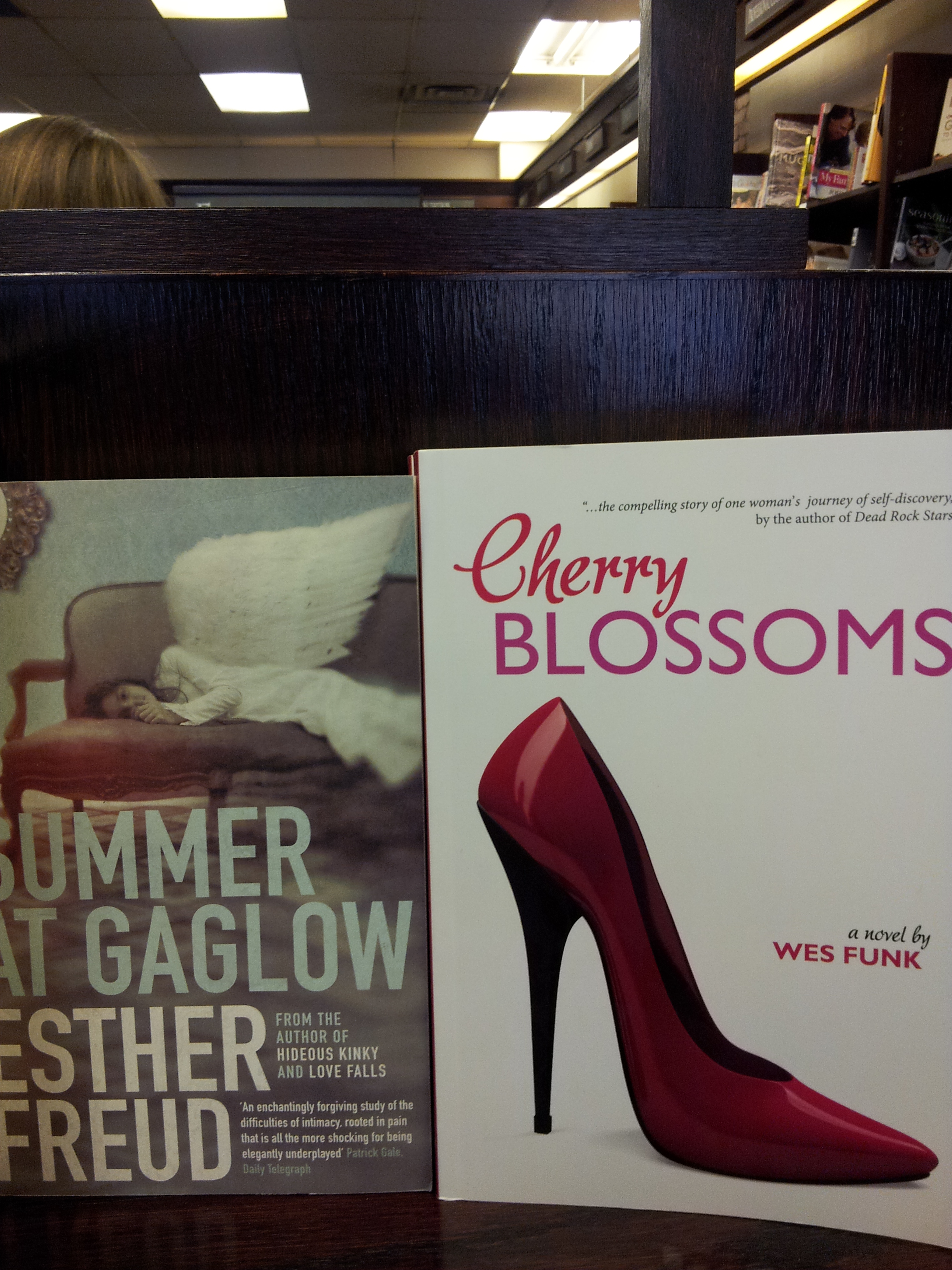
Summer at Gaglow by Esther Freud: Alternating between Sarah’s life and her grandmother’s childhood during the First World War, Summer at Gaglow unites four generations of an extraordinary family across the vast reaches of silence, place, loss, and time.
This actually sounds like a great read. I love WWI novels. Fun Fact – the author is the great-granddaughter of Sigmund Freud.
Cherry Blossoms by Wes Funk: …a wild ride – a poignant journey of one spirited woman’s search to find herself.
Apparently won an award for “steamiest read.” I have been on the lookout for erotica lately, but I think I’ll stick to Anais Nin.
After I took the first photo, I realized that if I ever wrote a book, I might write it under my maiden name, or hyphenated. Don’t know where that came from! Anyway, here’s where Laura Higgins(-Frey) would sit:
 A Devil is Waiting by Jack Higgins: The President is coming to London, but not to an entirely warm welcome. A fanatical mullah is offering a blessing to anyone who will assassinate the President, and though most London Muslims think the mullah has crossed the line, a few think otherwise.
So, political thriller? Not my bag. Higgins (which is a pseudonym) has written more than 70 books, which is just crazy!
Bookends by Liz Curtis Higgs: Emilie, a no-nonsense sort of woman, is determined to have her way. But Jonas is on a mission as well: He wants to hear Emilie laugh. Often.
This appears to be a Protestant romance and I really don’t have much more to say, except, that’s pretty crazy that “bookends” from The Dilettantes passage showed up, isn’t it?
Of these books, I might be nervous about rubbing shoulders with Ms Freud, but the others are wildly different for anything I would hypothetically write. Summer at Gaglow is going on the TBR, too.
Where would your book sit on the shelf?
The Dilettantes by Michael Hingston

The Dilettantes by Michael Hingston | Published in 2013 by Freehand Books | Paperback: 267 pages | Source: Review copy from publisher
My rating: 4/5 stars
Synopsis:
The Peak: a university student newspaper with a hard-hitting mix of inflammatory editorials, hastily thrown-together comics and reviews, and a news section run the only way self-taught journalists know how—sloppily.
Alex and Tracy are two of The Peak‘s editors, staring down graduation and struggling to keep the paper relevant to an increasingly indifferent student body. But trouble looms large when a big-money free daily comes to the west-coast campus, threatening to swallow what remains of their readership whole.
It’ll take the scoop of a lifetime to save their beloved campus rag. An exposé about the mysterious filmed-on-campus viral video? Some good old-fashioned libel? Or what about that fallen Hollywood star, the one who’s just announced he’s returning to Simon Fraser University to finish his degree?
I had all sorts of preconceived notions going into The Dilettantes. I thought I wouldn’t relate to it for various reasons, all of which were dumb and easily dismissed once I started reading. I think I was creating an elaborate defence mechanism, so if I didn’t like the book, I could be like “WELL it’s just because of X Y and Z” instead of having to say “I just didn’t like it,” which would be awkward because I will likely see the author at numerous literary events in Edmonton over the next few months. Luckily, I did like the book. A lot.
I thought it might be fun (…for me) to talk about all those excuses I came up with before reading the book, and how they were (mostly) overcome.
1. It’s about Millennials! Millennial are whiny and self-absorbed! I will strain something from rolling my eyes too much!
Depending who you ask, I’m a Gen-Xer by a margin of three months, or a Millennial by a margin of nine. Guess which one I choose to identify with? Yeah, I was only ten when Nevermind was released, but I spent my formative years without a cellphone or high speed internet. But here’s the thing: all “new adults” are whiny and self-absorbed. I mean, Catcher in the Rye, anyone? I wrote horrible poetry in a notebook when I was pretending to study, while these kids were probably posting to their Tumblrs or whatever. Big diff. The generational thing wasn’t an issue at all.
2. It’s about kids who actually went to class. And joined things, like newspapers. I hated those people. And also sort of regret I wasn’t one of those people. It’s complicated.
I don’t read a lot of campus novels. Maybe part of the reason is my ambivalence about my own university career. I was a great student. I just didn’t care about university, academically or socially. I didn’t make any friends. I certainly didn’t join any clubs. I went to the minimum number of classes I could get away with and didn’t contribute anything more than I had to. My energies, such as they were, were put towards clubbing and boys. This book made me feel at once nostalgic for something I never had, and relieved that I delayed the burden of giving a shit about stuff for a few more years. It also made me stop and evaluate a time in my life that was really difficult for me. When a book can make you do that, well, what more can you ask for? Continue reading
Rupert’s Land by Meredith Quartermain: Review and Author Q&A

My rating: 4/5 stars
Published: September 1, 2013 by NeWest Press
Source: Review copy from the publisher
Synopsis:
At the height of the Great Depression, two Prairie children struggle with poverty and uncertainty. Surrounded by religion, law, and her authoritarian father, Cora Wagoner daydreams about what it would be like to abandon society altogether and join one of the Indian tribes she’s read so much about.
Saddened by struggles with Indian Agent restrictions, Hunter George wonders why his father doesn’t want him to go to the residential school. As he too faces drastic change, he keeps himself sane with his grandmother’s stories of Wîsahkecâhk.
As Cora and Hunter sojourn through a landscape of nuisance grounds and societal refuse, they come to realize that they exist in a land that is simultaneously moving beyond history and drowning in its excess.
I try to go with my gut when I rate books, but sometimes, I make a change after letting a book digest for a while. I gave Rupert’s Land three stars at first, but as you can see, I’ve upgraded my rating to four stars. In the week since I finished it, I often find myself thinking about the story, the characters, and the historical context. I keep thinking that I need to recommend this book to people. Doesn’t sound like three stars to me.
So why the middling rating to begin with? Quartermain uses a distinctive writing style that was hard for me to get lost in. I stayed just a bit removed that perfect reading state where you’re not thinking about the words as you read them, you’re just absorbing them. On further reflection, though, it’s not that there’s anything wrong with the writing. It’s more a matter of taste, or mood, I think. (I’ll spare you a tangent on star ratings and what they mean.)
The writing is poetic, relies of streams of consciousness from our main characters, and has some quirks, like made up compound words and a lack of punctuation. The latter actually didn’t bug me, but I know it does some people. You will find a smattering of Cree vocabulary as well – don’t worry, there’s a handy glossary in the back. I would compare the style to Faulkner or even the little throw-away chapters in The Grapes of Wrath, you know, like the one where the men are at the car dealership and the reader “hears” the background noise and snippets of conversation.
To get a sense of what I mean, check out this scene, as heroine Cora is teased by her friend Netty for refusing to try on some lingerie:
You going to wear schoolgirl bloomers all your life? Netty leans against the door frame dropping one hip. A deep dimple creases soft white flesh overhanging the knickers. Golden fuzz coats her sturdy legs.
Rather do that than end up married to Bunk.
Rate you’re going, you’ll end up an old maid.
A fussy frump then. In her blue lisle stockings. Her face like a lastyear apple, a witch’s nose touching her witch’s chin. End up a schoolmarm with a stick body and claws for hands — children running away from her, boys making stink bombs and shooting spit balls at her A is for apple over and over on the blackboard until she died. But she’s not going to make herself all fluffy and cushy like Netty does.
Quartermain’s poetic language is grounded in some traditional CanLit territory, like the the depression-era prairie setting, the suffocating small town, and the outsiders up against the strict values of the establishment. But it’s the departures from the expected that make the story so rich. The two narrators aren’t at all who or what I expected them to be. Continue reading
Reading Roundup: Strange Summer and Frantic Fall
Strange things are afoot at Reading in Bed. I’ve noticed a couple of things since I finished reading Moby-Dick back in July:
- I’m kind of addicted to read-alongs, as I signed up for another one immediately, this time for Margaret Atwood’s Oryx and Crake. And I’m signing up for yet another this month.
- I keep stumbling on books that I connect with on a really profound and personal level. And I’m still trying to figure out how to review them without it becoming a weird confessional kind of exercise. They were: Bumped by Meaghan McCafferty, Rosina, The Midwife by Jessica Kluthe, and Love Letters of the Angels of Death by Jennifer Quist.
- I read Fifty Shades of Grey and didn’t hate it with the fiery passion I thought I would. (I hated it, yes, but I didn’t HATE it, you know?)
- I’m reading, like, SUPER fast. Six months ago I was barely managing ten pages per day. Now I’m flying through books in four days, or less. My secret is that I’m reading multiple books at the same time. This is something I’ve NEVER done. I’ve always been a serial monogamer in romance and in books. It’s like reading Moby-Dick flipped a switch in my brain and now I can just go back and forth between books with ease.
Anyway, these are all good things and I’m enjoying reading, and blogging, and chatting with other book bloggers, more than ever. In fact, after my social media break (social media free August, thanks Momaccounts) I logged on to Twitter and went on an unfollowing spree so that my timeline is now 80% book-related. Bloggers, authors, literary journals, and the like. And I love it.
Fall Plans
So things are great at the moment, but I must admit, I’m feeling a tad overwhelmed with all the stuff I have planned for Fall. Here’s a preview. Continue reading
Top Five: Fall 2013 Books by Edmonton Authors
I wrote about reading local last year, and why I think it’s important. I don’t know if there’s an exceptional crop of Edmonton books out this season, or if I’m just paying more attention, but I’ve got a short list that could rival any hoity-toity book award. Here are my most anticipated #yegbooks for Fall 2013. Which ones are on your To Be Read list?
1. Love Letters to the Angels of Death by Jennifer Quist
The basics:
- Release date: August 3, 2013
- Goodreads
- I received a review copy from the publisher, Linda Leith, but assure you it was my most anticipated book before that happened.
Why I want to read it:
- I love Jennifer’s blog. Every post has me nodding my head in agreement. She’s a beautiful writer.
- She got a great review in the Montreal Review of Books.
- The novel is about a happy marriage. I like to read about dysfunction so much that maybe I need to change things up.
- A personal connection. The set up is the death of the main character’s mother just before his wife gives birth. My husband lost his father just weeks before our first baby, and I didn’t deal with it very well. I’m looking forward to a fresh perspective on life and death (yep, my expectations are pretty high!) Continue reading
NeWest Press Spring Spectacular: Local Literary Love
Rebecca Campbell. Photo credit Brie Binicki
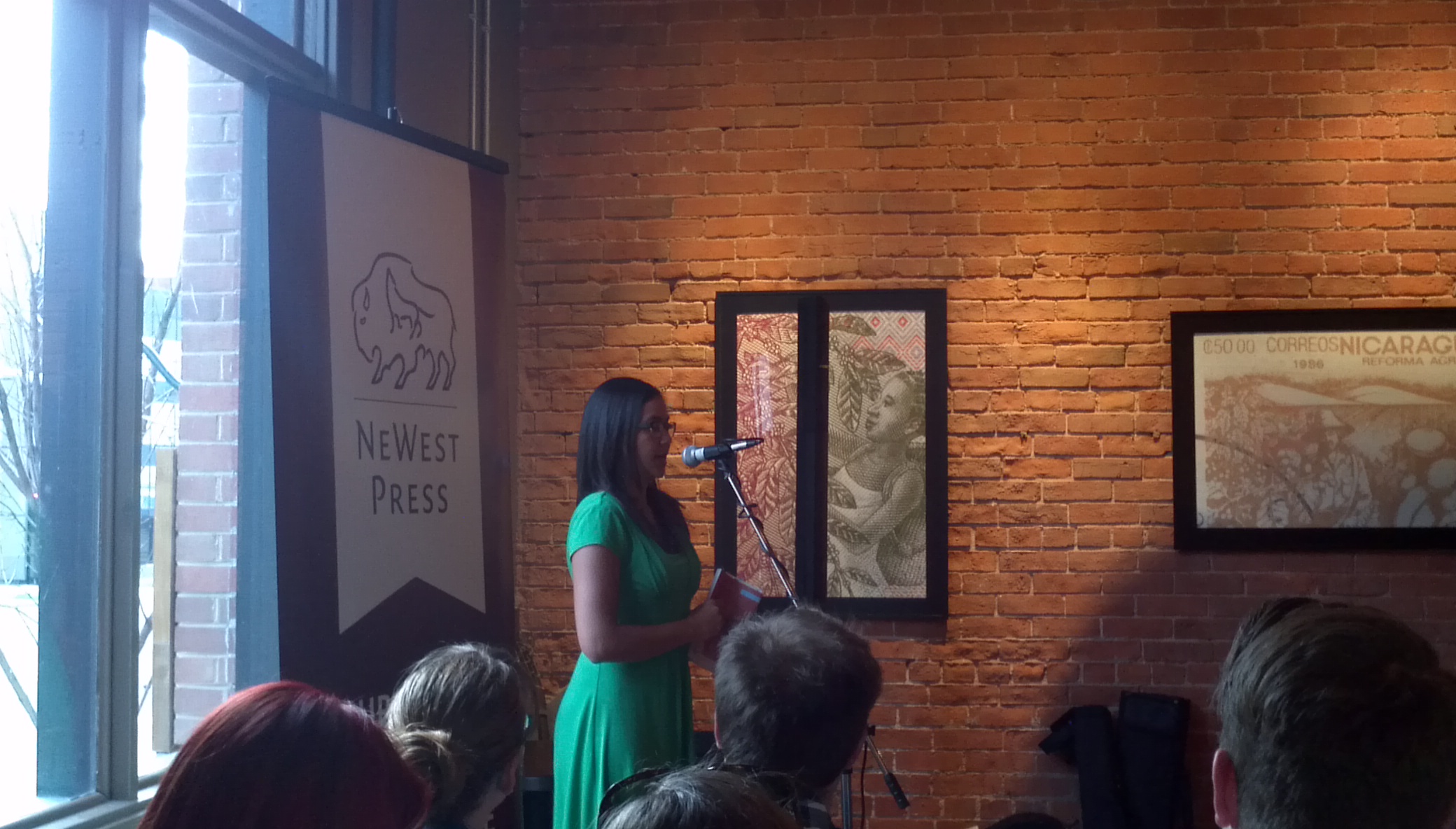
The Edmonton Book Bloggers were out in force last night, rubbing shoulders with the #yegbooks elite at the NeWest Press Spring Spectacular. This was only my second author reading, and had a very homegrown vibe compared to the Michael Ondaatje extravaganza back in March.
When I say homegrown, I don’t mean unprofessional. The event was very well run. Roast Coffee House was an almost perfect venue (just too hot), and Chris Craddock’s MCing was both brief and funny, which is exactly what you want from an MC. I thought it was strange to have a musical act, but Tyler Butler was fantastic, and gave the proceedings a nice, mellow vibe. Major shout out to NeWest’s Matt Bowes for pulling this event together.
Corrina Chong. Photo credit: Brie Binicki
We haven’t even talked about the readings!
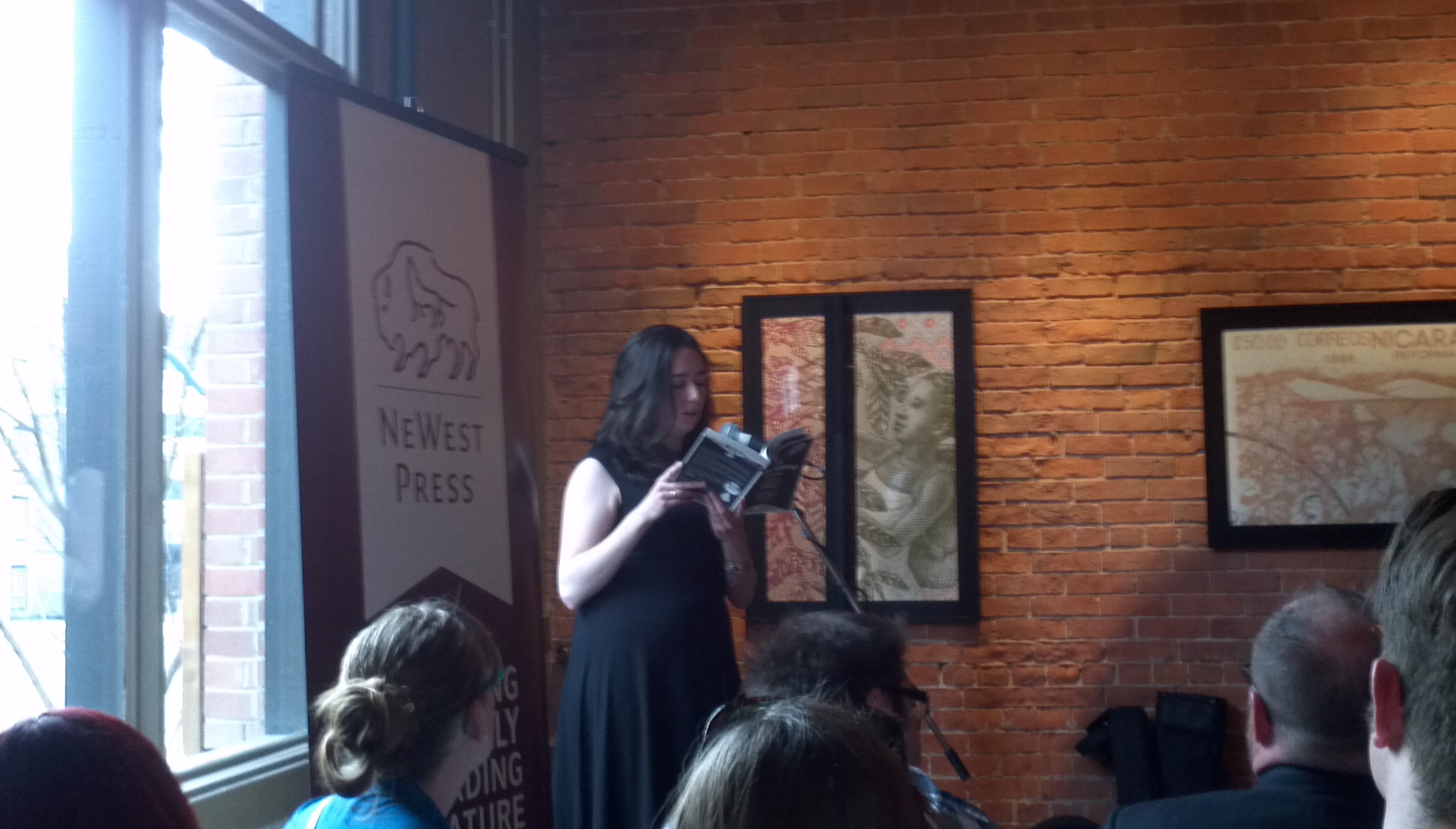
- Jenna Butler read from her poetry collection Seldom Seen Road. She was so poised and confident, and her work is beautiful. I was nodding along with her descriptions of small town prairie life.
- Rebecca Campbell was up next, and she blew my mind when she read my favourite passage from The Paradise Engine. Rebecca seemed a little nervous, and stumbled on a few words, but she dropped the f-bomb like she owned it. She really showed off the power of her prose (read my review).
- Marguerite Pigeon read from the thriller Open Pit. I admit that I had no interest in this book before, but she left us hanging and gave such a wonderful preview of her characters that I think I’ll pick it up on my Kobo soon.
- Finally, Corinna Chong read from Belinda’s Rings, and chose a funny excerpt followed by a dark one that hinted at the contrasts in her stunning debut novel (read my review).
I encourage you to check out the other Edmonton bloggers for their take. Rick from The Book-A-Week Project has a post up already (keener!) and Brie from Eat Books is working on hers. We also welcomed Elizabeth from Gossamer Obsessions to our little club, and I ran into author Jennifer Quist who posted this recap, including a hilarious account of our awkward “don’t I know you from somewhere” introduction.
I leave you with my night went in tweets and pictures. This is how I felt while getting ready to leave the house:
This is me with authors Corinna Chong and Rebecca Campbell, who both recognized me (omg) and were so lovely to talk to:

Corinna Chong, Moi, and Rebecca Campbell. Photo credit: Brie Binicki
And here’s my haul. Why yes, that is a signed copy of Cassie Stock’s Leacock Medal winning novel, Dance, Gladys, Dance. Jealous?

Three Paradise Engines, Two Belinda’s Rings, one Dance, Gladys, Dance, and a partridge in a pear tree.
 Reading in Bed