Category: Features
Jonathan Franzen’s Away Message
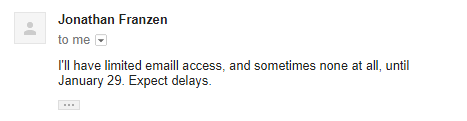
This time of year, I’d usually be kicking off another round of Franzen in February, but due to my unplanned, two-month blogging hiatus, I don’t have my shit together.
So, sadly, this year I will not be bringing you any new Franzen conspiracy theories, nor will I be peer pressuring anyone into reading their First Franzen (which has generally not gone well).
But I just remembered, the most amazing Franzen-related incident of my life occurred during my hiatus, and while I regaled everyone on social media, YouTube, and even IRL, I haven’t shared it with you, dear readers.
Short Story Recommendations from Short Story Lovers – and #SSAC2017 winner announcement


I would have announced this sooner, but I took at week-long internet break (inspired by Bookbii) and it was lovely.
Meghan has won the Short Story Advent Calendar giveaway! She’s an accomplished short story writer herself. Check out her writing here.
Thank you to everyone who entered. I asked you to tell me about a great short story collection as part of your entry, and did you guys ever come through. Below is the full list of recommendations: Continue reading
The Short Story Advent Calendar 2017: Giveaway open till Oct. 17
Disclaimer: Giveaway copy is courtesy of the kind people at Hingston & Olsen Publishing, but I bought my own copy. I know one of the creators, Michael Hingston, and reviewed his novel The Dilettantes here.
It’s that time of year again: The Short Story Advent Calendar is on sale now, and I have a copy to give away. I plan to do daily reveal videos, so subscribe on YouTube if you haven’t already!
The SSAC is exactly what it sounds like: individually bound short stories that you open every day from December 1 to 25. The creators also post daily author interviews and extras on their website. The best part is reading along and chatting about the stories with fellow bookish people on the internet – use #ssac2017 on Twitter.
How to enter & other fine print
- To enter: tell me about the last great short story you read in the comments, and make sure your comment either includes your email address, or links to somewhere I can find it. Or, email me at lauratfrey@gmail.com and put SSAC in the subject line. If you haven’t read a great short story lately, that’s okay! Just tell me how excited you are to start reading them, or something.
- Rules and regulations:
- Contest is open till October 17, 2017.
- On October 18, I will randomly choose a winner. I will notify the winner by email and ask for their mailing address. If I don’t hear back in 48 hours, I’ll choose again.
- The winner’s calendar will ship in late October.
- The giveaway is open internationally, but can only ship to addresses in Canada, USA, Mexico, Belgium, France, Germany, Ireland, Italy, Luxembourg, Monaco, the Netherlands, Portugal, San Marino, Spain, and the United Kingdom.
Good luck!
Psst… Hingston & Olsen are offering a second story box this year. The Ghost Box is full of scary stories, and is still available but probably won’t be for long.
CanLit for Cynics: Q&A with Peter Unwin
 When I wrote about CanLit cynicism for carte blanche, I started with Alex Good’s book of essays, Revolutions (full Q&A here). Then, a very strange novel fell into my hands (actually, it was placed there by Kelsey at Freehand Books) and I knew these books were meant to be together. Searching for Petronius Totem is a strange, hilarious book, and author Peter Unwin is a bit strange and hilarious himself. Read on for the full Q&A.
Many thanks to Mr. Unwin, and Ms. Attard at Freehand books!
CanLit for Cynics: Q&A with Alex Good
 I’m pretty cynical about CanLit lately. When I noticed that carte blanche, a Quebec-based literary journal, was running a “Who Needs CanLit” series on their blog, I knew I had to get in on it.
One of the books I drew on was Revolutions by Alex Good, a collection of essays that leaves no CanLit heavyweight unscathed. Have a peek at my essay over at carte blanche, then read on below for my full conversation with Alex Good, who may actually be more cynical than me.
Many thanks to Mr. Good and the fine folks at Biblioasis who put me in touch with him! And stay tuned for my Q&A with poet, novelist, and YouTube star Peter Unwin later this week.
How to read a book every week by ignoring your responsibilities: seven tips
Inspired by “How to read a whole damn book every week” by Kevin Nguyen, who has great bookish tweets
Ever notice that most “how to read more” articles are really basic? Smug too, but that’s inevitable. The GQ article above was better than most, but let’s talk about some ways to increase your book consumption that you might actually not know about. Continue reading
Before & After Canada Reads
Each year around this time, I take a social media break, and in 2017 it’s more extreme than usual: for the month of March, I’m not only staying away from Twitter and Facebook, but also YouTube, Instagram, Goodreads… anything with a “feed.” And this blog. I’m going to pretend the internet stopped evolving after 2006, basically.
I’d be remiss if I took off with out reminding you all about Canada Reads, which is going down March 27-30 on CBC (I am allowing myself to watch broadcast TV on YouTube. I gotta keep up on Workin’ Moms too!) AND letting you know that Write Reads podcast is staging its own version of the national reading debate.
“After Canada Reads” will be released in a special edition Write Reads podcast in late April. It’s sort of a homage to Canada Reads, but also sort of an anti-Canada Reads. If you enjoy the general concept of debating books, but find the topics and criteria for those debates to be somehow both insipid and alarmist (“the book Canada MUST READ RIGHT NOW”) – or if you just have a lingering ick factor due to the ex-host – this maybe be the reading event for you.
Oh, and I’m taking part! Of course.
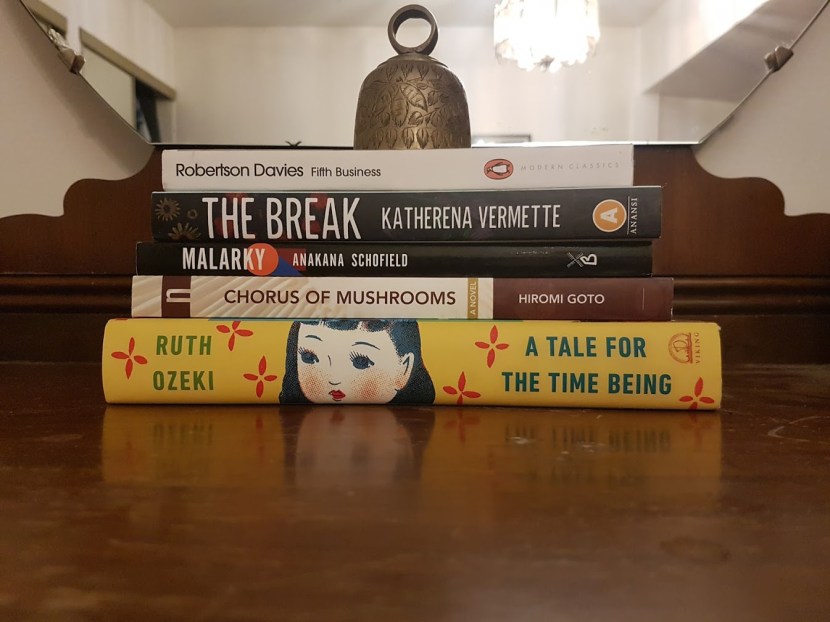
The theme: The best/most memorable/most inspirational female character in Canadian Literature.
The books:
- A Tale for the Time Being by Ruth Ozeki
- Malarky by Anakana Schofield (this one is mine!)
- The Break by Katherena Vermette (also on the legit Canada Reads)
- A Chorus of Mushrooms by Hiromi Goto
- Fifth Business by Robertson Davies
Check out all of the defenders and their book choices here.
So, while you struggle through the official Canada Reads without my insightful commentary about who lays the best smack downs, who has the best lipstick, and who needs to shut the hell up, remember to read along and get ready for After Canada Reads. See you all in April!
Jonathan Friendzoned: Some Thoughts on Purity
Our next #FranzeninFebruary guest post is courtesy of Matt Bowes, who’s pun game is on point (see post title). Matt is the General Manager at NeWest Press, my favourite Edmonton publisher. He sent me my very first review book back when I was a just a baby book blogger. He used to dabble in book blogging himself, but these days you’ll find him podcasting about Bollywood movies at Bollywood is for Lovers.

Jonathan Franzen can be a hard writer to like sometimes, but paradoxically I find him to be easy to love. The eternal English major in me thrills to see his recurring writerly tics crop up in each new fiction work, stuff like detailed descriptions of bird species, bathroom humour, the Club of Rome, and an uncomfortable sense of détente with the modern world. It’s one of the reasons people also like Wes Anderson: when an artist sets the table with recurring themes and preoccupations, it breaks down a sort of barrier, allowing readers to see what the deeper truth on offer is this time out. It’s like Commedia del’Arte, a set of agreed-upon motifs that act as a gateway to entertainment.
I’ve only read The Corrections, Freedom and now Purity, so I’m not entirely sure if these recurring traits appear in his earlier novels The Twenty-Seventh City and Strong Motion, but I would be surprised if they weren’t in there somewhere.
So while it’s easy to see a critic latching on to Franzen’s straightforward obsessions and calling them out as being on the nose, it’s this exact heart-on-the-sleeve nature of his work that makes me really like him, and stick up for him in conversation, even as Franzen the reluctant public personality often gets himself into trouble. His jeremiads against social media and its practitioners, his bemoaning the state of book promotion and his attempts to embody The Great American Writer archetype are well-documented and rightly mocked, but unlike some other claimants to that throne, Franzen always comes correct with the literary goods in the end. Continue reading
On not reading The Corrections
And now, the first guest post of Franzen in February 2017! The lovely Carolyn of Rosemary and Reading Glasses valiantly took on The Corrections, after promising to do so last year. Read on to see how she fared – though the title probably gives you an idea – and do check out her blog. Her Last Week’s Reading series is particularly good, if dangerous for the TBR; she is also a certified poetry concierge!
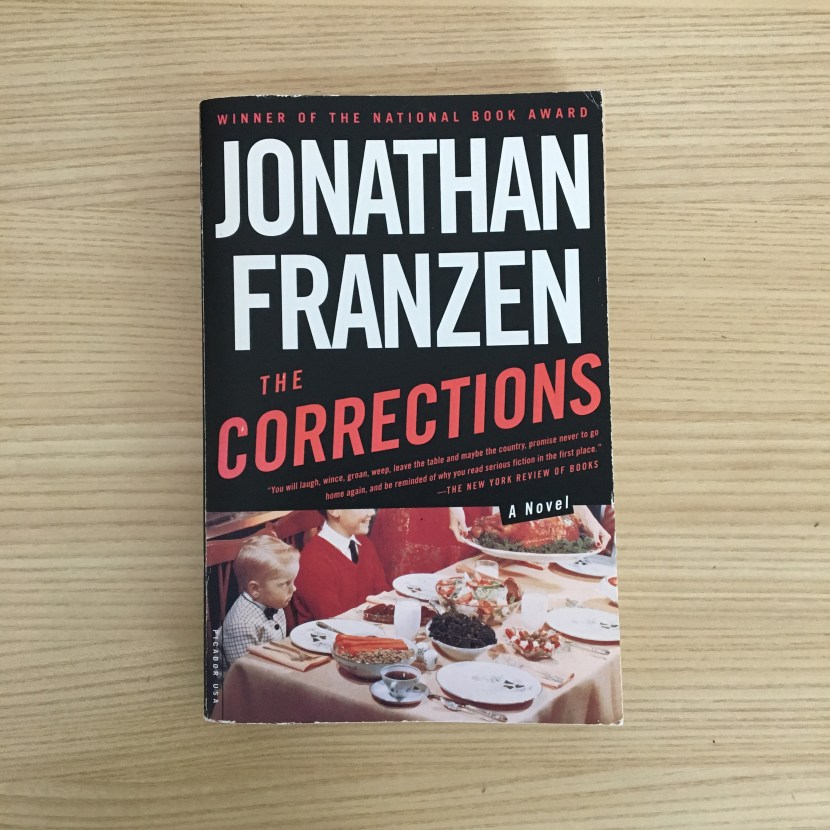
I’ve read a few of Jonathan Franzen’s essays (hated the one on Edith Wharton, in which he repeatedly comments on her looks; thought better of the one on Antarctica) and I’ve caught the general flavor of his views on technology and the reading public. I’ve also been delighted to read Laura’s spirited posts about the novelist over the last few years. All of this to say I came to Franzen in February wary of Franzen, but willing to be pulled in by his writing. Continue reading
Literary Jonathans


Portraits of the Jonathans as young men
Remember when Jonathan Franzen took a minor swipe at his not-quite-contemporary, Jonathan Safran Foer, in Purity?
“And are you a big fan of Jonathan Savoir Faire? So many of my students are…So many Jonathans. A plague of literary Jonathans. If you read only the New York Times Book Review, you’d think it was the most common male name in America.”
I don’t know that I’ve noticed a plague*, but I did just finish Foer’s latest, Here I Am, so let’s do a little comparing and contrasting.
Comparing the Jonathans
- Breakout novels in the early aughts (The Corrections and Everything is Illuminated)
- American Novels with side trips across the ocean: Chip’s Lithuanian vacation in The Corrections, Berlin in Purity, the whole Israel thing in Here I Am
- Voice of their respective generations: Franzen gets that label more than Foer, maybe, but remember, Foer isn’t even forty**. Give it time.
- Insufferable public personas: Do I really need to link to something for Franzen? And in case you missed it, Foer did… whatever this is.
- Environmentalist: Franzen is all about looking at birds, Foer is all about not eating them.
- Fascination and disgust with technology: I love how both include realistic technology in their novels (email exchanges in The Corrections, text messages in Purity; sexting, constant screen time, and a Minecraft-like online environment in Here I Am) but they both really hate it, too.
Contrasting the Jonathans
- The generation they are supposedly the voice of: Franzen’s a boomer, and Foer is technically a Gen Xer. Really though, he’s on the edge of Gen X and Millennial – just like me. Some call us Generation Catalano, but I prefer baby Gen Xer or elder Millennial, depending on my mood.
- Experimental vs realism: Franzen has a lot of range, but most of his writing is pretty straight up, realistic, and chronological. Foer experiments; not so much in Here I Am, which is much more Franzeny than his previous work, but in the invented language and mythology of Everything is Iluminated, and the flipbook at the back of Extremely Loud and Incredibly Close.
- Wunderkind vs Late Bloomer: Franzen was in his 40s with two novels behind him before he found success, while Foer was 25 and a debut novelist.
- Adaptation: Attempts have been made, but so far, Franzen’s work has not been adapted (Purity was in the works as a mini series but I haven’t heard anything in quite some time.) Both of Foer’s previous novels were made into movies; I wonder if Elijah Wood is free to play Jonathan, I mean, Jacob of Here I Am?
As for the books, I’ve only read two of Foer’s but each of them affected me more than anything of Franzen’s. I love ’em both, don’t get me wrong, but Franzen’s writing is a bit too sterile to give me that emotional devastation I crave. I have teared up for Franzen – but only for The Corrections, and only for one late, revelatory scene which I won’t spoil. Foer’s books don’t just make me cry, they have me weeping through entire chapters. Or the last 100 pages, in the case of Here I Am.
So, who’s your fav literary Jonathan? Meet me here for #FoerinFebruary in 2018?
*Jonathan was the 124th most popular name the year Franzen was born, and the 28th by the time Foer was born in 1977. It peaked in 1988 at #15, which suggests that the plague of literary Jonathans is far from over.
**He turns forty on Tuesday!
 Reading in Bed