It’s Always Sunny in La Mancha

I discovered two beloved and durable classics in 2025, but only one counts towards my 1,001 Books challenge: Don Quixote by Cervantes, translated by Edith Grossman.
Don Quixote’s length means it becomes an undertone to whatever else is going on in your life during the weeks (okay, months) you are reading it. For critic Ariel Dorfman, Don Quixote is forever linked to the coup in Chile, as she and 30 other refugees read it to each other in 1973 while hiding in an embassy. Ed Simon, an editor at LitHub, connects Cervante’s imprisonment and themes of freedom in the book with the kidnapping and imprisonment of immigrants in modern America.
As for me, I read Don Quixote (DQ hereafter unless I mean the character) while binge-watching It’s Always Sunny in Philadelphia (IASIP hereafter), and now, it is inextricably linked with The Gang’s adventures.
This is perhaps not as meaningful as others’ experiences, but as I watched and read, I started to suspect that Cervantes invented the sitcom, rather than the novel, which he is often credited with. This feels significant, as sitcoms are dying out, after overtaking novels as a dominant narrative form in the twentieth century*. So while I’m interested in what Cervantes has to say about freedom, imagination, and the dying days of the Spanish empire, my brain was primed to see him inventing the form that eventually led to Danny DeVito writhing on the floor, naked and covered in hand sanitizer.
So rather than write a review of DQ, as you hardly need me to tell you if you should read it, I’m going to look at all the ways in which DQ is echoed in IASIP, a show that premiered exactly four hundred years after the First Part of the Ingenious Gentleman Don Quixote of La Mancha was published in 1605.
I’m assuming that any reader of Reading in Bed is familiar with both of these works, even though I wasn’t until last year – but actually, I was, and you are too. If you know anything about knights in shining armour, damsels in distress, or mystical wizards, you’re halfway there. Just keep in mind that DQ is set a few hundred years after the golden age of chivalry. You can still be a knight, sort of, but wandering around the countryside looking for adventures makes you look more crazy than chivalrous. As for IASIP, if you know anything about sitcoms, you’re also halfway there. Remove the laugh track and every heartwarming moment, add at least one bodily fluid (puke is a safe bet) and instead of “coworkers annoy each other but have each other’s backs” it’s more “coworkers annoy each other and betray each other, and each others’ mothers, for the pettiest of reasons.”
In which Cervantes invents the sitcom
The first parallel I noticed was the episode and chapter titles. Cervantes uses those now-archaic “In which…” chapter titles, sometimes in a straightforward manner (“Which recounts what befell Don Quixote as he was going to see his lady Dulcinea of Toboso”), sometimes a little vaguely (“Regarding certain things that befell Sancho on the road, and others that are really quite remarkable”). IASIP episodes are similarly titled, sometimes straightforward (“The Gang Finds a Dumpster Baby”) and sometimes less so (“The Nightman Cometh”).
It also struck me how “episodic” DQ is. While there are overarching themes, and story lines that stretch over many chapters, many of the chapters are self-contained, with a single “adventure” that comes to a satisfying conclusion – much like a sitcom. There are also stories within stories, like “The Man Who Was Recklessly Curious”, an interpolated story that spans three chapters, which reminded me of season 15 of IASIP, when “The Gang go to Ireland” (S15E05) for a four-episode Charlie-centric adventure. Most chapters/episodes focus on the friend group as a whole, but sometimes a side character gets a very special episode, like when Sancho goes out on his own to govern an insula (of which more later), or when Mac finally comes out, in an episode that’s tonally different from the rest of the series.
In which Cervantes invents the buddy comedy
Speaking of “The Gang”, Don Quixote has a gang too – but only when he’s at home. In La Mancha, he hangs out with a priest, a barber, a “bachelor” (i.e. a student or scholarly young man, i.e. a nerd – every sitcom needs one!), a housekeeper and a niece. When he’s adventuring, though, it’s all about his squire, Sancho Panza.
Pairing a bumbling hero with an illiterate sidekick was so successful it became a template for buddy comedies, where the main guy thinks he’s got it all figured out, but the weird, little guy is actually the brains of the operation: from Napoleon and Pedro, to Wayne and Garth, to Shrek and Donkey, it’s a formula that works. In IASIP, we see this dynamic in Mac and Charlie.

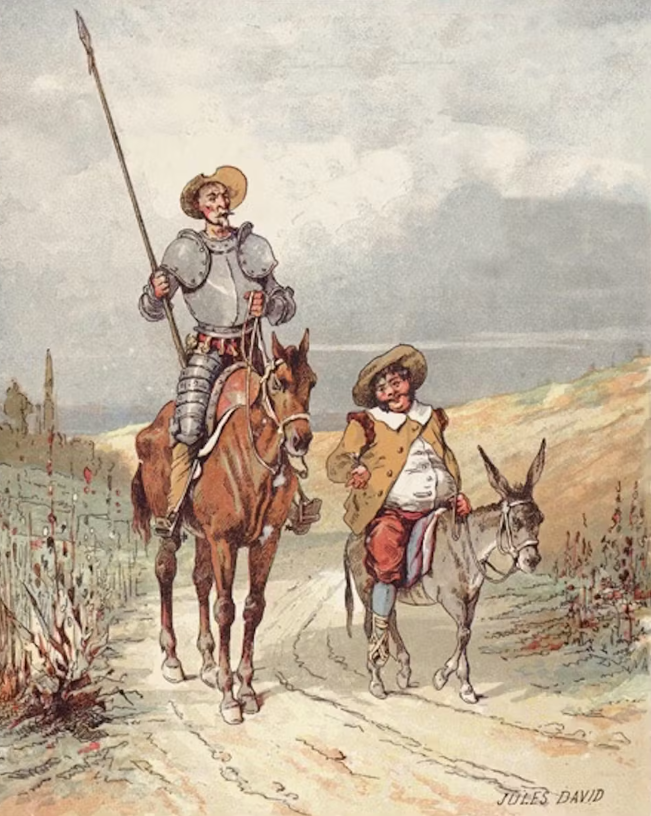
Mac is “security” for Paddy’s Pub, a role that includes keeping people safe, scanning for danger, and confronting bad guys. Of course, Paddy’s is never busy enough to require a bouncer, and on the odd occasion it does, Mac usually chickens out, but he makes sure to wear sleeveless tops, tactical gear, and, occasionally, a leather duster to signify his status. Don Quixote is a knight errant, a similarly redundant role in 17th century Spain, and is similarly devoted to the accoutrements of his occupation – from his armour to his lance to his “helmet,” which is really a glorified bucket. The key difference is that Don Quixote never backs down from a fight – even when the fight turns out to be against sheep or windmills, he always believes he’s rushing into danger. Here, Don Quixote embodies Mac’s “bad ass” persona:
“Don Quixote continued his journey, imagining, because of his recent victory, that he was the world’s most valiant knight errant of the age; he considered any adventures that might befall him from that time on as already completed and brought to a happy conclusion; he held enchantments and enchanters in contempt; he did not recall the countless beatings he had received in the course of his chivalric exploits, or that stones that had knocked out half his teeth…”
Charlie is a “janitor” for Paddy’s, which means he kills rats, unplugs toilets, and does other “Charlie work” that is below the rest of the gang. Charlie is illiterate and lives rather humbly on a pull out couch in a dilapidated apartment, subsisting on cat food, but he takes pride in his work. Sancho is a squire, similarly doing the jobs that are beneath a gentleman like Don Quixote, and with similar pride. He grudgingly subsists on nuts and berries when they are out adventuring, but yearns for the comfort of home, or at least an inn, much like Charlie, who becomes worked up at the very thought of leaving Philadelphia:
“Must we keep the vow in spite of so many inconveniences and discomforts, like sleeping in our clothes, and sleeping in the open, and a thousand other acts of penance…?”
What of Dennis and Dee, the twins who lord their higher-class status over Mac and Charlie and ostensibly tend bar once in a while? They don’t have a clear analog in DQ, though Dee is a bit Sancho-like, as she’s not really in the gang, always a bit of a side character (a major plot point of hers mirrors a major plot arc of Sancho’s, of which more later) and Dennis’ rage comes through in both Don Quixote and Sancho when they get frustrated with each other. Both of these lines could have been spoken by Dennis at a particularly “untethered” moment:
“You are a jackass, and must be a jackass, and will end your days as a jackass, for in my opinion, your life will run its course before you accept and realize that you are an animal.” -Don Quixote to Sancho, channeling Dennis calling someone an “idiot”
“By God…your grace has cleared up a great doubt, and said it so nicely too! Lord save us! Was the cause of my pain so hidden, that you had to tell me I hurt where the staff hit me?…all I hope is that I can see the first man who put the finishing touches on knight errantry burned and ground into dust!” -Sancho in a sarcastic moment, after Don Quixote helpfully points out that he’s been hurt after taking a beating
But neither Don Quixote or Sancho are as odious as either of the Reynolds. There’s an innocence to their madness. As Sancho says of Don Quixote:
“…there’s nothing of the scoundrel in him…; he doesn’t know how to harm anybody, he can only do good to everybody, and there’s no malice in him: a child could convince him it’s night in the middle of the day, and because he’s simple I love him with all my heart and couldn’t’ leave him no matter how many crazy things he does.”
Dee and Dennis’ closest analogues are probably the Duke and Duchess, haughty nobles who have nothing better to do than mess with Don Quixote and Sancho. There’s also Dennis’s beloved Range Rover, which is not nearly as roadworthy or impressive as he thinks, which bring to mind a minor character: Rocinante, Don Quixote’s scrawny old horse, who he imagines to be a powerful and well behaved steed.
And of course, there are love interests. In Don Quixote and Sancho, we see two sides of romantic love: an enamoured knight, in love with a woman who may or may not be enchanted or even a real person, and a married peasant, who argues with his wife about money and how to raise their children. There’s very little of normal married life in IASIP (I cannot call Dennis’ marriage to Maureen Ponderosa, who was slowly morphing into a cat, “normal”) but Mac and Charlie each have romantic interests that reflect the tropes introduced by Cervantes. Mac has never really been shown with a romantic partner, but before coming out, feigned interest in women on occasion. That’s the side of Don Quixote who’s a “confirmed bachelor” who never actually sees his beloved. Then there’s Charlie, who yearns for (i.e. stalks) “Waitress”, to a concerning degree, and that’s the enamoured side of Don Quixote who yearns for his Dulcinea and gets into a lot of trouble defending her “peerless” beauty. Thankfully, Don Quixote never pretends to be an alcoholic, a Big Brother, or to have cancer as a ruse to win her, but the feeling is the same.
(Before you ask: there is no analogue for Frank. Frank is wholly original.)
Both the book and the show are about people on the fringes of society; these are people who would be called mad (many characters remark on how Don Quixote is either the most mad or most wise person they’ve ever met; Dennis has a similar unsettling vibe) or laughable (everyone loves talking to Sancho because he’s so funny; Charlie has a similar vibe). We love these characters because they show us the absurdity of life. And they do get into some absurd situations.
In which a thousand trifles are recounted, as irrelevant as they are necessary to a true understanding of this great history**
DQ and IASIP have a surprising number of plots that echo each other, or in some cases, could almost be interchangeable. For example, there is an entire chapter, “Regarding the dreadful belline and feline fright received by Don Quixote in the course of his wooing by the enamored Altisidora,” devoted to a prank in which a cord with “a hundred cowbells” is lowered onto Don Quixote’s balcony, followed by a “huge sack full of cats, with smaller bells tied to their tails.” He sustains serious clawing injuries to his face, to the Duke and Duchess’ delight. This could literally just be another night outside of Charlie and Frank’s apartment, and reminded me of Charlie addressing a possible “cat in the wall” situation at Paddy’s by throwing additional cats in the wall (“Mac and Dennis Break Up”, S5E09), or the time Dennis scratches Mac’s face in a fight about steak (“Charlie Work”, S10E04).
These two plots are among my favourites, because they are built up over a long period of time, and take a joke farther than you thought possible: Early in the book, Don Quixote promises Sancho an “insula” to govern, presumably, from land he will be given by grateful recipients of his chivalry. Early in the show, Dee is an aspiring actress who always thinks she’s about to get her big break. Sancho and Dee both appear to get what they want through elaborate ruses that play on their vanity in cruel but hilarious ways.
The Duke and Duchess (who, again, have NOTHING better to do) design an elaborate scheme to make Sancho think he’s been given an insula to govern, making their staff play the roles of butlers, stewards, and subjects, while playing tricks, like giving Sancho a court physician who won’t let him eat (the food might be poisoned!), and sending in petitioners with increasingly esoteric requests. Sancho surprisingly rises to the occasion, giving wise advice to his “subjects”. In “The Gang Broke Dee” (S9E01), The Gang (who, much like the Duke and Duchess, have nothing better to do) hire actors, design elaborate sets, and manipulate Dee to think she’s finally hit it big when an “agent” gets her a stand-up set on Conan O’Brien. Dee similarly rises to the occasion, pulling off some decent (for her) comedy sets in the lead up.
The stories diverge in the conclusion: Sancho gets a dignified exit from his governorship, quitting after eight days of eating little and being plagued by needy subjects at all hours. He never realizes that it was all a prank. Dee is not afforded any such dignity. The ruse is so elaborate that she thinks she’s stepping onto set with Conan when she’s really just stepping into Paddy’s Pub, where The Gang laugh at her for thinking she really hit it big. This highlights a key difference in tone: IASIP brings the characters lower than you thought they could go, while DQ always leaves a little ambiguity about whether we should envy or pity them.
There are so many more parallels I could mention, but I’ll leave you with these:
- “Charlie Rules the World” (S8E08), in which the gang gets wrapped up in a fantasy video game and can’t distinguish fantasy from reality, much like Don Quixote can’t distingush between “enchantments” and real life. They even play characters that would be familiar to Don Quixote, like king, queen, and jester.
- Don Quixote encounters a soothsaying monkey at an inn who reminded me or the bartending monkey from “The Gang Replaces Dee with a Monkey” (S15E04).
- Don Quixote frees a group of prisoners, with unexpected results, much like Mac’s various interventions for his imprisoned father that don’t go the way he planned.
- Don Quixote and Sancho commandeer a boat with disastrous consequences, but perhaps not as disastrous as the time “The Gang Buys a Boat” (S6E03) only to have it both burn and sink.
- Sancho and Dee both get in trouble due to their need to shit in a particular place, politely expressed by Cervantes as “the urge and desire to do what no one else could do for him,” and, less delicately by Frank, “dumping up a John,” in “The Gang Solves the Bathroom Problem” (S13E06)
In which it’s always sunny in La Mancha
As I closed in on the end of the book and the show, I reflected on how Cervantes and The Gang deal with the passage of time. Time works in a funny way in both worlds. For Don Quixote, the sheer number of adventures or “sallies” suggests that a lot of time has passed. However, the first part takes place over a couple of weeks, and the second part over a couple of months. Sancho can’t believe it either, insisting that they’ve been adventuring for twenty years, when requesting some backpay from his master:
“If I remember correctly,” responded Sancho, “it must be more than twenty years, give or take three days.”
Coincidentally, that’s how long IASIP has been running, and the show has the opposite problem, being a visual media: time doesn’t seem to pass at all, but the actors have indeed aged, despite their surgical attempts to hide it. Apart from a few throwaway references to Dee suffering through menopause and Charlie missing his fortieth birthday by several years, The Gang are stuck in a time warp, and it’s becoming a little uncanny!
The name “It’s Always Sunny” speaks to another irregularity of time in sitcoms; it is always sunny, always summer, or at least, late spring/early fall, when the lighting is good and the characters can move freely without coats and boots and what not (unless it’s a Halloween or Christmas episode). In DQ, it’s similarly always fair weather, allowing the friends to sleep outdoors when they can’t find an inn. This might be somewhat more realistic in Spain than in Philly, but it’s also never Christmas time in La Mancha, or any other holiday, and no one has to work. The characters in both worlds have no demands on their time, other than having adventures, which is probably what makes this format so comforting for the viewer or reader, who has plenty of demands on theirs.
None of this is to say that I think Rob Mac, (who recently changed his name, much like a certain Alonso Quijano a.k.a. Don Quixote!) Glenn Howerton, or Charlie Day were actually inspired by Cervantes. I don’t really think Cervantes invented the sitcom either, or the novel for that matter (Rabelais, anyone? The Tale of the Genji?) I think humans just like to tell stories, and when it comes to telling humorous stories about a toxic friend group, there are many, but limited, possibilities. You’re eventually going to get a story about a boat, a monkey, or shit. The themes are probably going to touch on madness and sanity, selfishness and sacrifice, and, of course, friendship and love.
We are still reading Cervantes four hundred years later. Will IASIP be as durable? My mom’s boyfriend is currently binge-watching Leave it to Beaver on Tubi, so it’s quite possible.
In the meantime, if you’re ready for adventure, saddle up your Rocinante, or pile in the Range Rover!

*I’m not sure I can link Cervantes to the vertical video format that’s killing all other media, though I’m sure someone could!
**a real chapter title, Part II Chapter XXIV
 Reading in Bed
LOL I’ve never seen the sitcom but I have read DQ, so this was fun!
Thank you! It’s worth a watch, if you are into very Gen X, American, non-PC humour…
LOL Laura I’m not into any of those which is probably why I’ve never watched it!
I was a scam victim, I lost a lot of money up to $170,000 I would like to express my gratitude to Innovations recovery Analyst for their exceptional assistance in recovering my funds from a forex broker. Their expertise and professionalism in navigating the complex process were truly commendable. Through their guidance and relentless efforts, I was able to successfully recover my funds of $170,000, providing me with much-needed relief. I highly recommend them on – INNOVATIONSANALYST @ GMAIL. COM to anyone facing similar challenges, as their dedication and commitment to helping clients are truly impressive. Grateful for their invaluable support in resolving this matter.
This is such a smart and interesting (and funny!) take on Don Quixote’s significance! I haven’t seen IASIP, but the way DQ falls into bite-size episodes is highly recognisable, and what you say about the origins of buddy comedy and the way the sitcom has plots that echo those of the novel is really insightful.
Thank you! I love it when I big, serious classic is just a bunch of guys being dudes (see also, Moby-Dick, probably many others)
SO true of M-D.
This is great, I haven’t heard of ASIP or read DQ but I’m inspired to for the first time!
You really can’t go wrong
One day I will finish this! I’ve only read the first part and it reminded me very much of Pokemon… (character travels along, has a battle, wins or loses, carries on, has a battle, wins or loses etc etc….)
I love this!! Please finish reading it and write a post assigning every character a Pokemon persona…
I love DQ, it’s one of the funniest books I’ve ever read, but I have only watched a few episodes of IASIP. Nevertheless, I’m convinced by your argument. Brilliantly and hilariously done, Laura. Maybe I should carry on with IASIP.
If nothing else, watch The Gang Broke Dee. A stand-out episode and big inspiration for this post!
Despite having talked about it I still haven’t read DQ! But I loved the idea that if I had watched the sitcom, I might have been viewing something that Cervantes invented. Brilliant post Laura.
Fantastic post! I’ve never read Don Quixote but you’ve inspired me to dive in sooner rather than later. Keep up the wonderful words.