Western Lane by Chetna Maroo
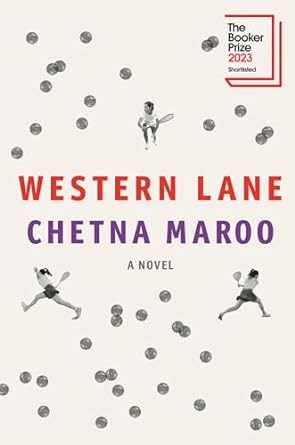
Maybe it’s because I’m off Twitter, but I haven’t seen too much discourse about the Booker prize this year. I’m thinking about the years in which people whined about too many debut authors, because this shortlisted book struck me as very “debut-y” – or maybe it’s just me.
Two trusted reviewers, the hosts of Novellas in November, who chose this book as a buddy read, don’t feel that way. Cathy found this story of a grieving eleven-year-old girl coping through a newfound love of squash, deep and satisfying:
“The narrative arc of Western Lane has all the staples of a standard Hollywood movie: rising from tragedy through sport, a romantic love interest and a thrilling climax of competition, but Maroo presents this recognisable story with a restraint and insight that elevates it beyond cliché.”
Rebecca found it illuminating in terms of “what is expected of young Gujarati women in England; on sisterhood and a bereaved family’s dynamic; but especially on what it is like to feel sealed off from life by grief”.
Rather than write a comment on their blogs about why I disagree, I thought I’d better review it myself. But I find that I can’t refute their points! The things I found trite or formulaic, they found “accessible with hidden depths” (that’s Rebecca.) I agree that the lack of “stylistic flair” (Rebecca again) is effective, and becomes a style of its own through repetition of certain metaphors. I just didn’t like the metaphors.
My issue isn’t with any individual scene, or the style, but with the structure of the book as a whole. I felt like I could see the plot outline underneath the finished product, like if I could go back to an earlier draft, I’d see a note: “insert squash metaphor here.” In fact, all eight chapters begin with a squash metaphor. They were well written, but to me, utterly obvious in what they were meant to convey about grief, and after the first few chapters I was sick of them.
Had the writing not been restrained (as per Cathy,) this could have been a disaster. In between sports metaphors and the family members alternatively falling into or resisting gender and birth order roles, there were quietly powerful moments, some even illuminating. I gasped at a pivotal moment, when the young protagonist makes a decision that seems out of character, but actually reveals a lot about how grief and family turmoil have affected her. But even this moment makes me feel like I can see a ghostly Google doc comment like “put an obstacle in the character’s way before she gets to the final battle.”
Cathy and Rebecca aren’t the only ones giving rave reviews. Canadian author David Chariandy calls Western Lane “a book of simmering intensities, reverberating silences, and exquisite literary timing.” This is an apt blurb, as his debut novella Brother touches on similar themes of grief, sibling relationships, and second generation immigrant experiences, with an overarching metaphor (music in his case). In my mind, Chariandy’s book was much stronger, as the structure wasn’t visible to me. Nothing felt repetitive or forced, and the musical metaphors, which I suppose were as obvious as the sports ones in Western Lane, were revealed at just the right moment to create a very emotional reading experience.
But as my mom says, there’s no accounting for taste. We’ll find out what the Booker judges think soon enough!
 Reading in Bed
Very interesting notes about the structure being visible—I think of this as “being able to see the seams” and find it equally offputting.
OMG I was trying to think of this phrase, it just wouldn’t come to me. Yes, the seams were jumping out!!
I love this review Laura, and oddly, despite loving this book, I completely agree with a lot of what you have said. The plot is a bit formulaic, but I still found the writing lovely and the space in between what was said powerful.
Thank you! Honestly think it’s a matter of taste, mood, etc. I’m not mad that you picked this book. I am going to pass on the cute hardcover edition I bought though 🙂
Yes, I, too, agree with much of what you’ve said! The links and metaphors are pretty obvious and it definitely feels like a debut (whereas I bet you’d say something different about Study for Obedience). Still, I found the story affecting and the writing spare but beautiful. And I have a soft spot for this book now because my review won me tickets to the Booker Prize ceremony this year 🙂
It did?? That’s incredible! You must tell us everything 🙂
OMG! You’re going to the Booker ceremony! I can’t wait to read your report – have fun!
I was pleased to read this Laura, not because I’ve read this, but one of my regular customers (I work in a small indie bookshop) likes to read as much of the longlist as he can each year. He usually picks the winner (this year he is gunning for The Bee Sting, but thinks that Paul Lynch’s book could take it out too). His comment on this was ‘okay, but reads like a YA novel’.