“Goodreads for movies”? How about a Letterboxd for books?
The fact that Letterboxd still bills itself as “GoodReads for movies” on their about page is hilarious to me, and not just because they’ve inexplicably styled “Goodreads” with a capital “R”. Letterboxd surpasses Goodreads in almost every way: user experience, functionality, aesthetics, not being owned by Amazon… and while Goodreads members outnumber Letterboxd users ten-to-one, surely the potential is there – how many people do you know who watched a movie in the last month? How many who read a book? And which do people talk about more?
Goodreads has a stranglehold on the book-tracking market, despite not serving anyone particularly well – readers, authors, or publishers – and despite persistent bad press. Is it just network effects? First mover advantage? I spent a little time investigating why things have been allowed to get this bad, and then had some fun imagining what a “Letterboxd for books” would be like.
Why is Goodreads the way that it is
There was nothing wrong with Goodreads when it launched in 2007. In a web 1.0, barely-social world (Facebook had just opened to the public) it was a boon to readers. The problem is that the site has barely changed since then.

The founders, a couple who met at Stanford and later married, had tech and journalism backgrounds, but they strike me as readers first and developers second. They sold to Amazon after rapid growth in the early 2010s and have since stepped away from the site. According to this recent Washington Post article, Amazon never intended to do much with Goodreads, apart from mine its data. Insiders claim that Goodreads is built on such old code and infrastructure, it would cost too much to update – I work in “digital transformation” in the public sector, so I get it – but if Jeffrey Bezos can’t afford to update some old technology, who can? Amazon decided it wasn’t worth it, and by letting it limp along into 2023 with 125 million members, they’ve made sure no one else has a chance make something better.
Letterboxd, on the other hand, was founded in 2011 by some guys who strike me as developers first, and movie fans second. They’ve recently cashed in too, selling a majority stake to a Canadian holding company called “Tiny”, which hopefully means any changes to the site will be “tiny,” because it’s such a joy to use (once you pony up for an annual “Pro” subscription and get rid of the ads.)
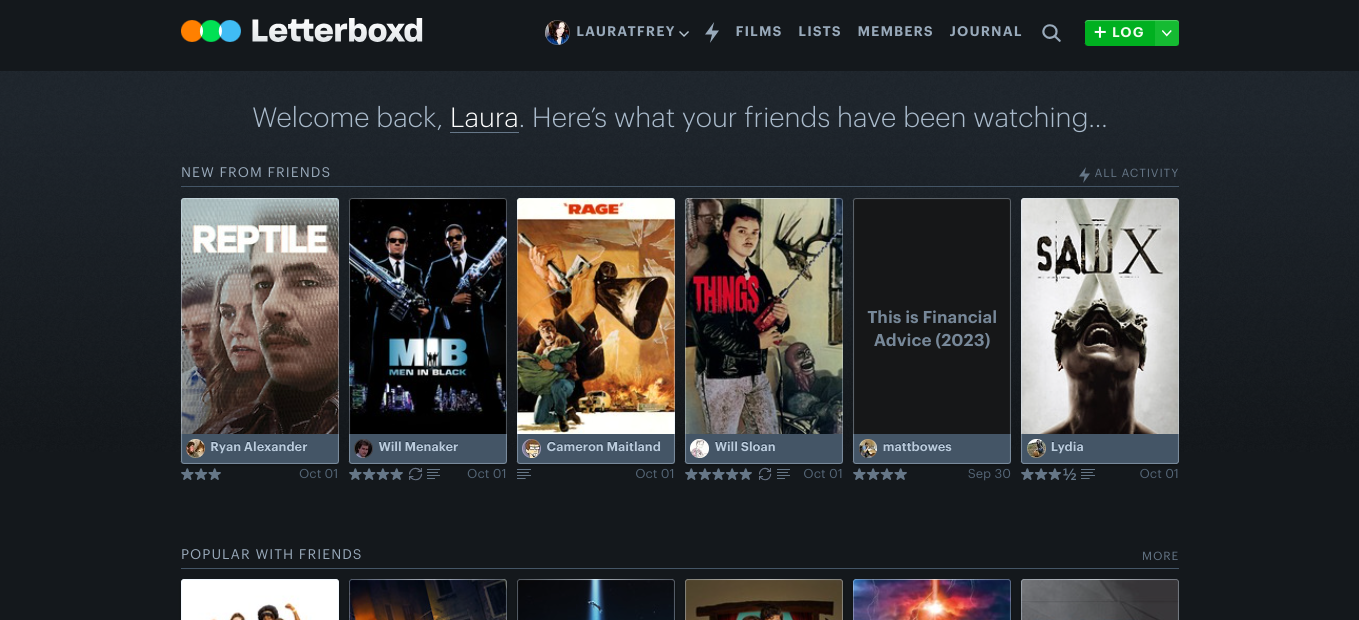
The discovery problem
There’s more to it than the timing and the founders’ backgrounds. While I was poking around on the respective “about” pages, I noticed the companies’ stated missions (the unstated obviously being “make money”):
Letterboxd is a place to “showcase your life in film”
Goodreads exists “to help readers discover books they love and get more out of reading.”
I don’t know about you, but I always have something to read – too much, in fact. Overflowing TBR shelves and avalanches of library loans are clichés in the book world for a reason. Goodreads wants to be about book “discovery” (tell me what to read next,) but I want it to be about book tracking and sharing (help me remember what I have read, and help me tell other people).
Discovery is a publisher and author problem. Tracking and sharing are reader problems.
The word “showcase” in Letterboxd’s statement helped me understand this. Letterboxd is solving a movie-watcher’s problem: how can I track what I watch, and share it?
And what else are readers trying to do on book blogs, bookstagram, booktube, booktwitter, and booktok if not “showcase” their reading lives? The most annoying part of each of those things is the -gram -tube, -twitter, and -tok (WordPress for the blogs). These places aren’t built for us; we have to carve out a little corner every time. There’s simply never been a place built for the type of reader whose last problem on earth is not knowing what to read next. Letterboxd is that kind of place for movies.
What if Letterboxd for books
I’ve given up on Goodreads becoming more than it is, and no, Storygraph, Book Sloth, Readerly etc. won’t get there either, because they are all centred around discovery too. But it’s fun to imagine what Goodreads could be if only Amazon threw a few dollars at it (and maybe hired one of the Letterboxd founders to help with the UX):
No-brainers
- Dark mode
- Half-star ratings
- A search engine that works
Overhauls
- A homepage where the first thing you see is a short, visual list of books your friends recently finished, rather than a text-heavy, infinitely-scrolling collection of random updates, recommendations, challenges, and god help us, Goodreads Choice Awards
- Profile pages where the first thing you see are a user’s favourite books and recent reviews, rather than their birthdate (???)
- A stats page that does literally anything more than “here’s how many books/page you read each year,” starting with a list most-read authors à la Letterboxd’s “Stars” and “Directors” stats*
Culture shifts (these will never happen)
- Decisions are made with readers in mind. Not authors, and not publishers.
- Finished books, and reviews of the same, are the focal point of the site – easy to find, easy to create, easy to share
- A social presence that isn’t extremely cringe (compare and contrast Letterboxd’s popular #LastFourFriday posts, and Goodreads’ sad attempt at a “Friday Reads” post)
As for me, I’ll continue using a Google sheet to track my reading, TBR, and home library (very loosely based on the popular one created by Brock at Let’s Read), a Twitter thread to share my recently-read books (until Twitter implodes) and this here blog to talk about the rest. But if Letterboxd wants to use any of their recent cash injection to create “Librry” or something, I would like to see it!
*Through this investigation, I found out that Goodreads stats does offer a “publication year” stats page, which I thought could be interesting, until I saw that it’s a scatter plot graph with a y axis that ranges from the year 1000 BC to the year 2500 AD for some reason, in one of the worst data visualizations I’ve ever seen – and I’ve seen plenty!

 Reading in Bed
Even though I still use Goodreads, I would love to seem something better. I would love to see a Letterboxd for books. Sure I like StoryGraph, but the social aspects need a lot of work
Yeah Storygraph seems like the closest competitor but it’s just not for me. I don’t like all those pie charts 🙂
Goodreads works fine for me, but I only use it for tracking and shelving. For example, when Simon at Stuck in a Book and Karen at Kaggsy’s Bookish Ramblings run an event such as the forthcoming 1962 club, I simply sort my TBR by year of publication to find the books that were published in 1962. My TBR has a shelf for #NovellasInNovember and for #WITMonth so I can always find what I’m looking for, and I have an exclusive shelf for books I’ve reserved at the library so that I don’t accidentally buy them as well.
It’s less unwieldy than adding these tags to my Excel spreadsheet which I maintain just in case Goodreads crashes one day. It’s often over-capacity, or that’s what they say…
Tracking books you’ve reserved at the library is brilliant! And yes, you hit on something I realized (but didn’t want to get into, this post was already long) but a key advantage of Goodreads is their database. Other sites are not as extensive, and tracking in a google sheet means I have to track down all the info about each book myself, which is a pain. I can’t easily do things like look for books on my TBR from a certain year.
I switched at Christmas (when I had time to scan all my books!) to BookBuddy, which is very expressly a home library app rather than a social one. I don’t even know if it has a place to upload reviews, but if it does I’m not using that function. I use it to track wishlist/owned but unread/reading/owned and read/borrowed from the library, and it does all those things brilliantly. I haven’t yet found a way to get my stats off of it, but it works very well for the purposes I want. I do owe the Goodreads algorithm one of my very favourite novels of all time, Edwin O’Connor’s The Edge of Sadness, which popped up in my recommendations about eight years ago and which I’d never heard of anywhere else. But in nearly a decade of using it, I’m not sure that’s a sufficient number to justify carrying on with it!
And I did have a Letterboxd account years ago but never really used it – I’m tempted to give it another go, as I’ve been watching many more films this year and would like to track them.
Oh thanks, I didn’t come across BookBuddy in my travels, I will check it out. I ended up getting all my books into my google sheet (which took a long time, as you might imagine) but it’s still annoying that I only have listings by title and author.
I’ve never heard of that book either, and that’s funny, I’ve heard people say the recommendations algorithm, which is supposed to be a main feature of goodreads, is not that good anyway!
BookBuddy doesn’t have an Android app 😦
Interesting – I actually love GR and find it user-friendly, and have started using it more and more as engagement on blogs drops. I agree about the half-star ratings though, and am fully aware of the pernicious effects of it being owned by Amazon. I’ve never used Letterboxd (don’t watch enough movies and tbh don’t want anyone to know about the trash I do watch!) so can’t compare.
Very good point about engagement. Do you find it pretty steady over the years? Because you’re right. Engagement here is not what it used to be, and Twitter is nearly useless too.
I’ve only just started using GR more so not really sure! I think you’re right in that its usefulness depends on what you use it for.
Goodreads needs to hire you in my opinion! Half star ratings is my biggest wish but in general the site feels tired. I do enjoy Letterboxd (do we follow each other) but I wish they would make it easier to find people you know on the site.
Haha yes! I would need an unlimited budget to make changes though. Yes we do follow each other on Letterboxd!
I agree you need to be in R&D for Goodreads. I use the site purely for book tracking and cataloguing my TBR by categories. I sometimes feel bad that I don’t engage with fellow readers more on it. How embarrassing that one of my DNFs made it onto your screenshot!
OMG sorry Rebecca! I took those screen shots a week ago and didn’t really look that closely.
I don’t use Goodreads but I do use Letterboxd, so far just listings for myself, but I feel encouraged to get more involved!
I love it… it’s not perfect, but that didn’t fit with my post here 🙂 Like I feel like you do need a paid account to have a good experience.
I use Goodreads mainly to post reviews, to track my reading rate, and to keep an eye on crits by reviewers I rate whose blogs I don’t follow (or indeed don’t have blogs). I certainly don’t want yet another singing and dancing social media site to distract me, there are enough of those around!
I know right… I wish Goodreads worked for me, it’s just too cluttered! I think what I really want is something that would replace all the bookish corners of various social media sites. Probably not realistic 🙂 I’m probably most happy right here, reading and writing blogs…
Interesting post. I’ve never used Goodreads, not tempted to after all you’ve said about it. I do, however, very much enjoy Letterboxd. I’m watching even more films this year and it’s nice to keep track of my viewing. It’s been a good year for films this year.
Despite having a book blog, I am actually a film reviewer first and have always been, so your post is very interesting to me. I came late to the letterboxd scene. I didn’t even know of its existence and did not care until about a year ago. It’s not terribly useful, I think, including as a discovery channel for new films. On the other hand, I do find goodreads useful, though I agree that half star ratings and better search engine would be a way to go. Also, I do struggle to interact with people on both platforms and use it as a more social channel, and I am still unsure why that it.