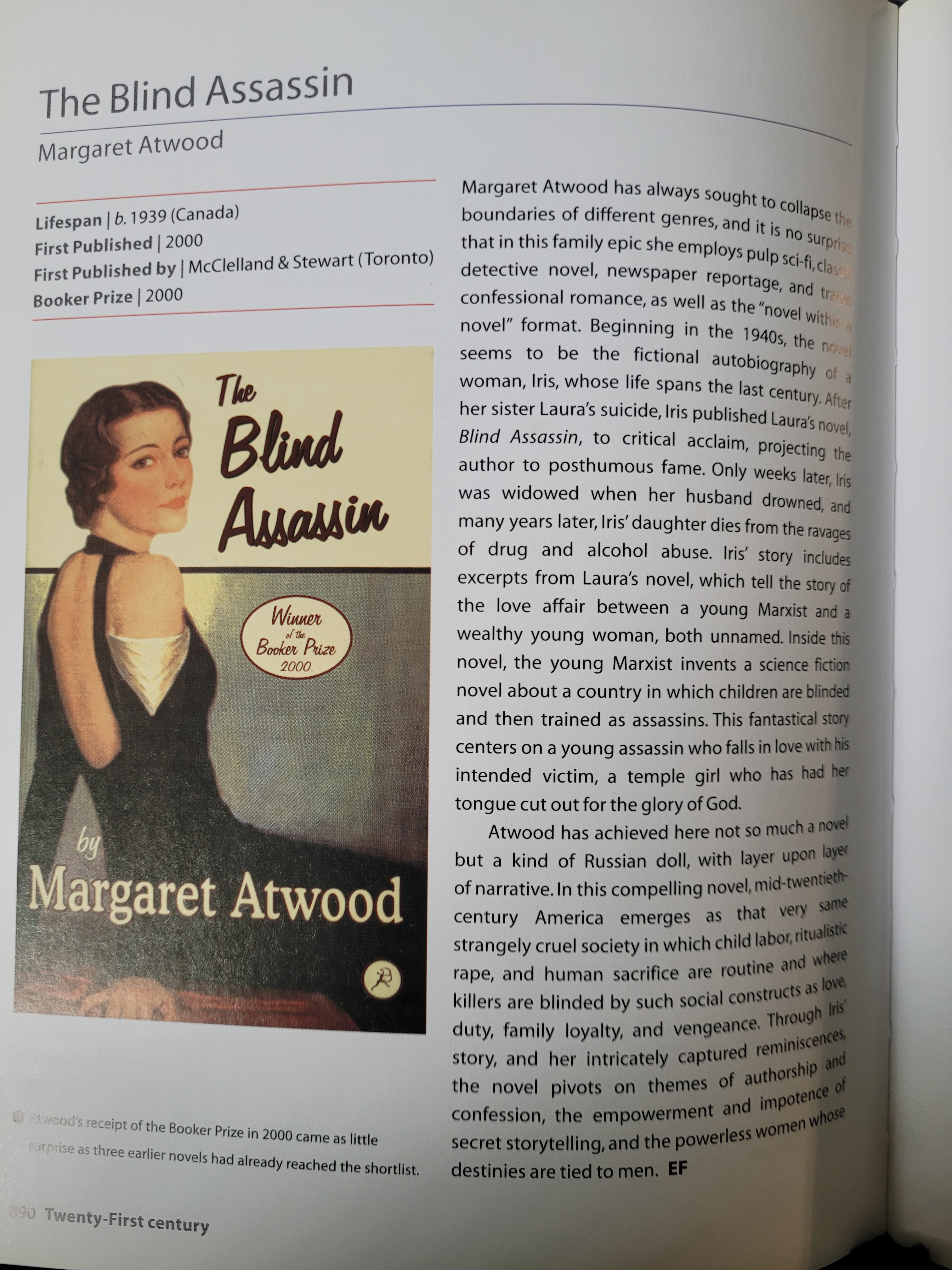
The Blind Assassin by Margaret Atwood
The Blind Assassin is #63 on the 1001 Books You Must Read Before You Die list. See the whole list and my progress here. This summer, I’m reading from the list for my 20 Books of Summer challenge, and instead of straight reviews, I’m going to compare the 1001 Books write ups with my own impressions – or in this case, I’m going to get angry about a contemporary review! The 1001 Books write up is fine and not that interesting.

It goes without saying that Goodread reviews are suspect. Where can a reader go for a trustworthy, competent review these days? Not the New York Times, apparently! After reading the fairly standard 1001 Books write up, I thought I’d look for something a little juicier, and I was shocked to find a blatant misreading of The Blind Assassin committed to print on the book’s publication date.
It’s difficult to describe what this review got wrong without going deep into the plot, and this is a deep plot, as in, layered. In my last 20 Books review, I talked about frame stories. This one has got frames on frames on frames. The main character is not only telling two stories at once, of her present-day life as an elderly woman, and of her childhood through young adulthood, but also the story of her younger sister, who attained cult status after her novel, also called The Blind Assassin, was published posthumously. Passages from that novel are interspersed into the narrative, and that novel has its own story-within-a-story. Oh, and there are newspaper clippings here and there, adding an extra “here’s what it looked like from the outside” layer. And of course, all the characters are hiding things, and are generally unreliable.
I hope *I* got all that right. But the NYT reviewer absolutely missed a major plot point. My best guess is that he took what the (clearly unreliable) narrator writes about the novel within the novel at face value, and either didn’t read the end, or skimmed it, and so never came to the (clearly signalled) revelation that I and other attentive readers did.
This oversight makes the reviewer’s subjective assertions, e.g. that characters are “flat as a pancake”, or that the reader’s first impressions of them are “not so much lasting as total”, or that a particular character is a “cardboard villain” extremely suspect. The narrator comments on the villainous presentation of her husband, and why she does it, and that’s just a minor example. When the reviewer goes on to complain that narrator’s “sourness” seems more “adolescent than geriatric” I wanted to shake him. YES, that is THE POINT, she is NOT DONE WITH THE PAST, she is STILL THE YOUNG WOMAN WHO… oh, you don’t even know which young woman she was!
I’m unable to find a direct quote, but Atwood either “said” she was amused or “seemed” amused by all of this, depending on the source. Would that all authors were so serene. Anything more than an “amused” reaction to a bad review, even a bad review that is clearly a misread of the book, is either going to backfire, or create a hot take cycle. Easy for Atwood to say, I guess, in the year 2000, where the majority of people reading that review were doing so on soon-to-be-recycled newsprint and book blogs were in their infancy, let alone Goodreads. She was also a four-time booker nominee (and soon to be a winner). But I suggest that even small, debut authors should take note. Don’t rise to it.
Or better yet, authors and readers alike should get off Goodreads entirely until we can figure out what the hell is going on. And go to a reliable source about books like… uh… BookTok?
 Reading in Bed
Oh my God, how embarrassing for that reviewer…!
Oh dear, that is a bad misreading! It’s a long time since I read this novel, but I do remember thinking the twist made it less interesting, though, as it puts the sisters back in the roles we might expect.
Wow, the NYT missing something that fundamental, how cringe-worthy! That seems like a classic example of writing about the book you expected to read rather than the one you actually did read (or not, as the case may be). I remember one time I gave an average review to a self-published novel and in her snippy response the author explained the twist — which I’d carefully avoided mentioning so as not to spoil it — as evidence of how clever she was.
Ha ha! This is great, just goes to show it doesn’t matter how accomplished a reviewer you are you can still miss the point.